
He Rode Tall

Excerpt

Harry
The Circle H Ranch
Willow Springs, Montana
April 28


“Hello back,” came the response from the barn.
Proceeding cautiously forward, Joel slid the large
barn door all the way open and entered. It took a minute or two
for his eyes to adjust to the shadows of the dusty interior.
He called again, “Over here.”
Squinting through the dust and the darkness, Joel could see
that his barn mate was an elderly man. As the stranger stood
from the chore of feeding the cats, Joel saw the rough and rugged
lines of the face of a Native American man.
“Harry,” the man said as he nodded.
“I’m Joel Hooper.”
“I know,” came the simple reply.
Reaching forward, Joel offered his hand. Harry reciprocated
with his respectfully limp hand and Joel proceeded to shake it
with far too much vigor and enthusiasm.
What an idiot, Joel thought of himself. Of all people, having
traveled and worked in so many foreign countries, he should be
more sensitive to the cultural differences.
Freeing himself from the clutch of Joel’s handshake and with
absolutely no eye contact at all, Harry retreated back into the
safety of the shadows. In silence, Harry proceeded to putter with
feeding the horses. From what Joel was seeing, it seemed that the
chore was a combination of throwing flakes of hay into the stalls
https://www.amazon.com/dp/0980897955

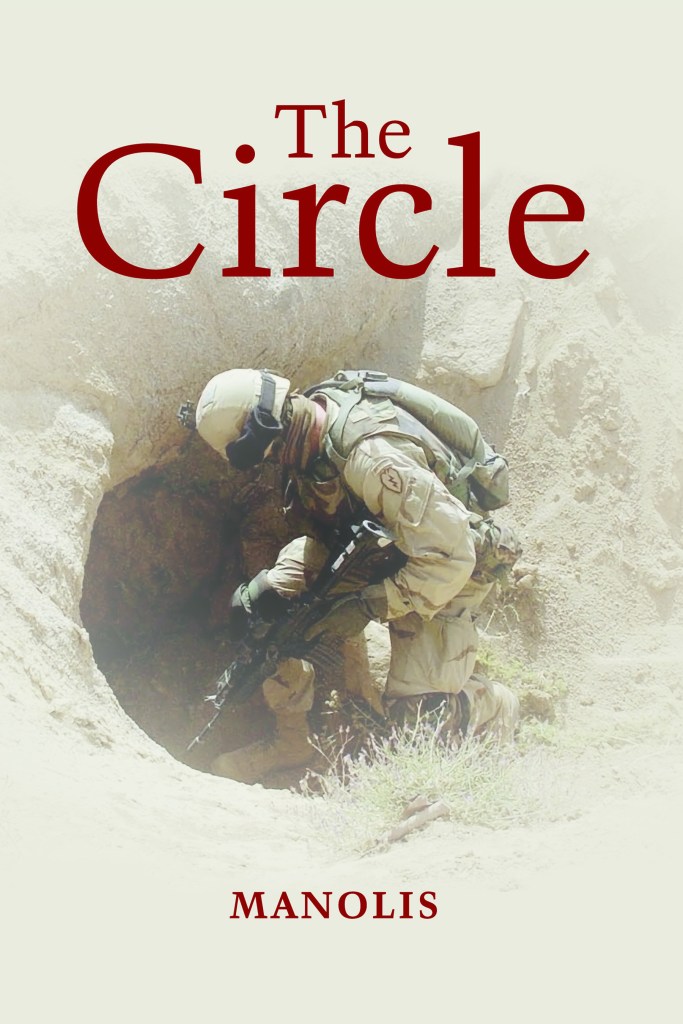
The Circle

Excerpt

“Are you okay? You look like something is bothering you.”
“Hakim, do you ever think about home? Do you miss home?”
“Yeah, I think about home, why?”
“For a long time now I’ve been having these dreams. I’m losing sleep because
of nightmares.”
Hakim’s eyes get cloudy while he browns the prawns in a pan. He turns and
looks deeply into Talal’s eyes and asks, “Why do you have nightmares? What
kind of nightmares?”
“Things from back home in Falluja, the war, the destruction,
things like that. I have nightmares about my parents when they died in front of
our house, their bodies badly burned. I see them in my dreams all the time.”
Hakim becomes agitated when he hears Talal’s description of his dead
parents. He finishes cooking the prawns and checks the rice in the cooker; it will
be ready in a few minutes. He knows very well about nightmares—he has his
share of them. He has had his own nightmares for a long time now, and hasn’t
said anything to anybody, not yet. Not even to Talal, who opens the discussion
about nightmares as if they were his monopoly. He knows too well the
devastating images from home, during those dark days of the war. He has seen
himself under the rubble of his house, covered by pieces of cement blocks and
broken furniture, the night when the American bombs fell from the sky like lava
from heaven and destroyed most of Baghdad. He takes his wine glass and raises it
to Talal’s glass.
“Don’t worry, bro. Don’t let these nightmares control your life. Here’s to
you!”
Talal doesn’t answer. Instead, he goes to the fridge and takes out the lettuce
for the salad. He starts to cut the lettuce, “I see the images of my parents over and
over in my head, as if they are in front of me, like the day it happened.”
“Tell me how your parents died, Talal.”
“It was that offensive; I think it was 2004, at the beginning of the war, when
the Americans fought against Falluja, against what they used to call insurgents.
Do you remember?”
“Yeah, those were the days of hell. I remember well. I was with Uncle Ibrahim
during that time. By then, our house was already destroyed.”
“Well, in our case the Americans tried white phosphorous against the
insurgents. They used chemicals that burned the bodies like fire. That is how my
parents died, because they didn’t leave their house. So much damage was done to
the people who stayed behind instead of leaving as they were advised to. People’s
flesh got burned up right on the spot. That’s how my mom and dad died. We
were a couple of kilometers away at my grandfather’s house,

https://www.amazon.com/dp/0978186524

Ken Kirkby, A Painter’s Quest for Canada

Excerpt

“Like physical punishment?” Ken asked.
“Yes, but of a horrible kind.”
“Well, I decided to take them on and use myself as the whipping boy.”
“That’s one of the things that interests me about your story and about
you,” Patrick said. “Are you sure you aren’t an Indian? That’s the kind of
thing we do.”
“No, it was just a way of achieving a goal I wanted. It was a mixture
of vengeance and proving myself smarter. What were the other horrible
things that were done to you?”
Patrick looked away. “I really don’t want to talk about it.”
On his trips with Patrick, Ken discovered a new world, so far removed
from the one he had grown up in, it might have been on a different planet.
I began to have the sense that I had left the shadow of my own people
and of my own world. I was not in that world and I was not in this world
and that has been a familiar place my whole life. In fact when I look at the
paintings that I make, they are actually portraits of that. I’m incredibly interested
in the places in between. I remember painting an old barn when I
was going through the barn phase, as everyone does. I noticed at one point
that the barn itself was not it. The barn was there so that I could paint the
cracks in it. I began to get the idea that time is short and the journey is long
and there is only one way to go in the journey. Imagine a giant sitting on a
beach surrounded by huge boulders and he has picked up two of them and
he’s banging them together. Every time he bangs them together a grain of
sand is created. If he goes on for long enough, at some point, there will be
a beach. That concept pleased me no end – that there was no quick way of
creating a beach. Consequently, there could be no quick way of getting anything.
Whatever it is that I was doing was going to take a very long time and
that was okay. There was something very pleasing about the fact that it was
going to take a very long time. The times in my life when I have been in some
form of contentment are when I have been immersed in a project, the end of
which I cannot see. And my mind stops worrying or considering what I will
do next. I have paddled from one giant project to the next.
He absorbed Patrick’s stories and tried to fit them into a logical context.
There had to be a reason for the actions the Europeans had taken.
One day while they were motoring on the river he asked Patrick, “Why
do you think the newcomers tried to deal with the native population this
way? The residential schools seem to be a complexly bizarre notion. We
know that if you say to someone, ‘This is my castle and you can’t come in’,
they’re going to bash the door down to gain entrance.”
“Yes. It’s bizarre,” Patrick said.
“When you force people to do anything – well we know what the reaction
to that is going to be.”

https://www.amazon.com/dp/0981073573