
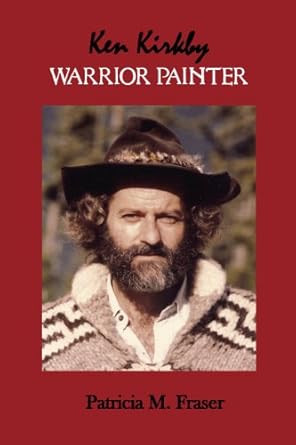
Ken Kirkby – Warrior Painter

excerpt

The Minister was a Maritimer and his open, neighbourly manner
delighted Ken. Their meeting resulted in the eminently successful 1975
exhibition of Ken’s Arctic work in Spain, and in the fashion of one domino
tipping the next, the first Canadian exhibition of the Arctic works was
triggered. Once the unusual, haunting images had been seen, and the origin
of the work was explained, all the right people wanted to own one of the
paintings, and gallery owners were clamouring to exhibit them. Best of
all, to Ken’s mind, it had been accomplished without cost to the Canadian
government beyond their public support and a few phone calls.
This was the beginning of the long road to the national introduction of
the Inuit, their stories and experiences, and the growing acceptance of the
symbol of the Inukshuk as a uniquely Canadian icon. It could be argued
this was the pivotal step that led to the Inukshuk becoming the distinctive
symbol of welcome for the 2010 Vancouver Olympics.
The Arctic paintings sold by the hundreds, nationally and internationally,
to the point where, a quarter of a century later, Canadian Art galleries were
objecting to anything other than ice, snow and Inuksuit displaying the
Kirkby name. It was ironic.
~~
Despite the history, the lack of outlets for Kirkby’s west coast images
promised a lean period ahead for the painter. He decided to force the issue
by withholding all of his art until the galleries accepted his new works. The
businessmen amongst the owners appreciated the fact that a painting with
the Kirkby signature translated into a certain sale, and Ken’s experience had
proven they’d come around when their stock was depleted.
He continued to work late, the bright light a beacon, spilling warmth
from the loft window. And then, one night he returned to the cottage to
find the message light blinking on the answering machine. That was the
start. While gallery managers still hopefully requested the Arctic series,
they agreed to hang work from his Vancouver Island series. Happily, new
customers liked it and previous Kirkby collectors were intrigued. Ten
years since that breakthrough, his work is more popular than ever and…
https://draft2digital.com/book/3562902

https://www.amazon.com/dp/B00CB8W4CG

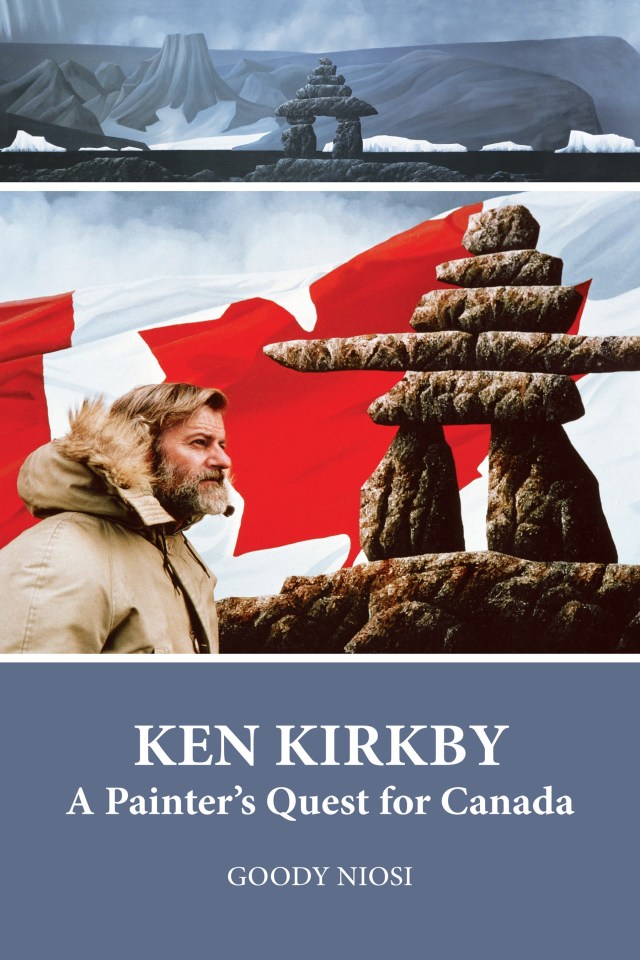
Ken Kirkby, A Painter’s Quest for Canada

excerpt

or not – it all depends on the environment. I suspect that you haven’t
thought your way through it – and I’m not trying to be rude, or difficult.
Usually, when people come in and ask for something that’s completely
outside their understanding, they, probably, aren’t asking for the right
thing. I’d like to suggest that I come down and make a presentation to
your company, on what I think you’re looking for.”
“You think so?”
“Yes. You don’t seem sure about why you want it, and you’re not sure
about the environment it will be in. I suspect that no matter what I paint
you won’t be happy. Painting what is in someone else’s mind is almost
impossible. So, would you do me the courtesy of letting me come down
and make a presentation, and see if that is what you want?”
“Certainly.”
A few weeks later, Ken walked into the formidable skyscraper in downtown
Toronto and gave the board members his analysis. They wanted a
large painting for the foyer. Fine – he could supply that, but it wouldn’t
be as large as the Reichmann painting. And, it would be the first of several
canvases. A smaller one would hang in the boardroom, and several others
would hang throughout the premises. The preliminary sketches and
drawings would be framed and hung as well. The paintings would tell a
story that would be repeated in a booklet. A six-minute film would also
tell the story, and it would play on a large screen television in the reception
area. When a client arrived for a meeting, he would sit and watch the
movie.
“Now, they have something interesting,” Ken said. “This is something
they have not anticipated seeing, and they realize that you are a lot more
than just what you do. When you meet the client, you tour them around
and show them all the works, and then you sit down and get down to
business. By now, they realize that you are interesting people. You have
things going on other than making money. When your business is concluded
you hand the client a copy of the book – signed by me and your
CEO – as something to take away and remind them of the meeting.”
Ken suggested they take a holiday during the month of August and
turn their offices over to him. When they returned the space would be
transformed – not just because the paintings would be hung. What good
were paintings if the background didn’t complement them? He proposed
changing the furniture to set off his work and painting the walls in appropriate
colours. Everything had to work – it had to be of a piece.
The cost, he said, was irrelevant – the accountants would write the
whole thing off. He thanked them, told them he had to return to his
painting, and left. During the next few days several of the board members
visited his studio. A couple of weeks later they accepted his fee of four
hundred eighty thousand dollars.

https://draft2digital.com/book/3562830

https://www.amazon.com/dp/0981073573

Ken Kirkby, A Painter’s Quest for Canada

excerpt

His scaffold was built, ladders leaned against the walls, tubes of paint –
by the carton – were stacked in the studio, and alarm clocks ticked beside
his narrow cot. He was ready to begin painting.
I felt very, very much that things had now solidified. This was now a fact,
and for the first time in this entire campaign, I actually knew that I was going
to make it – not only the painting, but also my fight for Nunavut. This
was it. It was now only a matter of physical labour to complete the vision.
There was a different feeling now. The desperation was gone, and there was
only a huge engine driving me. Now, there was only confidence. Now, I had
access to politicians, business people, media – an infrastructure so massive
and on such a personal level that I would be able to get this story through
and by hook or by crook it would come into being.
It occurred to him is his newfound euphoria – “We need to celebrate!”
He announced the “First Brushstroke” party and invitations went out in
the shape of artist’s palettes that hit the desk of every media contact in the
city. Every couple of days a new invitation in a different colour, embossed
with an Inukshuk, went into the mail. He called Keith and told him to
fill a plane with choice Arctic food. Bob Engels, the North’s most famous
bush pilot, volunteered to fly the northern contingent to Toronto. On
an evening in early September 1986, Ken climbed up on a ladder, from
which he made a speech to a roomful of people, and then splashed a giant
brushstroke across the towering, white canvas.
Then he settled into a routine that was to last for almost a year. He
painted the sky for several hours, slept for two hours, went back to work,
and then slept for two hours. As he painted he had a sense that this was
what he was meant to do – to paint on this scale. Every other painting
seemed too small – even the giant canvas that hung at First Canadian
Place was undersized. How could he ever go back to painting something
on a lesser scale? What he really wanted to do was buy Saskatchewan and
paint it from helicopters.
One day a woman, wrapped in a fur coat, swished in on stiletto heels.
She glanced around the studio and waved her arm at some paintings leaning
against the far wall. “I’ll have that one, and that one, and that one.”
“Madam,” Ken said from his perch on the scaffold. “I don’t know who
you are. I suspect you know who I am or you think you do. I would invite
you to go outside, take a walk around, come back in, and say – ‘Good
morning!’”
She took a step back. “Well! I have never been spoken to that way before!”
Ken waved his hand. “Go on! Go. Shoo… Shoo.”
She stalked out, and returned ten minutes later. “Good morning,” she said.

https://draft2digital.com/book/3562830

https://www.amazon.com/dp/0981073573

Ken Kirkby, A Painter’s Quest for Canada

excerpt

A short while later, a tall man came to the kitchen door. Salvador
greeted him and the two men talked quietly together for a few minutes.
Then Salvador pointed, and Ken heard him say, “This is the man I told
you about. He is the man who has been sent.”
Albert waved Ken toward him. “If you’ve been sent, you’d better come in.”
Ken shook his hand and entered the kitchen.
“Who sent you?” Albert asked.
“It isn’t a who; it’s a what. An idea sent me and the idea starts with
one human being asking another human being for one hour of his life to
listen to a story, and the story is of a man you may have some familiarity
with. His name is Lorenzo de Medici. Are you familiar with him?”
“Yes I am.”
“I want one hour of your life.”
Albert sat at the kitchen table, quiet and composed. Even his eyes were
still. His hands rested motionlessly on the tabletop, his fingers curled
comfortably inward.
Ken sat, took off his watch, and placed it on the table where he could
see the time ticking away. He told Albert his understanding of Lorenzo
de Medici’s life. He drifted away on his words, just as he had when he had
made his speech at the Columbus Centre. He lost himself in the intensity
of the moment – rushing down the white water of ideas like a kayaker
tumbling down a raging river.
“There are parts of that story I wasn’t familiar with,” Albert said, when
Ken had finished. “Where did you get your information?”
He told Albert about his birthday trip to Florence to see the statue of
David and how on another birthday his father had given him a beautifully
bound book of Michelangelo’s letters to Popes, kings and princes.
The letters, he told him, described his relationship to the Medicis in his
own words.
“So you are an artist?”
“I am a painter. Michelangelo was a sculptor who was made to paint.
I am a politician who is made to paint. I have a job to do, and I have a
mission to carry out that has to do with the people of the Arctic and the
soul of a nation. We in Canada wander around very confused as to our
identity. Our subjects of conversation are the weather, Quebec, and our
identity. I have found the soul of this nation, and in the process, I found
many wonderful stories and many wonderful symbols. At the same time,
I discovered hell on earth – hell is what is happening to those people. I
have been asked by the grandmothers to please tell the world about this.
The first thing I want to do is tell you about it.”
“Why would you want to tell me about it?”
“In Michelangelo’s time there were Popes, queens, and princes. There
were people who could sponsor great ideas.

https://draft2digital.com/book/3562830

https://www.amazon.com/dp/0981073573

Ken Kirkby, A Painter’s Quest for Canada

excerpt

Ken called and told the story of Isumataq. He offered a painting for the
paper, clinching the deal by telling them that everyone involved in the
project would very likely win an award and be exposed in some way to
massive media coverage. He also threw in some dubious oratory that was
so over the top that many people laughed. “Don’t worry about this moment,”
he said. “One day you’ll be in paradise with me.” If they snickered
behind his back, he didn’t care because by the time he was done he had
bartered for every service he needed – ninety thousand dollars worth. His
friends called the money he had used to pay for the brochure “Ken dollars”
and it was a term that stuck.
Elias Vanvakis, another of the young professionals who was a successful
insurance broker, commissioned a small pencil drawing of an Inukshuk.
“I’ll give it to you,” Ken said.
“No, I want to buy it.”
“Why would you want to buy it?”
“You’re painting the largest Inukshuk – I want the smallest,” he said.
Ken pocketed the five hundred dollars Elias offered and drew an Inukshuk,
which he handed to him. A few weeks later, on Ken’s forty-fifth
birthday, Elias presented him with a small jeweller’s box. Inside was a
small gold pin, a perfect replica of the pencil drawing.
Ken pinned it to his shirt. Minutes later he was struck by an idea. A
larger version of the pin was exactly what the front cover of the brochure
needed – but not in gold paint of even gold leaf – a pure gold Inukshuk.
The pin inspired yet another idea. The nation’s highest honour for its
citizens was The Order of Canada. He wanted something even more prestigious
– an honour that was almost impossible to receive – The Order
of the Inukshuk. He ordered a dozen more from the jeweller who had
designed it.
Whenever someone asked about the pin, he smiled and inferred that
it was special and only a chosen few would ever have the honour of receiving
one. To Rocco he said, “Anyone who buys a ten thousand dollar
painting, gets one.”
Ken was invited to the Columbus Centre again to give the keynote
speech at a dinner honouring Premier Peterson. At the end of the speech
he was to give him a painting of an Inukshuk. But instead of doing a
simple presentation, he told the story of the Order of the Inukshuk –
that the pin was the result of a visionary flood of alcohol consumed in
the land of the midnight sun on June 21, the longest day of the year. He
explained that they were almost impossible to get and only a few very
special people would ever be aware of The Order of the Inukshuk. “They
come to certain people who are magic,” he said. “They come to people
like me. Everyone else has to fight for them.”

https://draft2digital.com/book/3562830

https://www.amazon.com/dp/0981073573

Ken Kirkby, A Painter’s Quest for Canada

excerpt

He had more canvases made that together measured twenty-five feet,
eight inches long by two feet high. By anyone’s standard, this was an immense
painting: by Ken’s yardstick, it was a miniature. However, the size
was ideal, as it allowed him to sketch in every detail and nuance he wanted
to convey.
He worked eighteen hours a day, but time had ceased to have meaning.
He physically barricaded the studio to discourage visitors. Several weeks
later, when the large model was complete, he started to calculate what it
would take to paint a portrait that was twelve feet high one hundred fiftytwo
feet long. He estimated that he would need thirty-eight panels twelve
feet high by four feet long, butted seamlessly together.
He had immense issues to deal with. First, he had to find a supplier
who could stretch canvases of that size. He also had to keep Rocco supplied
with paintings, and he had to complete them on time. And, he had
to finish the Reichmann and Yellowknife Airport paintings. In addition,
he was once again doing presentations at schools. Common sense told
him to say no to those requests, yet he felt an obligation to talk to the
children – to fire their minds with dreams. Although he should have been
tired, he was bursting with energy. It was as though the furnace of his
heart was being stoked with a fuel that burned endlessly – a fuel more
potent than food, drink or rest.
He could find no one who would stretch the canvases. Those he approached
thought he was mad. He talked to the company that supplied
their framing material, explaining that he needed stretchers double kiln
dried so they wouldn’t warp. They also had to be bevelled so that when
the panels came together the seams would disappear.
Ken wanted all the materials he used to be made in Canada. It wasn’t
possible. No one in Canada made canvas, so he ordered several rolls from
Brazil, each roll weighing hundreds of pounds. He also had to import
brushes.
With leftover canvas from the Reichmann painting, he and Diane
stretched the first panel using the device he had invented that was a combination
of canvas stretching pliers, Vise-Grips, and a torque wrench. Every
part of the canvas had to be stretched to precisely the same tension.
The canvas was perfect when he could lay it on the floor, toss a coin
on it ,and have it bounce off like a bullet. If it wasn’t right he started over
again – and he began afresh many times.
Keeping in mind his insight about quantifying the painting, he made a
precise list of every item he needed. How much glue would he need? How
much gesso for four coats on each of thirty-eight panels? How much paint?
Ken met with Mr. Stevenson, of Stevenson and Company paint manufacturers,
“I think I’m going to need two tons of paint,” Ken said.

https://draft2digital.com/book/3562830

https://www.amazon.com/dp/0981073573

Ken Kirkby, A Painter’s Quest for Canada

excerpt

The media continued to be fascinated by him, the way an audience is
mesmerized by a performer who embarrasses himself inadvertently, on
a talk show. Ken had stepped so far outside the boundaries, had put on
a show so over the top, right down to the Inuksuit painted on the streets,
that the media haunted his studio just to see what would happen next. Ken
continued to feed them quotable lines that seemed to come effortlessly to
his lips, but that he had, in fact, been practising for months and years.
But, tidbits wouldn’t feed them forever. Eventually they would want to
stop nibbling and indulge in another meal – and the next banquet would
have to be bigger and better than the last.
He met Salvador Grimaldi for lunch again at Boccacio Restaurant, in the
Columbus Centre, and once again the architect came bounding into the
room, perfectly dressed in understated, expensive clothing, his eyes sparkling,
and his smile spreading goodwill around the room. Ken had a plan.
He told him that his next project had to be an even larger success than
the last, and described the two immense paintings he was currently working
on: one was a sixteen by sixteen foot canvas, featuring an Inukshuk set
against an enormous white cloud, that was intended for the Reichmanns.
Why the Reichmanns? Salvador asked.
“They are a very prominent family which the media and the public
have become very interested in,” Ken said. “They’re secretive and almost
impossible to approach. I’ve been studying them, and the information is
very sparse. I know they spent time in Valencia after leaving Eastern Europe,
and then they spent time in Morocco, and then from Morocco they
moved to Toronto: they started a tile business that immediately turned
into a raging success. Then, they went into high-end real estate development,
in which they have achieved even greater success. They are an
intriguing family – and just what I need. I need a Lorenzo de Medici.”
“I want to get to a place where other people cannot go. I want to sell
a painting to a man who doesn’t buy paintings and see it hung in the
foyer of the tallest building in the British Commonwealth – and have that
become a media event – even though they don’t like the media, that is
what I am after. What do you know about the Reichmanns that you feel
comfortable passing on to me? I get the idea you’re pretty close to them.”
Salvador allowed that he was close to Albert Reichmann, who preferred
to be called Mr. Albert. He had done his corporate landscaping and was
currently working on his personal property. “He’s a prince,” Salvador said.
“A merchant prince. He is a man of many talents, and I find it interesting
that you would have, instinctively, known that.’
Ken took Salvador to the studio to see the Reichmann and Yellowknife
Airport paintings, in progress. When he unlocked the door and switched
on the bank of lights, Salvador froze. The larger painting was nearing
completion while the other was only half finished.

https://draft2digital.com/book/3562830

https://www.amazon.com/dp/0981073573

The Circle

excerpt

“Yes, he spent so many years earning blood money, Bevan. I know; you’re
right. The agency is the first and foremost concern for all of you. The agency, no
matter what the result, no matter what the human cost,” Emily says, angrily.
Bevan knows this feeling of helplessness, this feeling of betrayal, and this
feeling of loss, particularly when the loss is for something you don’t agree with.
He knows all this because he feels that way most of the time himself.
“Yet, there is a reason why everything happens as it happens, my dear Emily,”
he says, as a way of inserting a sense of justice into something gone wrong.
“Also, don’t forget the police lieutenant mentioned that you told him, as you
told me, that Matthew was cleaning his service pistol that morning. After you
left, the accident took place.”
“Yes, Bevan, the accident took place while I was out with Cathy,” she repeats
monotonously.


The devastation is impossible to describe and the words are so humble and poor, trying
to explain to the flawless mind the inconceivable, the disappearance of logic, and
the return of mass mania for the slavery of feelings in the thirst for blood. The blood is
someone’s, anyone’s, as long as blood is shed and it paints the roads and the cobblestone
streets of this desolate place in red, this place that belongs to people who know
well the hunger and thirst for life.
The houses are mostly demolished; one cannot tell the wall of one from the yard
of the other—the doors, windows, gates, all destroyed. The roofs have collapsed and
walls lean on other walls as injured people try to hang onto one another in order to
stand. They resemble people trying to stay on their feet as others struggle to walk
uphill on crutches.
People shyly and full of fear come out of one hole or another, one by one, like
rodents in the fields popping their heads out to see the devastated condition of the
land and the devastated condition of the human race whose advanced technology
has enabled them to create so much destruction. People come out of their holes to
witness whether death has surpassed them, whether he went to the neighbor’s
house or took some unknown person; after all, Hades is here to take. They come out
of their holes to see whether Hades is still around in the form of a bullet from the
rifle of the soldier from the foreign land. The older ones have seen this before and
know well the pain and anger, but the children, for the first time, taste the loss of a
mother or a father who has died under the cement of their collapsed house, or the
loss of a brother or a dear friend killed by the non-discriminating bombs that fall
from the arms of the sky. The children run out into the desolate backyards and
behind the armored cars of the soldiers. They try to steal something of value…

https://www.amazon.com/dp/0978186524

https://draft2digital.com/book/3562817

Ken Kirkby, A Painter’s Quest for Canada

excerpt

assion doesn’t come from this generation.”
“I was. I was raised in an ancient place by somewhat ancient people.”
“So, what do you propose I do?”
“I propose you find out whether I am telling you the truth.”
As he and Rocco left, Ken turned and said, “By the way, I think the gallery
should be called The Joseph D. Carrier Gallery.”
Carrier smiled. “Of course.”
Once work on the gallery began, Ken and Carrier met frequently. When
Carrier discovered that Ken’s paternal grandmother, Constanze Inocente,
was from Genoa, he declared that the connection made Ken Italian, and a
member of the community. With Carrier’s urging, Ken joined the Canadian
Italian Business and Professional Association, a dynamic and diverse
group that included doctors, lawyers, carpenters, and bricklayers.
As opening night of the Carrier Gallery approached, Ken suggested a
show of his Arctic paintings, on a massive scale.
“You haven’t sold any and you want to start off with a huge explosion?
Rocco asked. “What if it fails?”
“You’re sounding like my mother. What if…”
“I love the idea, but what a risk!”
“When you jump off a cliff, make sure you do it head first. Be honourable.
Do it big.”
What about the cost?” Rocco asked. “Who will pay for it?”
“All we have to do is commit to the vision and the rest will follow.”
Ken rented the warehouse next door to the framing factory, a space
large enough for his Arctic paintings. He painted the ceiling black, the
walls white, and the floor battleship gray. Then, he went to work on the
giant paintings. Rocco focused on the show. They needed a sponsor, Ken
said. The show had to be unique. Canadians didn’t care about the Arctic
so everything about it had to be special.
“If Canadians don’t care, why are we doing this?” Rocco asked.
“Because this story has to be told,” Ken said, explaining that the entire
saga had begun on a beach in Portugal. And that’s when it struck him –
Portugal would be their sponsor.
He wrote a letter to Dr. Antonio Tanger Correia, the Portuguese Consul
General.
Correia called. “Mr. Kirkby. As if you had to explain yourself! What a
delight to get your letter. We must have lunch!”
They met for a lunch that extended into dinner. Ken explained that he
wanted the invitations for the exhibition to come from the Portuguese
people, meaning the Consul General and the Portuguese Ambassador to
Canada. “I’m not asking for money,” he said. “I simply want you to issue
the invitations.”

https://www.amazon.com/dp/0981073573

Ken Kirkby, A Painter’s Quest for Canada

excerpt

When they immigrated to Canada, and settled in Toronto, they founded
a tile company and then became real estate developers. Their flagship
building was First Canadian Place, the tallest building in the Commonwealth.
Ken talked about them and gnawed on the information he had
like a dog on a marrow bone.
“Forget about them and come into business with me,” Henri said.
“Why try to sell paintings to people who don’t buy paintings?”
Ken finally looked at the books, which revealed that the frame factory
was struggling to stay alive.
“You can buy half,” Henri offered.
“Why would I buy half of a sinking ship?” Ken asked. But, he agreed
to become a partner. Perhaps, it would be a good idea to be seen as a
businessman instead of an artist. He might be viewed with more respect
and given more credibility. He would buy his half with orders for frames.
Henri agreed to build Ken a studio across the top of the factory.
Within six months, Ken had paid off the fifteen thousand dollars he
owed and moved into his new studio where he began work on two large
Arctic paintings – one for First Canadian Place, measuring sixteen by
sixteen feet, and one measuring slightly less, for the new international
airport planned for Yellowknife.
Marsha said, “You have no money and you’re going to create two giant
paintings that no one wants to buy. It makes no sense!”
It made sense to him, even though he had no explanation to give. He had
learned to listen to his inner voice, and it was telling him to paint the canvases.
Nobody’s doubts could stop him. He was going to show the world!
The new studio was too small for the massive paintings and so were all
the conventional canvases. He joined four lengthened panels with invisible
seams by bevelling the wood, squeezing the stretchers together with
clamps and creating knife-edges that melded together. Through painstaking
experimentation with a torque wrench, Vise-Grips and a canvas
stretcher he created a unique design that produced perfect tension on
every square inch of canvas. When the tension was perfect, he hosed the
canvas down to shrink it. One of his first canvases exploded, and one flew
off spinning like a propeller, but he finally got it right and made a sixteen
by sixteen and a twelve by fourteen foot canvas.
He was still mystified by his inability to sell paintings of the Arctic.
One day, while he was driving on Steeles Road near the Allen Expressway
a question leapt into his mind. “If you were limited to one image – one
object from all your experiences in the Arctic, and that was all you were
allowed to portray, what would it be?”
Inukshuk!
Ken was stopped at a red light. The light turned green…

https://www.amazon.com/dp/0981073573