In Turbulent Times

excerpt

‘Whatever. Who knows what’s true and what isn’t? But you know Flynn Casey. Always the rebel Republican. Loyal follower of James Connolly, his hero. His socialism got him involved with the IRA in strikes in Belfast in the Thirties. In fact he was shot in the leg during a march in the Lower Falls area that led to clashes with the police. Three years ago he was interned in Crumlin Road jail after that IRA campaign of protest against the arrival of the American forces.’
‘I remember that,’ said Seamus. ‘De Valera considered the arrival of the Americans an intrusion on Irish territory. And he was born in America himself. New York, if I remember rightly. And his father was Spanish. What a mad world we live in, Caitlin.’
‘Let’s hope the real madness is over now, Seamus.’
‘Amen to that. So what’s Flynn doing in Belfast? Apart from stirring up trouble.’
‘He’s managing a pub on the Falls Road, though he longs to be back in his Drumard hills. But he has Dermot in Belfast, and a grandson, if you can picture Flynn Casey as a grandfather.’
‘Happens to most of us,’ Slattery declared. ‘A grandson’ll keep him anchored in Belfast.’
‘Dermot married the youngest Sweeney girl, didn’t he?’ Michael said, without taking his eyes off the dancers.
‘And carried her off to the big city,’ Seamus replied. ‘They’re very happy there, so I’m told. Dermot has his own business as an electrician.’ Seamus paused momentarily. ‘Now there’s another good man gone. Ignatius Sweeney. Got out of bed one morning and dropped dead. And he hadn’t a grey hair in his head when he died. Still that short hair that stood straight up on his head. What your father described as the unravelled end of a rope. Good old Ignatius. I think he ate himself to death.’
‘That’s a terrible thing to say, Seamus Slattery,’ Caitlin chided.
‘Oh you know I didn’t mean it. A poor joke, Caitlin, and I shouldn’t have said it. Though old Ignatius might have enjoyed it. Violet, of course, went to Belfast to live with Dermot and Maire after Ignatius died, but I hear her health is not too good.’
‘I don’t think she ever got over Ignatius’s death,’ Caitlin said. ‘It was so sudden and unexpected.’
‘And Joe Carney’s another one,’ Seamus continued in his vein of In Memoriam. ‘His heart let him down. And young Joe. Joe-Joe we used to call him. Remember?’ Seamus leaned forward. ‘Remember the day you pulled him out of the harbour, Michael?’

https://draft2digital.com/book/3562904

https://www.amazon.com/dp/1926763270

The Unquiet Land

excerpt

the good life of the gentry kept her there, an eccentric about whom stories would be told long after her name was forgotten. Her son Finn, her fifth of six children, inherited his mother’s love of the mountains and the sea. The sea, however, is faithless and fickle and given to unpredictable outbursts of savagely bad temper. One Friday in January 1854, a large fishing fleet set sail from Carraghlin harbour in fine, sunny conditions. But some hours later those benign conditions changed dramatically, the tranquil sea turned tempestuous, and the fleet was storm-tossed in gales and driving snow. Thirty-six Carraghlin fishermen perished. Among them were Finn MacLir’s twin brothers. The date was Friday, the thirteenth.
That same year, 1854, Finn himself was a sailor on board the tea clipper, Gypsy Lady. Having crossed the South China Sea from the ancient walled city of Fuzhou with a full load of the first tea of the season, the clipper ship caught fire on the thirtieth of May in the Sunda Strait, off the coast of Indonesia. Aware that his crew were unable to control the raging fire, the captain took the decision to sink the fast, sleek ship. Some of the crew, including Finn MacLir, scuttled her by cutting holes on the waterline, and she sank in seventy-three feet of water.
Finn swashed through a life of Conradian adventures till 1880. Then the Land League, a political organisation founded in County Mayo in 1878 with the aim of helping poor tenant farmers to win back “the land of Ireland for the people of Ireland,” embarked on a campaign of violence across the ravaged countryside. The principal aim of the Land League was to abolish landlordism in Ireland so as to enable tenant farmers to own the land they worked on. So began the so-called Land War. Tenants refused to pay their rents, resisted evictions, attacked land agents. English-owned farms were burned, animals killed or maimed, haystacks set ablaze, the English owners set on like curs. The land-owning MacLir family, close friends of the land-usurping Hamiltons, was targeted. In one bleak October night old Brigadier Richard Hamilton was brutally butchered in his bed, and Finn’s father and older brother were locked in the barn behind their large house, and the hay-filled barn was set on fire. Bullets from the hill above kept any would-be rescuers away until the blazing barn collapsed in on itself and on the two hapless men within.
When his father and brother were murdered during the Land War disturbances, and both his sisters had married and moved to England with their husbands, Finn MacLir returned to Corrymore and took over the farm. He stayed on in the village, out of defiance, according to some;

https://draft2digital.com/book/3562888

https://www.amazon.com/dp/1926763203

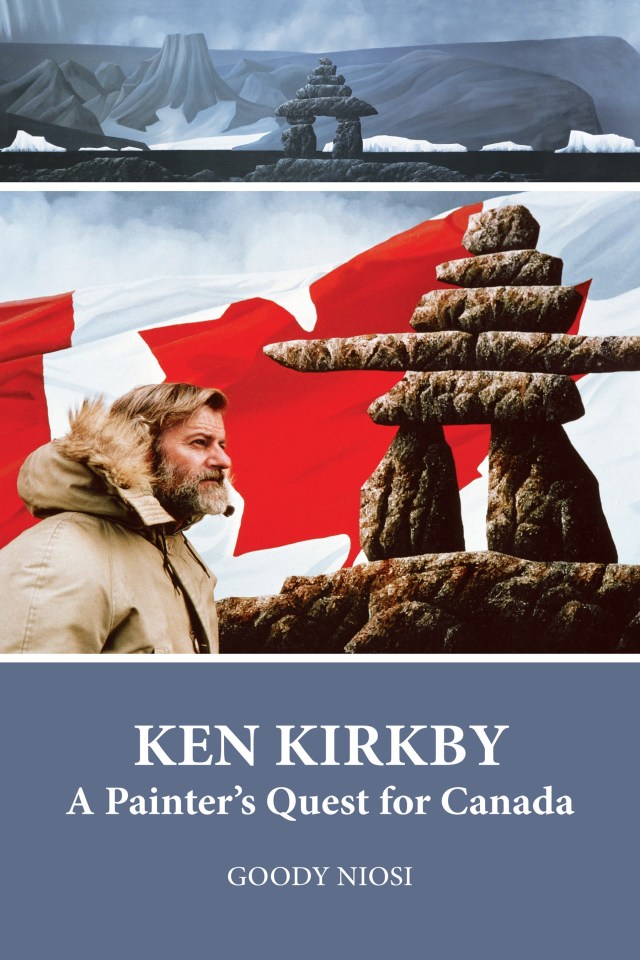
Ken Kirkby, A Painter’s Quest for Canada

excerpt

A short while later, a tall man came to the kitchen door. Salvador
greeted him and the two men talked quietly together for a few minutes.
Then Salvador pointed, and Ken heard him say, “This is the man I told
you about. He is the man who has been sent.”
Albert waved Ken toward him. “If you’ve been sent, you’d better come in.”
Ken shook his hand and entered the kitchen.
“Who sent you?” Albert asked.
“It isn’t a who; it’s a what. An idea sent me and the idea starts with
one human being asking another human being for one hour of his life to
listen to a story, and the story is of a man you may have some familiarity
with. His name is Lorenzo de Medici. Are you familiar with him?”
“Yes I am.”
“I want one hour of your life.”
Albert sat at the kitchen table, quiet and composed. Even his eyes were
still. His hands rested motionlessly on the tabletop, his fingers curled
comfortably inward.
Ken sat, took off his watch, and placed it on the table where he could
see the time ticking away. He told Albert his understanding of Lorenzo
de Medici’s life. He drifted away on his words, just as he had when he had
made his speech at the Columbus Centre. He lost himself in the intensity
of the moment – rushing down the white water of ideas like a kayaker
tumbling down a raging river.
“There are parts of that story I wasn’t familiar with,” Albert said, when
Ken had finished. “Where did you get your information?”
He told Albert about his birthday trip to Florence to see the statue of
David and how on another birthday his father had given him a beautifully
bound book of Michelangelo’s letters to Popes, kings and princes.
The letters, he told him, described his relationship to the Medicis in his
own words.
“So you are an artist?”
“I am a painter. Michelangelo was a sculptor who was made to paint.
I am a politician who is made to paint. I have a job to do, and I have a
mission to carry out that has to do with the people of the Arctic and the
soul of a nation. We in Canada wander around very confused as to our
identity. Our subjects of conversation are the weather, Quebec, and our
identity. I have found the soul of this nation, and in the process, I found
many wonderful stories and many wonderful symbols. At the same time,
I discovered hell on earth – hell is what is happening to those people. I
have been asked by the grandmothers to please tell the world about this.
The first thing I want to do is tell you about it.”
“Why would you want to tell me about it?”
“In Michelangelo’s time there were Popes, queens, and princes. There
were people who could sponsor great ideas.

https://draft2digital.com/book/3562830

https://www.amazon.com/dp/0981073573

The Circle

excerpt

“Come in, my son, come in. Let me introduce you to the Minister of Finance,
Omar Salem. Here’s one of my sons from the United States, minister. His name
is Talal Ahem.”
Omar Salem looks at Talal and smiles.
“He’s one of the seven?”
“Yes.”
“I’m very pleased to meet you, sir,” Talal says, and shakes the man’s hand.
“You, too, Talal Ahem,” says the minister. “Should we expect you to return
to your country soon?”
Ibrahim smiles with obvious pleasure as he tells the minister, “He’s a
chemical engineer.”
“A chemical engineer, very good; now, this is a man our country needs, don’t
you think, my good friend, Ibrahim?”
“Yes, of course. Yes, our country needs all her talents to help her in our years
of development.”
“Please tell me, Ibrahim, when your dearest son Hakim will visit us?”
“I hope very soon in the new year, minister.”
Talal shakes the hand of the minister once again and leaves him with Ibrahim
in the study. He finds Emily in the garden and they walk together for a while.
She’s curious to know what happened.
“Who’s meeting with Ibrahim, honey?”
“It’s the Minister of Finance for Iraq.”
“Well, it certainly seems Ibrahim is well-connected here.”
“He’s well-connected all over the world, my love. What surprises me,
though, is that there are seven of us in the United States.”
“What do you mean, seven of you?”
“Hakim and I are in the United States thanks to Ibrahim’s money. Now, I
find out there are another five who have gone to the states for studies, just as
Hakim and I did. I only know Ahmed, in Los Angeles whom I see often, but who
are the other four and where are they?”
“Why did Ibrahim send you if you are not a blood relative?”
“My mission is to be with Hakim and make sure he never feels alone, nor gets
into trouble. To make sure nothing bad happens to him.”
They walk hand in hand, silently, while Talal tries to figure out who the rest
of the seven could be and where they may be now. There must be a reason the old
man sent us all to the United States. Talal knows he needs to find that out before
they return home, so he can brief Hakim before he gets involved with Bevan and
his plans.
“Tomorrow we’re going to the gulf. Are you not excited?” he asks Emily.

https://draft2digital.com/book/3562817

https://www.amazon.com/dp/0978186524

Arrows

excerpt

thundersticks of the white men, never making it to the appointed
battlefield. Others fell under the hoofs of the frightening beasts or
were stuck by the long spears while trying to break through metal
with their wooden swords.
Guacaipuro and Paramaconi persisted in their attempts to pass,
thinking that the rest of the coalition must long be engaged in battle.
Precious hours went by. It was past noon when Losada, sick to his
stomach in bed, was notified of the unnatural gathering of savages
on the outskirts of the city.
The several caciques that had opted to wait and those who had
wanted the charge soon found the choice made for them. I was told
later by Benjamin that Losada dressed leisurely when alerted to the
Indian presence, showing once again the temperance that had
always characterized him. He chose thirty men and appointed the
rest to the protection of the city.
The cavalry went out first, forming a crushing front with horses
bred and trained for bodily conflict: horses that would kick, turn and
caracole on command; that would not shy away from the sound of
battle; that would dismiss wounds as long as they could stand. The
infantry followed, finishing off any stubborn traces of life. Many
Indians fled in confusion, but it was a massacre all the same.
In my days with the conquistadors, I heard many stories of battle
and triumph. In those accounts, there were always thousands of
Indians attacking a handful of heroes who, despite the odds,
managed to come out victorious. The Indians could not possibly win
simply because of their inferior means, but had there been so many
thousands, as the Spanish accounts relate, I am sure no Spaniard,
half-breed or traitorous Indian would have survived.
From living amongst them, I knew there was no lack of courage or
commitment from the Indians. On that day, according to Benjamin,
after the Spaniards had thought most of the Indians were dead or
had withdrawn, a solitary voice defied Losada. There, amid corpses
and dying friends, stood Tiuna with gold bracelets on his arms and a
gold pendant on his chest. He was a warrior from the Caracas
Indians, of which Catia was cacique.

https://draft2digital.com/book/3562848

https://www.amazon.com/dp/0981073522

Poodie James

excerpt

“What are you going to do?”
“If the railroad says there was sabotage, I’ll have my people run a
full investigation.”
“If they don’t?”
“I’ll give the mayor my report.”
“And?”
Spanger grinned.
“Thanks for your help, Paul. See you in court. Or somewhere.”
As he passed the checkers players, the old cackler was eyeing his
partner across the board.
Piles of broken ties, twisted rails and fragments of the blasted tank
car bordered Gellardy’s orchard. A section gang was tamping new
ties into place. The smell of creosote was heavy in the air. Spanger
saw the locomotive upright on the track near the hobo jungle, a
section of its cab wall bowed out, a sheet of steel dangling from it.
The crane, engine roaring and cables screeching, was beginning to
ease the distorted chassis of the tank car out of the depression
alongside the track. Spanger walked toward a half dozen men who
stood watching. He recognized all but one. As two of them greeted
him and moved aside to make room, he saw Poodie James. Poodie
looked up and made glottal sounds of greeting. The chief looked
from Poodie’s eager face to the blackenedwreckage and back again.
“It’s good to see you safe and sound today, Mr. James,” he said.
The inspector introduced himself as Lawrence Hall. Spanger
made small talk with the group of railroaders, then took the man
from Spokane aside.
“What have you found so far, Mr. Hall?”
“I’ve found a mess, Chief. There are no orderly derailments. I’ll
tell you, though, the fire department here did everything right and
kept this from becoming a first class disaster. Worst thing, of
course, is that we lost a good man. First death in a wreck since I’ve
been with the company. The coroner did an autopsy this afternoon
at my request and found that Mo d’Aleppo’s heart gave out. Massive
failure. I guess the crash triggered it. He’d had a couple of mild …

https://draft2digital.com/book/3562868

https://www.amazon.com/dp/B08W7SHCMV

Ken Kirkby – Warrior Painter

excerpt

The Promise that Propelled a Life
“But I have promises to keep, and miles to go before I sleep…”
(Robert Frost, Poet)
~~
Ken worked at a number of jobs on the lower mainland but never gave up
his fixation on the north. It is unlikely his sense of destiny remotely hinted
that the path he was on would directly consume thirty years and several
fortunes, the majority of which would be spent in one of the major cities of
the world. It was enough that his mind was filled with his dream of this vast
and empty land.
Many thousands of Canadians made their home in Vancouver and
environs, and it frustrated him that he’d not found anyone who had been to
the Arctic, or even expressed more than a passing interest in that inaccessible
land that made up one-third of Canada.
The city was not a good fit for him, and within a year, he was leaving
it behind. He worked for several seasons on the construction of the WAC
Bennett Dam at Hudson’s Hope—an experience that has stood him in
good stead both through the workplace challenges he met, and the lasting
connection he made with WAC Bennett himself.
This odd association resulted in a piece of useful advice offered during
Ken’s long battle on behalf of the Inuit. The Premier of British Columbia
recommended that if all else failed, Ken should practice “Legislation by
exhaustion—the last man standing wins.” Over the years, Ken found it fit
his style admirably.
While working in Hudson’s Hope, he fell in love with a beautiful First
Nations girl and crumbled in broken-hearted despair when she was taken in
a tragic accident on the eve of their wedding. Tormented and withdrawn, he
took refuge in the compelling images imprinted into his brain by Francisco’s
tales of the Canadian northland. These seemed to offer some promise of
respite and became the catalyst that drove him into the Arctic. By the time
he was twenty-five, he had lived several years with the Inuit and travelled
by foot, boat and dogsled from Coppermine, NWT to Baffin Island and
back. In the process, he gave his promise to an Inuit grandmother …

https://draft2digital.com/book/3562902

The Unquiet Land

excerpt

a while, but we don’t get along all that well. She’s a straitlaced Puritan like many here in the village. And I hate Belfast, don’t you? There’s a brother and his wife in Liverpool, but I’m never going to England. I have a good friend in Derry. You know her. Molly McEvoy. Her husband was killed last year. She has often said that she and I should live together.”
“Derry’s not much improvement on Belfast,” Finn pointed out.
“No,” said Mother Ross, “but it might have to do. I don’t have a great deal of choice.”
“Come home with me, Jinnie,” Finn said impulsively. “I need someone to look after the twins. They’re nearly six years old now, and Una Slattery’s finding them too much of a handful with four children of her own. Caitlin’s a self-willed little imp who needs some of the wildness spanked out of her. Hard to believe they’re sisters, let alone twins. My house is comfortable, and there’s plenty of room. Come on. I’ll take you up there right away. I’ve the pony and trap on the road beyond.”
That was twenty years ago—twenty-one come June—and Mother Ross had lived in Finn MacLir’s house ever since. Six months after moving in as the keeper of his house and the childminder of his two young daughters, six months of slander-scandaled tongue-wagging in the village of Corrymore, Mother Ross became the second wife of Finn MacLir. Arthur Hamilton, as justice of the peace, married them in the dining room of the large, stone house. A party began on that first Friday in December, 1898, that people still talked about two decades later. And the first Friday of every month since then, whenever he was home, Finn and his friends met to celebrate yet again the night he married the widow, Sinead O’Neill, otherwise known as Mother Ross. Though she was Mrs Finn MacLir by law, she was, and remained, Mother Ross by custom. Even Caitlin never stopped calling her by the only name she had ever known her by.
“My mother was Annie Hogan before she married Jimmy Ross,” Mother Ross once related to Caitlin. “She was the midwife here in Corrymore for many years. I was the youngest of her seven children and I used to help her at the birthing. I was with her that terrible night when you and Nora were born, Caitlin. When the arthritis crippled my mother’s fingers, I took her place. I never had any children of my own.” A sad, faraway look had come into her eyes. “I was pregnant when my husband was drowned at sea, and I lost the baby in a miscarriage. I survived on my own after Jimmy’s death using midwifery skills learned at my mother’s side. I not only took

over her job, I was given her name at the same time. Mother Ross. It has stuck to me ever since.”

https://draft2digital.com/book/3562888

https://www.amazon.com/dp/1926763203

Arrows

excerpt

We hobbled jerkily, as directed, like some pathetic, three-legged
creature, until gradually we learned to swing our shared leg in
unison. In this humbled manner we were brought before the war
council of caciques.
The caciques were seated in a circle, with Guacaipuro given no
special place of honour. I was surprised to find Baruta among them.
Apacuana later told us that he had recently been made a cacique and
his body still bore the scars of the tests he had completed.
These were men who exuded confidence and authority, not the
kind of men one would cross unnecessarily. Their reputation for
bloodthirstiness coloured my apprehensions. I wondered if perhaps
we were meant to be slaughtered before them, as some sort of
ceremonial prelude to war.
I knew as well as Tamanoa that these Caribs were warriors,
conquerors in their own right. For generations, they had moved
from the south of the mainland to the northern coast, fighting their
way and conquering the gentler Arawaks.
Caribs fought among themselves, too, and made trading
incursions to the islands north of the mainland from which they
obtained not only goods, but also women. Not surprisingly, such
men were not inclined towards plans for surrender.
Though most of these men wielded authority over vast expanses
of land, Guacaipuro was chief of six other villages besides Suruapo.
Consequently it was the military strategist Guacaipuro who had
summoned the caciques of seven neighboring nations.
Whispering, Tamanoa quickly explained the gist of the
situation: Losada had founded the city of Santiago de León de
Caracas upon the settlement of San Francisco, and for the natives,
this had but one meaning: war.We were present because a cacique
called Mamacuri from the coast was arguing in favour of using the
shaman of the white men to obtain inside information about
Losada and his party.
Other caciques, like Paramaconi, great chief of the Toromaynas
from the valley where the new city had been founded, were more
inclined to kill me. Catia agreed with Paramaconi.

https://draft2digital.com/book/3562848

https://www.amazon.com/dp/0981073522

Small Change

excerpt

The Best of Friends
ALL I KNEW ABOUT ETERNITY in those days came to me through the agency of its little cousin, boredom. It was Friday and it was spring. The big windows on the left side of our second floor classroom had been lifted as far as the old paint in their grooves would allow. All afternoon, an intermittent breeze came through the protective metal grill carrying coal gas and bus fumes and the oddly fishy odour of soap from the Colgate factory down by the river. It wasn’t much, but it was news from the world and I sniffed it with a perverse pleasure.
We weren’t allowed to look outside, but as often as I could I snuck a peek at the vacant lot with its bottle chips, rusty concrete, patches of crabgrass, and minute particles of coal that lay in thin drifts where the wind had blown them from the smoke of locomotives that passed all day on the elevated tracks across the street, beyond the wooden fence of the Delaware-Lackawanna coal yard.
Sister Violeta, with her lugubrious monotone and her black visions of life before death, seemed connected somehow to the nearly purple hills (piles, really) of pea coal, which I had a privileged view of at this height. They looked like black sand blown up into dunes in the desert landscape of an alien planet. I used to imagine she had been hatched there.
Father Brackendorf, who came every Friday to teach us religion, was fond of looking out toward the coal yard and explaining that our souls were like the snow before a train went by. Once we were born, the soot came down. Scrubbing did no good. You had to let confession melt the snow, and let the sin fall to the bottom. (The bottom of what, I wondered). Then a blast of grace would freeze it white again. This is what he was saying now. It made me feel empty and restless. The clock above his head, round and white and edged with black, was soft-clicking back and hard-clicking forward, minute by minute. And then the minute hand hit twelve and it was three o’clock, and we were free.
But there was this debt I owed to Danny Amoroso.
He was three or four years older than we were, but he was slow. And he seemed to enjoy it. Being slow, I mean. He was a titan among …

https://www.amazon.com/dp/1926763157