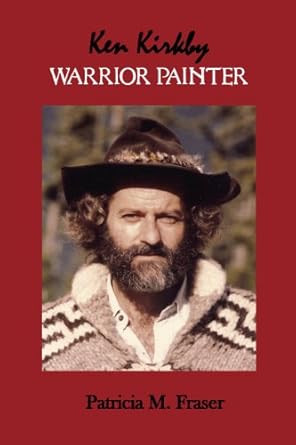
Ken Kirkby – Warrior Painter

excerpt

The Minister was a Maritimer and his open, neighbourly manner
delighted Ken. Their meeting resulted in the eminently successful 1975
exhibition of Ken’s Arctic work in Spain, and in the fashion of one domino
tipping the next, the first Canadian exhibition of the Arctic works was
triggered. Once the unusual, haunting images had been seen, and the origin
of the work was explained, all the right people wanted to own one of the
paintings, and gallery owners were clamouring to exhibit them. Best of
all, to Ken’s mind, it had been accomplished without cost to the Canadian
government beyond their public support and a few phone calls.
This was the beginning of the long road to the national introduction of
the Inuit, their stories and experiences, and the growing acceptance of the
symbol of the Inukshuk as a uniquely Canadian icon. It could be argued
this was the pivotal step that led to the Inukshuk becoming the distinctive
symbol of welcome for the 2010 Vancouver Olympics.
The Arctic paintings sold by the hundreds, nationally and internationally,
to the point where, a quarter of a century later, Canadian Art galleries were
objecting to anything other than ice, snow and Inuksuit displaying the
Kirkby name. It was ironic.
~~
Despite the history, the lack of outlets for Kirkby’s west coast images
promised a lean period ahead for the painter. He decided to force the issue
by withholding all of his art until the galleries accepted his new works. The
businessmen amongst the owners appreciated the fact that a painting with
the Kirkby signature translated into a certain sale, and Ken’s experience had
proven they’d come around when their stock was depleted.
He continued to work late, the bright light a beacon, spilling warmth
from the loft window. And then, one night he returned to the cottage to
find the message light blinking on the answering machine. That was the
start. While gallery managers still hopefully requested the Arctic series,
they agreed to hang work from his Vancouver Island series. Happily, new
customers liked it and previous Kirkby collectors were intrigued. Ten
years since that breakthrough, his work is more popular than ever and…

https://draft2digital.com/book/3562902

https://www.amazon.com/dp/B00CB8W4CG

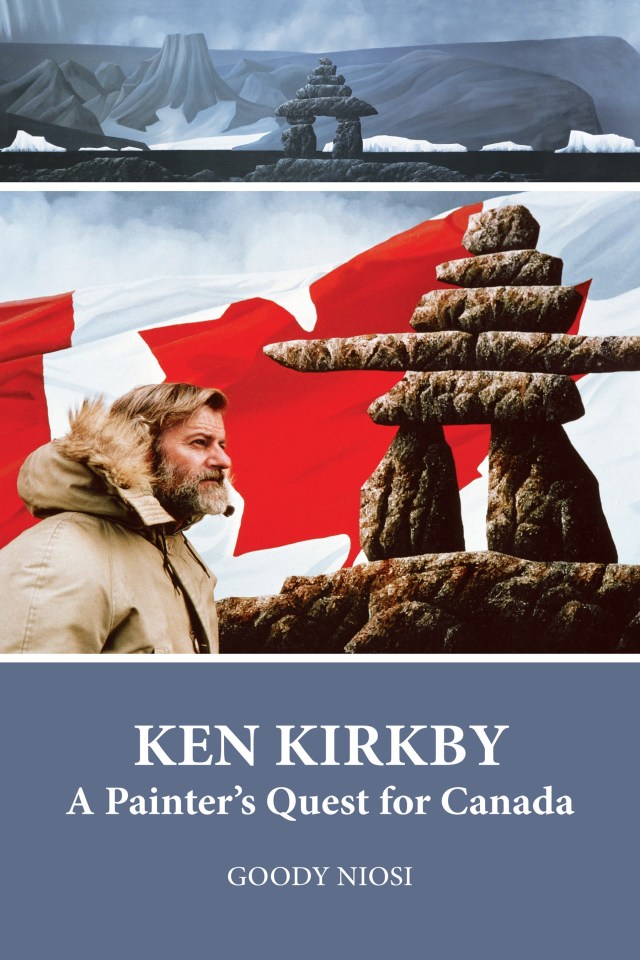
Ken Kirkby, A Painter’s Quest for Canada

excerpt

…grandly feted and on another day, he and Marsha visited the village that
had been his home. They walked up the Avenue of Princes and stopped
in front of number twelve – his home. In the garden, he saw a couple
talking with the gardener. Ken leaned over the garden wall, introduced
himself, and asked if he could look inside his old boyhood home. The
couple frowned, turned their backs on him, and walked into the house,
locking the door behind them.
The gardener said, “You’re Ken.”
“Yes.”
“I’m Francisco’s nephew.”
“How wonderful to meet you. But why are they so upset?”
“They think you’ve come back to claim the house.”
Ken laughed. “I just wanted to go inside and look. I thought it might
be very nice.”
“Oh no. People have been wondering when you would return to take
back what is yours.”
“I’ve never considered it mine,” he said.
They walked on through the village and then down to the beach. Nothing
had changed. The wall he and Francisco had built was still there and
still trapping the sand to create a beautiful stretch of beach. Even the
remains of Francisco’s cabin still clung to the cliffs.
They drove to Peniche, the home of their friend, the Count. Even here
Ken was recognized, not so much for himself, but for his father; a saint
according to the owner of a restaurant, who closed the café in celebration
of Ken’s visit and served up a feast for his honoured guests.
Back in Toronto, Ken settled into a routine that was continuously interrupted.
When he was not working on Isumataq he painted canvases
for the gallery and for the financial company’s new collection. His biggest
challenge was that the media liked him too much. They wanted to know
why he was meeting with presidents in Europe; they wanted to know his
plans – what was next? Too much good press was boring so they sought
out the malcontents – those who had accused him of appropriating a
culture that wasn’t his. He needled them until they fired back. He had
come back from his latest Arctic trip with letters from the grandmothers,
written in Inuktitut and translated into English, stating that they not
only approved of his art, but had also asked him expressly to do what he
was doing. The letters were tucked in a file that Ken suspected might be
useful one day.
Bad press was interesting but outrageous press was better. He had
about twenty unfinished paintings, stacked in a corner of the studio, that
he would likely never complete. He spread them out on the floor and
paced between them.
“What are you doing?” Diane asked, poking her head into the studio.

https://draft2digital.com/book/3562830

https://www.amazon.com/dp/0981073573

Ken Kirkby, A Painter’s Quest for Canada

excerpt

or not – it all depends on the environment. I suspect that you haven’t
thought your way through it – and I’m not trying to be rude, or difficult.
Usually, when people come in and ask for something that’s completely
outside their understanding, they, probably, aren’t asking for the right
thing. I’d like to suggest that I come down and make a presentation to
your company, on what I think you’re looking for.”
“You think so?”
“Yes. You don’t seem sure about why you want it, and you’re not sure
about the environment it will be in. I suspect that no matter what I paint
you won’t be happy. Painting what is in someone else’s mind is almost
impossible. So, would you do me the courtesy of letting me come down
and make a presentation, and see if that is what you want?”
“Certainly.”
A few weeks later, Ken walked into the formidable skyscraper in downtown
Toronto and gave the board members his analysis. They wanted a
large painting for the foyer. Fine – he could supply that, but it wouldn’t
be as large as the Reichmann painting. And, it would be the first of several
canvases. A smaller one would hang in the boardroom, and several others
would hang throughout the premises. The preliminary sketches and
drawings would be framed and hung as well. The paintings would tell a
story that would be repeated in a booklet. A six-minute film would also
tell the story, and it would play on a large screen television in the reception
area. When a client arrived for a meeting, he would sit and watch the
movie.
“Now, they have something interesting,” Ken said. “This is something
they have not anticipated seeing, and they realize that you are a lot more
than just what you do. When you meet the client, you tour them around
and show them all the works, and then you sit down and get down to
business. By now, they realize that you are interesting people. You have
things going on other than making money. When your business is concluded
you hand the client a copy of the book – signed by me and your
CEO – as something to take away and remind them of the meeting.”
Ken suggested they take a holiday during the month of August and
turn their offices over to him. When they returned the space would be
transformed – not just because the paintings would be hung. What good
were paintings if the background didn’t complement them? He proposed
changing the furniture to set off his work and painting the walls in appropriate
colours. Everything had to work – it had to be of a piece.
The cost, he said, was irrelevant – the accountants would write the
whole thing off. He thanked them, told them he had to return to his
painting, and left. During the next few days several of the board members
visited his studio. A couple of weeks later they accepted his fee of four
hundred eighty thousand dollars.

https://draft2digital.com/book/3562830

https://www.amazon.com/dp/0981073573

Ken Kirkby, A Painter’s Quest for Canada

excerpt

His scaffold was built, ladders leaned against the walls, tubes of paint –
by the carton – were stacked in the studio, and alarm clocks ticked beside
his narrow cot. He was ready to begin painting.
I felt very, very much that things had now solidified. This was now a fact,
and for the first time in this entire campaign, I actually knew that I was going
to make it – not only the painting, but also my fight for Nunavut. This
was it. It was now only a matter of physical labour to complete the vision.
There was a different feeling now. The desperation was gone, and there was
only a huge engine driving me. Now, there was only confidence. Now, I had
access to politicians, business people, media – an infrastructure so massive
and on such a personal level that I would be able to get this story through
and by hook or by crook it would come into being.
It occurred to him is his newfound euphoria – “We need to celebrate!”
He announced the “First Brushstroke” party and invitations went out in
the shape of artist’s palettes that hit the desk of every media contact in the
city. Every couple of days a new invitation in a different colour, embossed
with an Inukshuk, went into the mail. He called Keith and told him to
fill a plane with choice Arctic food. Bob Engels, the North’s most famous
bush pilot, volunteered to fly the northern contingent to Toronto. On
an evening in early September 1986, Ken climbed up on a ladder, from
which he made a speech to a roomful of people, and then splashed a giant
brushstroke across the towering, white canvas.
Then he settled into a routine that was to last for almost a year. He
painted the sky for several hours, slept for two hours, went back to work,
and then slept for two hours. As he painted he had a sense that this was
what he was meant to do – to paint on this scale. Every other painting
seemed too small – even the giant canvas that hung at First Canadian
Place was undersized. How could he ever go back to painting something
on a lesser scale? What he really wanted to do was buy Saskatchewan and
paint it from helicopters.
One day a woman, wrapped in a fur coat, swished in on stiletto heels.
She glanced around the studio and waved her arm at some paintings leaning
against the far wall. “I’ll have that one, and that one, and that one.”
“Madam,” Ken said from his perch on the scaffold. “I don’t know who
you are. I suspect you know who I am or you think you do. I would invite
you to go outside, take a walk around, come back in, and say – ‘Good
morning!’”
She took a step back. “Well! I have never been spoken to that way before!”
Ken waved his hand. “Go on! Go. Shoo… Shoo.”
She stalked out, and returned ten minutes later. “Good morning,” she said.

https://draft2digital.com/book/3562830

https://www.amazon.com/dp/0981073573

Ken Kirkby, A Painter’s Quest for Canada

excerpt

“Do you like it there?”
“No. It’s not where my heart wants to be but it is where I have to be.”
“I was in Toronto once. I married Hilu’s father and he was from Ottawa,
so I’ve been to Ottawa too.”
“What happened?”
“I don’t know how you people can live in a place like that. It’s soulless.
It’s like people living in caves up in the air. It’s just not human. How is it
that someone who isn’t born here, who doesn’t live here, and only spent a
few years here, can love this place and these people so much?”
“I don’t know,” Ken said. “I don’t know how that happened. We can
have a lot of ideas and we can say a lot of things, but the reality is that we
don’t know these things. We don’t know the first thing about love – we
haven’t a clue. We have all sorts of feelings and all sorts of passions. We
call it love and hate, but that’s just a lazy way of expressing something
we know nothing about. I think love is something that is lived. It doesn’t
have very much to do with the other person although we focus the idea
on one person. I think it’s a life lived in a particular way. It encompasses
all the things that are in that life and it depends on how that life is lived,
whether the invitation to love will be heard and accepted. I don’t think
there is any language, including Inuktitut, that truly expresses what that’s
all about. The only conclusion I can come to is the one I’ve given you.”
Joan let a long silence hang between them. Ken finally asked her again,
how she knew this was the place where he had witnessed so much death.
“It’s not just you knowing,” he said. “There’s something more concrete to
it. This is a specific place where a specific thing happened.”
“I know this is the place because my mother knew these people and
knows their story and she knows about you,” Joan said. “This was the
time of my grandmother, and my grandmother knew you. My grandmother
found you very interesting. They called you the quiet Kabluna
– the mysterious white man who had the capacity of silence. That’s how
I know about you.”
“Would it be possible to visit them in Baker Lake?” Ken asked.
“Yes.”
“Could we visit now?”
“They’re away.”
“Away?”
“Visiting.”
“Family and friends?”
“Yes – very far away.”
“So we can’t go and see them?”
“No.”

https://draft2digital.com/book/3562830

https://www.amazon.com/dp/0981073573

Ken Kirkby – Warrior Painter

excerpt

I took my rowboat and paddled out from shore to start the process of
familiarization. I observed the mouth of the creeks, the curve of the
beaches, the blend of driftwood and rock, the colour of the sky. I met
people with aircraft and begged rides off them. And, do you know?
This vast island is totally different than you might think. At one time the
bulk of the land between the seashore and the mountains was actively
farmed. The climate was favourable, and after clearing, the land was
fertile.
If you walk through it—there are still roads in the process of being
reclaimed by nature—you’d be amazed at how much of it had been
cultivated. Some of the parcels were very large, others just enough
to maintain a family or two. Then along came the Boer War, which
consumed a bunch of the young men, and then World Wars I & II
finished the job. Without the next generation to continue what had been
started, the forest grew back, roofs caved in, machinery rusted.
Once I got the feel of it, I decided I’d try to tell the story of this part
of the country—not the history, not the ‘big’ story, but the sense I had
of the size and shape of the island. The wind wracked trees and snowcrusted
mountains stirred my blood. And I found I was once again a
painter.
By the end of 2002, Ken was producing paintings to his satisfaction
and was pleased to find the attitude of the island galleries more amenable
than he’d experienced when he first returned to Vancouver. He came across
galleries dealing in second-market sales where a Kirkby oil of a solitary
Inukshuk standing proud on the tundra, or a parade of Inuksuit backed with
Arctic snows would be on display. He’d introduce himself and was pleased
to see that his name was recognised. He’d tell them that he was now in
business on the west coast. Might they be interested in fresh pieces?
The reaction was always positive. But when he laid out his canvases of
coppery grasses, water-worn granite boulders, wind-bowed trees or perhaps
a lonely lighthouse blinking eerily behind a rising ocean fog, he was met
with consternation.
“What’s this? Where are the icebergs? The Inuksuit? We can’t sell
these. That’s not you.”

https://draft2digital.com/book/3562902

https://www.amazon.com/dp/B00CB8W4CG

Ken Kirkby, A Painter’s Quest for Canada

excerpt

“I mean no disrespect, whatsoever,” Ken said. “I know the symbol well.
But that is the wall.”
Albert exchanged a few words with Leon and then nodded. The painting
would go on that wall. Then Ken and Leon tackled the problem of
hanging the massive painting on a marble wall. The maintenance staff
concluded they would have to drill into the ceiling beams and suspend
the painting from thin stainless steel wires.
They hung the painting after business hours. Ken invited the media.
He had the panels delivered to the lobby where he bolted them together.
Salvador and his staff came along to help. Many members of the young
professionals group also arrived on the scene. The media asked how much
the painting had sold for. “No comment,” Ken said.
“Was it a lot of money?”
“No comment.”
“How did you contact Mr. Reichmann?”
“No comment.”
“You’re an artist,” one of them said. “How do you know how to do
all these other things? Artists don’t know how to be entrepreneurs. Who
helps you?”
“That’s a big question,” Ken said. “It’s a spiritual matter. I don’t wish
to discuss it.”
“What do you mean it’s a spiritual matter?”
“Just that. I get my knowledge, inspiration, and advice from a higher
authority and beyond that, I don’t want to discuss it. But, I will say one
thing – my advisor is Mr. Albert Reichmann.”
“Yes,” Albert said, when a reporter asked. “I am honoured to be Mr.
Kirkby’s advisor. He is doing wonderful work.”
Those few words gave Ken the credibility he’d been looking for. He had
achieved what his father had always had – the power to command respect
and attention wherever he went.
Later that night, when he was one of the last to leave, he paused to look
at the painting that he had envisioned hanging in that space so many
times. It looked exactly as he had imagined. It was in perfect proportion
to the immense lobby. It wasn’t until one walked closer to it that one felt
the full impact of its size.
His greatest debt was to Salvador, who had arranged the meeting, but
when he told him that he wanted to give him several paintings, he refused.
Ken painted several canvases regardless and delivered them to his home.
Before getting back to the task of Isumataq, Ken returned to the Arctic.
Keith Sharp, the burly Englishman, had moved to a parcel of land near
Rankin Inlet and extended an invitation. Ken included Michael as well as
Avril the photographer, and Roberto and Egidio, the filmmakers, in his
entourage; in mid-July, the somewhat motley crew – loaded down with…

https://draft2digital.com/book/3562830

https://www.amazon.com/dp/0981073573

Ken Kirkby, A Painter’s Quest for Canada

excerpt

A short while later, a tall man came to the kitchen door. Salvador
greeted him and the two men talked quietly together for a few minutes.
Then Salvador pointed, and Ken heard him say, “This is the man I told
you about. He is the man who has been sent.”
Albert waved Ken toward him. “If you’ve been sent, you’d better come in.”
Ken shook his hand and entered the kitchen.
“Who sent you?” Albert asked.
“It isn’t a who; it’s a what. An idea sent me and the idea starts with
one human being asking another human being for one hour of his life to
listen to a story, and the story is of a man you may have some familiarity
with. His name is Lorenzo de Medici. Are you familiar with him?”
“Yes I am.”
“I want one hour of your life.”
Albert sat at the kitchen table, quiet and composed. Even his eyes were
still. His hands rested motionlessly on the tabletop, his fingers curled
comfortably inward.
Ken sat, took off his watch, and placed it on the table where he could
see the time ticking away. He told Albert his understanding of Lorenzo
de Medici’s life. He drifted away on his words, just as he had when he had
made his speech at the Columbus Centre. He lost himself in the intensity
of the moment – rushing down the white water of ideas like a kayaker
tumbling down a raging river.
“There are parts of that story I wasn’t familiar with,” Albert said, when
Ken had finished. “Where did you get your information?”
He told Albert about his birthday trip to Florence to see the statue of
David and how on another birthday his father had given him a beautifully
bound book of Michelangelo’s letters to Popes, kings and princes.
The letters, he told him, described his relationship to the Medicis in his
own words.
“So you are an artist?”
“I am a painter. Michelangelo was a sculptor who was made to paint.
I am a politician who is made to paint. I have a job to do, and I have a
mission to carry out that has to do with the people of the Arctic and the
soul of a nation. We in Canada wander around very confused as to our
identity. Our subjects of conversation are the weather, Quebec, and our
identity. I have found the soul of this nation, and in the process, I found
many wonderful stories and many wonderful symbols. At the same time,
I discovered hell on earth – hell is what is happening to those people. I
have been asked by the grandmothers to please tell the world about this.
The first thing I want to do is tell you about it.”
“Why would you want to tell me about it?”
“In Michelangelo’s time there were Popes, queens, and princes. There
were people who could sponsor great ideas.

https://draft2digital.com/book/3562830

https://www.amazon.com/dp/0981073573

Ken Kirkby, A Painter’s Quest for Canada

excerpt

Ken called and told the story of Isumataq. He offered a painting for the
paper, clinching the deal by telling them that everyone involved in the
project would very likely win an award and be exposed in some way to
massive media coverage. He also threw in some dubious oratory that was
so over the top that many people laughed. “Don’t worry about this moment,”
he said. “One day you’ll be in paradise with me.” If they snickered
behind his back, he didn’t care because by the time he was done he had
bartered for every service he needed – ninety thousand dollars worth. His
friends called the money he had used to pay for the brochure “Ken dollars”
and it was a term that stuck.
Elias Vanvakis, another of the young professionals who was a successful
insurance broker, commissioned a small pencil drawing of an Inukshuk.
“I’ll give it to you,” Ken said.
“No, I want to buy it.”
“Why would you want to buy it?”
“You’re painting the largest Inukshuk – I want the smallest,” he said.
Ken pocketed the five hundred dollars Elias offered and drew an Inukshuk,
which he handed to him. A few weeks later, on Ken’s forty-fifth
birthday, Elias presented him with a small jeweller’s box. Inside was a
small gold pin, a perfect replica of the pencil drawing.
Ken pinned it to his shirt. Minutes later he was struck by an idea. A
larger version of the pin was exactly what the front cover of the brochure
needed – but not in gold paint of even gold leaf – a pure gold Inukshuk.
The pin inspired yet another idea. The nation’s highest honour for its
citizens was The Order of Canada. He wanted something even more prestigious
– an honour that was almost impossible to receive – The Order
of the Inukshuk. He ordered a dozen more from the jeweller who had
designed it.
Whenever someone asked about the pin, he smiled and inferred that
it was special and only a chosen few would ever have the honour of receiving
one. To Rocco he said, “Anyone who buys a ten thousand dollar
painting, gets one.”
Ken was invited to the Columbus Centre again to give the keynote
speech at a dinner honouring Premier Peterson. At the end of the speech
he was to give him a painting of an Inukshuk. But instead of doing a
simple presentation, he told the story of the Order of the Inukshuk –
that the pin was the result of a visionary flood of alcohol consumed in
the land of the midnight sun on June 21, the longest day of the year. He
explained that they were almost impossible to get and only a few very
special people would ever be aware of The Order of the Inukshuk. “They
come to certain people who are magic,” he said. “They come to people
like me. Everyone else has to fight for them.”

https://draft2digital.com/book/3562830

https://www.amazon.com/dp/0981073573

Ken Kirkby – Warrior Painter

excerpt

For the first time since he’d been a kid, Ken had no deadlines or other
people’s needs to accommodate. He could sit, smoke and enjoy the flavours
of the sea air, the sound of the gulls, the calm mornings filled with a distant
hum of passing cars filtering down from the Old Island Highway. The
constant rhythm of waves on the pebble beach soothed him as he read late
into the night. The mental kinks slowly started to release.
The luxury of pursuing my thoughts in an academic fashion, waking
when I chose and stopping when I liked was heaven. Initially I was
spinning from Karen’s rejection and had to regiment my mind or the
pain would have driven me crazy. The pain was still there, but now I
was no longer hiding from my thoughts and I took pleasure in the way
one thought could morph into something else incredibly interesting,
but totally unrelated.
We humans fancy that we have evolved this elevated thing called
‘reason’ when compared to ‘sense’—that is, coming from the senses,
which has been developing over millions of years—reasoning is in the
kindergarten stages. When we talk of premonitions, or gut feel, that
also relates to our senses. We have survived from the beginning as
single cell organisms to this time and place, no thanks to reason, but
through our senses.
When Ken Kirkby moved to Bowser at the end of 2001, he was seeking
complete anonymity. His landlords, Ken and Jeanine Harris, were pleasant
and helpful but respectful of his desire for privacy. If Kirkby appeared in the
yard, they were quick to open a conversation, but other than that, they didn’t
intrude. Over the months, the three became friends as well as neighbours
and the Harris’s encouraged him as he established his programme to gain
back his health.
Ken Harris had retired from a high-pressure career in Vancouver. He
was a physically active person, who kept an eye on the community and
occupied his enquiring mind through study. He enjoyed engaging Kirkby
in conversations, which bordered on debates, and ranged far and wide. As
spring approached and the weather warmed, the two Kens would sit together
in the morning sipping their coffee, and sharing Kirkby’s cigarettes (Harris
claimed he had given up smoking) while discussing whatever surfaced …

https://draft2digital.com/book/3562902

https://www.amazon.com/dp/B00CB8W4CG