
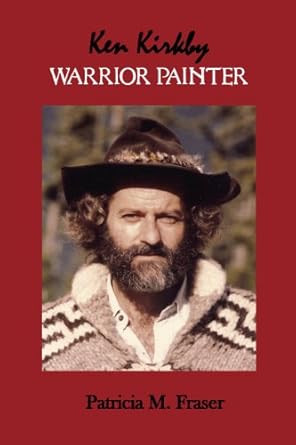
Ken Kirkby – Warrior Painter

excerpt

I took my rowboat and paddled out from shore to start the process of
familiarization. I observed the mouth of the creeks, the curve of the
beaches, the blend of driftwood and rock, the colour of the sky. I met
people with aircraft and begged rides off them. And, do you know?
This vast island is totally different than you might think. At one time the
bulk of the land between the seashore and the mountains was actively
farmed. The climate was favourable, and after clearing, the land was
fertile.
If you walk through it—there are still roads in the process of being
reclaimed by nature—you’d be amazed at how much of it had been
cultivated. Some of the parcels were very large, others just enough
to maintain a family or two. Then along came the Boer War, which
consumed a bunch of the young men, and then World Wars I & II
finished the job. Without the next generation to continue what had been
started, the forest grew back, roofs caved in, machinery rusted.
Once I got the feel of it, I decided I’d try to tell the story of this part
of the country—not the history, not the ‘big’ story, but the sense I had
of the size and shape of the island. The wind wracked trees and snowcrusted
mountains stirred my blood. And I found I was once again a
painter.
By the end of 2002, Ken was producing paintings to his satisfaction
and was pleased to find the attitude of the island galleries more amenable
than he’d experienced when he first returned to Vancouver. He came across
galleries dealing in second-market sales where a Kirkby oil of a solitary
Inukshuk standing proud on the tundra, or a parade of Inuksuit backed with
Arctic snows would be on display. He’d introduce himself and was pleased
to see that his name was recognised. He’d tell them that he was now in
business on the west coast. Might they be interested in fresh pieces?
The reaction was always positive. But when he laid out his canvases of
coppery grasses, water-worn granite boulders, wind-bowed trees or perhaps
a lonely lighthouse blinking eerily behind a rising ocean fog, he was met
with consternation.
“What’s this? Where are the icebergs? The Inuksuit? We can’t sell
these. That’s not you.”
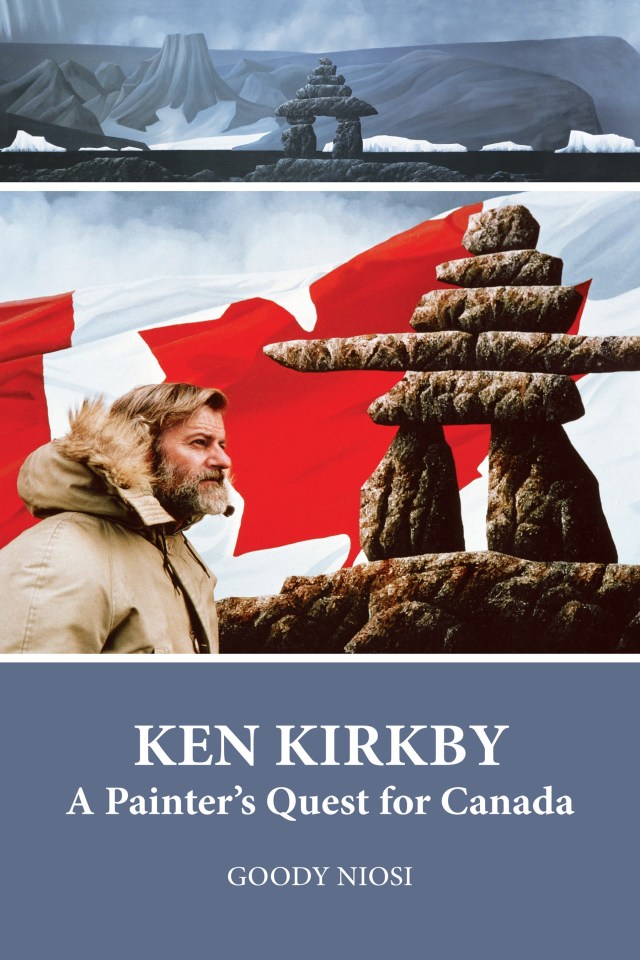
https://draft2digital.com/book/3562902

https://www.amazon.com/dp/B00CB8W4CG

Ken Kirkby, A Painter’s Quest for Canada

excerpt

“I mean no disrespect, whatsoever,” Ken said. “I know the symbol well.
But that is the wall.”
Albert exchanged a few words with Leon and then nodded. The painting
would go on that wall. Then Ken and Leon tackled the problem of
hanging the massive painting on a marble wall. The maintenance staff
concluded they would have to drill into the ceiling beams and suspend
the painting from thin stainless steel wires.
They hung the painting after business hours. Ken invited the media.
He had the panels delivered to the lobby where he bolted them together.
Salvador and his staff came along to help. Many members of the young
professionals group also arrived on the scene. The media asked how much
the painting had sold for. “No comment,” Ken said.
“Was it a lot of money?”
“No comment.”
“How did you contact Mr. Reichmann?”
“No comment.”
“You’re an artist,” one of them said. “How do you know how to do
all these other things? Artists don’t know how to be entrepreneurs. Who
helps you?”
“That’s a big question,” Ken said. “It’s a spiritual matter. I don’t wish
to discuss it.”
“What do you mean it’s a spiritual matter?”
“Just that. I get my knowledge, inspiration, and advice from a higher
authority and beyond that, I don’t want to discuss it. But, I will say one
thing – my advisor is Mr. Albert Reichmann.”
“Yes,” Albert said, when a reporter asked. “I am honoured to be Mr.
Kirkby’s advisor. He is doing wonderful work.”
Those few words gave Ken the credibility he’d been looking for. He had
achieved what his father had always had – the power to command respect
and attention wherever he went.
Later that night, when he was one of the last to leave, he paused to look
at the painting that he had envisioned hanging in that space so many
times. It looked exactly as he had imagined. It was in perfect proportion
to the immense lobby. It wasn’t until one walked closer to it that one felt
the full impact of its size.
His greatest debt was to Salvador, who had arranged the meeting, but
when he told him that he wanted to give him several paintings, he refused.
Ken painted several canvases regardless and delivered them to his home.
Before getting back to the task of Isumataq, Ken returned to the Arctic.
Keith Sharp, the burly Englishman, had moved to a parcel of land near
Rankin Inlet and extended an invitation. Ken included Michael as well as
Avril the photographer, and Roberto and Egidio, the filmmakers, in his
entourage; in mid-July, the somewhat motley crew – loaded down with…

https://draft2digital.com/book/3562830

https://www.amazon.com/dp/0981073573

Ken Kirkby, A Painter’s Quest for Canada

excerpt

A short while later, a tall man came to the kitchen door. Salvador
greeted him and the two men talked quietly together for a few minutes.
Then Salvador pointed, and Ken heard him say, “This is the man I told
you about. He is the man who has been sent.”
Albert waved Ken toward him. “If you’ve been sent, you’d better come in.”
Ken shook his hand and entered the kitchen.
“Who sent you?” Albert asked.
“It isn’t a who; it’s a what. An idea sent me and the idea starts with
one human being asking another human being for one hour of his life to
listen to a story, and the story is of a man you may have some familiarity
with. His name is Lorenzo de Medici. Are you familiar with him?”
“Yes I am.”
“I want one hour of your life.”
Albert sat at the kitchen table, quiet and composed. Even his eyes were
still. His hands rested motionlessly on the tabletop, his fingers curled
comfortably inward.
Ken sat, took off his watch, and placed it on the table where he could
see the time ticking away. He told Albert his understanding of Lorenzo
de Medici’s life. He drifted away on his words, just as he had when he had
made his speech at the Columbus Centre. He lost himself in the intensity
of the moment – rushing down the white water of ideas like a kayaker
tumbling down a raging river.
“There are parts of that story I wasn’t familiar with,” Albert said, when
Ken had finished. “Where did you get your information?”
He told Albert about his birthday trip to Florence to see the statue of
David and how on another birthday his father had given him a beautifully
bound book of Michelangelo’s letters to Popes, kings and princes.
The letters, he told him, described his relationship to the Medicis in his
own words.
“So you are an artist?”
“I am a painter. Michelangelo was a sculptor who was made to paint.
I am a politician who is made to paint. I have a job to do, and I have a
mission to carry out that has to do with the people of the Arctic and the
soul of a nation. We in Canada wander around very confused as to our
identity. Our subjects of conversation are the weather, Quebec, and our
identity. I have found the soul of this nation, and in the process, I found
many wonderful stories and many wonderful symbols. At the same time,
I discovered hell on earth – hell is what is happening to those people. I
have been asked by the grandmothers to please tell the world about this.
The first thing I want to do is tell you about it.”
“Why would you want to tell me about it?”
“In Michelangelo’s time there were Popes, queens, and princes. There
were people who could sponsor great ideas.

https://draft2digital.com/book/3562830

https://www.amazon.com/dp/0981073573

Ken Kirkby, A Painter’s Quest for Canada

excerpt

Ken called and told the story of Isumataq. He offered a painting for the
paper, clinching the deal by telling them that everyone involved in the
project would very likely win an award and be exposed in some way to
massive media coverage. He also threw in some dubious oratory that was
so over the top that many people laughed. “Don’t worry about this moment,”
he said. “One day you’ll be in paradise with me.” If they snickered
behind his back, he didn’t care because by the time he was done he had
bartered for every service he needed – ninety thousand dollars worth. His
friends called the money he had used to pay for the brochure “Ken dollars”
and it was a term that stuck.
Elias Vanvakis, another of the young professionals who was a successful
insurance broker, commissioned a small pencil drawing of an Inukshuk.
“I’ll give it to you,” Ken said.
“No, I want to buy it.”
“Why would you want to buy it?”
“You’re painting the largest Inukshuk – I want the smallest,” he said.
Ken pocketed the five hundred dollars Elias offered and drew an Inukshuk,
which he handed to him. A few weeks later, on Ken’s forty-fifth
birthday, Elias presented him with a small jeweller’s box. Inside was a
small gold pin, a perfect replica of the pencil drawing.
Ken pinned it to his shirt. Minutes later he was struck by an idea. A
larger version of the pin was exactly what the front cover of the brochure
needed – but not in gold paint of even gold leaf – a pure gold Inukshuk.
The pin inspired yet another idea. The nation’s highest honour for its
citizens was The Order of Canada. He wanted something even more prestigious
– an honour that was almost impossible to receive – The Order
of the Inukshuk. He ordered a dozen more from the jeweller who had
designed it.
Whenever someone asked about the pin, he smiled and inferred that
it was special and only a chosen few would ever have the honour of receiving
one. To Rocco he said, “Anyone who buys a ten thousand dollar
painting, gets one.”
Ken was invited to the Columbus Centre again to give the keynote
speech at a dinner honouring Premier Peterson. At the end of the speech
he was to give him a painting of an Inukshuk. But instead of doing a
simple presentation, he told the story of the Order of the Inukshuk –
that the pin was the result of a visionary flood of alcohol consumed in
the land of the midnight sun on June 21, the longest day of the year. He
explained that they were almost impossible to get and only a few very
special people would ever be aware of The Order of the Inukshuk. “They
come to certain people who are magic,” he said. “They come to people
like me. Everyone else has to fight for them.”

https://draft2digital.com/book/3562830

https://www.amazon.com/dp/0981073573

Ken Kirkby – Warrior Painter

excerpt

For the first time since he’d been a kid, Ken had no deadlines or other
people’s needs to accommodate. He could sit, smoke and enjoy the flavours
of the sea air, the sound of the gulls, the calm mornings filled with a distant
hum of passing cars filtering down from the Old Island Highway. The
constant rhythm of waves on the pebble beach soothed him as he read late
into the night. The mental kinks slowly started to release.
The luxury of pursuing my thoughts in an academic fashion, waking
when I chose and stopping when I liked was heaven. Initially I was
spinning from Karen’s rejection and had to regiment my mind or the
pain would have driven me crazy. The pain was still there, but now I
was no longer hiding from my thoughts and I took pleasure in the way
one thought could morph into something else incredibly interesting,
but totally unrelated.
We humans fancy that we have evolved this elevated thing called
‘reason’ when compared to ‘sense’—that is, coming from the senses,
which has been developing over millions of years—reasoning is in the
kindergarten stages. When we talk of premonitions, or gut feel, that
also relates to our senses. We have survived from the beginning as
single cell organisms to this time and place, no thanks to reason, but
through our senses.
When Ken Kirkby moved to Bowser at the end of 2001, he was seeking
complete anonymity. His landlords, Ken and Jeanine Harris, were pleasant
and helpful but respectful of his desire for privacy. If Kirkby appeared in the
yard, they were quick to open a conversation, but other than that, they didn’t
intrude. Over the months, the three became friends as well as neighbours
and the Harris’s encouraged him as he established his programme to gain
back his health.
Ken Harris had retired from a high-pressure career in Vancouver. He
was a physically active person, who kept an eye on the community and
occupied his enquiring mind through study. He enjoyed engaging Kirkby
in conversations, which bordered on debates, and ranged far and wide. As
spring approached and the weather warmed, the two Kens would sit together
in the morning sipping their coffee, and sharing Kirkby’s cigarettes (Harris
claimed he had given up smoking) while discussing whatever surfaced …

https://draft2digital.com/book/3562902

https://www.amazon.com/dp/B00CB8W4CG

Ken Kirkby – Warrior Painter

excerpt

years old, they were taken south and lost to their families as they were given
an education that could not be applied to their northern way of life.
The soft voice of the Grandmother ended the story by saying, “Perhaps
it would be good to have Isumataq.”
Isumataq, Ken learned, also meant many things—big, or spokesperson—
but the most accurate definition seemed to be “an object or a person in
whose presence wisdom might reveal itself.”
This was the exact point at which he discovered the meaning of his
life in Canada—the unknown purpose for which he’d embarked on this
mysterious and gruelling quest.
The idea that wisdom was a thing that existed on its own and could
only show its value if one was prepared to allow that to happen, was
electrifying. I felt a driving urgency to gather as much information
as possible—a burning need to disseminate that knowledge to those
who could not otherwise experience it for themselves. I had a definable
purpose.
The time came when the Grandmother took Ken aside. She sat on the
floor in front of him and pronounced, “In our mind you are Inuk. You are
learning our language and eating our food and you are a part of us. Our wish
is that you will stay with us, but you tell us that you have to go back to your
world, and that is as it must be. It is our wish that you tell the people in your
world of the many things you have seen—all of the things you know.”
And that was when Ken made the promise to the Grandmother that
would shape, drive and guide him for the next thirty plus years of his life.
I felt I was equipped with the knowledge of something unique. The
spirit of Isumataq had become a living thing in my heart! And as an
artist I had absorbed stunning material at the cellular level. It would
never leave me.
By his own calculations, Ken spent thirty-one years, several million
dollars, ended a marriage and lost numerous friends to his fixation on
keeping his promise to bring the story of the desperate plight of these
indigenous peoples to the 90% of Canadians who lived, totally unaware, in
the southern portion of the nation.

https://draft2digital.com/book/3562902

https://www.amazon.com/dp/B00CB8W4CG

Ken Kirkby, A Painter’s Quest for Canada

excerpt

sexual gratification of a bunch of perverts. If this happened to your family,
wouldn’t you want someone to care? Wouldn’t you want someone to
raise a stink? Wouldn’t you want someone to help? That’s all I’m trying
to do. Apparently, to my surprise, it seems this painting was the two by
four needed to apply to the side of your head to get you to pay attention.
My job is to announce to you what has gone on and what continues to
go on. I’m robbing you of your innocence. I’m not going to give you the
chance to say, ‘If only I had known’. Now you know. What are you going
to do about it?”
The mood of the public changed. People began calling to agree with
him. Battle lines were drawn and half – or perhaps even the magic fiftyone
percent – agreed with him.
Ken spent an hour or more each day, at the Columbus Centre, talking
to people who lined up to see the painting and talk to the artist. Thousands
of people came – far more than had attended his opening night.
Ken finished each of his stories with a plea for help. He urged people
not to simply believe his stories, but to investigate and make up their own
minds. And if they discovered that what he said was true, let the government
know how they felt. This was what democracy was about – and he
was appalled at how lightly most people took the democracy they lived in.
“No one that is born here really takes it seriously,” he told them. “Do you
know how many rivers of blood were spilled to have what we have here?
How can we pretend to be this thing that we say we are when you can’t
bother to inform yourselves about what goes on in your own country?
How can you be a nation without knowing what goes on in your own
backyard?”
Ken received a phone call from Wayne Morrison, the executive director
of the Friends of Canadian Broadcasting and the stepson of Northrop
Frye. Could they meet, he asked? Ken invited him to the studio.
Wayne was a dapper and polished gentleman who expressed fascination
with the furor caused by the flag painting. The CBC was about to
suffer large financial cuts, which would seriously endanger its existence,
he said, and he wanted Ken’s help. He wanted to reproduce the flag painting
in full page magazine advertisements with Ken standing beside it
holding a paintbrush with the quote, “I haven’t been this mad in twenty
years.” Below that would be the story of the CBC cutbacks.
Ken said yes, but he was not prepared to use the painting. He would
create another similar one instead. When Diane asked why, he said, “I’m
going to give it to Canada and I don’t want it reproduced. It’s going to go
to the country pure.”
“You’re going to give it away? Good lord, we don’t have enough money to
do what we’re doing and you’re going to give paintings away! Why are you
going to give something to the government? They already take too much!”

https://draft2digital.com/book/3562830

https://www.amazon.com/dp/0981073573

Ken Kirkby, A Painter’s Quest for Canada

excerpt

He had more canvases made that together measured twenty-five feet,
eight inches long by two feet high. By anyone’s standard, this was an immense
painting: by Ken’s yardstick, it was a miniature. However, the size
was ideal, as it allowed him to sketch in every detail and nuance he wanted
to convey.
He worked eighteen hours a day, but time had ceased to have meaning.
He physically barricaded the studio to discourage visitors. Several weeks
later, when the large model was complete, he started to calculate what it
would take to paint a portrait that was twelve feet high one hundred fiftytwo
feet long. He estimated that he would need thirty-eight panels twelve
feet high by four feet long, butted seamlessly together.
He had immense issues to deal with. First, he had to find a supplier
who could stretch canvases of that size. He also had to keep Rocco supplied
with paintings, and he had to complete them on time. And, he had
to finish the Reichmann and Yellowknife Airport paintings. In addition,
he was once again doing presentations at schools. Common sense told
him to say no to those requests, yet he felt an obligation to talk to the
children – to fire their minds with dreams. Although he should have been
tired, he was bursting with energy. It was as though the furnace of his
heart was being stoked with a fuel that burned endlessly – a fuel more
potent than food, drink or rest.
He could find no one who would stretch the canvases. Those he approached
thought he was mad. He talked to the company that supplied
their framing material, explaining that he needed stretchers double kiln
dried so they wouldn’t warp. They also had to be bevelled so that when
the panels came together the seams would disappear.
Ken wanted all the materials he used to be made in Canada. It wasn’t
possible. No one in Canada made canvas, so he ordered several rolls from
Brazil, each roll weighing hundreds of pounds. He also had to import
brushes.
With leftover canvas from the Reichmann painting, he and Diane
stretched the first panel using the device he had invented that was a combination
of canvas stretching pliers, Vise-Grips, and a torque wrench. Every
part of the canvas had to be stretched to precisely the same tension.
The canvas was perfect when he could lay it on the floor, toss a coin
on it ,and have it bounce off like a bullet. If it wasn’t right he started over
again – and he began afresh many times.
Keeping in mind his insight about quantifying the painting, he made a
precise list of every item he needed. How much glue would he need? How
much gesso for four coats on each of thirty-eight panels? How much paint?
Ken met with Mr. Stevenson, of Stevenson and Company paint manufacturers,
“I think I’m going to need two tons of paint,” Ken said.

https://draft2digital.com/book/3562830

https://www.amazon.com/dp/0981073573

Ken Kirkby – Warrior Painter

excerpt

lobsters and many varieties of fish. Francisco would light a fire on the
rocky floor and the smoke would rise through the gap overhead while
we prepared a feast. Monsieur Desjardines thought this secluded spot
was heaven. We’d spend the day fishing, eating lobster over an open
fire and sharing stories. There was something deliciously daring about
being in a place feared by the locals—if the weather blew up a storm,
as it could easily do, the magical hiding spot could well become a
watery tomb.
Ken’s young life was idyllic but Portugal was changing. At the close
of three decades in power, the once-benevolent dictatorship of Antonio
de Oliveria Salazar was losing favour. In an effort to maintain control as
opposition coalesced behind the dissident Henrique Galvoa, Salazar’s
secret police grew more and more vicious, and by 1956, the country was
under siege.
Lisbon was the kind of city that attracted unusual people: the brilliant,
the demonic and those who drifted on the fringes of society. Spies abounded.
Ordinary people were recruited to inform on their friends and neighbours,
and paid according to the value of their information. Many innocent people
were ruined and the ensuing chaos heightened Ken’s determination to get
himself and his family out of the country.
Although his employees revered Kirkby, Sr. his position as a major
industrialist was unpopular with the authorities. It was no secret he had ties
with the exiled Galvoa. The contents of their ongoing correspondence was
less public and this was a double-edged sword: the Salazar supporters were
suspicious of his connection with the agitator, but totally unaware of the
extent to which Kirkby, Sr. was being kept apprised of problems brewing
within the country.
By early 1957, the Kirkby business empire was showing signs of
imploding under the intensified attentions of the secret service. Sixteen-year-
old Ken had an extensive network of friends at all social levels. When
he realised that time was running out for his dad he managed, with their
help, to orchestrate his father’s escape via a private plane in the gloom of an
early morning with government enforcers hard on their heels.
Monsieur Desjardines arranged the necessary paperwork for Kirkby, Sr.
to enter Canada. However, it took many months and the official intervention

https://draft2digital.com/book/3562902

https://www.amazon.com/dp/B00CB8W4CG

Ken Kirkby – Warrior Painter

excerpt

I’m aware that you are frequently faced with idiots and liars and
scoundrels but, in telling this story, I hope to explain that I am none of these
things. You need to know there are people in this world who actually do
give their entire lives to something bigger than themselves.”
“We have an hour,” she replied.
Fifty-nine minutes later, Ken had told the story of Isumataq and of the
cause of the Inuit. “That’s the preamble—now here’s the paperwork,” he
said, sliding neat folders of material across the table to her. “Here’s how the
money came in and here’s how it went out. For myself, I’ve always lived a
Spartan life. I’ve no real interest in possessions or material things. Money is
simply a necessary tool, like a hammer or a screwdriver—or a paintbrush.”
Some time later the Judge looked up and announced, “You don’t owe
a penny, Mr. Kirkby.”
“I know. If I did, I would pay it.”
When he emerged from the meeting, Ken felt as though his feet were
gliding above the rain-washed pavement. It had been worth the battle and
his sense of justification made him giddy. Karen was out of town again, but
when he phoned to share the good news, her bitter response was “Well, I
guess rules just don’t apply to you.”
He spent the evening in company with his long-time friend and fishing
buddy, Ron Gruber. Since Ken’s return to Vancouver, Ron had watched his
friend’s relationship deteriorate. He was increasingly concerned as he saw
Ken slide steadily into that solitary and dark place from which there seems
no escape. Ron was one of the few people in the world Ken could talk to
about personal matters and he told him of his concern that Karen seemed
determined to alienate her colleagues. As he put it, “It’s like watching
someone you care for deeply move dangerously close to the edge of the
cliff, and there’s no way to save her.” He harkened back to earlier situations
when Karen had set herself on collision course, and then dragged others
with her into disaster.
It was not Ken’s nature to give up without a fight, and it took several
months more before he would accept the end of their relationship. He’d
committed to change his life for Karen and he meant to do everything
humanly possible to retrieve the closeness he’d once had with her. But even
that steely resolve wilted when, before leaving on another business trip,
Karen voiced her opinion that they had nothing whatsoever in common…

https://draft2digital.com/book/3562902

https://www.amazon.com/dp/B00CB8W4CG