The English translation carries that same balance of intensity and difficulty. Aligizakis gives the poems a clear, open page: the short lines and ample white space encourage the reader to pause, and the recurrent images remain easy to follow. Some formulations, however, sound awkward or opaque in English. At times the syntax and word choice make it difficult to know whether a phrase’s strangeness is intentional or a result of translation. The book does not print the Greek originals alongside the English, so readers cannot compare the two versions. This matters in poetry, where sound, rhythm and shades of meaning are part of the work, not incidental features. Still, the translation’s occasional friction can also suit a poet concerned with language that fails, changes or cannot fully carry an experience.
The substantial introduction traces Faitas’s career and interprets each collection, providing helpful context for readers unfamiliar with the poet. It also quotes many poems and explains their philosophical implications in advance. Some readers will appreciate this guide; others may find that it narrows the space for discovery. The poems often work best when encountered directly, before their imagery is translated into a single explanatory argument. The praise section and biographical notes add further context, though the book’s strongest case for Faitas remains the poems themselves.
Entropy will appeal most to readers drawn to philosophical lyric poetry, Greek myth, and sustained reflection on mortality and the cosmos. It is not a collection built around narrative momentum or sharply individualized dramatic voices. Its movement is cyclical: an image or question returns altered, as if the book’s own form were mimicking the rhythms it describes. That repetition can be immersive, sometimes excessive, but it also gives the collection its identity. Faitas writes from the conviction that a person is brief, knowledge incomplete and the universe beyond comprehension. Yet the poems continue to ask, to remember, to love and to make images out of what cannot be mastered. Their deepest subject may be not entropy as dissolution, but the human urge to find connection within it.
“Twentieth Canto” develops this qualification through the reciprocal action of hands and clay: the hands work the material, while the material works upon the hands. Creation here involves being changed by what one touches. The image quietly opposes the juvenile God’s unilateral impositions. It also offers a persuasive account of poetic responsibility. The artist should discover something through the encounter, rather than merely force the world to illustrate a conviction. This modest image of making carries as much ethical weight as the sequence’s more thunderous denunciations.
The language largely proceeds through accumulation. Short lines, limited punctuation, and rapid shifts between bodily, botanical, theological, and political vocabularies create a restless current. A metaphor rarely remains isolated; it attracts another before its implications have settled. The result can be exhilarating, particularly when an unexpected verb animates a familiar object or when a delicate creature abruptly interrupts an abstract claim. The page gives this crowded movement room through generous spacing, while the Cantos’ italic setting visually distinguishes their answering voices from the Hours.
The same abundance occasionally strains clarity. Successive abstractions and densely modified images can compete for attention, leaving the emotional direction clearer than the relationship between phrases. Similarly, the repeated denunciation of clerics and fanatics sometimes offers less dramatic discovery than the ambivalent treatment of Death. These limitations arise from the work’s chosen pressure: it wants to be chorus, accusation, love song, and cosmic argument at once. Its finest passages allow a concrete action to organize that energy, giving the reader somewhere to stand amid the verbal tempest.
The concluding movements deepen the book by bringing loss closer to the speaking voice. In “Twenty-Third Canto,” a photograph taken from a wallet releases tears, and the speaker loses his desire for a favourite wine. The shift matters because grief is registered as an alteration of appetite and habit. The public vocabulary of outrage yields to the difficulty of continuing a private life. A model train then delivers the familiar promise of doing better, placing the refrain in an object whose smallness contrasts sharply with the cosmic machinery surrounding it.
The final Canto makes the personal cost unmistakable. While the speaker persists in household chores, news arrives of his son’s death in a zealot’s war. This is a revelation within the poem, not a warrant for assuming autobiography. Its force comes from the collision between ordinary maintenance and irreversible loss. Watering flowers becomes almost unbearably inadequate, yet it remains an act addressed to living things. The surrounding animals continue to know their paths and habits until bullets and nets interrupt them. Human bereavement and ecological destruction become neighbouring instances of life needlessly cut short.
At this point the refrain changes. The question becomes whether He could have done better, and the sea answers that He could. The shift moves from an undertaking to a judgment. It withdraws the excuse that the existing order must be accepted as the best or only possible one. The concluding passage attributed to Elytis leaves ethical existence poised upon a precarious point, preserving the difficulty of choice after the accusation has been delivered. There is no easy reconciliation between the poem’s anger and its love of the world.
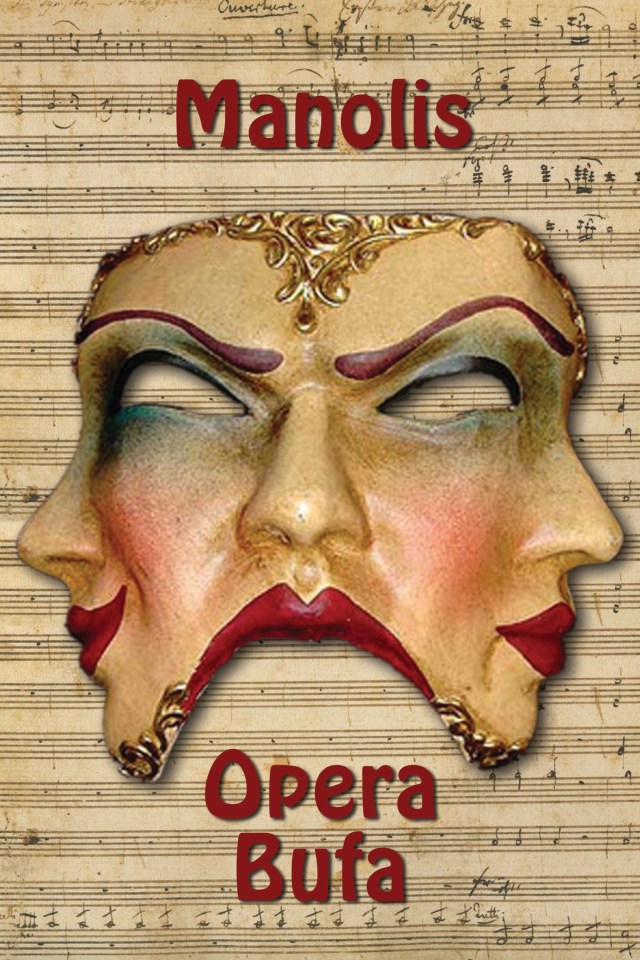
Opera Bufa succeeds most fully as a work of impassioned refusal, sustained by the pleasures that make refusal necessary. Its theatrical God, philosophical Death, wounded creatures, lovers, and grieving speaker occupy a stage where authority is continually tested against vulnerable life. Although its rhetorical abundance sometimes obscures distinctions, the sequence’s formal persistence gives its indignation cumulative force. The final grief also changes the resonance of everything preceding it. What initially sounds like defiant confidence becomes a more demanding promise: to do better means continuing to care when neither cosmic justice nor personal consolation can be guaranteed.
Herod of Attica Ah, this glory of Herod of Attica, what a glory it is. Alexander of Seleucia, one of our good sophists, arriving in Athens to speak, finds the city deserted, because Herod is in the countryside. And all the young people followed him there to hear him. So, Alexander the Sophist writes Herod a letter, and begs him to send the Greeks back. However, the witty Herod answers at once, “I am also coming along with the Greeks.” How many boys are now in Alexandria in Antioch, or in Beirut (tomorrow’s orators that Hellenism has trained), when they gather at the best tables where sometimes the talk is of refined sophistry, and sometimes of their splendid love lives, turn suddenly absent-mindedly silent. They leave their glasses untouched in front of them, and contemplate Herod’s good fortune. Has another sophist achieved so much? Whatever he wishes, whatever he does, the Greeks (the Greeks!) follow him, without judgment or debate. They don’t even choose anymore; they follow.
Pip: Manolis Aligizakis runs a site where the archive reads like a library that survived something — poetry, prose, myth, and survival narratives stacked shelf by shelf.
Mara: vequinox has been posting across a wide stretch of territory this week — modern Greek poetry in translation, mythic and symbolic verse, and prose fiction rooted in exile and displacement.
Pip: Let's start with the poetry.
Voices from the Greek Tradition
Mara: The posts gathered here share a preoccupation with what endures when attention fails — statues, mirrors, people, memory — and what happens when the witness disappears.
Pip: The Yannis Ritsos volume sets the frame precisely. The poem "At Least" opens with a claim that stops you cold: "The statues, he said, die if you don't look at them."
Mara: And the poem follows that logic all the way through the city. Mirrors fill every shop window — bakery chimneys, loquat trees, women, flower carts — all held in glass. Then the stores close, each person takes a mirror home, and the streets go empty and watchful.
Pip: So the mirror isn't vanity — it's a life-support system for things that need to be seen.
Mara: The Tasos Livaditis selection pushes that further into grief. "Return" brings back a childhood friend who died young and comes back, the poem says, to sob through the night because "he had died very young and he had returned to cry so his purpose on earth could be fulfilled."
Pip: Ritsos gives us statues waiting to be witnessed. Livaditis gives us the dead waiting to finish what they started. That's a consistent obsession across this tradition.
Mara: It runs through the Yannis Ritsos Volume IV post as well — "Double Condemnation" ends on those cardboard shoes, "red and imperial, with small mirrors all around." The mirror image returns, this time attached to failed authority.
Pip: Katerina Anghelaki-Rooke's "Writing" in her Selected Poems takes the act of creation itself as the erotic and physical center — the poem ends with "Creation is in full blast," which is either transcendence or the best deadline energy I've ever read.
Mara: Titos Patrikios in his Selected Poems asks a quieter question: "Do we become smaller in our daily life or do we assume our natural dimensions?" The poem is about the brotherhood that can't survive ordinary hours.
Pip: Milos Sachtouris, Nikos Engonopoulos, the Neo-Hellene anthology, Hours of the Stars, Nuances, Second Advent of Zeus, Ugga, and the Yannis Ritsos Volume III posts all circle similar ground — identity dissolving into crowd, myth pressing up through lyric, the body as landscape.
Mara: Nuances puts it most brutally: the individual in the agora becomes "salami at the master's lunch," the goal of creating a new world reduced to "his burp at the end of it all intensifying the fragrance of lilac blooms."
Pip: From statues dying unseen to the self digested by the crowd — the tradition holds that witness is not optional.
Mara: Which makes the mythic and symbolic registers these poets reach for feel less decorative and more structural. That's the next layer worth looking at.
Myth, Symbol, and the Threshold
Mara: The posts here work with myth not as backdrop but as the actual grammar of meaning — the way a poem reaches for something larger than its occasion.
Pip: Triptych opens that space quietly: "I pass my finger over your tear wiping sorrow from your sigh, hold on to me and care for buttercups wild crocuses and mustard yellows." Tenderness as its own cosmology.
Mara: Mythography goes darker and stiller — a thicket that declares "Thick shade I shall become," offering cover to a toad, a bass, every creature retreating into evening. The benediction of darkness rather than its threat.
Pip: Wheat Ears lands the loneliness of that threshold: autumn arrives, the vacant chair smiles, and you stand "alone by your shadow, a hint of hope lingering in your mind yet not a single person to share this heaven with." Myth without a congregation.
Mara: That isolation — beautiful landscape, no one to witness it with — connects directly to the survival narratives in the prose fiction.
Surviving the Unquiet Road
Pip: The prose fiction here puts bodies in motion through hostile territory — political, physical, moral — and asks what it costs to keep moving.
Mara: The Unquiet Land anchors the segment in Irish sectarian tension. Jim Patterson's internal monologue lays it out plainly: "We Protestants are not going to live in an Ireland ruled by the Roman Catholic Church. Never." The novel maps how that certainty calcifies into something dangerous.
Pip: Fear of the other's governance — that's the engine of displacement in a lot of these narratives, and it runs across centuries and continents.
Mara: The Gospel of Silence moves that into a military conscript's interior life under surveillance. The narrator describes nodding to survive: "Not because I understood, but because in those days every nod was a form of survival." Silence becomes, as the excerpt puts it, "the permanent environment in which I could exist."
Pip: That's the most precise description of institutional endurance I've encountered in a while — performing normalcy so thoroughly that the performance becomes the self.
Mara: Blood, Feathers and Holy Men puts a traveling group under different pressure — a wilderness route, a missing member, Fire Maker's rule that the group cannot wait for stragglers. The survival logic is immediate and physical rather than political.
Pip: And Redemption and The Long Road round out the theme — one following a character named Hermes through a moment of crisis and ordinary intimacy, the other mapping the erotic and the cosmic onto the same body: "a snowdrift, a galaxy and a nipple, harmony in the arms of life."
Mara: Across all of it, displacement is never just geographic. It's the gap between what a person knows and what they're permitted to say.
Pip: Statues dying unseen, the self digested by the crowd, silence as survival — this is a site that takes witness seriously as a moral act.
Mara: The poetry and the prose keep asking the same question from different angles: what remains when no one is looking, and what does it cost to look?