Pip: Manolis Aligizakis runs a site where the archive is essentially a library — except the library is on fire, in the best possible way.
Mara: vequinox has been publishing across a wide range of work here: modern Greek poetry in translation, philosophical prose on myth and imagination, and narrative fiction set against some of history's uglier political backdrops. Let's start with the poetry.
Voices Across the Greek Tradition
Pip: The through-line across these poetry collections is that they're not decorative — they're doing something urgent, whether that's Tasos Livaditis processing alienation and survival, or the broader Greek canon being made available in English translation.
Mara: Livaditis sets the tone immediately. The post for Tasos Livaditis – Poems, Volume II was long-listed for the 2023 Griffin Poetry Prize, and the excerpt earns that recognition. Here is the poem speaking for itself: "the deadliest sin is not to love oneself, and one day, I couldn't take it anymore, 'Do you know me?' I asked them, 'No,' they told me; thus, I took my revenge, and I was never deprived of the distant sounds."
Pip: So the revenge isn't violence — it's continued existence. Staying present, staying strange, staying in earshot of the world that rejected him. That's a quietly devastating pivot.
Mara: And the poem sustains it. Later it lands on: "I prefer to hang a watch on my vest than to hang myself; it would be as if I were trying to explain too many things." Survival as understatement.
Pip: The Tasos Livaditis – Selected Poems post shows a different register — grief observed through objects and bystanders, a child bloodied by a car, curtains standing at attention. Livaditis keeps finding the peripheral witness.
Mara: Titos Patrikios – Selected Poems takes a more stoic angle. The poem "Change of Times" counsels neither self-justification nor self-condemnation — "You'll come out of this a little wiser, if you only learn to face all human things a bit more serenely." It reads almost like a letter to someone mid-crisis.
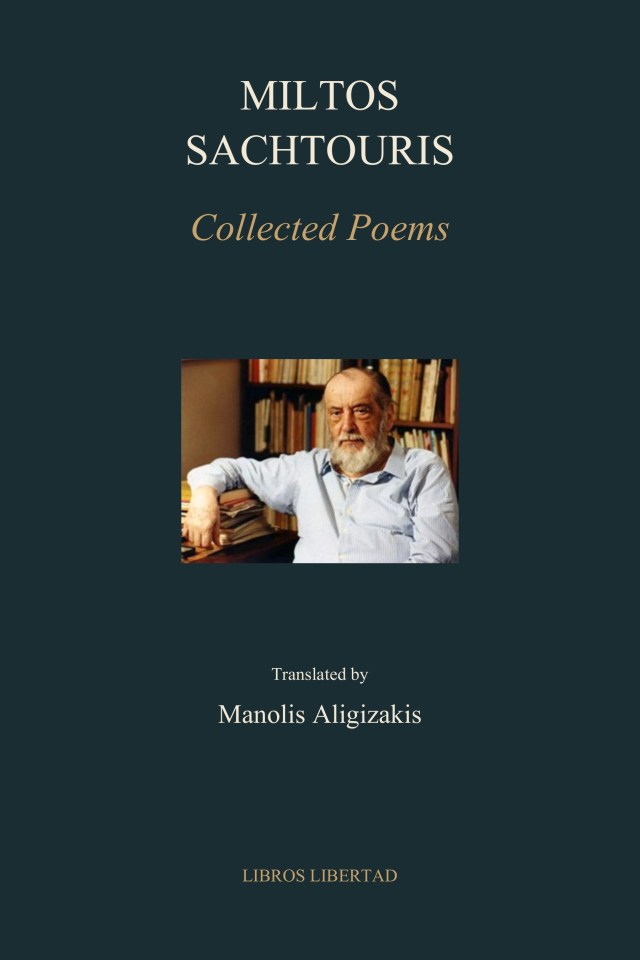
Pip: Miltos Sachtouris – Collected Poems goes somewhere darker. The "Night of the Forgotten" is a fragmented, incantatory thing — someone being called back by a voice while they lose pieces of themselves, arm, breast, eyes, until the poem turns on a single word: dawn.
Mara: Yannis Ritsos – Poems, Volume III pulls from the exile diaries — brief, dated entries, a swollen moon like a drowned body, broken arms in flashlight, two people sharing a broken leg under a wall. Compression as witness.
Pip: Several of the collections move between myth and the personal. Second Advent of Zeus brings Aphrodite into something almost confessional, while Neo-Hellene Poets: An Anthology of Modern Greek Poetry reaches further back — an orphic hymn climbing toward Apollonian light while darkness still holds the valley below.
Mara: Kariotakis-Polydouri: The Tragic Love Story is the outlier in tone — elegiac, addressed to a brother, full of scattered dreams and the image of a sun-flooded city from childhood. Antony Fostieris – Selected Poems is leaner: a tree that could be a man, or the devil, shaking branches over wild bodies at night.
Pip: Übermensch, Hours of the Stars, Vespers, The Long Road, Nostos and Algos, and Entropy round out the range — from the compressed image of a colt and dolphin parading in a field of blue flags, to a morning commute where the economic index drops and the beggar count rises and you start wondering if progress is real or if we're just coasting downhill without brakes.
Mara: Entropy puts it plainly: "The river has many homelands / it flows, it doesn't think / it flows loaded with seasons and people." Movement without destination — that's the collection's argument in three lines.
Pip: Which is also, quietly, a decent description of a translation project this large.
Mara: The philosophical work here asks a related question — not where we're going, but what makes existence possible in the first place.
Myth, Being, and the Structure of Imagination
Pip: The Essay on the Structure of the Human Imaginative is doing something different from the poetry — it's prose philosophy working through Greek cosmogony to ask what imagination actually is and where it comes from.
Mara: It opens with ontology and moves fast into myth. The excerpt reads: "That which makes it possible for something to be is Being (ta oũsia). Thus, from the various possibilities of Being, through a process of union, the universe comes into existence, together with the natural phenomena and the elemental forces of nature embodied in the image of the Cyclopes — terrifying beings outside the ordinary order of existence."
Pip: So the Cyclopes aren't monsters in a story — they're a way of thinking about what lies outside normal categories of existence. The framework uses myth as philosophical vocabulary.
Mara: Exactly. Cronus, Nyx, Nemesis, Thanatos — each deity in the succession myth maps onto a force: Discord, Deceit, Destruction. The essay notes that "the first part of this myth makes no mention whatsoever of a creation of an anthropomorphic kind," which is its hinge — imagination precedes the human.
Pip: That's the kind of argument that makes the poetry collections feel less like a separate shelf and more like the same inquiry running in a different register. Speaking of registers — the fiction here is working in a much grittier one.
Conflict, Desire, and the Weight of History
Pip: The narrative excerpts span Irish political violence, wartime Romania, and a Greek coming-of-age story — all of them placing ordinary people inside systems that are either collapsing or crushing them.
Mara: The Unquiet Land anchors the segment. A letter read aloud describes Ireland in the early 1920s, and it doesn't soften anything: "people going about their business as if living in a bad dream and not knowing if it's going to get worse or better before they wake up. All they seem to be able to talk about is Sinn Fein, Eamon de Valera and the possibility of civil war, together with the latest outrage."
Pip: And then a man named O'Rourke leaves a party and is found shot on the road. No explanation. The letter writer just says she couldn't get over it the next day. That's the texture of political violence — it happens next to dinner parties.
Mara: In Turbulent Times is set in Belfast and Glasgow, following characters negotiating business, family pressure, and escape — someone who fled his overbearing family for Belfast, which says something about how bad Glasgow felt. The Gospel of Silence is the most harrowing: soldiers forbidden to speak at funerals, families forbidden to ask questions, coffins sealed shut.
Pip: The essay on the Transfăgărășan road — built over five years, six thousand tons of dynamite, dozens of soldiers' deaths — lands on this: "in that country even your death did not belong to you, but to the state."
Mara: Straits and Turns and Red in Black close the range — one a Greek youth story with a quick, charged encounter and the social geometry of a classroom exam, the other a poem about two triggers pulled simultaneously, a poacher and a buck, Thanatos delivered to two hearts at once.
Pip: History and desire, both arriving faster than anyone planned.
Mara: What holds all of this together is a persistent question about what survives — a poem, a myth, a letter, a sealed coffin.
Pip: Or a watch on a vest instead of a noose. Livaditis had a point. Next time, more from this archive.