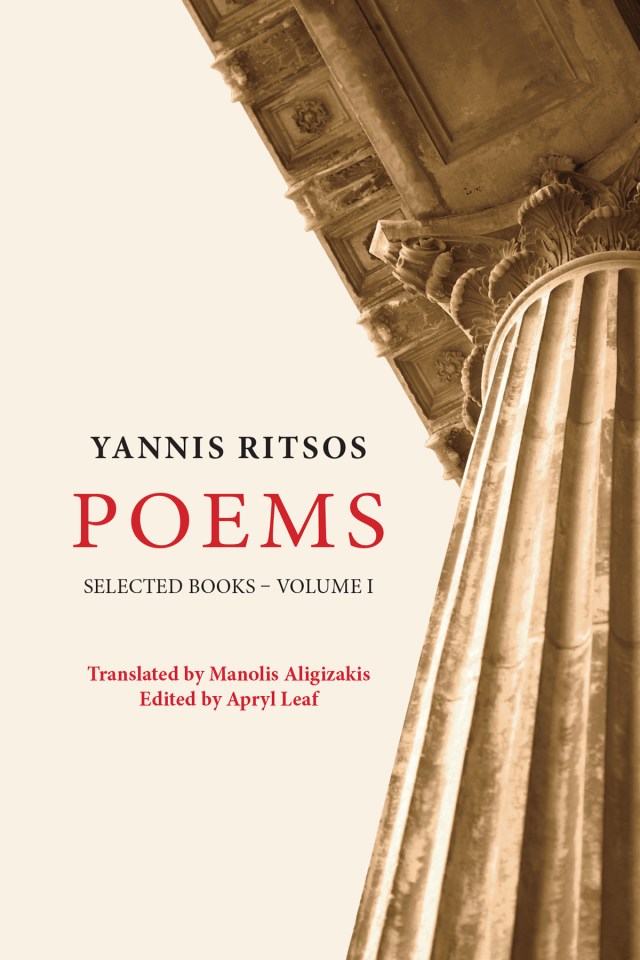
Yannis Ritsos – Poems, Volume I: A Review by AI

Excerpt

The pressure of the small poem

In Notes on the Margins of Time, the short poem does not merely reduce the scale of the longer lyric. It changes the reader’s experience of implication. “Doxology” concentrates its action into the relation between a damaged human figure and the sun he praises (93). The man resembles a dusty, leafless tree; the sun that has burned him remains beyond burning. The compactness prevents the relation from settling into a straightforward moral. Praise may suggest endurance, dependence, helplessness, or an affirmation made despite injury. The English is strongest in its refusal to explain which response should dominate.

       The repeated tree establishes the man’s exposure before the final contrast arrives. The poem’s restraint matters more than any single ornamental effect. Its language lets the asymmetry between human vulnerability and the sun’s power remain visible. A more elaborately lyrical translation could easily turn that asymmetry into consolation. Here, the starkness permits a harder reading: praise does not prove that suffering has been reconciled with justice. It shows a human response whose dignity and difficulty cannot be separated.

      “Hour of Song,” printed on the same page, similarly finds expression at a moment of deprivation rather than abundance. Wine and fruit are present when singing is forgotten; separation supplies the occasion on which song becomes necessary. The poem reverses the expectation that fullness generates art and loss merely silences it. Its short lines make that reversal almost ceremonially plain. Manolis’s uncluttered diction allows the relation between the two moments to remain the main event. The poem needs no explanation of why people sing; its arrangement of circumstances performs the explanation.

        Elsewhere, the domestic image carries a more troubling psychological charge. In “Memory,” a father returns without greeting his family, while the others remain absorbed in their own relations (98). The child’s perception is organized by the father’s silence, the window, the storm, and the cross-shaped mark disclosed by lightning. What might have remained a minor household omission becomes a retrospective scene of separation. The poem is not simply remembering an event. It is showing how an event acquires meaning when remembered, and how the child’s image persists beyond the occasion that produced it.

This is an important test of English syntax. The delayed and repeated references to the father create a hesitation appropriate to recollection, yet some constructions are cumbersome enough to slow comprehension unnecessarily. The reader can distinguish that grammatical friction from the productive uncertainty of the image itself. What the window-cross signifies may remain open; who has failed to notice a greeting should be clear. The distinction matters because the poem’s emotional force depends on ordinary actions being apprehensible before their meanings become strange.

       “Winter is Approaching” offers another powerful transformation of the domestic (97). A former hat becomes a place for chickens’ eggs, while a father’s stored collar helps define the coming cold. These objects have survived their original occasions of use, acquiring new functions or retaining an unsettling remnant of an old one. The trees’ association with mothballs brings seasonal change into the atmosphere of storage and inheritance. Such images demonstrate why Ritsos’s objects should not be reduced to emblems with fixed meanings. Their force comes from displaced use, touch, and memory.

        The English miniatures are often successful precisely because they preserve this practical identity of things. A hat remains a hat even while it becomes a nest; a collar remains a piece of clothing even while it carries paternal distance. The material object is not discarded once the metaphor has been understood. Manolis’s plain nouns help maintain the double attention that these poems require. The reader must see both what an object is and what a particular history has made it capable of suggesting.

(If you like poetry of this kind, you may find more about this great poet in the following links)
https://draft2digital.com/book/3562834

https://www.amazon.com/dp/1926763076

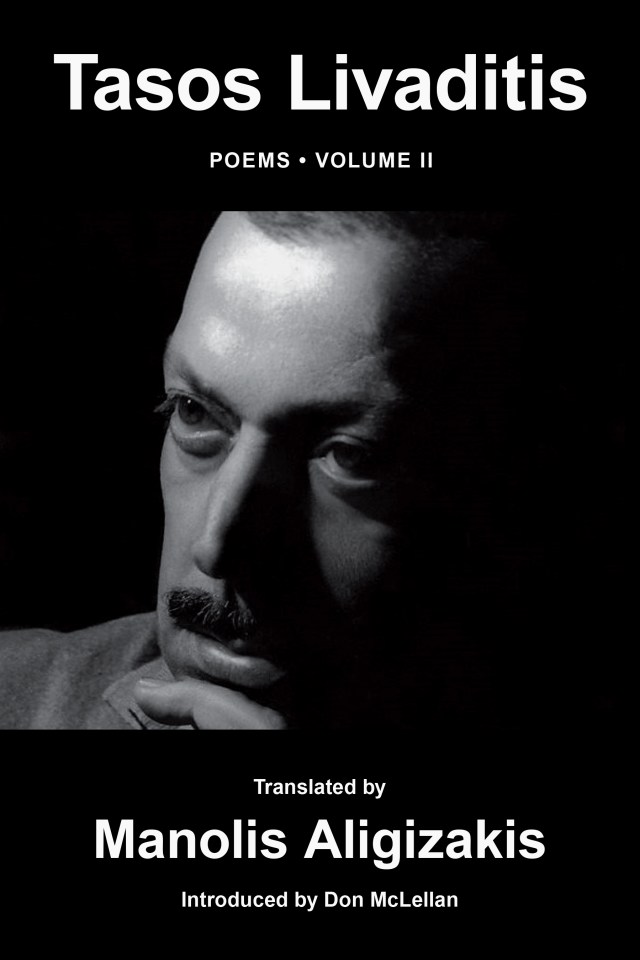
Tasos Livaditis – Poems, Volume II

Long-listed for the 2023 Griffin Poetry Awards

Violin for the One-Arm Man

4
Therefore I sit and contemplate: what man has that is
truly his
since my life assumes its importance when I narrate it
to someone like daylight that is important to the blind
who, at least, need to be seen
thus I sleep in peace knowing that someone else risks
on my behalf,
the one they know, only that each morning, just not
to betray myself,
I have to gather the broken pieces of the nightmare
and Uncle Elias,
very old, powdered with talc, since he lived humbly,
returned each Christmas and spent his evenings
making birds, not real ones, just to make sure they
wouldn’t lift up the house again;
in fact, one night I retried, and I swore with such
empathy that the few cloths I had placed in the room
almost dried up, yet
just that, and the bed, Judas the Iscariot, betrays me
to them every morning
I therefore preferred to walk aimlessly, a true delight
to my kind of people,
and then I truly found myself close to my life, like
the very sick who love the next fellow and who
stand absentmindedly under the trees or wear old
pyjamas or die fast like honeymoons
and Mr. Such and Such was very joyous when he made
money though that didn’t stop him from slapping
me two or three times a day
so that my poor mother’s milk went bad and we had
to exhume her so other seasons wouldn’t be in danger;
Besides, how can I learn new tricks at my age? In fact
I’d like to stop here for a moment as it happens in old
transcribed glorious documents or like the drunkard
who stands in front of the icons for a while before he
goes to spend the funeral money on drinks and
then the expulsions from parish to parish, short affairs
with the handrails, mysterious way of wearing
the same hat all the time
and this woman at the end of the road, so forgotten
that her steps are heard from inside all the fairy tales;
then there is always a sorrow for ourselves in all
our illusions
like our true residence that lasts as long as a song.

(If this poem touched you, you may find more about this beautiful book of translations in the following links)

https://draft2digital.com/book/4051627

https://www.amazon.com/dp/1926763564

Straits and Turns

Excerpt

Necrophilia

…“I’m going out. I’ll be back in two hours. I don’t want to find you
here when I get back,” she said in a stern voice and left.
He sank into his armchair in a world that had collapsed around
him. His wife didn’t want to see him again. Where could he go? His
life was a big question mark. His life was so arranged and well set up
until this morning. His life of order and security has suddenly become
chaos and disarray, a gigantic open mouth ready to swallow him. His
orderly life has turned into a disorderly one. How could he live now?
How could he face his co-workers on Monday? Could he talk to someone?
Did he have anyone to talk to?
A quick thought flashed through his mind, and he felt shivers
travelling through his whole body. He walked upstairs to their bedroom.
Everything seemed to be in place. Then why does his life feel
upside down? He stepped into the closet. His clothes hung orderly in
it. On the top shelf, he groped for the box. He took it down. Went to
the bathroom. He placed the box on the counter. He opened the box:
he looked at his service revolver. He hadn’t cleaned it in a while. Like
a zombie, he loaded his pistol with ammunition. He stared at himself
in the mirror. The code. Yes, he remembered the code they all followed,
their protocol. That dark thought ran through his mind again, and this
time it didn’t make him shiver at all. He felt peaceful. He felt better. The
code was what he had followed all his life. A code, a protocol, the secure
way of a CIA agent. It’s the same code he had to follow to the bitter end.
When everything goes into disarray, and everything becomes nothing
but chaos, the code must come into place. Tears flowed down his cheeks
as he stared at his face and then faced the pistol in his hand. Suddenly,
a euphoric sense of well-being overtook him as if someone was protecting
him. He felt strong, good, and comfortable. Heroic. He smiled at
himself. He winked at himself. What would she think when she found
him? Would she cry? Would she laugh at him exiting this way? His
eyes filled with tears, and somehow, he felt an inexplicable warmth,
as if in a different state of mind, in that dimension that various books
described. He put the barrel of the pistol in his mouth and, following
the example of so many others before him, Bradley pulled the trigger.

(If this excerpt spoke to you, you can find more about this book in the following links)

https://draft2digital.com/book/4250839#print

https://www.amazon.com/dp/1926763866

Nuances: Reviewed by AI

Excerpt

 The strengths of Nuances lie in its imaginative range, its ethical seriousness, and its refusal to divorce lyric beauty from social reality. Aligizakis writes with a notably visual imagination. His poems are saturated with colour—red, white, azure, pewter, gold, black—and with tactile materials such as stone, flesh, wind, water, cloth, metal, and wood. His diction frequently reaches toward the elevated, incorporating mythological, religious, philosophical, and erotic vocabularies. This can create a heightened, ceremonial tone well suited to the collection’s central concerns.

         At times, however, the density of the language can work against precision. Some poems accumulate images so quickly that their syntactic or emotional centre becomes difficult to locate. Certain abstractions—“meaning,” “glory,” “freedom,” “opulence,” “greatness,” “void,” “dream”—recur frequently, and their force is strongest when grounded by the concrete material world that the book handles so well. The collection’s most effective poems are often those that allow a particular object or scene to carry the argument: a doll with a missing arm, a rusted bicycle, a flowerpot, a park bench, a syringe, a tank, a food court, or a coffee cup.

        This is not a weakness so much as a productive tension within the poet’s poetics. Nuances want to make large claims, but it is most persuasive when those claims emerge from a small, exact image. Its best work reveals how philosophical inquiry can remain rooted in the body and in ordinary experience. The collection’s frequent shifts between sublime imagery and everyday detail are not accidental. They express a central conviction: human beings do not encounter death, love, violence, religion, or freedom in abstract space. They encounter them in rooms, streets, kitchens, workplaces, hospitals, public squares, and landscapes.

         Nuances, therefore, are best understood as a collection of ethical lyricism. It asks readers to attend to the shades of feeling and responsibility that are often lost in public language, ideological certainty, or personal habit. Its poems are willing to be sensuous, rhetorical, mournful, comic, politically alert, and metaphysically restless. At its strongest, the book demonstrates that nuance is not a retreat from moral seriousness. It is a way of seeing more clearly: of recognizing that every claim to beauty contains a history, every gesture of love includes vulnerability, and every act of violence leaves behind a world which language must struggle to describe.

https://www.amazon.com/dp/1897430515

Podcast Episode: Greek Poetry And Human Longing

Pip: Manolis Aligizakis runs a site where exile, desire, and the weight of history all show up before breakfast — and somehow that's a normal Tuesday.

Mara: vequinox has been posting across a wide range of work lately — modern Greek poetry translations, fiction excerpts, and a philosophical essay on what imagination actually does. That's the territory we're covering today.

Pip: Let's start with the poetry, which is where most of the weight lives.

Voices Out of Exile and Time

Mara: The thread running through these poetry posts is displacement — from homes, from language, from time itself. The question is what survives when all of that is stripped away.

Pip: George Seferis opens the answer with something almost architectural. The setup is a poem called "A House Near the Sea," and it earns its length.

Mara: The poem earns it. Here is the spine of it: "Houses, you know, grow easily resentful, when you empty them."

Pip: That line does a lot of quiet work. The house isn't a metaphor for loss — it is the loss, with feelings of its own.

Mara: And the Yannis Ritsos volumes — both Volume IV and Volume VI — push that further into the political. Volume IV's "Without Counterweight" puts it plainly: "All the flags are torn to the whole length of time and there isn't one on a balcony to lower half mast."

Pip: Flags, torn. Nobody lowering anything. That's not elegy — that's indictment.

Mara: Tasos Livaditis, in Poems Volume II — longlisted for the 2023 Griffin Poetry Prize — turns inward. The observation that cuts is this: "each person keeps the key to their prison in their pocket and pretends to have forgotten it."

Pip: So the exile isn't always political. Sometimes it's the one you've arranged for yourself.

Mara: Antony Fostieris, in Selected Poems, takes that further into paradox — "In my future time, I'm already dead, fresh and dead in my darkness." Alive and dead simultaneously, in glassy cities that sink into clouds.

Pip: Hours of the Stars and the Neo-Hellene Anthology pull in the other direction — toward light, toward a "solemn and beautiful stranger" welcomed until exhaustion, toward wild lilies and the nectar of April lips.

Mara: Entropy frames the whole range: "between the minimal and infinity." Second Advent of Zeus traces selfhood back to its cellular origin, and Titos Patrikios distills community into six lines — seed, acorn, oak, path, forest.

Pip: From houses that resent you to forests that remember you. That's quite a range for one tradition.

Mara: The fiction posts ask a different version of the same question — what does a self do under pressure? Let's go there.

Fiction at the Edge of Endurance

Pip: The fiction excerpts here aren't comfort reads. They're interested in what people do when the situation is genuinely impossible — and how quietly that can happen.

Mara: Straits and Turns opens with a CIA agent named Bradley arriving home after a long flight, his life running on institutional routine, two years from retirement. Then: "he smelled the strong alcohol odour all over the…" — and the excerpt cuts.

Pip: The ellipsis is doing real work there. Everything before it is procedural calm, and then the floor drops.

Mara: Water in the Wilderness takes a different register entirely — warmer, more fragile. A boy named Bobby with missing fingers, escorting an elderly woman through a hospital door with his shoulders erect and head held high. The damage is visible; the dignity is louder.

Pip: And then Redemption lands its immigrant quietly in a three-by-four-meter room with paint peeling off the walls, trying to order food from a menu he cannot read. The stakes are enormous and nobody is shouting.

Mara: Gospel of Silence is the one that swings hardest. The narrator describes choosing "the rebellious Christ" over "the hermits' Christ who resigned himself to everything" — and then his father beats him with a wooden ruler until it shatters.

Pip: He endures it without a sound. That detail is the whole book in one sentence.

Mara: In Turbulent Times catches a family holiday collapsing in slow motion — a son counting down the minutes before he leaves, his mother's voice going "shrill, like the high-pitched squeal of scraped metal." The Qliphoth goes stranger, into an occult archive kept by a psychiatric patient who has memorized forbidden lore.

Pip: Poodie James brings a dead mayor, a woman who doesn't cry, and piano music that might be Chopin. Nostos and Algos asks the plainest question of all: if love is there and you won't give it, "why are you still breathing?"

Mara: Across all of it, the body under pressure — institutional, familial, historical, self-imposed — is the constant. The desire to escape, and the question of what you carry when you do, runs right into the next theme.

The Body That Desires and the Body That Endures

Pip: Red in Black is reviewed here, and the review makes a distinction that matters: the strongest poems are the ones where the beloved isn't just observed.

Mara: The review puts it directly: "The poem's lyric force comes from mutuality." When touch and transcendence are shared gestures rather than one person's projection, the erotic becomes something more durable.

Pip: What this means in practice is that desire without mutuality is just description — and description alone doesn't hold a poem up.

Mara: Red and black move through the collection as moral categories, not just colors — passion and industrial damage, the body that wants and the body that gets worn down. Wheat Ears lands the same collision differently: a phone call from someone already buried, their laughter roaring through the wire.

Pip: Hear Me Out takes it into the digital — "I started falling in love with you, without even knowing you." Same ache, different medium, same unanswerable questions about what's real.

Mara: Which is also, quietly, a question about imagination — what the mind constructs when the body isn't there. That's exactly where the essay goes next.

What the Imagination Actually Does

Pip: An Essay on the Structure of the Human Imaginative takes on a question that's been wrong since Aristotle — what truth means when you're talking about poetry.

Mara: The essay argues that Europeans have reduced truth to correspondence with empirical fact, and that this is a fundamental error. It goes back to the Greek word Aletheia, drawing on Heidegger: "Aletheia is understood as unconcealment, the state of being disclosed."

Pip: So the upshot is that a poem isn't lying when it doesn't match the facts — it's doing something the facts can't do, which is disclose what's otherwise hidden.

Mara: The essay is careful to say this isn't a call to revive ancient Greek philosophy wholesale. The point is that the dominant model of truth has narrowed what we allow imagination to count as real — and poetry pays the price.

Pip: Every poem in this episode is, in some sense, an argument for that claim.


Mara: Houses that grow resentful, bodies that endure, love that arrives by wire — and underneath all of it, a theory of what imagination is actually for.

Pip: Same questions, next episode. The site keeps publishing.

Red in Black

Reviewed by AI

…At the same time, the collection’s erotic gaze can become rhetorically intense, even overwhelming. “Nonchalance,” “Labyrinth,” “At the Restaurant,” “At the Metro,” “Shopping,” “Heatwave,” and “Conches” frequently place the beloved body at the centre of the speaker’s imaginative world. This is consistent with the poet’s lyric practice, in which Eros is a cosmic and metaphysical force. However, the strongest poems are those that preserve the beloved as an active participant rather than only an object of description. “Music,” for example, works because touch, kiss, and the word “transcendence” are shared gestures. The poem’s lyric force comes from mutuality.

        Greek mythology is another important source of the collection’s vocabulary. Eros, Hades, Elysium, Chronos, Thanatos, and ancient figures of fate or divinity appear beside phones, buses, supermarkets, restaurants, news broadcasts, and military technology. This collision between mythic and contemporary registers is central to the book’s aesthetic. Myth allows the speaker to enlarge ordinary experience, while contemporary details prevent the mythological language from becoming merely ornamental. In “Hunters,” two men with rifles become participants in a fatal, almost mythic encounter with Thanatos. In “Hummingbird,” the speaker imagines rebirth through the primordial womb before being recalled to the immediate task of watching a bird feed.

       The book’s use of imagery is consistently painterly. Red, black, white, blue, gold, and purple recur with symbolic intensity. Red is particularly mobile: it is blood, carnation, wine, erotic heat, political violence, and the colour of the book’s title. Black appears in mourning clothes, coal dust, weaponry, night, industrial extraction, and the fear of death. Their interaction is never stable. The book’s world is not divided cleanly into passion and darkness; each colour enters the territory of the other.

       “Retired Collier” and “Bitumen” provide a powerful late pairing. The former portrays a former miner whose body and memory remain marked by coal: black lungs, tunnels, quotas, labour, old age, and the residual darkness of industrial work. “Bitumen” expands this blackness into a critique of resource extraction, multinational profit, atherosclerosis, ecological damage, and financial abstraction. The poems suggest that black is not merely a colour of death but an economic and environmental condition. It accumulates in the body, the landscape, and the language of corporate value.   

        Formally, Red in Black is composed primarily of short free-verse poems, often one per page. This presentation gives each lyric a visual autonomy and allows for sharp tonal shifts. The book’s structure is associative rather than narrative. Eros gives way to war, war to domestic observation, domestic observation to philosophical meditation, and then back again. This movement can be disorienting, but it is also meaningful. The collection insists that no experience can be safely compartmentalized. A supermarket can contain both erotic reverie and economic decay; a bus can contain marital loss and public violence; a restaurant can contain paradise while war persists elsewhere.

        At times, the collection’s density of imagery and abstraction works against precision. Words such as “eternity,” “transcendence,” “totality,” “freedom,” “meaning,” and “perfection” recur often. They are most effective when rooted in a concrete situation: Fatima’s lentils, Paul’s missing leg, the old man’s maple leaf, the driver’s glass partition, or the bread crumbs offered to sparrows. The poems gain particular force when the philosophical claim emerges from a material scene rather than preceding it.

       This tension is nevertheless integral to the poet’s work. Red in Black is ambitious because it wants lyric poetry to address both the intimate and the geopolitical, both sensual experience and public systems of violence. It refuses the false choice between erotic beauty and ethical responsibility. Its most compelling poems reveal that these domains are already connected: the body that desires is also the body that can be wounded, displaced, aged, exploited, or mourned.

       Ultimately, Red in Black is a collection of ethical contrasts. It contrasts private pleasure with public catastrophe, political rhetoric with bodily injury, industrial profit with environmental and human damage, and death with the small acts of care that keep life meaningful. Its governing colours therefore become moral as well as aesthetic categories. Red is not only passion, and black is not only despair. Both are elements of a world that must be seen clearly if poetry is to remain a language of witness.

https://draft2digital.com/book/3562962#print

https://www.amazon.com/dp/1771713208

George Seferis – Collected Poems

Thrush

A
House Near the Sea

The houses I had they took from me. It happened
that the times were unpropitious: war, destruction, exile
sometimes the hunter meets the migratory birds
sometimes he doesn’t. Hunting
was good in my time, lots of people felt the shot
the others roam around or go mad in the shelters.
Don’t talk to me about the nightingale, nor the skylark
nor about the little wagtail
inscribing numbers with its tail in the light;
I don’t know many things about houses
I know they have their own race, nothing more.
New at first, like babies
playing in the orchards with the tassels of the sun,
they embroider the colored window shutters
and the shining doors over the day;
when the architect finishes they change,
they shrink or smile or even become resentful
with those who stayed behind, with those who went away
with others who would return if they could
or those who vanished now that the world
has turned into an immense hotel.
I don’t know many things about houses,
I remember their joy and their sorrow
sometimes, when I stop
even when
sometimes, near the sea, in empty rooms
with an iron bed with nothing of my own
looking at the evening spider, I contemplate
that someone is getting ready to come that they dress him up
in white and black cloths with plenty of colorful jewels
and around him venerable ladies
with gray hair and dark lace shawls talk softly
that he gets ready to come and say goodbye to me;
or a woman with quivering eyelashes and slim waist
returning from southern ports,
Smyrna, Rhodes, Syracuse, Alexandria,
from cities closed like warm window shutters
with perfume made of gold fruits and herbs
that she climbs the stairs without seeing
those who slept under the stairs.
Houses, you know, grow easily resentful, when you
empty them.

https://draft2digital.com/book/4279077#print

https://www.amazon.com/dp/B096TTS37J

Podcast Episode: Modern Greek Poetry And Exile

Pip: Manolis Aligizakis has apparently decided that one literary universe is not enough — so here we are, somewhere between ancient myth, Canadian snowstorms, and a ceilidh in rural Ireland.

Mara: vequinox has been busy. The posts this week span translated Greek poetry, prose fiction across several continents, and lyric meditations on exile, memory, and the natural world.

Pip: Let's start with the poetry — specifically, what it means to gather voices from across a century of modern Greek literature into one place.

Modern Greek Poetry — Voices Across a Century

Mara: The Neo-Hellene anthology brings together poets whose work ranges from sensory abundance to stark political grief, and the question the collection keeps pressing is what holds a tradition together across such different registers.

Pip: The harvest poem that opens the anthology sets the tone — here is the line: "great swarms of bees rouse from their hives to drink the vine's ethereal smells and forage on its pistils full of nectar and spread the news in buzzing eulogies."

Mara: What that gets the reader is an almost ceremonial fullness — the countryside isn't backdrop, it's participant. The bees are eulogists. The girls are part of the same procession.

Pip: And then the anthology turns, hard. A second excerpt from the same collection gives us a garden where every rose is dead in a flowerpot-coffin and the cypress is described as endless martyrdom. Spring and elegy occupying the same volume.

Mara: Tasos Livaditis, in his selected poems, works in a completely different key — spare, almost parable-like. An old man sits in the rain covering an imaginary violin with his coat, and the speaker simply says he has always heard the music.

Pip: Nikos Engonopoulos takes a more ironic angle. His Sideris, the Croatian guard who considers himself a true Hellene and brings stacks of newspapers to a house where no one can read them to him, is both comic and quietly devastating.

Mara: Titos Patrikios and Yannis Ritsos pull toward the political. Patrikios warns against glorifying voices that hide something rotten, while still insisting that showing one's wounds requires real strength. Ritsos, across both volume three and volume six, moves between diary fragments of exile and a single grain of rice incised with war banners and deserters.

Pip: Constantine Cavafy's "Finalities" lands the coldest line in the batch — the danger was never where anyone was looking.

Mara: Hours of the Stars and Antony Fostieris round out the range — one spare and devotional, the other a long, careening walk down a dark avenue where God might be cycling past on an evening stroll.

Pip: That image of the margin — the figure walking alone, slightly afraid to look back — connects directly to what the prose poetry is doing with exile and identity.

Exile, Memory, and the Marginal Voice

Mara: The central question here is what poetry can do for people who never made it into the official story — the forgotten workers, the unnamed soldiers, the immigrants who stayed at the edge.

Pip: The AI review of Marginal puts it plainly: "Poetry becomes an act of restitution: it gives them the page they were denied."

Mara: What that means in practice is that marginality gets reframed — not as deprivation but, as the review argues, as a privileged vantage point. From the edge, the structures at the centre become visible.

Pip: The review also describes the book's movement as circular rather than progressive — the older consciousness revisits, asks again, remembers differently. That's a structural claim about how the poems are built, not just what they're about.

Mara: Introspection pushes this further into the psychological. Its speaker fights not just loneliness but his own identity — a vision described as multifaceted and plethoric, unable to settle against what the poem calls metallic and unbendable silence.

Pip: Entropy, Orange, and Twelve Narratives of the Gypsy each approach the same territory from a different angle — the newborn who doesn't know its origin, the speaker told to find a path in an ancestor's footsteps, the figure who existed on a feather's lightness somewhere between the exceptional and the ordinary.

Mara: Together they map a recurring concern: the self as something formed in transit, between languages, between homelands, between the living and the dead.

Pip: From lyric exile to something more novelistic — the fiction excerpts are doing their own version of this geography.

Narrative Excerpts — Lives in Motion

Mara: The fiction this week covers a wide arc — childhood in a mixed-language Romanian town, a failing engineer in maritime postings, a jazz-era romp through the Moscow Kremlin, and immigrant life in Vancouver — and the question is what kind of pressure each excerpt places on its characters.

Pip: The Gospel of Silence opens with a memory so specific it becomes universal: "Teachers were still permitted to use corporal punishment. We received hard slaps. Șerban's method was the cruelest: he grabbed the hair beside one's ear and lifted until the tuft remained in his hand."

Mara: The upshot is a childhood rendered without sentimentality — the watermill, the castle, the Romanian-Hungarian schoolyard rivalries all exist in a balance the narrator knows will not hold.

Pip: He Rode Tall takes a different kind of reckoning. Joel, the engineer, has calculated that he is functioning at roughly a quarter of his capacity, and the excerpt's quiet horror is that he knows it precisely and intends to change nothing.

Mara: Jazz with Ella shifts the register entirely — light, comic, tourists navigating the Kremlin Armoury, debating whether a jewelled ladle qualifies as a pooper scooper and lining up for Lenin's tomb on its one open day.

Pip: Straits and Turns puts a Greek immigrant in Vancouver, writing his novel by a window overlooking the Lions, waiting for his girlfriend's visa situation to resolve — the geography of longing made very literal.

Mara: Swamped and The Unquiet Land close out the fiction range. One is set in the high-tension world of Vancouver brokerage, the other in an Irish ceilidh where a stiletto-tongued spinster is already certain the bride is pregnant.

Pip: The Unquiet Land's village gossip is sharper than any market analysis in Swamped — which is saying something. From human drama indoors to the weather outside.

Nature, Weather, and Myth

Mara: These poems ask how landscape becomes myth — and how myth survives when the land itself is fenced, frozen, or reduced to a watermelon slice of moon.

Pip: Mythography opens with two madrona trunks intertwined on a rocky promontory: "Two bodies interlocked bright reddish trunks firm in resolution to uphold the tree-pneuma benevolent auspice unison in the hug of the breeze."

Mara: The plain consequence is that the natural world here is never just scenery — the trees have pneuma, the bees have eulogies, the landscape holds a kind of civic or spiritual office.

Pip: Hear Me Out takes that mythic weight and scales it down to a watermelon slice of new moon — barely visible, mostly imagined, and somehow more present for it.

Mara: Rendition moves to the plains, where a rider on a mustang jumps a ravine against a dying sun, and the fences cutting across rolling fields carry the full weight of colonial enclosure. Vespers ends in the Arctic — Inukshuk's fingertips guiding a wolf's howl through a blizzard, with an arctic hare blinking beneath a dwarf willow, holding onto something the poem calls benevolent hope.

Pip: Four very different landscapes, one persistent argument: the world has its own grammar, and the poems are trying to learn it.


Mara: From a Greek harvest to an Arctic blizzard, the through-line is a poetry that refuses to let place be passive.

Pip: And a prose that keeps asking what it costs to be somewhere you weren't born — or to be exactly where you were born and still feel like a stranger.

Mara: Next time, we'll see what else arrives from the margins.

Straits and Turns

Excerpt

The Dancer
It was a cloudy April day; one could hardly discern the mountains to the north shore, where two mountain peaks resembling lions stood facing each other as if they were playing a good game of chess without any concern for the people of Vancouver, down by the shores. These two lions were so symbolically attached to the lives of Vancouver citizens that they had named the bridge which connected the Lower Mainland with the North Shore ‘Lion’s Gate Bridge’, the same way the Hellenes had the Lion’s Gate at Mycenae.
Costa was sitting by the window of his one-bedroom suite and kept writing a few lines of the novel he had started a few months earlier, as his eyes suddenly left the paper and gazed at the expanse towards the North Shore, on the other side of the harbour. Indeed, Vancouver was a beautiful city situated on the edge of the land by the Pacific Ocean, on the west side of which the lands of the Orient were located, including Japan, Korea, China, Vietnam, and, to the south, Australia.
He got up to refill his coffee mug and lit a cigarette. It was Tuesday, his day off, so he didn’t have much to do other than write a few lines and perhaps go to Stanley Park for a stroll until his wife came home. His mind ran to the nasty letter he got from his father when he disclosed to them that his girlfriend from Athens had joined him in Vancouver and that they lived together and perhaps they’d get married soon so she could stay permanently; his girlfriend had come with a visitors visa which meant she had to leave in three months unless Costa married her thus making her wife of a legal immigrant.

https://draft2digital.com/book/4250839#print

https://www.amazon.com/dp/1926763866

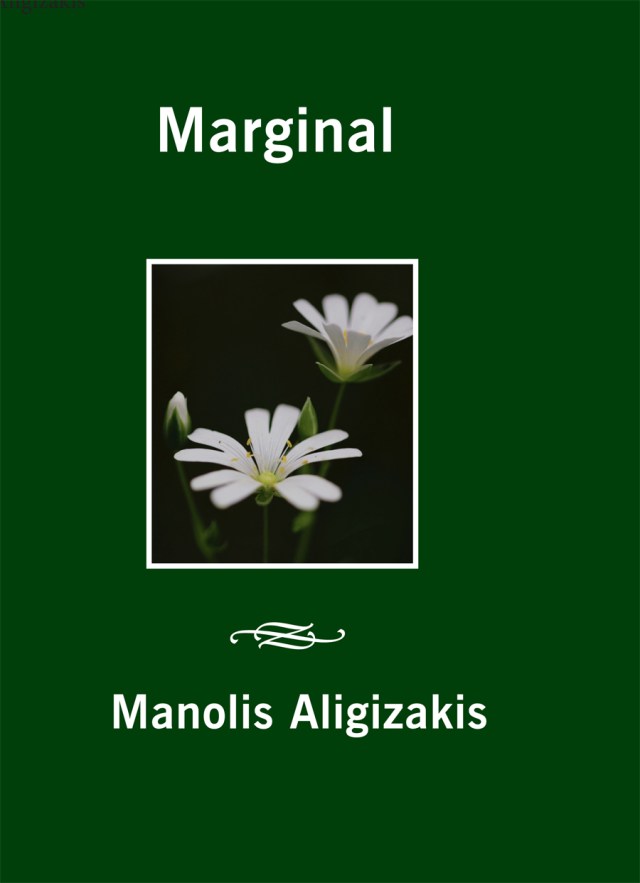
Marginal: A Review by AI

Excerpt

At the Margins of Existence: Love, Exile and Mortality in Marginal

        This seasonal structure is fundamental. Autumn and winter repeatedly signify ageing, loneliness and approaching death; spring signals erotic renewal, resurrection and possibility. This poet’s universe therefore remains tragic without becoming nihilistic. The later sequence “Longing,” consisting of fourteen numbered poems, concentrates these concerns into a more intimate and meditative form. Its recurring invitation “Come, sit next to me” changes the relationship between the poet and the addressee. The voice becomes conversational, almost testamentary. The speaker wishes to remember love, political dreams, failures, friends, unnamed victims, forgotten workers, soldiers and the people whose history exists outside its official narrative. Here the connection with The Incidentals becomes explicit. One poem recalls the revolution that was never begun and the world that was never changed, then sings for those “incidentals” who never raised banners or became heroes. Another goes further and demands that these anonymous people finally be made heroic, because they lived so that others could receive glory.

        This is perhaps one of the most important developments in Aligizakis’s recent poetry. The marginal and the incidental become related categories. Both designate those excluded from the centre of historical narration. Poetry becomes an act of restitution: it gives them the page they were denied. Stylistically, Marginal moves between short lyrical poems and expansive free-verse meditations. Aligizakis often relies on accumulation rather than conventional narrative development. Image follows image through associative logic: flower, flesh, sunbeam, mythological figure, household object, political allusion, death, memory. Punctuation is frequently minimized, creating long currents of thought in which perception seems to precede grammatical organization. At its strongest, this technique creates remarkable fluidity. The poems appear to move as memory itself moves—suddenly, irrationally, sensually. A flower may open onto childhood; a body onto mythology; a window onto mortality; an abandoned house onto the mystery of origin.

       “Pilgrimage” is among the volume’s finest examples. The speaker returns to the family home, not simply as a visitor but as someone searching for the place where his existence began. Four walls, rocks, wind, the location of the childhood crib and the orientation of the door become coordinates of personal mythology. The house is a finite space placed inside infinity. Biography becomes metaphysics. This exploration continues in “Wisdom of the Nude,” where the abandoned family home becomes associated with an abandoned body, and absence itself becomes a form of knowledge. Such poems reveal Aligizakis at his most compelling: personal memory is neither memoir nor nostalgia but material for ontological inquiry. The volume is not without excess. Aligizakis frequently returns to the same constellation of images—flowers, irises, Eros, death, light, statues, female beauty, loneliness, ancient Greek mythology—and some poems state philosophically what their imagery has already conveyed more effectively. Erotic rhetoric can likewise become so insistent that individual images lose some of their uniqueness. Yet repetition in Marginal also functions almost musically. These motifs return like themes in a long composition, altered slightly by age, memory and context. And repetition is appropriate to a book about ageing.

       The older consciousness does not simply advance. It circles. It revisits. It asks again. It remembers differently. The final movement of Longing therefore offers an appropriate culmination. The lovers sit together at dawn and look toward the first rays of light. Their love becomes “blessing,” “endurance,” and “eternity,” and the concluding vision imagines them giving birth metaphorically to a new generation of immortals. This is not naïve immortality. Aligizakis knows too much about death for that. The immortality envisioned by Marginal is the human refusal to let death possess the whole meaning of life.

       We die, but we have loved. We disappear, but someone remembers our voice.     The homeland changes, but the landscape survives in language. The house becomes empty, but the first cry of the child remains somewhere between its walls. The lover vanishes, but her shadow continues to occupy the arms of memory. The immigrant may remain marginal, yet the very margin from which he speaks allows him to see what those standing comfortably at the centre often cannot. And perhaps this is the central achievement of Marginal. Manolis Aligizakis transforms marginality from a condition of deprivation into a privileged poetic perspective. From the edge, the structures of the centre become visible. From exile, homeland can be questioned. From old age, youth can be understood differently. From loneliness, love acquires its full weight. From the proximity of death, the body becomes luminous. Marginal is therefore a book of boundaries, but also of their transgression. Its poetry continually inhabits the narrow strip between the temporary and the eternal. And in that uncertain territory, among flowers, bodies, memories, myths, empty rooms and returning light, the poet finds what poetry has always sought: not an escape from mortality, but a language capable of standing before it.

https://draft2digital.com/book/3747032#print

https://www.amazon.com/dp/1771715987