Podcast Episode: Poetry, Fiction, And Memory

Pip: Manolis Aligizakis runs a site where Greek modernist poetry, frontier fiction, and poems about desire share the same digital neighborhood — which is either a very ambitious curatorial vision or the world's most eclectic bookshelf.

Mara: vequinox has been posting across all of that territory this week — translations of major Greek poets, a wide range of fiction excerpts, and poetry collections that sit somewhere between the surreal and the visceral. Let's start with the Greek poetry translations.

Greek Poets, Translated and Alive

Pip: The question underneath all these translations is whether a poem can survive the crossing — from modern Greek into English, from one cultural world into another, without losing whatever made it matter in the first place.

Mara: The Tasos Livaditis volume, long-listed for the 2023 Griffin Poetry Prize, gives you a direct answer in the verse itself: "and it's strange how untrue the most real things look sometimes — ah mother when you gave birth to me you should had given birth to a rock."

Pip: That line does something interesting — it frames grief as a structural flaw in the person, not a wound from outside. The rock wouldn't feel any of this. The human does, and that's the problem.

Mara: The Yannis Ritsos volumes — both Volume IV and Volume V — push into similar territory from different angles. The Volume IV poem "Method of Optimism" describes a man whose face stays sunlit even as everything around him is almost black, furniture, faces, time, windows. Volume V is starker: "Come on, let's finish it, he said, continuance is boring."

Pip: Ritsos apparently had no patience for the long goodbye.

Mara: Titos Patrikios takes a different approach in his Selected Poems — the poem "Monument" builds an image of everyday inertia, "without a bang, without pleasure, with inert touch deep in your viscera," which is a very specific kind of monument to build.

Pip: The Nikos Engonopoulos collection moves through myth and desire, tracing a line from ancient phallic dances to "these black eyes that look at me." And the George Seferis Collected Poems lands somewhere more desolate — "High mountains, you can't hear us! Help! Help!" — a cry that expects no answer.

Mara: What holds all of these together is the translation work itself, carrying voices across decades and languages. That same labor of rendering inner life legible shows up differently in the fiction excerpts.

Fiction's Pressures: Family, Land, and Conflict

Pip: The fiction this week keeps returning to one question — what happens when the world outside a family is in crisis and the world inside it is already broken?

Mara: The excerpt from He Rode Tall sets the frame clearly: seventeen-year-old Joel is riding the high ridges on July 20, 1969, and the narration notes that "the Circle H was not a healthy place for this seventeen-year-old boy to be; and really, not a healthy place for anyone, and certainly not a place with a future."

Pip: That date is doing quiet work. The moon landing is happening on a radio somewhere while this kid is counting cattle and absorbing his father's cruelty. History as backdrop to a family that has no room for it.

Mara: Jazz with Ella moves the coordinates entirely — Moscow, a young woman named Jennifer discovering she has family in the Soviet Union, and a conversation that keeps circling a family accident nobody names directly. She says, "Everything about my family is to do with the accident." And then she decides to send a telegram rather than call, because withholding, as the narrator puts it, ran in the family.

Pip: Withholding as inheritance. That is a very compact way to describe a very large problem.

Mara: In Turbulent Times and The Unquiet Land both place their characters inside Irish political fractures — the latter featuring a long pub argument about partition, two nations, two parliaments, and a Council of Ireland that one character calls "two sham parliaments and a Council that can't raise a single tax." The tension is constitutional, but it's also personal.

Pip: Wellspring of Love and Water in the Wilderness share a quieter register — a nurse named Tyne appears in both, at a patient's bedside in one, tending her aunt in the other, prayer and practicality running side by side.

Mara: Blood, Feathers and Holy Men takes the widest historical lens — a traveling company of Norse, Irish, and Indigenous characters crossing a continent, with a Mandan chief named Fire Maker telling stories by campfire, and a monk determined to make converts.

Pip: Poodie James and Straits and Turns close out the range — one a tense small-town confrontation between a reporter and a sweating councilman who would very much like the past to stay in the past, the other a Greek-diaspora social scene where desire and social performance are basically the same activity.

Mara: Across all of it, characters are navigating what they've inherited — land, silence, conflict, family damage. The poetry collections make that inheritance lyric rather than narrative.

Desire, Dread, and the Surreal Interior

Pip: The poetry here isn't interested in resolved emotion — it's interested in the moment before resolution, or the moment when resolution turns out to be impossible.

Mara: The Gospel of Silence opens this territory with a prose-poem voice that is unusually direct: "For a long time, I believed one stays alive by understanding everything. Now I know there are things one must simply endure, survive."

Pip: That's a significant revision to make about your own operating assumptions. And the childhood scenes that follow — ice cracking underfoot, wading into black marsh water, counting leeches as proof of having gone somewhere forbidden — all enact it physically.

Mara: Medusa frames desire as interruption — grand mythic language about "an apocalyptic prophecy" and "the parabolic myth of my oppressed life" cut through by italicized domestic voices: "Get up and help me do the dishes." The sublime and the mundane are arguing in the same stanza.

Pip: The mundane wins on points, as it usually does.

Mara: Nuances and Impulses work in shorter, more compressed registers — whispered desire in the first, dancers and an old man lost in reverie in the second. Twelve Narratives of the Gypsy gives the speaker a different kind of motion: "I was a river passer, a mule rider, an engraving on the rock — mule and man, the same flesh."

Pip: Entropy, Troglodytes, and Ugga push toward something more abstract — cells dying without noticing, troglodytes dividing the first earthly ownership while fireflies drift through cave air, and a sequence of compressed philosophical fragments about thought, logos, and the concept of the infinite reduced to "tiny concept for first-grade school."

Mara: What runs through all of it is a refusal to separate the body from the idea — desire is always also dread, survival is always also endurance, and the inner life keeps finding the outer world waiting for it.


Pip: Greek modernism, frontier families, diaspora parties, ice cracking under children's feet — it's a wide map.

Mara: What connects it is the pressure of inheritance — what gets passed down, what gets translated, what gets endured. More of that territory next time.
Straits and Turns

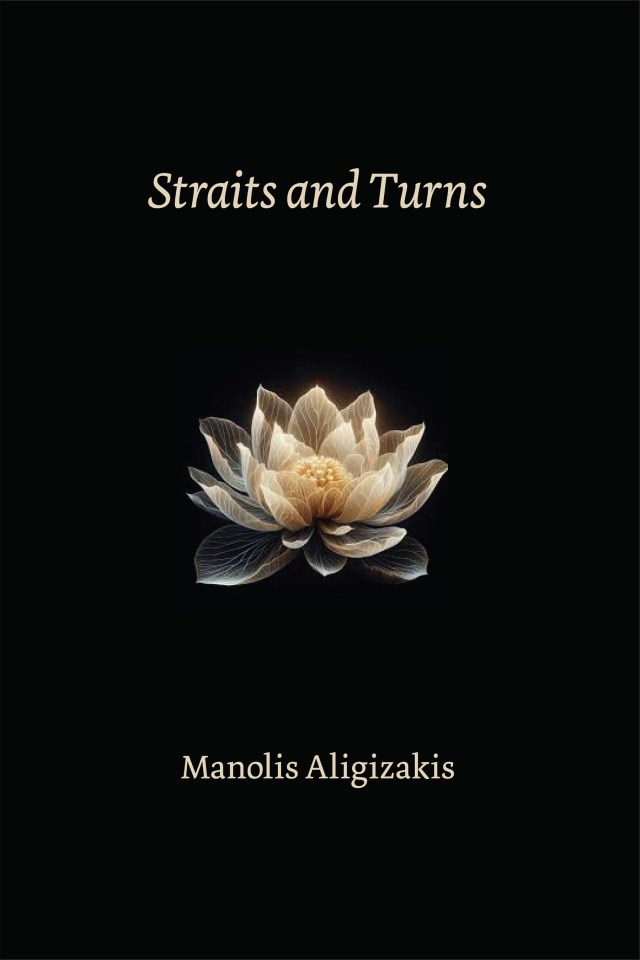
Excerpt

The predictable phrases came and went, and the warmth of the
wine, combined with the body heat of the people in the room, made
the atmosphere cozy. Even the conversation grew softer and fluffier as
the wine flowed. When Paula got up to visit the powder room, one of
the guests, Kostas, found the courage to lean in and ask, “Hey, Costa,
is she hot?”
Costa flashed his widest smile at the poor man, but before he
could reply, Vangelis butted in. “Don’t worry about Costa. He’s got it
right. He can pick and choose.”
Costa could almost see the man salivating at the concept.
He laughed out loud, but now the doorbell interrupted them, and
as their host went to greet the new arrivals, Costa saw Anna, the
airy, sexy, pretty, and ethereal Anna, enter the foyer, her husband
close behind. Anna was always perfectly dressed, always trendy and
sexy. She walked gracefully, elegantly, through the living room, and
Costa’s expert nose picked up her light lilac perfume. He fixated his
eyes on her, and he sensed that Anna knew he had been watching
her as soon as their eyes met. Somewhere between her sexy walk and
her faint, provocative smile, Costa saw the prettiest female of the
evening.
How do women always know when a man is looking at them?
Costa had often wondered about this but had never found an answer
that satisfied him. But they always know. And they almost always
smile back. It must be the same knowledge Costa always had when, in
a gathering of women, one, that special one, would be looking at him
with desire amid others who didn’t give a damn. It was knowledge
acquired from experience, and a womanizer like Costa had plenty of
that. Anna surely must have heard all the stories of Costa’s escapades
and misadventures. After all, the whole Greek community had heard
of them. As Anna joined the other women, Costa watched all the hugs
and kisses coming and going, each woman hugging and loudly saying,
“Hi, how are you?” while murmuring to herself, “bitch,” a word every
woman used when a prettier one entered the room and the eyes of all
the men glued themselves to her like limpets on a rock.

https://draft2digital.com/book/4250839#print

https://www.amazon.com/dp/1926763866

Podcast Episode: Greek Poetry And Fiction

Pip: Manolis Aligizakis has assembled a catalog that moves from ancient Greek shores to Canadian prairie schools to a Moscow hotel hallway — and somehow it all holds together.

Mara: vequinox brings it together across poetry translations, novels, and short fiction — territory we'll cover through modern Greek verse, prose excerpts, and the themes of love, memory, and identity that run underneath all of it.

Pip: Let's start with the poetry.

Voices Across the Greek Tradition

Mara: This segment is about what it means to translate a literary tradition — to carry voices like Cavafy, Ritsos, Engonopoulos, and others across languages without losing what makes them cut.

Pip: And Cavafy cuts immediately. The setup in "The City" is a man planning his escape — new land, new sea, fresh start — and then the poem turns on him completely.

Mara: The turn is the whole poem. "New lands you will not find, you will not find other seas. The city will follow you. You will return to the same streets. You will age in the same neighbourhoods, and in these same houses, you will turn gray."

Pip: So the upshot is that geography is not the problem. The self is the problem — and it travels with you, luggage you cannot check.

Mara: Engonopoulos makes a different kind of claim in "Nikos Engonopoulos – Poems." His "Angry Poem About the Occupation" turns elegy into defiance — workers dropping their tools, fists raised, a martyred figure walking the earth pale-lipped but beloved.

Mara: Ritsos appears across multiple volumes here. "Yannis Ritsos – Poems, Volume II" gives us a boatman striding into a harbor at dawn, the sun rising like a woman's wet hair curled around cranes — sensory and grounded. "Volume V" and "Volume VI" are quieter, more unsettled.

Pip: "Kariotakis-Polydouri, The Tragic Love Story" brings the biographical weight — two poets whose lives ended badly, rendered here in verse about a woman at a piano, butterflies leaving through a window.

Mara: "Tasos Livaditis – Selected Poems," "Katerina Anghelaki Rooke – Selected Poems," "Hours of the Stars," and "Troglodytes" fill out the range — from Livaditis's compressed night imagery to Anghelaki Rooke's half-words and olive tree shapes. "Neo-Hellene Poets" and "Orange" and "Mythography" sit alongside them as further evidence of how wide this tradition runs.

Pip: From classical echoes to prairie roads — the fiction covers different ground entirely.

Prose Across Borders and Generations

Mara: The fiction here spans continents and registers — from a child's first bus ride in wartime Canada to a Moscow reunion to a painter's Arctic trek — and the question running through all of it is how people find their footing in unfamiliar places.

Pip: "Water in the Wilderness" opens that question gently. A woman named Tyne has been living on hospital food, and her friend Moe has kept a phone call from her on purpose.

Mara: The reason matters: "Moe smiled. 'Morley is awake and asking for you.' Tyne let her breath out on a deep sigh, sat back and covered her face with her hands. 'Thank you, God, thank you,' she whispered, then shot out of her chair and ran to get her coat."

Pip: Relief as a physical event — breath, hands, running. The excerpt earns it without explaining it.

Mara: "The Qliphoth" operates in a completely different register — adult, raw, interior. "In Turbulent Times" follows Ian, a man trailing a woman named Nora through a coastal Irish hotel, his knees literally trembling at the bar. "Redemption" gives us a young man leaving home for Vancouver, his father crying openly at the table.

Pip: "Wellspring of Love" brings back Rachael, older now, stuck on a dusty highway while her cousin heads west — and "Water in the Wilderness" shows us Rachael younger, boarding that bus for the first time, shuddering at its size.

Mara: "Jazz with Ella" lands its protagonist in a Moscow hotel corridor and delivers the line "We are your family" to a woman who was certain she had no family there. "Ken Kirkby: A Painter's Quest for Canada" documents a real exhibition at Parliament — a painting one hundred and fifty-two feet long, twenty years in the making.

Pip: "Small Change" puts a boy in a Pennsylvania classroom trying to locate his immortal soul while Sister Assunta slaps a pointer against her palm. "Prairie Roots" is lunch-hour softball and girls comparing notes in the willows. "Wheat Ears" and "Cloe and Alexandra" round out the set — one a memory of Cretan youth, the other a poem built around a denial: it wasn't me in that yellow cab, it wasn't snowing, I have no hair.

Mara: What ties them together is the texture of ordinary life under pressure — the meals, the car keys, the Scotch ordered twice.

Pip: And underneath the prose, there's a question the poetry keeps asking too — about where you belong and what you carry.

The Self That Cannot Escape Itself

Mara: Love, memory, and identity keep circling the same problem across these works: the past is not behind you, it is inside you, and it shapes every attempt to move forward.

Pip: Cavafy says it flat out. "As you have wasted your life here, in this small corner, you wasted it in the whole world." There is no smaller indictment.

Mara: Ritsos in "Yannis Ritsos – Poems, Volume V" reaches for the same idea differently — a man who keeps a small mirror in his pocket because it's the one fixed point when everything else shifts without warning.

Mara: "Kariotakis-Polydouri" holds memory as tenderness — butterflies always flying out through the window. "Mythography" turns inward to still water and a fir tree asking the night for wisdom. "Introspection" names it directly: practicing a religion on the longing for the past.

Pip: "Orange" answers that longing with the wind's reply — your sunshine hides in your heart. "Hours of the Stars" writes love onto the mountain tops of memory. "Katerina Anghelaki Rooke" and "Troglodytes" close the circle — half-words left behind, and a young poet begging the Muses to free him from his own imposed fears.

Mara: The pattern holds: escape is not the remedy. The work is staying present to what you carry.


Pip: A city that follows you, a mirror in your pocket, a bus you board for the first time — it's all the same question dressed differently.

Mara: Where you are, and what you brought with you. More from this site next time.

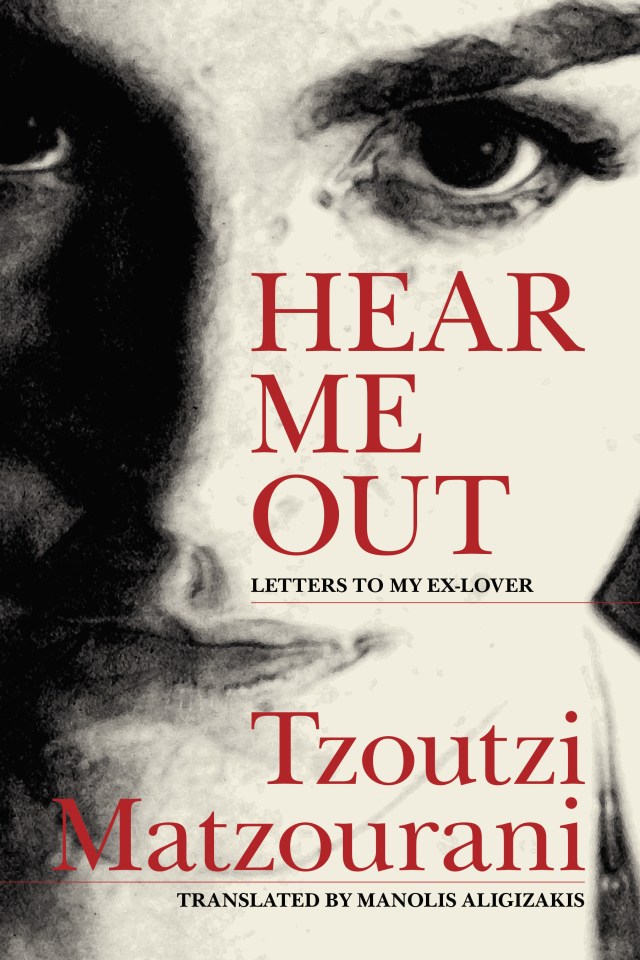
HEAR ME OUT

The Lost 1%
Finally you turned me into yourself, my love!
Or perhaps I’ve been this way all along unable to answer the same way when they tell me “I love you”. Unable to say, “me too…”, or “I also love you.”
The phrase almost reaches my lips but is not stated.
To observe other men with that sad and full of agony glance, the one I noticed in your eyes for a long time, and not being able to answer.
Now I can understand what you felt.
I feel the same way.
Now, I know what it means for the other person to expect something from your lips and you unable to utter a word.
And it is not that you don’t love the person, it’s not that you don’t care for them.
The opposite, you care and you hurt more so. But that 1 % that is missing, that you miss and without it the word isn’t said.
That 1 % you know you won’t ever find.
That, as if you came faulty out of the factory and you miss something, what you’ll never acquire and as a result you’ll never be able to give it to anyone.
And you’ll remain like Sisyphus to go up and down the mountain with the weight of love on your back, forever searching to unload it and to offer it somewhere.
70
But there will never be anyone to lighten up your load no one will ever walk along with you up the mountain and no one will ever give you a hand just to stop you from slipping down the slope.
Because simply you can’t grasp onto anybody’s hand you can’t grasp onto anything.

https://draft2digital.com/book/3562946

https://www.amazon.com/dp/1926763807

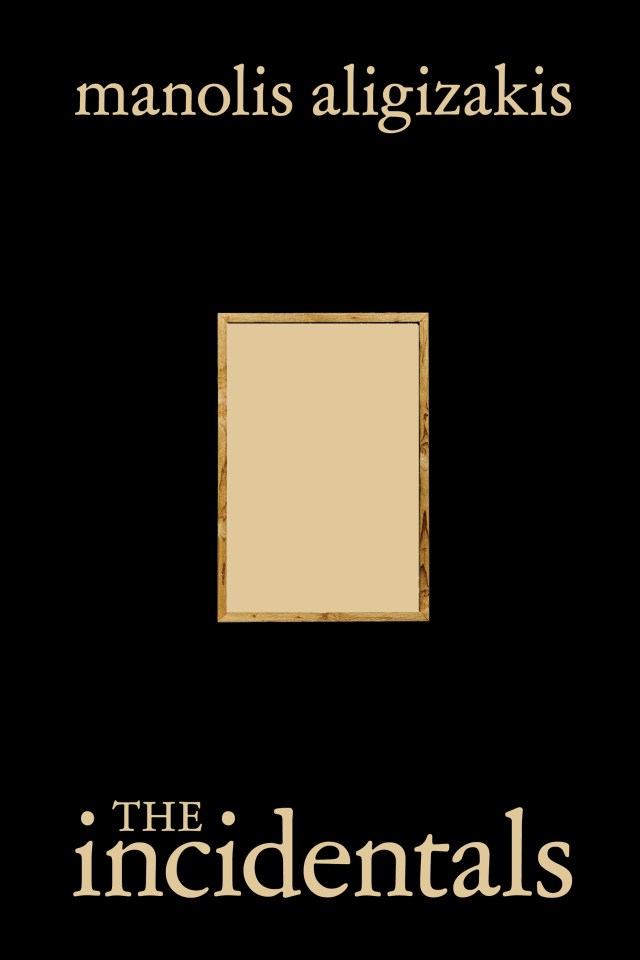
The Incidentals (review)

The Dignity of Lives Deemed Incidental

The postman in Mail moves from house to house carrying news of marriages, births, and children living far away. For everyone else, he is the bearer of messages, while tears run down his face because he too waits for a letter that never arrives.

Here lies one of Aligizakis’s strongest poetic gifts: his ability to create an entire human destiny from a few concrete gestures.

He does not write psychological portraits in the conventional sense. Of many of his characters we know almost nothing. We are given an occupation, a gesture, a memory, an object.

The rest is accomplished by metaphor. The net becomes a trap. The rope becomes a life.

Bookkeeping becomes an account with death.

The felling of a tree becomes an image of our own disappearance. The letter becomes a metaphor for absence. The shoe becomes the sign that, for a little while longer, we may still walk upon the earth.

This poetic world is at once archaic and contemporary. Hades and Thanatos move naturally through gas stations, diners, hospitals, stock-market screens, garages, and Canadian immigration offices. For Aligizakis, Greek mythology is not museum material but a still-living language through which human finitude can be expressed.

The immigrant is therefore a particularly significant figure. In Immigrant, the protagonist leaves his homeland to begin a new life on the other side of the planet. He promises his youth and productive years to the new country in exchange for security—but the poem’s ruthless conclusion suggests that in doing so he has, in a sense, sold himself “for a few dollars more.”

This experience carries particular resonance in the work of a poet whose own biography has been shaped by emigration. Yet Aligizakis does not write autobiographical complaint. Migration becomes another model of the human condition: we all make exchanges with the world. We give time for money, freedom for security, dreams for predictability. The only question is whether we are aware of the contract we have signed.

The Incidentals is not a comfortable book. Nor does it wish to be.

It is often rough, grotesque, ironic, sometimes sarcastic. It refuses to beautify the body, old age, labour, or death. Aligizakis occasionally uses brutal language to awaken the reader from precisely the complacency he wishes to attack.

Yet beneath this harshness lies an unusual humanism.

Because if these people were truly incidental, no poems would be written about them.

Poetry itself refutes the title.

The moment the poet writes about Gladys, Mathew, Stefan, Benjamin, Galanos, or the nameless postman, he abolishes their insignificance. He lifts them out of the anonymous mass of time. Society may have counted them as numbers, but poetry gives them names, faces, stories, and deaths.

This is perhaps the most beautiful ethical gesture of the volume. Poetry cannot defeat death.

But it can defeat oblivion—if only for the duration of a poem.

Manolis Aligizakis’s The Incidentals is therefore far more than a collection of poems about ordinary people. It is at once a modern dance of death, a social diagnosis, a sequence of philosophical parables, and an ironic catalogue of human existence. The volume asks how many people live out their lives without ever daring to move away from the stake to which an invisible rope has tied them.

And it asks an even more difficult question: how long is the rope on which we ourselves live?

The poet cannot answer that question for us.

Perhaps this is precisely the point at which the stories of the  „incidentals” cease to be the stories of others. And ours begins.

Balázs F. Attila

poet, writer, editor

https://draft2digital.com/book/3745812#print

https://www.amazon.com/dp/1926763637

Podcast Episode: Modern Greek Poetry And Memory

Pip: Manolis Aligizakis — translator, poet, publisher, and apparently a one-person archive of everything Greek literature has ever felt about mortality, love, and the road.

Mara: vequinox has been busy. Today we're moving through modern Greek poetry in translation, then into myth and mortality, and finally into fiction and travel narratives that cross borders both literal and historical.

Pip: Let's start with the poets.

Voices Across the Aegean: Modern Greek Poetry in Translation

Mara: The throughline across these translations is a question: what survives when a poem crosses languages? The Cavafy post gives us one answer through the myth of Achilles and a god who betrays his own prophecy.

Pip: And Cavafy frames it with Plato first, which is a move — citing the Republic to set up a poem about divine bad faith. The quote lands hard: "Yet, he, himself… who sang the hymn… he killed my son."

Mara: That line is Thetis speaking. Apollo sang paeans at her wedding foretelling her son's long life, and then personally went to Troy and killed Achilles. The prophecy and the killing share the same mouth.

Pip: Which is either theology or the oldest recorded case of a conflict of interest.

Mara: The Yannis Ritsos volumes — both Volume V and Volume VI — push into similar territory from a different angle. Volume V gives us the evening star as an eraser moving back and forth over a mistake that never quite disappears, birth and death as a rhythm rather than a sequence.

Mara: Volume VI's "Same Word" watches language itself tremble under its own unfamiliar meaning, like a nerve that shivers and bursts. Ritsos keeps returning to the threshold between sense and silence.

Pip: Tasos Livaditis takes that threshold into a tavern. The bouzouki player in Volume II swears every day he'll turn his life around, and every night the world deepens and pulls him back through the door.

Mara: George Seferis in the Collected Poems gives us crickets ticking out of rhythm, a house full of them, and the line "we don't even whisper, because the machine is speeding before horror and contempt." The anthology Neo-Hellene Poets lands a parable about a bird that can learn every sweet song except the words "I love you."

Pip: Katerina Anghelaki Rooke's Selected Poems counts time differently: "I count time with what I've lived and what is forthcoming that resembles the incomparable end. Only, look, the craft and the fisherman can't be separated from the blue."

Mara: Titos Patrikios in Selected Poems is more pointed — "Economic Development" watches emigration and foreign investment rise together while newspapers announce cultural ideals are being maintained. And Nuances holds the sharpest compression: a poem called "Repetitions" that names peace as something a sword erases.

Pip: Red in Black steps outside Greece entirely, finding illumination in Craiova, Romania, through Brancusi sculptures — the Blind Boy and The Kiss — connecting Greek poetic consciousness to Romanian artistic space. That range from Cavafy's Troy to a Romanian museum is the real scope of this project.

Mara: From mythic time to the present tense — which is exactly where the next set of poems lives.

Eros, Entropy, and the Weight of Ending

Pip: This cluster asks what myth and love actually cost — not in the abstract, but in the body, in the moment, in the interruption.

Mara: Medusa opens with a poem called "Gravestone" where Eros descends to a melancholic youth and a widow turns in the moonlight, and then the poem pivots without warning: "Nothing matters more than the armchair craving my body as the widow craves her late husband."

Pip: The domestic interruptions — the faucet, the table, the wife demanding full attention — aren't a joke at the poem's expense. They're the actual argument: desire and the ordinary are not separate territories.

Mara: Entropy's "Eternal Cycle" strips that argument to its bones — earth aging, returning its shine, then embracing each thing on its path toward what it always longed for. Wheat Ears traces the same arc through a single memory: beauty glimpsed through a window, understood only later when years have become dry leaves on a sidewalk.

Pip: Rendition and Life is a Poem hold the stranger registers — one a requiem tracking dawn through alcohol and fear, the other a surrealist marketplace where oaks erect monuments and white rabbits somersault on floating meadows. Hours of the Stars closes it with a prologue about those who never let their glance reach the light, and the chaste people who do.

Mara: That tension between those who see and those who can't — it runs through the fiction too.

Roads Taken Hard: Fiction and Travel Across Borders

Pip: The fiction here is about people in motion — and motion that doesn't stop even when it probably should.

Mara: Ugga frames that with unusual economy: "For the light to change the production must pause and the pause must be produced methodically." Four lines that describe filmmaking and also, quietly, everything else.

Pip: In Turbulent Times gives us Ian Anderson driving furiously south from Lisburn, cursing his own idea the entire way, and not stopping. The road is "drunken," the steering wheel swung "in fury, like a ship's skipper in a storm."

Mara: The rationing detail grounds it precisely in postwar Northern Ireland — no meal over five shillings, no more than three courses, restaurants exempt and resented for it. The historical texture is load-bearing.

Pip: Straits and Turns puts a mechanic behind a fogged window in a Vancouver train yard, rain dripping steadily, "poetically, he'd say." The Circle moves between Baghdad and a new apartment, a move organized with pizzas and a reserved elevator and a view west toward the Pacific.

Mara: Blood, Feathers and Holy Men is the furthest journey — Irish monks in North America, a guide warning that the trip takes five or six seasons and that stragglers get left behind. And Jazz with Ella lands in Moscow, a Canadian teacher stepping onto Soviet soil and remembering Churchill: "a riddle wrapped in a mystery inside an enigma."

Pip: She suspected it was hyperbole. Then she stepped off the plane.


Mara: What holds all of this together is the act of crossing — languages, borders, centuries, the distance between a prophecy and its betrayal.

Pip: Next time, we'll see where that crossing takes us.

Straits and Turns

excerpt

…lavishing her body, erotic and desirous, promising and promiscuous;
Mona, the nurse who came to replace his gauzes. Mona, a woman,
came to the help of a man desiring nothing more than what nature has
allotted to him: lust, even with his half-severed penis, a man desires to
ride on top of a woman’s body, this woman’s, Mona’s. In this war zone,
man never stopped longing for that exquisite moment of coupling,
nature’s first and most powerful expression: a man, an injured man,
coupling an eloquent, musical, poetic, female body.
His eyes still closed, he saw himself on a bed where he was battling
his last, three days and three nights, with his stressed breath in
irregular spasms of a living-dead man, skinny, leftover of stamina
recluse in his austere village bed. Shadow of a man left to perish as
nature commanded, yet, his last breath was delayed as for three long
days and three long nights, he kept on gasping for air unable to release
his soul to his creator while from time to time he would whisper in
his so ever weak voice one word, “pussy” to the amazement of his relatives,
especially to his two sons who didn’t know how to play out their
father’s last wish. And the night arrived again for the fourth time, and
the owls sang their lonely songs in the nearby barn while the moon
kept on playing hide and seek behind the clouds, while the unrested
soul of the old man repeated the same double syllable word, “pussy”.
Indeed, it was tragic and comical for the three relatives who stayed for
the vigil: one of his sons, the old man’s niece, and the servant girl who
attended to the wishes of the almost-dead man. Not any special wishes
did the moribund man have other than perhaps stir him from time to
time to check whether he was still on the upper stratum, although his
occasional whisper, “pussy” was witness to the fact.
At the desperate moment of ambivalence when no one of the three
knew what to do to help the old man relax and let his soul be released
to the elements, Mona, the twenty-four year old maid with her flaming
eyes and promiscuously half-open lips and her voluptuous breasts, an
angel of mercy nonetheless, neared the bed of the old man, raised her
skirt, took his fragile hand and placed it behind her light undergarment
and between her legs upon which time and upon feeling the touch of his…

https://draft2digital.com/book/4250839#print

https://www.amazon.com/dp/1926763866

Small Change

excerpt

sixteen-year-old breasts, long legs, the outline of her female parts where the wet cloth of the suit pulled tight, and I felt a surprising warmth flow down from my racing heart to fill the netted sling in my swim trunks with muscular intensity. I could barely breathe. My head seemed to float above my shoulders, and as I stared like a hypnotized animal, she caught my look and smiled.
I never saw her again until that fall. It was almost supper time; the street was deserted and it had begun to get cold. She came right up to me and I felt my chest tighten till I was breathless and a little giddy. I couldn’t read the look on her face. It was amused, but not quite sure of what she was going to do, as if she were crossing a line, or testing something, and there was a challenge too, and I remembered that smile from the summer and I saw it now as something else, something that made me feel a flicker of anxiety along with the excitement and the wonder of this unexpected proximity.
She didn’t say hello, or what’s your name, or I know you, she just blurted it out, “Wanna wrestle?” and she was a little breathless too. It was something my friends and I did all the time, but I’d never even imagined wrestling with a girl, much less an older girl who was already a woman, and I didn’t know what to think about that, and before I could think anything, she stepped up and put her right arm around my neck, trying to pull me into a headlock. I slipped out, spun around, grabbed her forearm and wrist and attempted to force her arm behind her back, but she was taller and heavier than I was and she used her weight to push me off balance. She grabbed me from behind, but I squirmed around until we were face to face inside her bear hug, and I could feel her warmth, smell the light fragrance of her deodorant and a deeper, muskier scent that astonished and aroused me so quickly that I could feel my stiffness fit between her legs, and her face looked shocked and she tried to twist away and we fell, and my ankle caught on the curb and she landed on top of me, both of us breathing hard, and I heard a dull crack, and a stab of pain like an electric current that shot up my left leg, and I went pale and started to faint, and she looked scared, rolled off of me, took off at a full run down the street.
I lay there catching my breath and wondering what to do next. When I tried to get back on my feet, the pain shot up from my ankle again and I felt a moment of panic. How long would I have to lie here before I could walk? Should I yell for someone to help me?

https://www.amazon.com/dp/1926763157

Straits and Turns

excerpt

I had a good bite of my sandwich, turned the food in my mouth and chewed slowly while I stared at the beautiful Goddess who was observing me and after I slowly chewed and swallowed my food while she was chewing hers and while my wife was sipping her red wine, I sent towards the Minoan beauty a kiss with an imperceptible movement of my lips to which the Minoan Goddess reciprocated with an even sweeter kiss sent my way and the pact of the day was sealed, the
beauty the up to now dull day had changed into, brought back my
thoughts about the travellers in the Atocha train station in the bowels
of which thousands of people go through, like that blonde traveller I
met yesterday, who played footsies with me and who would probably
was with her lover, yes at this moment in time, in this big city of
Madrid, she was surely enjoying the body of her husband, or lover,
or Lesbian partner, while the Minoan beauty, who had just finished
paying her waitress, got up and walking towards us and quite unexpectedly
she faced my wife and asked, “visitors?” to which my wife
said “yes”, “Having a good time in Madrid?” “Yes,” my wife said, “how
long have you been here?”, “a week, but we go home tomorrow” my
wife added, “have a great time and safe travels back home…by the way
where is home?”, the Minoan beauty asked, “Vancouver, in Canada,”
my wife said, “well enjoy your stay in Spain” the young woman added,
to which my wife and I said in unison, “thank you” and the Minoan
beauty turned and walked away showing us the calligraphy of her
buttocks, knowing well that I’d make sure I’d pay attention to them
as I paid attention to the unimaginable images she graced me with,
images that surely I’ll keep in my mind for the rest of my life.

https://draft2digital.com/book/4250839#print

https://www.amazon.com/dp/1926763866