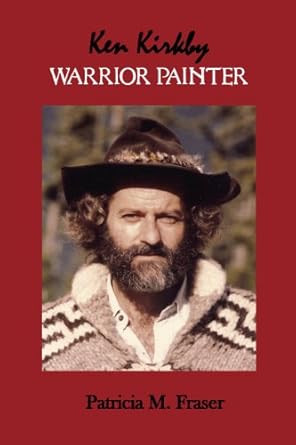
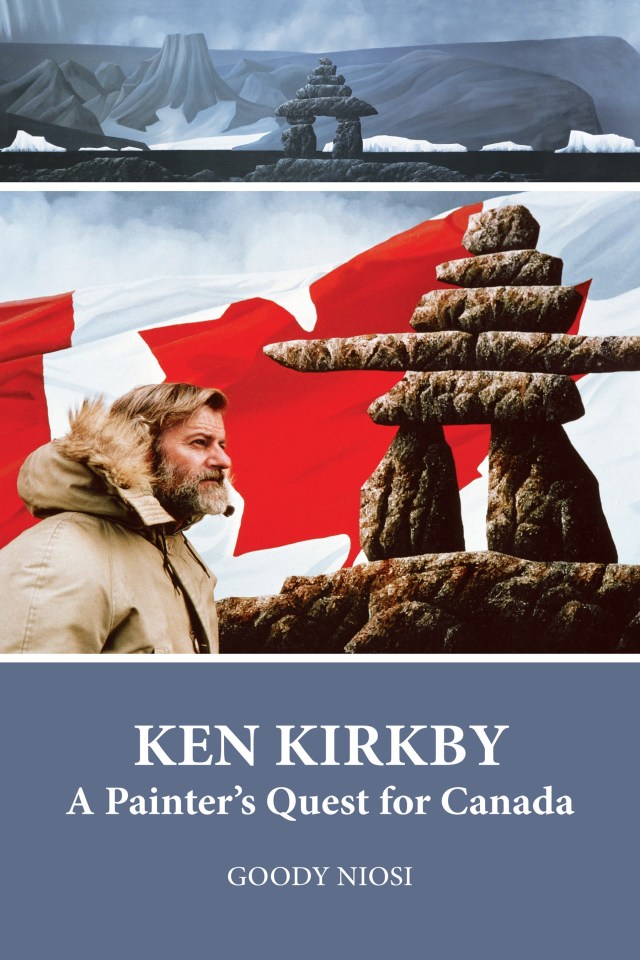
Ken Kirkby – Warrior Painter

excerpt

The Minister was a Maritimer and his open, neighbourly manner
delighted Ken. Their meeting resulted in the eminently successful 1975
exhibition of Ken’s Arctic work in Spain, and in the fashion of one domino
tipping the next, the first Canadian exhibition of the Arctic works was
triggered. Once the unusual, haunting images had been seen, and the origin
of the work was explained, all the right people wanted to own one of the
paintings, and gallery owners were clamouring to exhibit them. Best of
all, to Ken’s mind, it had been accomplished without cost to the Canadian
government beyond their public support and a few phone calls.
This was the beginning of the long road to the national introduction of
the Inuit, their stories and experiences, and the growing acceptance of the
symbol of the Inukshuk as a uniquely Canadian icon. It could be argued
this was the pivotal step that led to the Inukshuk becoming the distinctive
symbol of welcome for the 2010 Vancouver Olympics.
The Arctic paintings sold by the hundreds, nationally and internationally,
to the point where, a quarter of a century later, Canadian Art galleries were
objecting to anything other than ice, snow and Inuksuit displaying the
Kirkby name. It was ironic.
~~
Despite the history, the lack of outlets for Kirkby’s west coast images
promised a lean period ahead for the painter. He decided to force the issue
by withholding all of his art until the galleries accepted his new works. The
businessmen amongst the owners appreciated the fact that a painting with
the Kirkby signature translated into a certain sale, and Ken’s experience had
proven they’d come around when their stock was depleted.
He continued to work late, the bright light a beacon, spilling warmth
from the loft window. And then, one night he returned to the cottage to
find the message light blinking on the answering machine. That was the
start. While gallery managers still hopefully requested the Arctic series,
they agreed to hang work from his Vancouver Island series. Happily, new
customers liked it and previous Kirkby collectors were intrigued. Ten
years since that breakthrough, his work is more popular than ever and…

https://draft2digital.com/book/3562902

https://www.amazon.com/dp/B00CB8W4CG

Ken Kirkby, A Painter’s Quest for Canada

excerpt

…grandly feted and on another day, he and Marsha visited the village that
had been his home. They walked up the Avenue of Princes and stopped
in front of number twelve – his home. In the garden, he saw a couple
talking with the gardener. Ken leaned over the garden wall, introduced
himself, and asked if he could look inside his old boyhood home. The
couple frowned, turned their backs on him, and walked into the house,
locking the door behind them.
The gardener said, “You’re Ken.”
“Yes.”
“I’m Francisco’s nephew.”
“How wonderful to meet you. But why are they so upset?”
“They think you’ve come back to claim the house.”
Ken laughed. “I just wanted to go inside and look. I thought it might
be very nice.”
“Oh no. People have been wondering when you would return to take
back what is yours.”
“I’ve never considered it mine,” he said.
They walked on through the village and then down to the beach. Nothing
had changed. The wall he and Francisco had built was still there and
still trapping the sand to create a beautiful stretch of beach. Even the
remains of Francisco’s cabin still clung to the cliffs.
They drove to Peniche, the home of their friend, the Count. Even here
Ken was recognized, not so much for himself, but for his father; a saint
according to the owner of a restaurant, who closed the café in celebration
of Ken’s visit and served up a feast for his honoured guests.
Back in Toronto, Ken settled into a routine that was continuously interrupted.
When he was not working on Isumataq he painted canvases
for the gallery and for the financial company’s new collection. His biggest
challenge was that the media liked him too much. They wanted to know
why he was meeting with presidents in Europe; they wanted to know his
plans – what was next? Too much good press was boring so they sought
out the malcontents – those who had accused him of appropriating a
culture that wasn’t his. He needled them until they fired back. He had
come back from his latest Arctic trip with letters from the grandmothers,
written in Inuktitut and translated into English, stating that they not
only approved of his art, but had also asked him expressly to do what he
was doing. The letters were tucked in a file that Ken suspected might be
useful one day.
Bad press was interesting but outrageous press was better. He had
about twenty unfinished paintings, stacked in a corner of the studio, that
he would likely never complete. He spread them out on the floor and
paced between them.
“What are you doing?” Diane asked, poking her head into the studio.

https://draft2digital.com/book/3562830

https://www.amazon.com/dp/0981073573

Ken Kirkby, A Painter’s Quest for Canada

excerpt

or not – it all depends on the environment. I suspect that you haven’t
thought your way through it – and I’m not trying to be rude, or difficult.
Usually, when people come in and ask for something that’s completely
outside their understanding, they, probably, aren’t asking for the right
thing. I’d like to suggest that I come down and make a presentation to
your company, on what I think you’re looking for.”
“You think so?”
“Yes. You don’t seem sure about why you want it, and you’re not sure
about the environment it will be in. I suspect that no matter what I paint
you won’t be happy. Painting what is in someone else’s mind is almost
impossible. So, would you do me the courtesy of letting me come down
and make a presentation, and see if that is what you want?”
“Certainly.”
A few weeks later, Ken walked into the formidable skyscraper in downtown
Toronto and gave the board members his analysis. They wanted a
large painting for the foyer. Fine – he could supply that, but it wouldn’t
be as large as the Reichmann painting. And, it would be the first of several
canvases. A smaller one would hang in the boardroom, and several others
would hang throughout the premises. The preliminary sketches and
drawings would be framed and hung as well. The paintings would tell a
story that would be repeated in a booklet. A six-minute film would also
tell the story, and it would play on a large screen television in the reception
area. When a client arrived for a meeting, he would sit and watch the
movie.
“Now, they have something interesting,” Ken said. “This is something
they have not anticipated seeing, and they realize that you are a lot more
than just what you do. When you meet the client, you tour them around
and show them all the works, and then you sit down and get down to
business. By now, they realize that you are interesting people. You have
things going on other than making money. When your business is concluded
you hand the client a copy of the book – signed by me and your
CEO – as something to take away and remind them of the meeting.”
Ken suggested they take a holiday during the month of August and
turn their offices over to him. When they returned the space would be
transformed – not just because the paintings would be hung. What good
were paintings if the background didn’t complement them? He proposed
changing the furniture to set off his work and painting the walls in appropriate
colours. Everything had to work – it had to be of a piece.
The cost, he said, was irrelevant – the accountants would write the
whole thing off. He thanked them, told them he had to return to his
painting, and left. During the next few days several of the board members
visited his studio. A couple of weeks later they accepted his fee of four
hundred eighty thousand dollars.

https://draft2digital.com/book/3562830

https://www.amazon.com/dp/0981073573

Ken Kirkby, A Painter’s Quest for Canada

excerpt

His scaffold was built, ladders leaned against the walls, tubes of paint –
by the carton – were stacked in the studio, and alarm clocks ticked beside
his narrow cot. He was ready to begin painting.
I felt very, very much that things had now solidified. This was now a fact,
and for the first time in this entire campaign, I actually knew that I was going
to make it – not only the painting, but also my fight for Nunavut. This
was it. It was now only a matter of physical labour to complete the vision.
There was a different feeling now. The desperation was gone, and there was
only a huge engine driving me. Now, there was only confidence. Now, I had
access to politicians, business people, media – an infrastructure so massive
and on such a personal level that I would be able to get this story through
and by hook or by crook it would come into being.
It occurred to him is his newfound euphoria – “We need to celebrate!”
He announced the “First Brushstroke” party and invitations went out in
the shape of artist’s palettes that hit the desk of every media contact in the
city. Every couple of days a new invitation in a different colour, embossed
with an Inukshuk, went into the mail. He called Keith and told him to
fill a plane with choice Arctic food. Bob Engels, the North’s most famous
bush pilot, volunteered to fly the northern contingent to Toronto. On
an evening in early September 1986, Ken climbed up on a ladder, from
which he made a speech to a roomful of people, and then splashed a giant
brushstroke across the towering, white canvas.
Then he settled into a routine that was to last for almost a year. He
painted the sky for several hours, slept for two hours, went back to work,
and then slept for two hours. As he painted he had a sense that this was
what he was meant to do – to paint on this scale. Every other painting
seemed too small – even the giant canvas that hung at First Canadian
Place was undersized. How could he ever go back to painting something
on a lesser scale? What he really wanted to do was buy Saskatchewan and
paint it from helicopters.
One day a woman, wrapped in a fur coat, swished in on stiletto heels.
She glanced around the studio and waved her arm at some paintings leaning
against the far wall. “I’ll have that one, and that one, and that one.”
“Madam,” Ken said from his perch on the scaffold. “I don’t know who
you are. I suspect you know who I am or you think you do. I would invite
you to go outside, take a walk around, come back in, and say – ‘Good
morning!’”
She took a step back. “Well! I have never been spoken to that way before!”
Ken waved his hand. “Go on! Go. Shoo… Shoo.”
She stalked out, and returned ten minutes later. “Good morning,” she said.

https://draft2digital.com/book/3562830

https://www.amazon.com/dp/0981073573

Ken Kirkby, A Painter’s Quest for Canada

excerpt

“Do you like it there?”
“No. It’s not where my heart wants to be but it is where I have to be.”
“I was in Toronto once. I married Hilu’s father and he was from Ottawa,
so I’ve been to Ottawa too.”
“What happened?”
“I don’t know how you people can live in a place like that. It’s soulless.
It’s like people living in caves up in the air. It’s just not human. How is it
that someone who isn’t born here, who doesn’t live here, and only spent a
few years here, can love this place and these people so much?”
“I don’t know,” Ken said. “I don’t know how that happened. We can
have a lot of ideas and we can say a lot of things, but the reality is that we
don’t know these things. We don’t know the first thing about love – we
haven’t a clue. We have all sorts of feelings and all sorts of passions. We
call it love and hate, but that’s just a lazy way of expressing something
we know nothing about. I think love is something that is lived. It doesn’t
have very much to do with the other person although we focus the idea
on one person. I think it’s a life lived in a particular way. It encompasses
all the things that are in that life and it depends on how that life is lived,
whether the invitation to love will be heard and accepted. I don’t think
there is any language, including Inuktitut, that truly expresses what that’s
all about. The only conclusion I can come to is the one I’ve given you.”
Joan let a long silence hang between them. Ken finally asked her again,
how she knew this was the place where he had witnessed so much death.
“It’s not just you knowing,” he said. “There’s something more concrete to
it. This is a specific place where a specific thing happened.”
“I know this is the place because my mother knew these people and
knows their story and she knows about you,” Joan said. “This was the
time of my grandmother, and my grandmother knew you. My grandmother
found you very interesting. They called you the quiet Kabluna
– the mysterious white man who had the capacity of silence. That’s how
I know about you.”
“Would it be possible to visit them in Baker Lake?” Ken asked.
“Yes.”
“Could we visit now?”
“They’re away.”
“Away?”
“Visiting.”
“Family and friends?”
“Yes – very far away.”
“So we can’t go and see them?”
“No.”

https://draft2digital.com/book/3562830

https://www.amazon.com/dp/0981073573

Ken Kirkby – Warrior Painter

excerpt

I took my rowboat and paddled out from shore to start the process of
familiarization. I observed the mouth of the creeks, the curve of the
beaches, the blend of driftwood and rock, the colour of the sky. I met
people with aircraft and begged rides off them. And, do you know?
This vast island is totally different than you might think. At one time the
bulk of the land between the seashore and the mountains was actively
farmed. The climate was favourable, and after clearing, the land was
fertile.
If you walk through it—there are still roads in the process of being
reclaimed by nature—you’d be amazed at how much of it had been
cultivated. Some of the parcels were very large, others just enough
to maintain a family or two. Then along came the Boer War, which
consumed a bunch of the young men, and then World Wars I & II
finished the job. Without the next generation to continue what had been
started, the forest grew back, roofs caved in, machinery rusted.
Once I got the feel of it, I decided I’d try to tell the story of this part
of the country—not the history, not the ‘big’ story, but the sense I had
of the size and shape of the island. The wind wracked trees and snowcrusted
mountains stirred my blood. And I found I was once again a
painter.
By the end of 2002, Ken was producing paintings to his satisfaction
and was pleased to find the attitude of the island galleries more amenable
than he’d experienced when he first returned to Vancouver. He came across
galleries dealing in second-market sales where a Kirkby oil of a solitary
Inukshuk standing proud on the tundra, or a parade of Inuksuit backed with
Arctic snows would be on display. He’d introduce himself and was pleased
to see that his name was recognised. He’d tell them that he was now in
business on the west coast. Might they be interested in fresh pieces?
The reaction was always positive. But when he laid out his canvases of
coppery grasses, water-worn granite boulders, wind-bowed trees or perhaps
a lonely lighthouse blinking eerily behind a rising ocean fog, he was met
with consternation.
“What’s this? Where are the icebergs? The Inuksuit? We can’t sell
these. That’s not you.”

https://draft2digital.com/book/3562902

https://www.amazon.com/dp/B00CB8W4CG

Ken Kirkby, A Painter’s Quest for Canada

excerpt

Keith nodded. “Well, that’s something I want to talk to you about. I can
help you and I want you to help me.” His room bookings for the following
year, when the lodge would be completed, were with Americans and
a handful of Europeans – not a single Canadian on the reservation list.
“You seem to have a great capacity for publicity and getting media attention,
and I’d like you to help me. In return, you can come and stay here,
have the use of airplanes – anything you want. But I need you to help me
to get people to come.”
Ken thought about the problem and suggested a slide show in his studio
with multiple projectors. He enlisted the help of Avril and Roberto;
they commandeered Tergey, the young Norwegian pilot who worked for
the lodge.
As Keith had predicted it wasn’t long before they heard the sound of
an approaching float plane that glided to a landing on the lake. It pulled
up to the dock and two men stepped out. They shook hands and asked
Ken what he was doing at the lodge. “Fishing with my son,” he said, and
excused himself, explaining that it had been a long trip and they were
tired.
They crawled into their sleeping bags, pulled caribou hides over them,
and drifted blissfully off to sleep. Too soon, a hand shaking his arm woke
him. “There’s someone I want you to meet,” Keith said.
Joan Scottie, a reserved and beautiful Inuk woman, had been born
about two miles down Ferguson Lake. “Joan has been a friend for years,”
Keith said. “She’s here to help us finish building the lodge. She is the most
capable human being you will ever encounter. There isn’t anything she
can’t do. She was born in an igloo and is a computer expert. She is also
the finest hunter and fisher you will ever meet.”
Joan was also a photography buff. She took Ken to her hut near Keith’s
home and showed him a collection of photographs. Her Scot and Inuk,
father, Basil Scottie, who was almost totally deaf and dumb, glared fiercely
at the camera. Another photo showed her family, two men, and seven
women, standing formally in a row, dressed in bleached white hides with
intricate designs.
“I think I have been where these pictures were taken,” Ken said, studying
them. “But I can’t be sure.”
“Yes,” she said. “They were taken near here and you were there.”
“How do you know?”
“I heard.”
“Who told you?”
“Old folks.”
“I had an incredible experience – a horrible experience that never left
me. It was somewhere in this region – a lot of people died.”
“Yes, I know.”

https://draft2digital.com/book/3562830

https://www.amazon.com/dp/0981073573

Ken Kirkby, A Painter’s Quest for Canada

excerpt

“I mean no disrespect, whatsoever,” Ken said. “I know the symbol well.
But that is the wall.”
Albert exchanged a few words with Leon and then nodded. The painting
would go on that wall. Then Ken and Leon tackled the problem of
hanging the massive painting on a marble wall. The maintenance staff
concluded they would have to drill into the ceiling beams and suspend
the painting from thin stainless steel wires.
They hung the painting after business hours. Ken invited the media.
He had the panels delivered to the lobby where he bolted them together.
Salvador and his staff came along to help. Many members of the young
professionals group also arrived on the scene. The media asked how much
the painting had sold for. “No comment,” Ken said.
“Was it a lot of money?”
“No comment.”
“How did you contact Mr. Reichmann?”
“No comment.”
“You’re an artist,” one of them said. “How do you know how to do
all these other things? Artists don’t know how to be entrepreneurs. Who
helps you?”
“That’s a big question,” Ken said. “It’s a spiritual matter. I don’t wish
to discuss it.”
“What do you mean it’s a spiritual matter?”
“Just that. I get my knowledge, inspiration, and advice from a higher
authority and beyond that, I don’t want to discuss it. But, I will say one
thing – my advisor is Mr. Albert Reichmann.”
“Yes,” Albert said, when a reporter asked. “I am honoured to be Mr.
Kirkby’s advisor. He is doing wonderful work.”
Those few words gave Ken the credibility he’d been looking for. He had
achieved what his father had always had – the power to command respect
and attention wherever he went.
Later that night, when he was one of the last to leave, he paused to look
at the painting that he had envisioned hanging in that space so many
times. It looked exactly as he had imagined. It was in perfect proportion
to the immense lobby. It wasn’t until one walked closer to it that one felt
the full impact of its size.
His greatest debt was to Salvador, who had arranged the meeting, but
when he told him that he wanted to give him several paintings, he refused.
Ken painted several canvases regardless and delivered them to his home.
Before getting back to the task of Isumataq, Ken returned to the Arctic.
Keith Sharp, the burly Englishman, had moved to a parcel of land near
Rankin Inlet and extended an invitation. Ken included Michael as well as
Avril the photographer, and Roberto and Egidio, the filmmakers, in his
entourage; in mid-July, the somewhat motley crew – loaded down with…

https://draft2digital.com/book/3562830

https://www.amazon.com/dp/0981073573

Ken Kirkby – Warrior Painter

excerpt

is this illusion…you and I can go for a walk wherever you choose and
I challenge you to show me where money grows. It is a man-made
convenience, but we have turned it into God and the almighty banks
into the churches.
Money in itself is a nonentity, a paper mirage. But if you understand
how it functions you realise currency can be artificially created—
MasterCard and Visa are good examples. It no longer needs to be
printed by the Mint. I wish people would realise it is only a tool, to be
used like any other implement, and no more mysterious.
As the two men worked, Harris proposed assorted schemes to make money.
These were discussed, dissected and for one reason or another, discarded
at the end of the workday. Perhaps, like crossword puzzles or Sudoku, they
served to keep the workers’ mental juices flowing.
~~
Ken Kirkby is a particularly fine cook and, having been raised in
Francisco’s kitchen, can turn the simplest ingredients into a dish to be
savoured and praised. As his circle of friends expanded, he resurrected his
long-dormant culinary skills.
Portuguese meals would not be complete without a bottle of fullbodied
red or crisp white on the table. When Ken left Portugal, he had been
selective as to what he took with him, but one of his prized possessions
then and now, is the family wine recipe dating back several centuries. He
continually has a batch on the go although he is a moderate drinker himself.
It was likely a day or so after a well-spiced supper of clams, shrimp and
prawns cooked in Kirkby’s special fish stock prepared from flounder, too
small in themselves to eat. While spreading topsoil for the eventual seeding
of the lawn, Harris says, “You know, Kenny, that’s a damn fine wine you
make. You could probably make a pile of money if you set yourself up to
produce and sell it.”
“Probably,” says Kirkby.
Harris does some mental calculations. “How much do you think you
could make?”
“Money, or wine?” Kirkby quips.
“You’ve got a few racks there—how much do you usually make?”

https://draft2digital.com/book/3562902

https://www.amazon.com/dp/B00CB8W4CG

Ken Kirkby, A Painter’s Quest for Canada

excerpt

A short while later, a tall man came to the kitchen door. Salvador
greeted him and the two men talked quietly together for a few minutes.
Then Salvador pointed, and Ken heard him say, “This is the man I told
you about. He is the man who has been sent.”
Albert waved Ken toward him. “If you’ve been sent, you’d better come in.”
Ken shook his hand and entered the kitchen.
“Who sent you?” Albert asked.
“It isn’t a who; it’s a what. An idea sent me and the idea starts with
one human being asking another human being for one hour of his life to
listen to a story, and the story is of a man you may have some familiarity
with. His name is Lorenzo de Medici. Are you familiar with him?”
“Yes I am.”
“I want one hour of your life.”
Albert sat at the kitchen table, quiet and composed. Even his eyes were
still. His hands rested motionlessly on the tabletop, his fingers curled
comfortably inward.
Ken sat, took off his watch, and placed it on the table where he could
see the time ticking away. He told Albert his understanding of Lorenzo
de Medici’s life. He drifted away on his words, just as he had when he had
made his speech at the Columbus Centre. He lost himself in the intensity
of the moment – rushing down the white water of ideas like a kayaker
tumbling down a raging river.
“There are parts of that story I wasn’t familiar with,” Albert said, when
Ken had finished. “Where did you get your information?”
He told Albert about his birthday trip to Florence to see the statue of
David and how on another birthday his father had given him a beautifully
bound book of Michelangelo’s letters to Popes, kings and princes.
The letters, he told him, described his relationship to the Medicis in his
own words.
“So you are an artist?”
“I am a painter. Michelangelo was a sculptor who was made to paint.
I am a politician who is made to paint. I have a job to do, and I have a
mission to carry out that has to do with the people of the Arctic and the
soul of a nation. We in Canada wander around very confused as to our
identity. Our subjects of conversation are the weather, Quebec, and our
identity. I have found the soul of this nation, and in the process, I found
many wonderful stories and many wonderful symbols. At the same time,
I discovered hell on earth – hell is what is happening to those people. I
have been asked by the grandmothers to please tell the world about this.
The first thing I want to do is tell you about it.”
“Why would you want to tell me about it?”
“In Michelangelo’s time there were Popes, queens, and princes. There
were people who could sponsor great ideas.

https://draft2digital.com/book/3562830

https://www.amazon.com/dp/0981073573