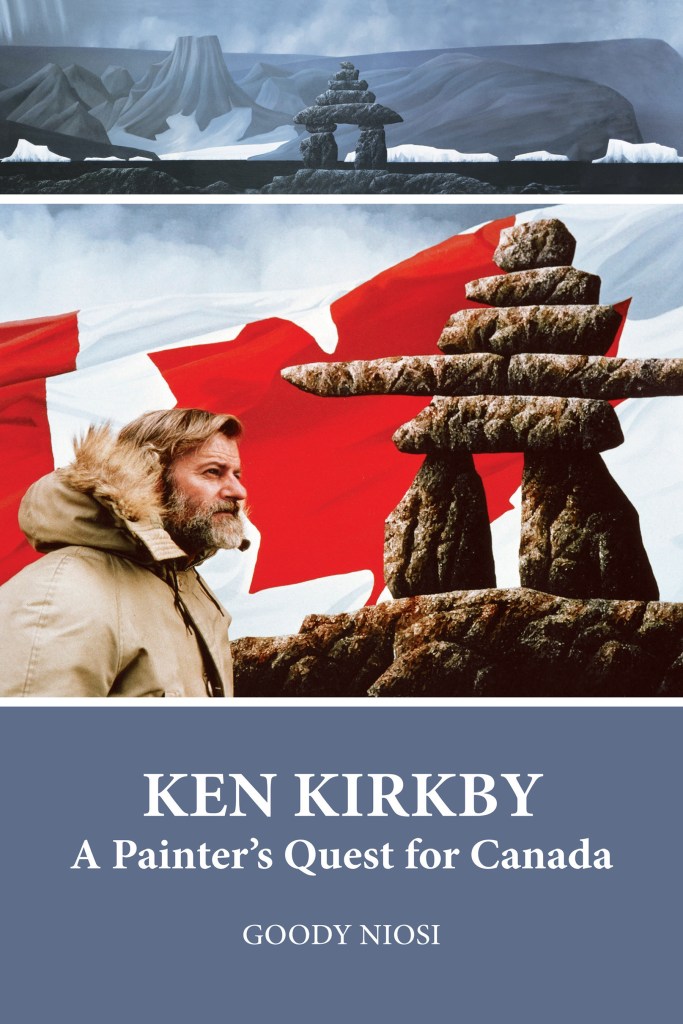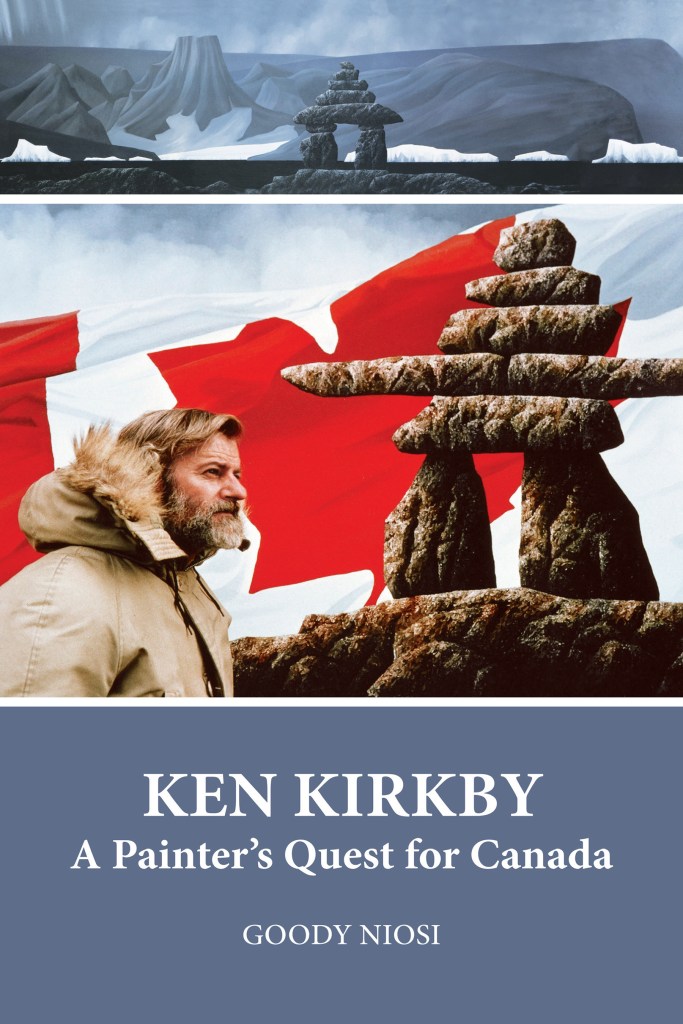
Ken Kirkby, A Painter’s Quest for Canada

excerpt

There is a deep hunger to have the sunshine of their former
homes, and of their great-grandparents’ former homes. There are these
stories that persist about how wonderful life was, and how sunny it was,
and how warm it was. But, with the exception of this little coastal strip,
this is a very cold country. You’re trying to give paintings of vast, distant
places that are freezing cold, to Canadians. Why would anyone, with the
psyche I’ve described, even think of buying one? They won’t even come
out to look at them.”
“Well, Jesus!”
“Go ahead – break my argument.”
“What else about these paintings then?
“One word – pretty. The Canadian art scene is almost non-existent,
but what passes for imagery in the public mind at large is pretty. Doreen!
Doreen! Bring some magazines!”
Fraser grabbed the top one, from the stack Doreen delivered, and
opened it at random. He turned two pages and pointed. “Look – here’s an
ad – it’s perfect. Isn’t that a pretty photograph? Do you notice that it has
a white, sandy beach, a scantily clad couple, and palm trees? People work
very, very hard to make money, so they can save some up and go to that
place – and it’s very pretty. That’s what is in their minds. You and I are the
children and grandchildren of peasants, and we have their tastes.”
Fraser reached into his pack of cigarettes, pulled out a fresh one, and lit
it from the butt that had almost burned down to his fingertips.
“It’s taken Europe an eon to get to its appreciation of art. You’re expecting
too much, too quickly.”
“But, if we don’t push we won’t get anywhere,” Ken said.
“It’s not just a matter of pushing the public. We have to find individuals
who will get behind this. It’s not just good old Alex and Ken who are
going to go and foist this on the country. It’s a much bigger story.”
Ken left the gallery deep in thought. Yes, there was truth in what Fraser
had said but it wasn’t the whole truth. Canada was ready for his paintings.
The Group of Seven was proof. Fraser thought they were rubbish too. If
he wanted to tell his story through his paintings, it wouldn’t be with Alex
Fraser by his side.
Unexpectedly, Ken received a letter from his Aunt Vicki in Madrid. She
had taken the photographs he had sent her, of his latest paintings, and
shown them to a popular gallery owner who wanted to exhibit them.
He tapped the note against his desk, read it again, and picked up a
pen. He wrote a letter to Mr. McEachern, the Minister of Foreign Affairs,
describing his good fortune in coming to Canada, and telling him how
he had arrived in this country. He wrote about his art and said that he
wished to go back to Europe for an exhibition in Madrid.

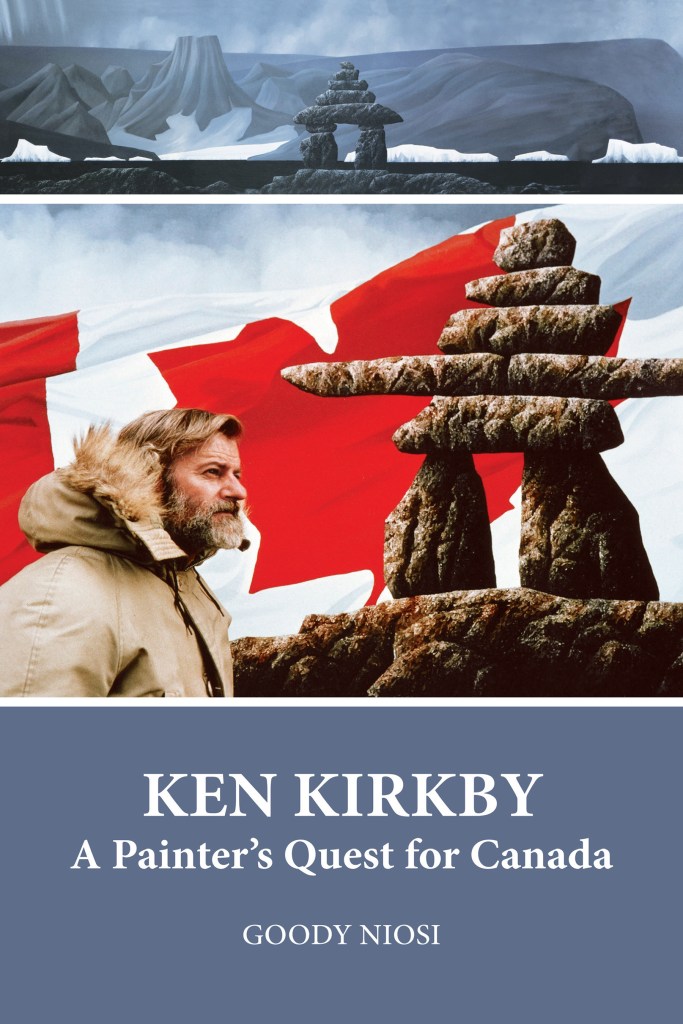
https://www.amazon.com/dp/0981073573

Ken Kirkby, A Painter’s Quest for Canada

excerpt

When he entered the classroom, he sat on the teacher’s desk, his feet
dangling, and told stories about the Arctic. The children listened raptly.
He received another speaking request, and then another, and another.
He accepted all of them. His talks were a training ground for what was to
come. Fraser had been right. “”We’re not selling paintings; we’re selling
stories.”
He spoke to classrooms of elementary students and to older students in
high schools. One time he began with, “Before we get going I want to tell
you, just so that no fraud is committed here – I never went to school.”
The children gasped.
“It’s kind of weird, isn’t it – that I’ve been asked to come and talk to
you but I didn’t go to school? Now, make of that what you will. I’m not
suggesting that you don’t get a formal education, but I am suggesting that
there are those of us who probably fare better if we don’t.”
He shared his thoughts on education – what it is and what it is not. He
wove his ideas into stories of the Arctic, stories of politics, and stories of
old mythology. His stories posed questions. “Why do we think things are
right and why do we think other things are wrong? Where did we get all
this stuff? Who wrote it down? Who says it’s true?”
His speaking invitations multiplied, until he could accept no more. He
met with the principal of one school that had made a request, and said,
“I want to speak to the whole school. Give me your auditorium. This is
a performance, and I don’t want forty-five minutes – I want the entire
afternoon.”
He asked that the banners in the auditorium be taken down, all the
lights turned off, and the windows curtained. He asked for one microphone,
with a long cord, and a spotlight on centre stage. There would be
no adults in the auditorium, although teachers could position themselves
out of sight where they could hear. The children were to come in and sit
on the floor. When they were seated, the room would be plunged into
total darkness, and the children would sit for three minutes in silence,
before he walked on the stage.
“Are you out of your mind?” the principal said. “These aren’t children
– they’re little animals! It will be chaos! You obviously don’t understand
children!”
“I probably do,” Ken said. “I was one once and I probably still am.”
“It can’t be done.”
“Fine. I live in a world where apparently everything can’t be done.
Have you ever tried this?”
“No.”
“Then, you’re educating children and giving them advice based on
things you’ve never done. That’s one hell of a way of going about things.
Well, that’s my offer – take it or leave it.”

https://www.amazon.com/dp/0981073573

Ken Kirkby, A Painter’s Quest for Canada

excerpt

“Why?”
“A painting that is given is all but worthless. It’ll be up in the attic or
down in the basement before you know it. A painting must always be
well paid for and it will be up above the mantel quicker than you can
snap your fingers – and it will stay there. And another thing you need to
know – you never give wealth a gift. It’s one of the ‘middle classes’ really
bad habits.”
When Ken walked into the gallery in Kelowna, Jack Hamilton took
him into the back office and handed him an envelope. “I see you keep
very fancy company,” he said.
Ken tore it open. The premier had written that he would be delighted
to visit the gallery the next morning at eight.
At seven-fifty, Jack staggered down the steps from the apartment above
the gallery, in his rumpled pyjamas, unlocked the front door to let Ken
in, and shuffled back up the stairs. At eight sharp, a chauffeur driven car
pulled up, and Bennett stepped out. He gave Ken a hearty handshake, sat
down at a small table near the front of the gallery and asked to hear stories
of the Arctic. “I thought you were just going up there for a month or
two, but you seem to have gotten yourself lost up there.”
“In a way, I did,” Ken replied. “It’s a long story.”
“I want to hear it.”
He told the Premier about his adventures and the atrocious conditions
the people lived with. He talked about the famine and the disease, and the
autocratic rule of the church, the RCMP, and the Hudson’s Bay Company.
When he finished, he asked if there was anything the Premier could do to
help the people up there.
Bennett stood. “Let’s see your paintings,” he said.
They walked through the gallery.
“What do the red dots signify?” Bennett asked.
“It means they’re sold.”
“It looks like they’re all sold.”
“Yes, they are.”
“You must be doing very well.”
“Yes I am – I’m very lucky.”
“I’d say there’s more than luck involved. I know nothing about art but
I do like what you’re doing, especially that one,” pointing to a landscape
of rolling grasslands. “I’d be interested in owning that one.”
“I’m sorry,” Ken said. “I’m afraid the entire exhibit was sold before it
got here.”
He led him into the back office where three paintings leaned against
the wall. “These are not sold,” he said.
Bennett pointed to one of the high plateau on the Douglas Lake Ranch.
“I like that one. Where is that?”

https://www.amazon.com/dp/0981073573

Ken Kirkby, A Painter’s Quest for Canada

excerpt

“Sure. I’ll be happy to try that, but you know that while I’m doing that
I won’t be painting.”
“Don’t worry about that,” Fraser said.
“I’m not worried. I just don’t want you to get in a huff about not having
enough paintings.”
“I said don’t worry. I’ll make it worth your while.”
“That’s not what I mean. I’m happy to do it for you in return for what
you’re doing for me. And I don’t want any money for it.”
“You don’t want any money! Well, I never – a man who doesn’t want
money. So what do you want?”
“I just don’t want you to get upset when my painting production falls
off because I’m doing other things for you.”
“Of course, I’ll be upset at your lack of paintings. Why wouldn’t I be?”
“But that’s not reasonable!”
“It’s quite reasonable in light of how you present yourself – as the one
apart – the one to whom the rules don’t apply – the one who walked in
here without an appointment. There isn’t a painter in the country that
would dare do that. And, your shenanigans in the Peace River Country
– and your wanderings in the Arctic – as if you owned the bloody place.
You put yourself forward, with a quiet aloofness, as the man who can do
everything and anything, so I’m sure it won’t be any kind of a trick for
you to be in two places at the same time, doing two different things at the
same time.”
“Well,” Ken said. “That’s not how I see myself.”
“Fine. But I’m only telling you how you portray yourself.”
“If I was who you say I am, I’d be able to get my Arctic paintings and
stories out to the public, and I can’t.”
“Your Arctic paintings are the only tentative part of you. You haven’t
come to terms with that subject. You’re unsure and it shows. Everything
else you paint is clear, simple, strong and sure-footed. But don’t be concerned.
In good time, all of this will look after itself. With your confidence
and your bloody single-mindedness, you’ll work your way through it. But
right now, you’re not there and I will neither show them nor recommend
them. In that area you have a long way to go.”
That evening, he related the conversation to Helen.
She laughed. “Don’t tell me you’re surprised. You have an ego as big as
the world. You’re full of yourself. The long and short of it is that you’re
arrogant. Alex is right. You wander into a place, you give it the once-over
and all of a sudden, you’re going to fix everything, you’re in control, and
you’ll take care of it. That’s what it looks like from the outside.”
“It does?”
“Yes, it does. And what do you have in mind anyway? Where are you
heading with all this?”

https://www.amazon.com/dp/0981073573

Ken Kirkby, A Painter’s Quest for Canada

excerpt

While he studied, he periodically found himself distracted by the
thought of the one art gallery in Vancouver he had not approached with
his paintings – the Alex Fraser Gallery. Stories of Alex Fraser, and his
treatment of artists in his London and Vancouver galleries, had circulated
through the art community for years. Ken was angry with himself. He
was rarely afraid of anyone and had met no one in Canada yet who had
intimidated him. Alex Fraser’s reputation did.
He had heard that the man was irascible – so what? He had heard he
was powerful. Was it in his power to judge his work? What if he found it
wanting?
The only thing worse than his fear was the prospect of his disappointment
in himself if he refused to face it, so one day he screwed up his
courage, loaded his truck with paintings, and drove to 41st Avenue near
Boulevard in Kerrisdale.
He walked into the gallery, where an attractive middle-aged woman
asked if she could help him.
“Yes, I’m here to see Mr. Fraser if he’s about.”
“Mr. Fraser doesn’t see people without an appointment.”
“Oh, that’s a shame. I’m here and I have some paintings. Please, can
you ask if he’ll see me?”
She smiled and walked into a back room. A few minutes later, a small
man with slicked-back hair and icy, blue-green eyes walked out. He was
dressed in a perfectly fitted gray pinstriped suit, with knife pleats in the
trousers and shoes that shone like mirrors.
Exhaling a great puff of smoke, he lowered himself into a big armchair,
and placed two packages of Players unfiltered cigarettes and an ashtray
on the little gate-legged table beside it. Taking a fresh cigarette from one
of the packages, he lit it from the one in his yellowed fingers, and crushed
the stub in the ashtray.
Turning to the woman who had followed him out of the back room he
called, “Doreen! Doreen, I want you to tell the young man about manners.
Ask him does he understand the meaning of manners?”
“Mr. Fraser would like to know if you understand the meaning of manners,”
she said, turning to Ken.
“Indeed I do,” Ken said. “And I apologize for coming in without an appointment
but I was nervous and I managed to screw up all my courage
to come in – and here I am.”
“Doreen! Doreen, tell him he is quite right to be nervous in approaching
me. Ask him what it is that he wants.”
“I have some paintings and would like to show them to Mr. Fraser.”
“Tell the young man that I can’t bloody see his paintings, anywhere.
Where are his paintings?”

https://www.amazon.com/dp/0981073573

Ken Kirkby, A Painter’s Quest for Canada

excerpt

With the Group of Seven paintings as
a template, he taught himself to paint again, working only on southern
landscapes. He took several to the owner of The Golden Key Gallery who
placed one in the window and sold it within two days. More sold during
the next few months, but then the gallery owner sold his business and
Ken was once again without an outlet.
Still, he persisted and one day, while sketching the bent shapes of driftwood,
in the dunes near the airport, it occurred to him that he could make
a profit from the abundance of wood on the beach. He purchased a pickup
truck and two chain saws, cut up the wood, wrapped velvet ribbons
around the most attractive pieces, and attached a card with his telephone
number. He left the wood on the front steps of the city’s grand homes
and within days, the orders came in. While he delivered and stacked the
firewood, he told the homeowners his stories of the Arctic, and when
they asked about his paintings, he would display the canvases he carried
in the cab of his truck. The Arctic paintings didn’t sell but the southern
landscapes were a hit.
He taught himself to become a storyteller, rehearsing every anecdote
he had, practising his tone, volume, order of words and, most importantly,
his choice of words. Where was the power of the story?
His clients listened, but showed little interest, so he made a list of every
service club in the city. Would they like a guest speaker at their next
meeting? Yes, they would like to hear about the Arctic, and so, Ken did
the rounds. Each audience contained a handful of people who showed
mild interest – the rest were bored, and often antagonistic. Sometimes
he was heckled, and a red tide of anger would creep up from his chest to
flush his neck and cheeks. Once someone shouted that he, and the rest of
the people there, resented an immigrant telling Canadians how to live in
their country and run their lives.
“That is hardly what I am doing,” Ken retorted. “I intend no disrespect.
I am simply here bringing information from a faraway place.”
His words dropped like ragged bits of paper to lie discarded on the
floor. Perhaps his stories were so outside the experience of most Canadians
that they seemed like tall tales – unlikely and unbelievable. There had
to be a better way to tell people about the Arctic but what was it?
His father told him that he was involving himself in matters that were
none of his business. He was not a citizen of Canada and until he was,
he should keep his opinions to himself. He responded that he was only
doing what he had learned at his father’s knee, in Portugal. He reminded
his father that Ken Sr. had not been a citizen of Portugal and yet he had
become deeply involved in the affairs of that country and had worked
hard to help the people. The Inuit were human beings in great distress, he
said, and he was trying to help.

https://www.amazon.com/dp/0981073573

Arrows

Excerpt

Sweat broke out on my nape and forehead. The woman watched
me closely, giving me the annoying feeling that she could read my
thoughts. Perhaps she was a witch.
When a gourd filled with a milky beverage of uncertain origin
arrived under my nose, I began to miss my countrymen. Tamanoa
held it while the rest awaited my reaction. The children giggled and
I smiled, raising one eyebrow at them. I took the gourd out of
Tamanoa’s grasp, noticing the quizzical expression in his eyes.
“It’s chicha,” he informed me.
I sat down on the ground and crossed my legs, minding the
Seraphic Rosary so that it rested on the cloth of my cassock stretched
between my knees. I raised my eyes to heaven, as much to bless the
chicha as to ask for help. Well, Salvador, if you want the dog, you’ll
have to accept the fleas, I told myself, and took a gulp.
It wasn’t completely unpalatable. Had I known that its
fermentation was aided by the spittle of the women who concocted
it, I might have been less inclined to drink it. I passed it along,
fighting the urge to retch, eyes watering. Mater Dei, please tell me
that gourd never covered anyone’s genitals, I prayed.
The sight of another male with his foreskin neatly strangled with
a cord that went about his hips, his balls—wrinkled and
saggy—hanging like a cockerel’s wattles, made me regurgitate the
devil-sent chicha. I kept swallowing it back until, able to escape
unnoticed, I hid behind a tree and vomited my guts out.

We neared Nueva Segovia de Barquisimeto, a city founded in 1552,
along a murky river the Caquetíos Indians had called Variquesemeto
long before the Spaniards began renaming everything.
Diego de Losada led the way on his magnificent black
Andalusian horse, which seemed to share its master’s dreams of
greatness. All horses except my Babieca were proud, elegant beasts
with thick necks, strong chests and powerful, arched croups. Bred
from the first horses to arrive from La Española,

https://www.amazon.com/dp/0981073522

Ken Kirkby, A Painter’s Quest for Canada

Excerpt

Near the end of the term, when Ken had counted 138 beatings, he once
more entered the office and this time, instead of standing in front of the
big desk, he sat down.
“Don’t sit down,” the headmaster growled. “I haven’t invited you to sit.”
“Well, I’m doing it anyway,” Ken said, placidly. “And I want to tell you
what I think of you. I think you’re a little man – a very, very tiny person.”
Ken held his thumb and forefinger about an inch apart to demonstrate.
“The people who have hired you and who have hired all the people here
have taken very tiny people who will obey their rules, no matter how ridiculous
or horrible those rules are. And you do it because you have no
other place in the world to go. This is your last refuge. This is the way you
have to be. I think you’re evil.”
A light flickered in the headmaster’s eyes. He sputtered incoherent
words as he reached for his cane.
“You cannot inflict pain on me,” Ken said. “Not physically. The pain
that I feel is in a different place.”
The headmaster came at him. Ken pulled down his trousers and lifted
his shirt. “Go on then,” Ken taunted him.
The man lost control and flailed Ken’s back and buttocks until his arm
could no longer lift the cane. He threw down his weapon, stormed out of
the room and slammed the door. Slowly Ken pulled his clothes back on,
feeling the blood soaking into his shirt. This was his moment.
He left the school and walked home. By the time he got there the blood
had begun to congeal and each movement caused pain. Ken Sr. had left
his office early that day and was at home to greet his son. His smile of
welcome faded. You don’t look well,” he said. “You’re white.”
“I’m not too well,” Ken said.
“What happened?”
Ken moved to take his jacket off, but when his father saw the pain it
was causing he put out his hands to help. “What is this?” he asked. The
shirt under the jacket was soaked in blood. His face grew white and his
lips compressed into a thin line. Gently he put his arms around his son,
“What on earth happened?”
Ken told him the story.
His father’s lips grew whiter and thinner until they formed a colourless
line. When Ken had finished his tale, he said, “We’re going to the doctor
right now and we’re also going to the police. He documented the evidence
of the beating with a camera and had charges laid against the headmaster.
The man was arrested and left the country within a month.

https://www.amazon.com/dp/0981073573

Yannis Ritsos – Poems, Volume I

Moonlight Sonata

Φορές-φορές, την ώρα που βραδιάζει, έχω την αίσθηση
πως έξω απ’ τα παράθυρα περνάει ο αρκουδιάρης με τη γριά
βαριά του αρκούδα
με το μαλλί της όλο αγκάθια και τριβόλια
σηκώνοντας σκόνη στο συνοικιακό δρόμο
ένα ερημικό σύννεφο σκόνη που θυμιάζει το σούρουπο
και τα παιδιά έχουν γυρίσει σπίτια τους για το δείπνο και δεν τ’
αφήνουν πια να βγουν έξω
μ’ όλο που πίσω απ’ τους τοίχους μαντεύουν το περπάτημα της 
γριάς αρκούδας –
κι η αρκούδα κουρασμένη πορεύεται μες στη σοφία της μοναξιάς 
της, μην ξέροντας για που και γιατί-
έχει βαρύνει, δεν μπορεί πια να χορεύει στα πισινά της πόδια
δεν μπορεί να φοράει τη δαντελένια σκουφίτσα της
να διασκεδάζει τα παιδιά, τους αργόσχολους, τους απαιτητικούς,
και το μόνο που θέλει είναι να πλαγιάσει στο χώμα
αφήνοντας να την πατάνε στην κοιλιά, παίζοντας έτσι το 
τελευταίο παιχνίδι της,
δείχνοντας την τρομερή της δύναμη για παραίτηση,
την ανυπακοή της στα συμφέροντα των άλλων, στους κρίκους 
των χειλιών της, στην ανάγκη των δοντιών της,
την ανυπακοή της στον πόνο και στη ζωή
με τη σίγουρη συμμαχία του θανάτου – έστω κι ενός αργού 
θανάτου  –
την τελική της ανυπακοή στο θάνατο με τη συνέχεια και τη 
γνώση της ζωής
που ανηφοράει με γνώση και με πράξη πάνω απ τη σκλαβιά της.

Sometimes as evening comes I have the emotion

that outside the windows the bear handler goes by with

his old heavy she-bear

her hair full of thorns and thistles

creating dust on the neighborhood road

a lonely cloud of dust that rises like incense in the sundown

and the children return to their homes for supper and

are not allowed out anymore

although behind the walls they guess the old

bear’s footsteps –

and the tired bear marches in the wisdom of her loneliness

not knowing where or why –

she has grown heavy and she can’t dance on her hind legs

anymore

she can’t put on her lacy bonnet to entertain the children

the loafers or the ones who are hard to please

and the only thing she wants is to lie down on the ground

letting them step on her belly thus playing her

last game

showing her formidable power for resignation

her disobedience to others’ interests the rings in her lips

the needs of her teeth

her disobedience to pain and life

with her certain alliance with death – even a slow death –

her final disobedience to death with the continuance

and knowledge of life

that ascends with wisdom and action above her slavery

https://www.amazon.com/dp/1926763076

Ithaca Series, Poem 705

a second

My hands are cold.

                                              I’ve gone out into the street,

I’ve settled the minor matter

and returned home to take again

my place at this table.

                                              I then discovered

the coldness of my hands,

                                              a sign

which disturbs me perhaps without justification,

it’s just a little thing to have cold hands.

This cold of November

is in my hands, nothing else.                

                                                              It’s me:

I see the simple Greek vase

and the usual evening around me.

But it’s very rare for me to have cold hands.

In a fleeting second, my thought has seen

the probable fog, the filled out gray leaf

where the name I have would be crossed out

with the frosty ink of the end.

ΔΕΥΤΕΡΟΛΕΠΤΟ

Τα χέρια μου είναι κρύα

                              βγήκα έξω στο δρόμο

να ταχτοποιήσω κάτι ασήμαντο

γύρισα σπίτι κι έκατσα στο τραπέζι

                               Τότε διαπίστωσα

πόσο κρύα είναι τα χέρια μου

                                σημάδι

που μ’ ανησυχεί ίσως δίχως λόγο

ασήμαντο να `χεις κρύα χέρια.

Το κρύο του Νοέμβρη

στα χέρια μου, τίποτε άλλο.

                                Εγώ είμαι:

Βλέπω το απλό Ελληνικό βάζο

και το συνήθες βράδυ ένα γύρο μου.

Μα σπάνια έχω κρύα χέρια.

Μια φευγαλέα μου σκέψη παρατηρεί,

μες στην ομίχλη, το γκρίζο φύλλο

με τ’ όνομα μου ξεγραμμένο

με την κρύο μελάνι του τέλους.


Μετάφραση Μανώλη Αλυγιζάκη//Translated by Manolis Aligizakis

Antonio Cabrera, Spain, (1958 – 2019)