
Jazz with Ella

Excerpt

Just as they had spent that first evening on the street, Jennifer and Volodya spent the next afternoon mostly on the street, in the peculiar privacy that Soviets find in large crowds. She bought him cognac and cigarettes at Beryozka the foreign currency souvenir store. He bought her Russian language books, stories of the city, and corrected her sentences. She showed him her contact lenses and how they worked. He marvelled. Such things were unheard of in the Soviet Union, he told her, but he had seen some Japanese tourists use them. That night Jennifer returned to the hotel, Volodya to his home.
The next day as they were passing the Hotel Europe, another accommodation reserved solely for visitors from the west, he grabbed her hand, glanced around to see if they were being followed and walked into the lobby, saying in English, “I want to show you something. Go along with me to the restaurant.” They strolled to the elegant restaurant portal and waited in the foyer. There was no one in sight.
“Hey, if you’re pretending to be an American, you’re holding your cigarette all wrong,” she whispered. “Don’t curl it under your hand. Just let it sit between your fingers. Like so.” She surreptitiously straightened his fingers, rearranging the cigarette. He grinned at her. She felt the warmth of the smile and let her hand linger on his.
“Thank you,” he said in English. “Now look over at that table under the light. I will not point. You see?” Jennifer peered. “See the centre arrangement? That is a microphone—how they listen. Only the ones with that arrangement—and some of the others there, that table and that one.”
Jennifer stared but couldn’t see the difference in the various tables.
“How do you know?”

https://www.amazon.com/dp/1926763246

Still Waters

Excerpt

with pleasant features which, at this moment, looked grim. But he
smiled reassuringly when he saw the fear on the faces of Carol Ann’s
parents. He nodded to Tyne, then turned to them.
“Mr. & Mrs. Shaughnessy, I’m Dr. Kendall. Your daughter will be
fine. She’s in the recovery room, but you can see her as soon as she
comes to the ward.”
Mr. Shaughnessy, who had risen to his feet, took a deep breath. His
voice was hoarse. “Thank you, Doctor. That’s such a relief.” He hesitated,
glanced at his wife, then turned again to Dr. Kendall. “Do you
know what caused so much bleeding? Is it likely to happen again?”
Dr. Kendall’s eyes opened wide, and for a moment he stood immobilized.
Tyne held her breath. Then, appearing to regain his composure,
he stepped further into the room. “I’m sorry. I see you were
not aware that Carol Ann was pregnant.”
“Oh, my God.” Mrs. Shaughnessy’s hands flew to her face.
Mr. Shaughnessy stood rigid, his face drained of colour. “What are
you saying?” His eyes, two deep pools of anger and shock, did not
leave the face of the man in front of him. “What are you saying?” he
repeated, his voice rising.
“I’m sorry to have to tell you this, Mr. Shaughnessy,” Dr. Kendall’s
face registered genuine regret, “but I’m afraid Carol Ann went to
someone to have the pregnancy terminated. Whoever it was did only
half the job. She could have died.”
Mr. Shaughnessy sat down heavily and buried his face in his
hands. His wife broke into uncontrollable sobs as Tyne held her, her
own heart breaking. 
Carol Ann came to the ward from the recovery room at eleven
o’clock. Tyne remained in the waiting room while Mr. & Mrs.
Shaughnessy went in to see their daughter. She thought they might
wish to speak with her before they left. But when they came out
of the room, grim-faced, they passed the open door of the waiting
room without a glance in Tyne’s direction.
Feeling light-headed from lack of sleep and food, she made her
way to the nurses’ station to speak to Sister Mary Louise. “May I see
Miss Shaughnessy now, Sister?”

https://www.amazon.com/dp/1926763068

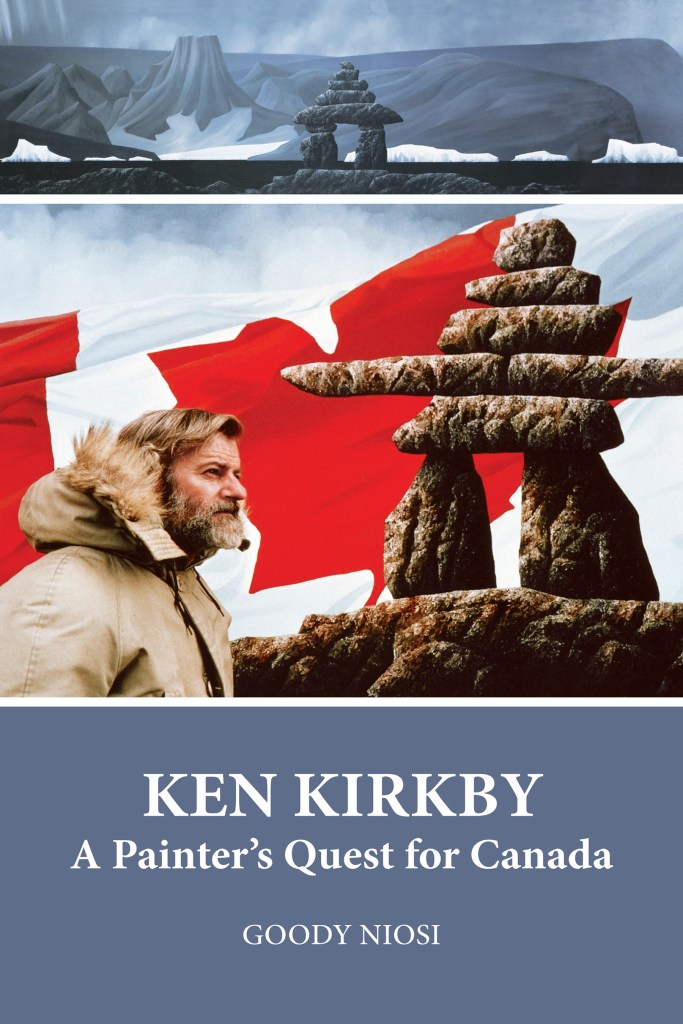
Ken Kirkby, A Painter’s Quest for Canada

Excerpt

distance away observing him. When they saw that he had noticed them,
they came to sit beside him. The man said, “My mother says you are a
very quiet Kabluna.”
“Maybe all Kablunat are quiet,” he said.
The man translated for his mother and said, “She says that all other
Kablunat that she has known are noisy. They talk a lot.”
“Maybe I don’t have much to say,” he replied. “Maybe I don’t know
very much.”
When Ken questioned the old woman about the Inuksuit she told him
a story that began a long, long time ago when there were very few human
beings. They travelled over the vast land in small family groups, following
the herds of caribou that were the source of their food, their tents,
their clothing, and their utensils. They could not afford to deplete their
energy by chasing the food. Instead, they made stone human beings and
called them Inukshuk, which means, like a person or acting in the place
of a person.
The people placed the Inuksuit in V-shaped formations. The caribou
with their poor eyesight, thought the Inuksuit were hunters and so it required
only a very few people to herd them into a trap. The closer they
came to the end of the V, the closer together the Inuksuit were placed.
At the point of the V, hunters hid behind boulders while women
and children lay on the ground beside the Inuksuit. As the caribou approached,
the women and children jumped up, waved their arms, and
danced about, to give the appearance of many, many hunters. The caribou
would then stampede to the end of the V, which was usually at the
junction of a lake and a river. When the caribou plunged into the lake,
the hunters hidden behind the boulders would jump into their kayaks
and paddle after them, spearing them in the water. Then they would haul
them back to shore where the entire family, even the children, would
clean and gut the animals.
Inuksuit also took on many other shapes, the old woman said. The one
on the river’s edge where they were sitting was a fishing Inukshuk. She
knew this because it was topped with a smooth stone taken from the riverbed.
It indicted that the fishing was good here. Other shapes had other
meanings and the configurations of Inuksuit had meaning also.
To my mind, what I was hearing sounded like language but they didn’t
write the language on a piece of paper – they wrote it directly on the land.
And I was beginning to get the picture of absolute practicality. Here you
could live with minimum technology if you knew how. To think that you
could direct an entire way of life by putting a few stones together just so,
so that other people coming would be able to read the significance of these
things. The degree of sophistication of this began to seep into me and I realized
there was much to learn here. And this way of life was like the people

https://www.amazon.com/dp/0981073573