
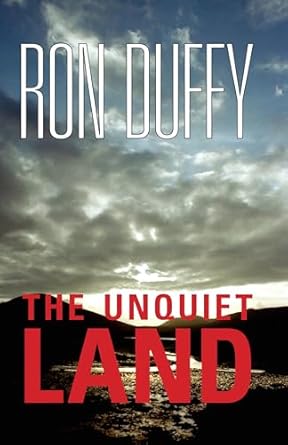
The Unquiet Land

excerpt

“But aren’t you trying to change souls with your sermons? Aren’t you trying to make them more acceptable to your God?” Finn leaned forward on the table, his massive hands cupped around his glass of wine. “The soul cannot be so untouchable.”
“With the word of God one can indeed reach into the soul,” Padraig consented. “But no instrument devised by man has the same power.”
“Ah, we have a conflict here,” said Finn. “Sweeney, fill up my glass and top up your own. Any of you others care to join us, help yourselves to whatever you want. That stage is getting set again. See why I prefer to act than to watch?”
“You don’t act, Finn,” Sweeney observed; “you direct.”
He poured the wine for Finn. The last drops from the decanter he shook into his own glass. His sunset face was blazing crimson, with purple only in the shadows. He replaced the empty decanter in the centre of the table and turned up the wick of the low-burning lamp. Shadows flickered on the walls, on the dark sideboard and the cabinets, on the tall clock and the pale porcelain of the Victory.
“So, Padraig,” Finn went on, “you think the word is mightier than the surgeon’s knife.”
“The Word that was in the beginning, yes; the Word of God that was made flesh as Jesus Christ.”
“What do you say to that, young Clifford?” Finn asked. “Does the Word of God tell us more of man and nature, life and death, than your brain and blade will ever reveal?”
“You’re confusing two separate realms, Finn,” Clifford argued in a precise, dry voice. “The brain is a material thing. We probe into it, repair it, understand it, with the aid of material instruments. The soul is immaterial. We change it, if we change it at all, with immaterial instruments: with words, thoughts, ideas, emotions, that reach it through the mind.”
“Body and mind; matter and spirit; material, immaterial.” Finn repeated the words reflectively. “That sounds reasonable enough. Conflict resolved.” He sipped some wine, then looked at Clifford. “You say that the soul is reached through the mind. So you separate mind and soul?”
Clifford looked around the table self-consciously. Michael was asleep with his head fallen forward on his chest. Seamus and Sweeney stared at their wine and looked as though they wished they too were asleep. Only Padraig, facing Finn across the length of the dish-and-bottle-laden table, stayed alert, leaning back in his chair with his left hand dangling and his right hand holding a half-emptied glass of wine.

https://www.amazon.com/dp/1926763203

The Circle

excerpt

“Yes, indeed. It’s terrible, Bevan, yet what do you think could be the cause of
all this?”
The Admiral doesn’t get the chance to answer right away, because the server
brings their plates. When she walks away, Bevan tells Ibrahim that maybe
Matthew’s death had a lot to do with his work. So much time away from home,
away from his wife, from his daughter. “Who knows, perhaps our line of work is
not meant for family people? Most don’t have the ability to cope with the
pressure. They begin to show signs of stress and despair even from their early
days on the job.”
“Yes, perhaps some people don’t have the ability to cope with the pressure,
deadlines, and demands of the system. Then maybe the problem is not the
people. Have you ever thought of that?”
“Yes, my old friend, I have thought of that many times.”
They remain quiet for a while. Ibrahim raises his wine glass and toasts the
Admiral.
“This is to your good health, my old friend.”
“And to yours, Ibrahim. May Allah bless you with many pleasant and healthy
days…Have a good trip back home. Don’t forget I’m here and you may call me
anytime.”
Ibrahim has tears in his eyes, and looking deep into his friend’s eyes, says the
only thing he cares for is his beloved son who lives here. He asks the Admiral to
make sure nobody harms him or puts any impediment in his path.
“As long as I am alive, you can count on that, my dear friend.”
Then Ibrahim leads their conversation back to Matthew’s suicide. In his
view, the problem hasn’t been the pressure; perhaps it isn’t even the people. It’s
the agency and what the operatives are called on to do for the agency. It’s also
what the other side does with the intelligence turned over to them.
“You mean ‘The Circle’?” the Admiral asks.
“Of course it is, my dear friend. Look inside yourself there where the answer
lies. See how you feel about the results of your work. The other guys you work with
are humans, too. The time comes when they crack, because of the guilt, because of
all the anxiety, because of all the killings and destruction they help create. They see
it in the daily news, they hear about it everywhere they go, they know what goes on
when they see the dead or the maimed soldiers coming back home. Don’t think
you are the only one who feels the misery of what you help create all over the
world, my good friend. Perhaps this man collapsed under the same pressure of
guilt and disappointment for all the years of killings and murders.”
“Yes, perhaps that’s where the root of the problem is. That means we need to
do something about it and bring about change.”

https://www.amazon.com/dp/0978186524

Ken Kirkby, A Painter’s Quest for Canada

excerpt

trying to meet you for years,” he said. Gruber carved decoys, many of
which had made their way into Ken’s extensive collection. “Our paths
have crossed many times,” he said. “But somehow we’ve never met. Now,
unfortunately, we have to meet under circumstances that aren’t the best. I
work for a credit company, and I have to cancel and pick up your gas card.
I’m awfully sorry to do this.”
“That’s fine,” Ken said. “You’re just doing your job. Come over now.”
They talked, while consuming an entire bottle of Scotch, and became
friends for life. Ron and his wife lived in a big house near Jericho Beach,
that had separate living quarters on the ground floor. When Ken told him
he had just lost his house, Ron suggested he move into their ground floor
suite, and a few days later, Ken loaded his possessions into his truck and
drove to Jericho Beach.
Revenue Canada sent a letter demanding a large sum of money in back
taxes on his real estate investments. Because he had never taken the money,
but only reinvested it, it had never been taxed. Ken put the letter on his
bureau. Another letter arrived and then another, until he had accumulated
seventeen progressively threatening tax notices. The final one informed
him he was being sued. Ken took the notices to his accountant who was as
puzzled as Ken. Each one demanded a different sum of money.
When they went to court, the lawyer for Revenue Canada made his
statement. The judge turned to Ken. “Guilty or not guilty?”
“Not guilty,” Ken said. “Impossibly and completely not guilty.”
“How so?”
“Your honour, if I may be allowed to approach the bench and present
you with the situation in writing. But, before I do that, may I ask you a
question in order to help clarify the situation?”
“What if one were walking down the street,” he asked, “and came across
a car lot, and spotted a car he fancied, and wanted to buy it, and the salesman
didn’t know how much it cost? And what if he went to his sales manager
and the manager, also, didn’t know how much it cost? And what if
he went to the owner of the car lot and the owner didn’t know how much
the car cost – would one be able to conclude a satisfactory transaction?”
“Clearly not,” the judge said.
“This would appear to be the same situation,” Ken said, handing the
demand letters to the judge. “There are seventeen different notices here,
which are completely confusing. There is no way, even according to the
accountants I am acquainted with, to make head or tail of it. Every single
one has a different figure on it: that makes no sense at all.”
The judge studied the demands, his frown deepening.
“As far as I’m concerned, I don’t owe the money,” Ken said.
“I think you’re absolutely correct,” the judge said. “This is disgraceful.”
And he threw the case out of court.

https://www.amazon.com/dp/0981073573