In Turbulent Times

excerpt

Petty Officer Joseph Ignatius Carney sat in an empty compartment, staring out sadly at the green and yellow countryside of England. The train chugged through it noisily and slowly. It looked so peaceful. Who could have believed that the country was at war, that it had just been fighting for its very survival like a fish on a hook? Now the worst was over and the battle for Britain won. But the battle for Europe was not going well. The German army had pushed into Yugoslavia and Greece. Yugoslavia had surrendered, and the future for Greece looked grim.
Here in England all of that was a world away. Cows lazily grazed the fresh spring grass. New-born lambs on new-found, nimble legs scampered after shaggy ewes. The first crops were growing in the ploughed fields, and women, girls, young boys, and old men joined farmers in waging their own war against the invidious invasion of weeds. In the few orchards that the train chugged by, the apple and the cherry trees were dressed in blossom like lovely, young spring brides. The April sun was warm, and the faces that turned to watch the train pass noisily by were tanned already. So few were young men’s faces. Many were the so-called Land Girls, thousands of them, recruited from the city to boost farm production to thwart the German blockade of imports brought to the country by sea. Barmaids, waitresses, maids, hairdressers and others working in urban female occupations proved themselves tougher in the fields than the sceptical farmers had imagined. They worked fifty hours a week in summer, forty-eight in winter, ploughing fields, driving tractors, making hay. They undertook the full rigours of harvesting, threshing, and thatching. They also reclaimed land, worked in orchards and market gardens, and though they had to steel themselves to do it, they caught rats as well. As for the men, most of England’s farming labourers were far from their fields and pastures. In other fields their tired, tense faces, rank on rank, were shaded only by their gun-barrels. They were strained and stressed and drained of colour. Or smashed to gory pulp. Or still, limestone grey, like the faces in church effigies, turned towards the blue sky, their eyes closed in the unsought peace of death.


https://draft2digital.com/book/3562904

https://www.amazon.com/dp/1926763270

Wheat Ears

Hermes
Early in the morning Hermes
helped me discover why
I was different
from the statue, tasting as
I was like the abalone.
Individualization
incarnation and
shiny pebbles
by the shore
naked Korae with
the sweetness of fresh grapes
during a summer hespera
purple colored sighs
and the lone martyr who I became
I felt indisposed to uphold
blasphemies of the pious
thus annulling their advice
and turning inward to my roots
the depth of my path I discerned
reaching my catharsis
that the north wind
bestowed unto my body
but not before
I defended the patriot ground,
with my armor:
exquisite gardenia aroma
gills of fishes full of bubbles
and small sponges
that I pulled from
the bottom of the sea
another way
to cleanse the moral impurities
of my soul

https://draft2digital.com/book/3748127#print

https://www.amazon.com/dp/B0BKHW4B4S

Ken Kirkby – Warrior Painter

excerpt

Warriors Come in Many Shapes
“We all grow up with the weight of history on us.
Our ancestors dwell in the attics of our brains as they
do in the spiraling chains of knowledge hidden in every cell of our bodies.”
(Shirley Abbott, Writer)
~~
Ken Kirkby inherited genes from a thousand years of determined and
intelligent men and the clever women who worked beside them. In each
generation, the face of the world inhabited by his ancestors was left
improved. If he feels some pressure to leave his own imprint on his world,
he chooses to do so by inspiring others as he has been inspired; by restoring
what has been spoiled and by righting what is wrong. Justice is an important
word in his vocabulary.
His father, Ken Kirkby, Sr. turned his back on both a fortune and his
influential British steel family as a young man. He left his assured place
in Britain to make a successful life in Australia and eventually returned to
England with a reputation for a sound ability to turn failing companies into
profitable ventures. With World War II on the horizon, he was seconded by
Winston Churchill’s team to transform the venerable but struggling Rover
Motor Company into an efficient, profit-making war machine.
In 1938, he met and married Ken’s mother, Louise May Chesney. Her
father was a respected Spanish industrialist whose family traced their roots
back to Rurik of the Rus, a Dane whose history was recorded in written
form in 746 AD. Ken was born in 1940 and his sister three years later. The
Kirkby and Chesney families left recession strapped Britain for Spain in
1946 and the Kirkby family ultimately settled in the Portuguese village of
Parede, a coastal village south of Lisbon. Their neighbours were diplomats
or professional elite, but Ken’s father preferred to do his own gardening and
knew the children of all his employees by their first names.
Ken’s childhood was unorthodox by any measure. Their family home
on the Avenue of Princes welcomed many of the brightest minds of the
European world at the time, but he ran barefoot with the Gypsy kids, bartered
his drawings in the marketplace and escaped his mother’s restrictions

https://draft2digital.com/book/3562902

https://www.amazon.com/dp/B00CB8W4CG

In the Quiet After Slaughter

excerpt

But their censure didn’t weaken her resolve. She savoured my
father’s embarrassment — and cursed his having been conceived
every step of the way home.
He drank with old navy buddies at one of the Canadian Legion
branches and foolishly denied doing so. He attempted to disguise
the alcohol on his breath with Halls Cough Drops. Tobacco fumes
clung to his clothes like an invisible lint. Sometimes my mother
alleged the scent of woman.
On occasion, it was true, my father would take off for a few days
—to where, no one knows. Going absent without leave guaranteed
an intensified resumption of their conflict at some future date. The
air in our house crackled in anticipation of the rematch.
Once, to regain entry, he claimed to have gone angling with
friends.Mymother circled him warily, a dog sniffing a fire hydrant.
– Lying bastard!
Punishment often entailed his eviction from their bedroom. Banishment
could stretch from three days to three months, depending.
He appeared relieved to be sentenced to an air mattress on the living-
room floor. Because mybrother Burt and I often took myfather’s
side, it was self-serve in the kitchen until a truce was reached. Our
body weights fluctuated accordingly.
I viewed my father’s carousing like this: he was born during the
First World War and orphaned in the Depression. He spent the best
part of his 20s fighting the Second World War. I reckoned the occasional
disappearance was his way of making up for lost time.
People sometimes remarked that my parents seemed to have little
in common. This may have been the case. But there had to be a reason
they were able to cohabit for as long as they did. I think they
were joined together, as many unions are, by the sum of their unfulfilled
expectations, and because as the years passed, options
decreased and habits fossilized.
My parents, you see, were either in love or at war. Rancour
seemed an aphrodisiac. There was no Switzerland, no neutral
ground. It was the one thing they seemed to agree on: the enemy of
love is indifference.
My mother, in anticipation of their evening fete, had passed the afternoon
tethered to the dresser. Her features had been transformed by …

https://draft2digital.com/book/3562874

https://www.amazon.com/dp/B00731WSPE

Impulses

Politicos
We mapped policy algorithms
piercing through modern
pointless void after partisan
campaigns dubious races
swayed by oafs and army chiefs
egos swollen whales
heard hollow promises affected
fervor lists implying god’s locale
and we called the vain politico
for a crumb of substance
his argument was adamant
the god we sought is dead
and the masses gamboled
joyous in contention and agreement

https://www.amazon.com/dp/0981073565

https://draft2digital.com/book/3744513#print

Tasos Livaditis – Selected Poems

THEN what else is the future but our true motherland
since the dream goes that direction and when we die
we’re ahead of yesterday, dead in the great tomorrow,
same as when mothers to be still look at the engagement
ring on their finger in awe, we’re, in tears and already
walking toward time.

https://draft2digital.com/book/3562930

https://www.amazon.com/dp/B087367R7C

George Seferis – Collected Poems

XII
Unprofitable route
What goes on with the rudder?
The boat inscribes circles
and not one seagull
XIII
Sick Fury
She has no eyes
the serpents she held
eat her hands
XIV
This column has a hole
do you see
Persephone?
XV
The world sinks
hang on it will leave you
alone in the sun
XVI
You write
the ink lessened
the sea increases

https://draft2digital.com/book/3562890

https://www.amazon.com/dp/B096TTS37J

The Incidentals

Coal
When the sun was scorching all
earth dwellings the voice of the coal
seller was heard, a sweaty man
promoting his black merchandise,
his treasure trove for people’s heaters,
coal made of olive tree wood, good
heating coal some bought while the sun
up on the horizon smiled ironically for
coal seller who at the end of summer
had brought the cold in people’s minds
and the wine flask and the chestnuts
on top of the burning stove, thoughtful
villagers taking care of their winter needs
justified the coal seller, who
in the summertime, sweaty and tired as he
was selling his black merchandise
to the wise villagers concerned with
the cold days and nights of winter
and you said,
he too had tied an anchor around
his ankle like a donkey fastened
onto his predestined space-time.

https://draft2digital.com/book/3745812#print

https://www.amazon.com/dp/1926763637

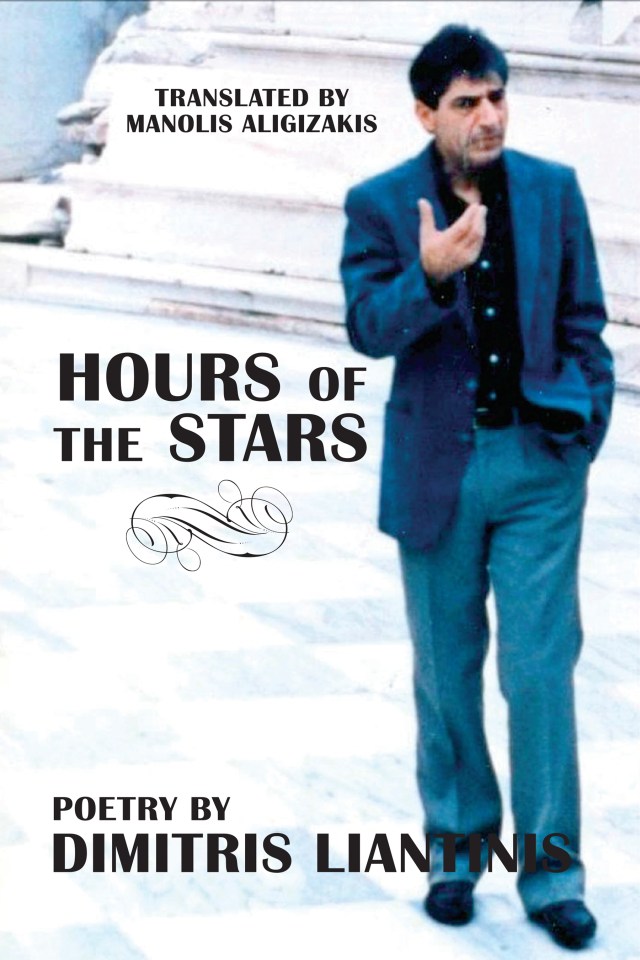
Hours of the Stars

Philemon and Baucis
Plundering didn’t touch our made of sticks hut
dark blue river that encircled us
didn’t make a dent in the conflagration of the city
we laid our limbs
onto the covers of the sun
cared by the sob of our hands
born in idolatry and grace
If we got whipped by the spring windstorm
it was because the winters
opened and shut around us like Symplegades
our unspoken hour bloomed among the cypresses
we gazed the trees that with no tie nor watch
listened to the flow of their sap
stretching their fingers with selfless supplication
and when the gods arrived we welcomed them
because we imagined people like them
not being lucky to ponder
on the uncounted discretion
we didn’t think of death as our Fate
we who have known our forgetfulness
Now our silence a roof over the nakedness of time

https://draft2digital.com/book/3562939

https://www.amazon.com/dp/1926763408

Jazz with Ella

excerpt

“What do you mean by that?”
“Look, it doesn’t have your name on it.” She had the sensation of the floor moving away from her and decided to run for the door while her dignity was still intact.
Back in her cabin tears overwhelmed her. You give me hope. She missed Volodya more than ever. She sat on the bed and smoothed the crumpled paper, studying it, trying to understand what Chopyk had meant. True, it was not addressed to her but had been sent in care of Natasha Kuchkov as tour guide. A number followed—presumably that represented the bureaucratic Intourist agency’s official designation for the tour. If it had not been intended for her, then who? Did he really send it? Volodya was a very common name—and there was no last name. So how did Natasha know whom to check? And how did Natasha know the telegram was meant for her?
Her class that afternoon was conducted in a pall of discomfort. Most of the students had overheard the dispute in the dining room without knowing exactly what had transpired. She thought of having Paul lead the class instead of her but she couldn’t find him anywhere. The mood stayed with her through the formal dinner that evening, well into the hour of entertainment—several of the students had learned Russian poems or ditties and were amusing the Americans by reciting the translations—and it lasted on into the evening.
As she lay awake, she began to have doubts about her behaviour. Maybe Chopyk was only being a good guy, after all—meddlesome but showing genuine concern. Maybe Volodya was a dead loss. After some agonizing, she realized that Volodya must know Natasha. Of course. He must have known her when he had worked for Intourist. She had even said she was from Leningrad. They would have been colleagues. That would explain a lot. So maybe Natasha had known about Volodya and her all along. Could he have wanted Natasha to see the telegram—maybe to let her know that he was attempting to leave the country? Could it be that Natasha was helping? As Jennifer rolled on to her back in the cabin berth she felt the increased pressure from Volodya as if it were some live thing pressing on her chest. What a day! Even the strange comment from Hank in the hallway that morning. It all fit into the stew. She fervently hoped that sleep would give her some respite from her muddled thoughts.

https://draft2digital.com/book/3562892

https://www.amazon.com/dp/1926763246