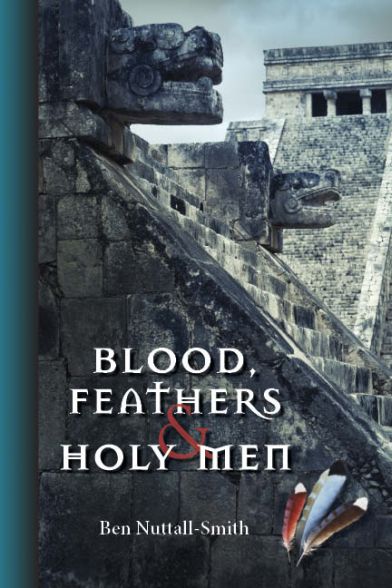
Blood, Feathers and Holy Men

excerpt

Perils of the Sea
As if the wind heeded Finten’s prayer for a quick return to Ireland, a stiff breeze
blew the tiny craft steadily southeast, along the coast of Mull. By noon, they were
in sight of Colonsay but the wind died before they came close to Islay. Now they’d
definitely not reach Kintyre before dark when the North Channel currents would be
most treacherous.
Rordan felt miserable that Finten had chosen to sit next to him as if to make sure
he said his prayers aloud with the other Brothers. Why can’t we just pray silently
on our own. I’m not up to all this chatter when we’re cramped together like this. In
chapel it’s different, I don’t have someone breathing down my neck. He tried shifting
away from the priest but Father Finten just seemed to lean in closer.
As evening approached, a chill wind whipped up waves and enclosed the craft in
clinging fog. The monks bobbed around until they lost all sense of direction. For a
few brief moments, the moon appeared through the mist and, by her position, the
seamen knew they were heading north instead of south.
Keallach exclaimed, “My God, we’re sailing in the wrong direction.” He pulled in
the sail while Laoghaire manoeuvred the side rudder to bring the currach around.
The turn took all of fifteen minutes, an eternity in the choppy sea.
The moon hid behind a black cloud as the sky darkened. Chilly sleet drifted over
the huddled crew and icy rivulets seeped down their necks. Finten crawled between
furs, shivering violently, praying his Pater Nosters and Ave Marias. Brother Ailan slid
a cover loosely over his cauldron. He had just gathered the uneaten supper from
wooden plates to be saved for a later meal and had secured the supplies in leather
bags against the mounting storm. The currach began to be walloped by waves, as she
moved up one side and down the other of each mounting swell.
The dizzying lift and drop made Finten nauseous. Soggy bread that had slipped
from its package swished about in the seawater among smelly slices of semi-preserved
whale meat and kippers. All that and the stench of the dying hermit priest
were more than Finten could stand. He grabbed the wooden bucket knowing he
was about to throw up before he could reach the side. “Out of my way.” He knocked
Rordan from his seat as he leaped up dropping the bucket. “Lord, Lord of the Seas.
Ohhh! My churning gut.”
Father Finten stumbled to the leeward and heaved his stomach contents to the
sea. Swiftly, Brother Ailan moved and grabbed his priest to save him from being
washed overboard. He led him gently back to his seat amidst the furs next to Brother
Rordan who turned his head away to avoid the sickly smell of the priest’s breath.
“Brother Rordan, for the love of Jésu, what have you in your bag to soothe this
wretched sickness?” Finten groaned.

https://www.amazon.com/dp/1926763106

Ken Kirkby, A Painter’s Quest for Canada

Excerpt

Ken circled around the stone people, which he later learned were called
Inuksuit. Around and around he walked, occasionally reaching out a hand
to touch them in a dazed kind of wonderment and awe. For the first time
in many weeks, his spirit began to lift.
I thought I was quite a well-informed person on a variety of subjects,
given that in my upbringing, acquiring general knowledge was considered
important. General knowledge led you to being a generalist and it’s the generalists
that run the world so you want to have vast amounts of knowledge
in a variety of areas. So, you learn about the pyramids and the sphinx and
Stonehenge and Easter Island and all of that. But here were these strange
human-like figures made of stone that I had never heard of – and at that
point, I started to come out of my stupor. These figures got a hold of me. This
was something that captured my attention in a major way.
He set up his tent some distance from them, thinking perhaps they
were sacred symbols and while he struggled with his tent, he kept glancing
at the stone men, reluctant to look away even for a moment lest he
lose the magic. With his little tent tamed, and his camp set up on the
windy plain, he dug out one of his rolls of paper – from the depths of
his backpack – and began drawing. He rolled the paper farther after each
drawing and began another. He couldn’t stop; he was infused with the
same energy he had felt when he first began drawing, in Portugal, as a
young boy.
When his stomach let him know he was hungry, he walked down to
the river and caught a fish. Cooking was a challenge because there was so
little wood of any kind to burn. He had learned to start a fire with dried
moss and then add bits of shrubbery to get an intense blaze that lasted
mere minutes. He usually managed to cook one side of the fish over the
flame. Then he had to start a fresh fire to cook the other side. In time, he
learned to eat and enjoy raw fish because it was so much simpler.
While camped near the Inuksuit for several days, making drawing after
drawing, he noticed a group of people setting up camp some distance
from him near the river. The people on the west side of the river didn’t
acknowledge these people on the east side, and they in turn did not speak
to the people on the west bank. Ken concluded that these were Eskimos,
the people he had been searching for.
The Eskimos paid no attention to Ken and he did not try to make
contact. Instead, he continued to draw, fish and cook his meals. He was
consciously becoming a silent person and the deeper he fell into the stillness,
the greater the solace he found.
One day a woman with a deeply lined and weathered face carried some
fish and bannock on a flat stone to Ken’s tent, placed it on the ground and
walked back to her camp. Ken ate gratefully. “How shall I respond?” he
wondered.

https://www.amazon.com/dp/0981073573