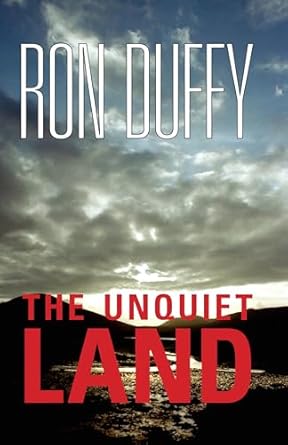
The Unquiet Land

excerpt

Two doors opened off this part of the landing. One led to Caitlin’s room. The other had led to Nora’s room, but Nora was married now and had a home of her own in the village. Caitlin and Nora, night and day, his sisters in all but blood.
The priest turned sharply to the right and followed the landing alongside the stairwell to the front of the house. The old, brown wood of a large cupboard glowed in the lamplight. The door of the bedroom to the right of the cupboard stood half-open, and heavy, catarrhal breathing rasped in the dark interior.
Old Finn has feasted well and sleeps like a king, thought the tired priest. Better not disturb him.
The priest turned to the door of the bedroom to the left of the cupboard. His old room. The room in which he had lived as a boy, laboured over his books with the patient Caitlin, grew to be a man, a young, raw man, dedicated to God. Was the room the same as when he had left it? Yes, it would be. Nothing ever changed here. Tonight, or what was left of the night, he would sleep again in the old iron bed with the patchwork quilt. Nostalgic remembrance pierced the priest’s heart. The blood drained out into his belly and down into his loins. The hot blood chilled and made him shiver. The hair rose on the nape of his neck.
Seven years ago last September. Seven momentous years. Seven long strides from aspiring youth to zealous priest.
He turned the handle, and the door opened without a sound. He stepped inside, pushed the door shut behind him, and walked with silent tread across the polished wooden floor to the bed. He set the lamp down on the dresser.
“Caitlin,” he said in involuntary surprise.
She lay in a cloud of eiderdown. Gleaming even in the dark, her black hair trailed across the pillow, across the shoulder of her green-flowered nightgown. Her arm lay outside the shiny green covers. The priest leaned forward and touched the cool back of her hand. The body turned. The black cirrus stirred on the pillow.
Caitlin, the priest thought. My God, what a beautiful woman you are.
He had come unwittingly to the wrong room. Caitlin had given up her own old room and moved in here for some reason. Yet little beyond the bedclothes had changed from the way he remembered it. Caitlin had changed, though. She looked more mature and even more beautiful. Having seen her, he felt he had to talk to her.
“Caitlin,” he whispered.

https://www.amazon.com/dp/1926763203

Arrows

Excerpt

In the general direction of the enemy, Indian servants placed
forked poles to hold the muzzles of the heavy harquebuses. The
horses whinnied and stamped their hoofs, rustling the foliage as
they tugged at their halters. Somewhere farther away, I could hear
sheep bleating; closer the squealing of pigs.
Losada had mounted his black horse and was now whirling in
circles and bellowing orders, sword raised high over his head. I
glimpsed an Indian woman scampering into the bush with a toddler
on her back, suspended on a thick band hanging from her head. The
Indian servants scurried about, grabbing whatever they could and
herding the animals. All the riders mounted, and the dust cloud
thickened, forcing me to hold my breath. Gregorio ran past me,
balancing a harquebus in his hand.
“Don’t just stand there, hide!” he bellowed, his voice almost
drowned out by the racket.
“Where is she?” I yelled back.
But he was gone to join the harquebusiers gathering behind the
riders. I hunched into myself, rosary tight in my right hand. I came
upon the fire, blinking to clear the smoke from my eyes, and found
the last place I’d seen her. I stumbled over a basket and nearly fell. In
the name of all saints, I didn’t even know her name!
The servants had disappeared. I was the only idiot awaiting the
arrows. At the sound of grunting, I looked down to see a pig
careering into the heart-shaped leaves of a huge philodendron. I
followed the pig.
It took a moment for my eyes to grow accustomed to the dimness
in the jungle. I could discern crouching human silhouettes. Indian
women were huddled together on the ground, some crying, others
staring vacantly while frightened children clutched at them, some
finding oblivion at their mothers’ breasts. I made hushing sounds
and touched a shoulder here, another there, gesturing toward the
trunk of a big mahogany tree and mimicking the arrows falling

https://www.amazon.com/dp/0981073522

Arrows

Excerpt

Sweat broke out on my nape and forehead. The woman watched
me closely, giving me the annoying feeling that she could read my
thoughts. Perhaps she was a witch.
When a gourd filled with a milky beverage of uncertain origin
arrived under my nose, I began to miss my countrymen. Tamanoa
held it while the rest awaited my reaction. The children giggled and
I smiled, raising one eyebrow at them. I took the gourd out of
Tamanoa’s grasp, noticing the quizzical expression in his eyes.
“It’s chicha,” he informed me.
I sat down on the ground and crossed my legs, minding the
Seraphic Rosary so that it rested on the cloth of my cassock stretched
between my knees. I raised my eyes to heaven, as much to bless the
chicha as to ask for help. Well, Salvador, if you want the dog, you’ll
have to accept the fleas, I told myself, and took a gulp.
It wasn’t completely unpalatable. Had I known that its
fermentation was aided by the spittle of the women who concocted
it, I might have been less inclined to drink it. I passed it along,
fighting the urge to retch, eyes watering. Mater Dei, please tell me
that gourd never covered anyone’s genitals, I prayed.
The sight of another male with his foreskin neatly strangled with
a cord that went about his hips, his balls—wrinkled and
saggy—hanging like a cockerel’s wattles, made me regurgitate the
devil-sent chicha. I kept swallowing it back until, able to escape
unnoticed, I hid behind a tree and vomited my guts out.

We neared Nueva Segovia de Barquisimeto, a city founded in 1552,
along a murky river the Caquetíos Indians had called Variquesemeto
long before the Spaniards began renaming everything.
Diego de Losada led the way on his magnificent black
Andalusian horse, which seemed to share its master’s dreams of
greatness. All horses except my Babieca were proud, elegant beasts
with thick necks, strong chests and powerful, arched croups. Bred
from the first horses to arrive from La Española,

https://www.amazon.com/dp/0981073522

Arrows

Excerpt

“We cultivate corn, roots and cacao,” he said. I remembered the
sweet, delicious aroma of a cup of hot chocolate. He must have read
my mind or heard my stomach rumble. “You must be famished!” he
said. “We ought to find you something to eat. Let us pay doña
Perpetua a visit in the kitchen.”
I followed him into the parish house. It looked like one of those
straw lofts we had in Spain. The inside was austere. Brother Carvajal
invited me to take a seat on a chair made of hide that smelled
strongly of its previous owner. A table, two chairs and a cabinet
completed the furnishings. The house was spacious, with a thatched
roof nine or ten feet high. It had a muggy, earthy smell to it. The
interwoven wattles protruding from the mud walls were
disconcerting.
He opened a trunk and produced a bottle of wine and two silver
cups.
“It’s wine from an outstanding harvest,” he said, “a present from
the new governor, don Ponce de León. Do you care for wine?”
I had little knowledge on the subject beyond colour and
sweetness and was going to say so, but he continued.
“It’s my only indulgence,” he said, chuckling at the double
meaning. I smiled, because we both knew an indulgence was a
pardon of sins granted—or sold—by the Church to the faithful. He
sniffed the open bottle. “These hazel-coloured wines are vigorous
enough to survive the crossing of the ocean without detriment to
their quality. The ones from La Mancha are the favorites in court.”
He filled the cups and handed me one. He waved his cup under
his big nostrils, then sunk his nose into it. “But, please, let us toast
the joyful arrival of another labourer to this field and the merits of
our allotted toils. May the Almighty bless them and give us drink
from the abundant flow of the fountain of his sacred heart.”
“How long have you been here?” I asked.
“Ten years, my son! Ten years of unremitting struggle to build
this.” His eyes scanned the wattle and daub walls,

https://www.amazon.com/dp/0981073522

Arrows

Excerpt

“My mother always worked in a household.”
“Why is it bad to ask your name?”
“You didn’t ask my name. Say the words again, and I’ll tell you
what they mean.”
The horse had begun to graze, and Tamanoa took hold of the
bridle again.
“Matircom yeunatir ueipano dauquir” I repeated slowly.
“Breasts, nipples, whore . . .” His voice trailed off as he signalled
the meaning of the last word by pointing to his crotch. “And what
was the other thing you said? Ah, yes. Guecenar onque. That means
give me your . . .” Again his voice trailed off, and he turned and
pointed to his rear end.
Heat rushed to my face. I massaged my eyes with the heels of my
hands and heard him giggle.
Torn between anger and laughter, I laughed. Benjamin, Benjamin.
He had taught me words I would never have dreamed of saying,
and I had repeated them like a parrot. No wonder we had gotten so
many looks. I was laughing so hard I removed myself and my horse
from the convoy.
“It was Benjamin,” I said. “So it’s your turn to help me. How do I
ask your name?”
“It depends. There are Indians from far away who have been
brought here to work, and we all speak different languages. But in
mine it would be atiyeseti?”
“What language is yours?”
“Cumanagoto. Carib. It comes from the eastern coast. It’s the
most common. My mother came from the region of Cumaná.”
“Are the families brought here together? As husband and wife?”
He shook his head. I looked at the Indians around me. That could
explain much of their sullenness.
In the year 1511, the Church had proclaimed the equality of men
and denounced the Spanish debauchery in La Española. But in that
same year, King Fernando El Católico had declared the branding of
cannibals. For the Spaniards, natives out of range of missionary
protection were cannibals. They were raided and sold as slaves.

https://www.amazon.com/dp/0981073522

Arrows

Excerpt

Bartolomé let him go, patting him on the shoulder. Pánfilo bent over
and coughed, hand on his throat as though choked instead of rattled.
I crouched beside Antonio and tilted the flask. I wasn’t sure how
much would suffice; a few drops would have to do as more would
kill him. I concentrated on balancing against the movements of the
ship and tilted the flask just a little more until a few droplets fell into
Antonio’s limp mouth. The potion squirted between Antonio’s lips.
He coughed from the bitterness and tried to sit up.
I gasped and tried to clean the excess with a rag, but it was too
late. Antonio had swallowed it all. I uttered unconfessable
commentaries under my breath and glanced at Bartolomé. He
looked at me, and I shrugged helplessly. We took our positions in
silence. I buried my nostrils in my armpit while positioning my
hands on Antonio’s chest, bewildered by the stench.
Benjamin knelt beside me, arms straight down, squashing
Antonio’s good leg. I was sweating, we all were.
Bartolomé produced a leather bundle and carefully spread it on
the floor, revealing a number of surgical instruments. Rag strips
were neatly folded in a small pocket. In the monastery, Fray
Bernardo had taught us to cure wounds. A few times we saved the
life of one of the animals by cutting an infected limb. We had always
proceeded faster when we placed a board underneath for support. I
found one and put it under the leg with a subtle nod to my brother.
He acknowledged with the sharp knife, ready to cut.
“Lord, have mercy.” I said.
In the uncertain light given off by two candles, Bartolomé crossed
himself and began cutting with long swift movements. Antonio’s
drunkenness and my potion failed to stop him from becoming a
struggling, swearing beast, but finally he passed out when
Bartolomé began sawing the bone.
We loosened our grip. Pánfilo gawked at the wound. Better he
keep his mouth shut for, whenever he talked or breathed, the foul
odor of his remaining teeth made me want to vomit.

https://www.amazon.com/dp/0981073522

Arrows

Excerpt

Despite it all, I felt gratified to be useful. Rats were a frequent
nuisance on ships; they woke us up at night, walked on us, dug their
teeth into our flesh. Many sacks had holes, and in some the rats were
still feeding. What to do? Benjamin was wiggling a stick in his hand.
He snuffled repeatedly while throwing me a similar weapon.
We took the hideous fruits of our slaughter to the upper deck,
spilling them overboard. The bodies of the rats floated on the surface
until two small sharks appeared and devoured them.
“Do what’s bad and expect it back,” Benjamin said, waving an
accusatory finger at the rats. I couldn’t tell whether he was joking.
Normally he was laughing. His eyes turned into a glittering line
whenever he laughed—but for several hours he had seemed almost
despondent.
“Something bothering you, my friend?” I asked.
He shrugged. “I’ve been from here to there and back all my life,
not knowing where night would find me. I thought life at sea would
be better, but . . . I should never have come.”
Our work together below decks had brought us together. This
was a different sort of confessional than I was accustomed to
hearing. I felt the solution was not necessarily in God’s hands.
“Why don’t you come with me to join the expedition? I’m sure
they will need a strong man like you.”
He looked up, eyes brighter, then his shoulders slumped again.
“I’ve signed on for five years with the captain,” Benjamin said. “I
have to stay.”
“You leave that one to me,” I said. And so devised a simple plan,
knowing I would soon be losing my brother’s companionship.
Although I felt I did not need my older brother as a protector, I knew
Bartolomé liked to feel he was necessary to me in that way.
Therefore, if Benjamin went to Bartolomé and volunteered to act as
my guardian in the New World, my brother might allow Benjamin
to leave the ship to accompany me, for my benefit…

https://www.amazon.com/dp/0981073522

Arrows

Excerpt

I gripped the lifelines, my habit soaked and
pasted to my body. He shook his head and curled his mouth as he
placed his bare feet on the steps.
Bartolomé glared when I came up to the quarterdeck. He and the
helmsman were fighting with the long tiller to steer the Isabella who
was surfing a wave downwind with increasing speed. He was too
busy to pay me attention.
I could see he was thinking hard, for he had seen men break their
bones when propelled by the long tiller as the waves jerked the
rudder.
The pilot concentrated on the movements of the needle in the
compass set in a wooden box fixed onto the binnacle. A sailor tried
to record the time and course while another minded the sandglass.
Every man there had a duty to perform; all others were tucked away
in the relative safety of the ship’s innards. Bartolomé chewed his
inner cheek, as he always did when considering his options.
The visibility was nil, no other ships were in sight. Every vessel
was on its own now, each full of men fighting for their lives and
praying, the galleons surely better off than the Isabella. They didn’t
have the wretched high castles fore and aft, taking all the wind and
making the vessel ungovernable.
Bartolomé growled, covering his eyes with one hand and
lowering his head without releasing his grip on the tiller. I saw his
lips move silently amid the roar of wind and sea. He could attune his
senses to the mood of the wind, feeling it on his nape, sniffing it out
of the air, hearing it on the sails and rigging.
Bartolomé knew I was adamant about staying on deck; nothing
short of an angel or God’s thunderous voice would send me down.
He aimed a sullen glare in my direction and yelled to the sailor
minding the sandglass to pass me a coil of line. I caught it in the air
and fumbled, keeping an eye out for waves until I found the end of
it. Bartolomé motioned me to bring it around my waist. I managed a
knot above my Franciscan cord and tied myself to the rail as the
others were to the binnacle, but he sighed, nodded to the pilot, let go
of the tiller and came to tie the knot to his liking.

https://www.amazon.com/dp/0981073522

Arrows

Excerpt

I retched again and leaned to one side to let out a stream of bitter
bile. I blinked in the darkness and looked around without the least
hope of standing up. The roof was low and the hot air impregnated
with damp and the smell of unwashed bodies, vomit and bilge; the
air seemed to congeal as I exhaled.
How long had we been rocking and shaking in this darkness? A
day? Two? “Eloí, Eloí, lama sabactani?” I quoted, meaning every
word our Lord had said when feeling forsaken on the Cross.
Trembling, I grasped a coil of rope. My tonsured head was bathed
in cold sweat; drops trickled down my forehead, slid down my neck
and soaked my grey cassock. The Seraphic Rosary dangled from my
cord, rippling monotonously. I took no more than shallow breaths,
distracting my mind amid the artillery, lines, water barrels and
cases, some knocked about by the sea’s fury despite having been
lashed down.
The hatches and portholes were kept closed to avoid water, and
the lighting of candles was strictly forbidden. I had withstood the
first hours by meditating on the Passion of Our Lord, but once
overcome by sickness, I could not stop vomiting.
The danger on deck had confined many men below: the carpenter
and his mates, the cook and his galley lads, the gunners, seamen
awaiting the change of watch. We sat close to one another, sweating
and praying, eyes fixed on the ceiling, following noises from the
upper deck. After making vows and promises to the virgin,
swearing to make penitence of fasting on bread and water the first
Saturday of every month, some wished to confess.
To my surprise it was Pánfilo, a wiry old midshipman who had
lost most of his front teeth, who came first. I dried my face with the
sleeve of my habit, uncertain of my strength, and passed my hand
across my wet chest and aching belly. My stomach was void, though
still assaulted by waves of nausea. “Move over, hombre! My sins are
only God’s to hear, you filth,” lisped Pánfilo. Others shifted. Pánfilo
knelt beside me.

https://www.amazon.com/dp/0981073522

Arrows

Excerpt

We threw together in a childish competition
that entertained not only us but also the lads kneeling in groups of
four holystoning the deck.
“Hey!” I turned and saw the weather-worn face of Pedro Mendez,
the ubiquitous bosun, obscured by the sun at its zenith, as he
glowered down at us from the quarterdeck. Already, everyone
knew better than to provoke him.
“Ballast is for ballast,” he snapped. He marched toward us, bare
feet turning inwards, glared at the bucket, snatched the stone from
my hand and shoved the bucket at Bartolomé’s page, a boy
nicknamed the Canary for his constant whistling. As the bosun
returned to his duties, my fellow passenger chortled, half-covering
his mouth with his hand. He took a big step back and bowed with
one hand on his belly, the other on his back.
“Gregorio de la Parra, at your service.”
I had seen Gregorio a couple of times before but had never talked
to him. To my surprise, I quite liked him. He was different from the
man who stood apart with a haughtiness around his jaw and neck
that went all too well with his inquisitive brown eyes.
“What did you do back in Spain?” I asked.
“I studied Canon Law in the University-College of Santa María de
Jesus in Seville,” he said. “But my godfather, who lives in Havana,
wanted me to join the next expedition to the land of the Caracas
Indians.”
“Why, God must have something in store for us, my friend!” I
said, “I was sent to join the same expedition!”
I assumed we might become friends but instead he briefly
frowned and looked me over as though for the first time.
“Did you finish your studies, then?” I asked, changing the subject
but keeping the smile in place. He pulled at his leather doublet to
make it fit more comfortably.
“No,” he muttered, straightening his back and looking away.
“Are you planning to finish them?”
I was mystified by his sudden solemnity. His eyes took on a
piercing intensity.

https://www.amazon.com/dp/0981073522