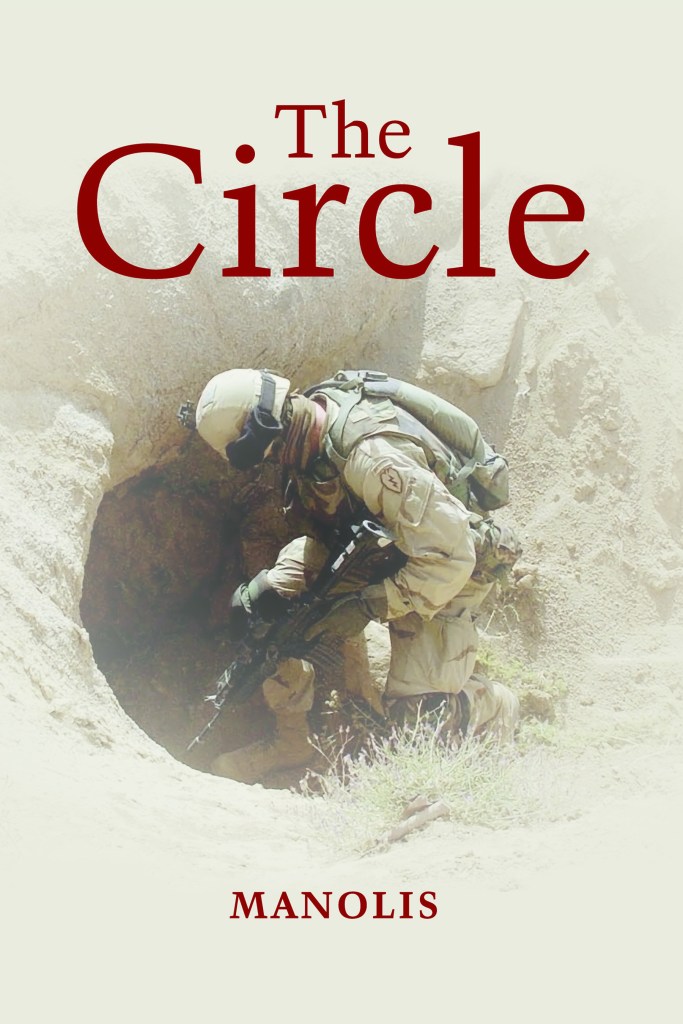
The Circle

excerpt

have to do now is carry on one day at a time. I’m sure we’ll manage. If you are
concerned about money, don’t worry, we’ll find our way.”
“I don’t worry about money, mother—not at all. I’m just trying to see life
without Dad from now on. It will be hard to adjust.”
“We’ll manage, you’ll see. Just be careful and take care of yourself. Hakim
appears to be a very good man and I know he’s to come into a lot of money. Your
father told me all about it.”
“Why did Dad look into Hakim’s life, Mom?”
“Well, honey, that was your father.”
Later at around six, Hakim tells Jennifer he wants to go see how his uncle is.
The limo will take him to the Sheraton Hotel and from there, when he’s done
with Ibrahim, the driver will drive him to his apartment. Cathy gets up also and
says goodnight to Emily.
“Don’t forget to call anytime, remember?”
Helena also says goodnight and leaves.
“I’d like to go with Hakim, Mom. Are you going to be alright?”
“I’ll be just fine, honey. Go, I’ll be just fine. Talal may stay for a while to keep
me company. You just go.”
Hakim is ready to go, when Talal whispers in his ear, “I’ll stay for a while to
keep Emily company, okay?”
“Are you going to be okay?” Hakim asks, looking at Talal.
“We’ll be just fine. You guys go and see Ibrahim. Say hi to him for me.”
They walk out to the limo and Rassan sits in the front with the driver and
Hakim with Jennifer sit in the back. Fifteen minutes later they arrive at the
Sheraton. They find Ibrahim in his suite happy because he’s out of the clinic and
because the chemotherapy hasn’t given him any negative side-effects, so far.
“Hello, my uncle, how are you?”
“I’m fine, my dear boy. What is this about Jennifer’s dad?”
“He is dead, sir. The police are doing their work now; we’ll hear from the
medical examiner in the next little while,” Jennifer says.
“Oh, my dear, oh, I’m so sorry,” he opens his arms as if ready to hug Jennifer.
She takes the opportunity and falls into his arms. Ibrahim is a bit surprised by
this; however, he knows that this is customary for North Americans, and he hugs
the young woman. Hakim smiles. His uncle is very fond of Jennifer, and that
pleases him a lot.
Ibrahim is already prepared for his return home and Rassan is making the
flight arrangements for as early as tomorrow. Mara will be most happy to have
him home with her.

https://libroslibertad.com/2016/11/09/the-circle-a-novel-by-manolis/

Jazz with Ella

excerpt

That idea began to grow within him. He wanted to try being Montreal Paul. Maybe it wasn’t too late. In Canada, he could also study Russian, he thought. By that time it was 1963—the Berlin Wall had been constructed two years earlier, and the fear of Communists had driven many Russian speakers to deny their heritage. Yvonne’s home, on the other hand, had become a safe haven for Russian emigres, a place where they could speak freely, down brandy, and discourse on Russian art without being accused of being bolsheviks.
“Surely this is the time to be learning the language of our enemies—not being afraid of it,” he announced to Yvonne, with the earnestness of a 17-year-old. Although he truly believed his own words, he was also restless. He wanted to get out on his own and see Canada again so he kept at this theme as a possible reason for why he must attend university there. It worked. Yvonne had put aside a trust fund for his university studies, and she turned it over to him on his eighteenth birthday. At the same time she also told him that she would leave the bulk of her estate to him on her death.
He was selected for the University of Vancouver, on the west coast of Canada, far from Montreal but not so much of a culture shock for a kid raised in California. For seven years, he lived in Vancouver and was convinced that the Russian language department was all he wanted. He was torn from his academic shell by the news that grandmother Yvonne had died suddenly of a heart attack. At age 75, she had taken a new young lover who, it was whispered at the memorial service, had exhausted her. The gossip was malicious, Paul thought, but if only half of it were true, he couldn’t help but admire Yvonne’s love of life and her ability to take emotional risks even into her seventies.
Why couldn’t he find a woman who exhausted him? Most of the women he met were not serious students so there was no meaningful conversation. They knew how to have a good time, kind of like the old days at Shakey’s Pizza, and he badly wanted to bed one of them—it didn’t matter which one—but it seemed dishonest because he knew it was purely to alleviate his own carnal desires.
Now, on this warm summer evening in the heart of the Soviet Union, some latent urge was manifesting itself. Unscholarly thoughts filled his mind: ice cold beer in the university pub, a woman’s browned skin in a white summer top. Sensual things, hands-on things. Music moved him.

https://www.amazon.com/dp/1926763246

Jazz with Ella

excerpt

David smiled. “You know, I don’t know when Gorky wrote that, but it’s the utterly perfect story for this country in 1974. Don’t you find that so much that’s told to us is a beautiful illusion when the truth is really ‘bitter’?”
“Yeah, I know what you mean,” Paul continued. “The Soviets are like the old man—they just ignore the failures. The elevators that don’t work. The trucks that break down. The harvests that don’t yield what they expect. We visitors are like the father—we have to put a name to it, admire the beauty, then we point out that it’s not the truth. It’s no wonder they don’t really like our visits.”
“This is great philosophizing,” Maria cut in, “but I hear the truth right now.” She leaned over the railing. “I’m sure I hear a real nightingale singing.” The notes were pure and true, haunting. The group was quiet for a long time, listening, delighted.
Finally Paul got up from his deck chair. “Nah, it was just a scrubby little village lad.”

Paul Mercier returned to his cabin with the intention of diving into the definitive biography of the Sentimentalist period writer Karamzin that he had been trying to finish before the end of the trip. It had been difficult to find any study time because of their rigorous sightseeing schedule, though his conversations in Chopyk’s advanced class had been informative. That’s one thing about the guy, he is a serious scholar. He wondered if academia was truly his own calling. Did he really want to end up like Chopyk—an old lady, unloved by students and women alike? When they started out on this trip, he had found it easier to read the Sentimentalist view of nature in literature than to be out in the streets of Moscow actually viewing the real thing. But while they were in Leningrad something new had been emerging, something not found in books. He had been taking enjoyment from the scenery; it was refreshing. And he had even been moved by the rich, barbaric Russian history he saw depicted in paintings and church frescoes. For amusement, Paul had been keeping an informal list of the countless statues of Lenin they had seen to date, the endless art galleries, museums, and palaces of culture they had visited, but now he threw down these lists in disgust.

https://www.amazon.com/dp/1926763246

The Circle

excerpt

“Matthew,” she yells, but hears no answer.
She walks upstairs to their bedroom. Everything is the way she left it before
going out. She goes toward the bathroom and before entering, sees his body
through the half-opened door.
“Oh, my God!” she yells to herself. “Oh my God, Matthew…” She leans
against the door frame of the bathroom. “Oh, my God, you found the courage for
that!” It seems as if she’s waiting for an answer from her dead husband.
She lets her body slide down along the door frame to the floor of the bathroom,
and sits staring at him. All the clocks of the world suddenly stop, and Emily
Roberts exists in a timeless state, in a condition of self-absorption and
contemplation, as if amid the petals of a diaphanous flower, or amid the thorns of
a crown an invisible hand has placed on top of her head, and her blood begins to
trickle down her forehead like in a crucifixion. Then suddenly, time strikes loudly
on her left tympanum and pierces her head to the right, making her blink as if
trying to find consolation among the myriad bad thoughts flooding her mind. The
world doesn’t have any consolation for Emily Roberts, not now, not at this
moment, not today. The world has turned into a new purgatory and Emily floats
like a masked misery searching for the proper face. She feels an inexplicable
numbness; not hatred anymore, not anger, not joy—but a feeling of immense
freedom from the chain she has dragged for such a long time. She feels no pain, but
what is it she feels? Is she filled with fear or is she light as a feather, like a free
butterfly flitting from one flower to the other? Time strikes again as if hitting a
loud cymbal and brings her back to this world where she has things to do. She
needs to call Jennifer; she needs to call the police; perhaps she has to call Bevan;
and yes, she needs to call Talal. Oh, God, how she needs to call him now.
She runs downstairs and picks up the phone.
She dials Talal’s number first.
He answers, “hi, sweetheart, what’s up?”
“Matthew. Matthew is dead.”
“What? How? Are you okay? I’m coming right over. Stay calm, I’ll be right
there.”
She dials Jennifer’s cell number.
Jennifer answers, “hi mom, how are you?”
“Sweetheart, it’s your dad. Come home, please. Your dad is dead.”
Jennifer is with Hakim in Ibrahim’s hotel room. They have helped him from the
clinic to his suite at the Sheraton. She’s flabbergasted hearing about her dad being
dead. She says aloud, “What happened? How? I’m coming home, right now.”
Hakim, who has overheard, says, “What happened? Is everything alright?”
“No honey, I have to go home, right now, please. My dad is dead.”

https://www.amazon.com/dp/0978186524

Jazz with Ella

excerpt

ROSTOV-NA-DONU, JULY 13, 1974
The Canadian student tour group were old hands at Soviet travel by the time their plane left Leningrad bound for Rostov-na-Donu in the Ukraine. The usual plump stewardesses, more relaxed on this domestic flight, handed out the usual sticky candy. The students played the now familiar game of who had the functioning seatbelts. David had no seatbelt, and he threatened to hang on to Paul’s leg for the duration of the flight should they meet turbulence.
Despite the gloom of parting from Volodya, Jennifer’s spirits lifted slightly. The plane was full of Ukrainians returning home—women in harem pants, swarthy men with metallic, toothy grins carrying bundles, carpets and, in one case, something alive in a cage that screeched at intervals. The passengers moved around the plane freely, paying no attention to the attendant yelling at them.
Jennifer wasn’t the only one who was mourning the loss of a friend in Leningrad. Ted had ended his stay there at a party with students from the institute. He had met them on the street, and over some powerful moonshine liquor they had discoursed heavily on the problems of the cold war and had resolved to bring peace to their various countries. Unfortunately, Ted couldn’t quite recall how they had proposed achieving this lofty aim. Lona had also found some friends in Moscow, it seemed, and was only now telling the group about them. Jennifer wondered if Lona would have admitted the liaison if she had not been spotted outside the hotel with a group of sharp and eager young men whom everyone suspected of being some kind of confidence tricksters. If anyone can take care of herself, it’s Lona, thought Jennifer, and she wondered if Lona’s swains had asked her to help them leave the country. Then, in an attempt to shake off…

https://www.amazon.com/dp/1926763246

The Circle

excerpt

incinerated bodies, and pain. Then she remembers the body of a man next to
hers and she is being violated. Her mind, suddenly feels as if it is exploding when
she realizes what had really happened.
She turns to Matthew and says, “So, you have come to enjoy necrophilia
these days, Matthew Roberts. You must be really desperate. You obviously
couldn’t wait until morning.”
He turns looking at her with a smile.
“You looked so attractive, sweetheart, I couldn’t resist.”
Suddenly the room becomes dark and an explosive anger overtakes her
whole body; her eyes darken and her heart accelerates in a frenetic rhythm as if to
break through her chest and run away, burning everything in its path.
“Of course, you couldn’t resist using your weekend whore. That’s what you
always do, five minutes for your pleasure; five minutes is always enough for you
to find your manhood at its peak. The thought of how you view lovemaking
makes me puke,” she yells.
He’s flabbergasted by her outburst; he has never seen his Emily in this state of
mind. This is not his Emily, the quiet calm person he has known all those years.
She screams from the depths of her larynx and her voice carries such disgust,
such pain, such nausea that his eyes and mouth open wide and he doesn’t know
what to do or say. Suddenly, he interrupts her.
“What is it, sweetheart? Why all this commotion?”
“Don’t sweetheart me! Don’t you ever dare sweetheart me again, Matthew
Roberts. I’ve had enough of that. I have had enough of that, do you hear me? I’m
not your sweetheart or your weekend whore, anymore!”
He ducks down as if expecting her to throw something. He has never seen her
this way. He becomes apologetic.
“What would you like me to do, Emily?”
But her anger is so fierce and unappeased that she can no longer think logically.
She yells out her frustration and pain, “When you come to the point of violating me
when I’m asleep, I don’t know what you want me to say, Matthew. You are
despicable! You make me sick! Yes, my God, how you make me sick! I don’t even
want to look at you anymore.Why the hell do I put up with your crap all the time?
For the stupid salary you earn; for the stupid agency you work for; for the stupid life
you and I lead? It makes me sick to think of all that. Yes, Matthew Roberts, it makes
me sick! You make me sick. I want you out of here. Are you listening to me? I want
you out of here, out of my life! I’m not your weekend whore, anymore. Go, go to
your stupid hotel where you spend every day of the week. You may as well spend
your weekends there. Why did you come here? For your five-minute fuck?” The
tears course down her cheeks, and she wonders why she has not revolted before?

https://www.amazon.com/dp/0978186524

Jazz with Ella

excerpt

said Chopyk with only a hint of irony. He stroked his beard and stared at her with curiosity in his eyes. “I understand from Maria that you have a class scheduled for this morning.”
“Yes,” replied Jennifer tersely. Don’t explain, don’t apologize. Last night is none of his business. “I want to hear the students’ experiences in Leningrad. I have my own to share, too.”
“But I also know that you have been cancelling classes while in Leningrad….”
“As we discussed that first night,” she broke in quickly, starting across the lobby.
“Yes, agreed…but….” Chopyk followed, taking small, deliberate steps beside her. She matched his fussy gait. What is this nonsense all about? Surely he isn’t going to punish me?
“Since I have been carrying on with classes while in Leningrad for any who care to study,” he sniffed, “I think it only right that you should lead both groups, juniors and seniors, while on the Volga cruise.”
So that was it. Once again, he had hit her at her most guilty moment. He wanted to lounge on the sundeck reading his academic papers and not have to deal with a pack of rowdy students.
“Certainly. I’d be happy to do that,” she answered. “I know how one’s research suffers when class prep is a priority,” she added archly. He appeared not to notice her tone of voice. They entered the dining room in silence.

That morning she ended her class by presenting a poem that Volodya had written out for her: an excerpt from “Spring in Leningrad” by the Russian war poet, Margarita Aliger. Jennifer told the students the story of the Leningrad mother who had suffered during the siege and how her son, Volodya, had been moved by this poem. Despite her own sense of loss, Hank’s bad mood and Ted’s hangover, the students rallied and they recited it in Russian, then took a stab at translating it.
“O city without light, without water!
One hundred and twenty five grams of blockade rationed bread…
Savage rumbling of trouble
from the pitiless, dead sky.

https://www.amazon.com/dp/1926763246

The Circle

excerpt

and then when they retire, most often they collapse from the stress of the
years they spent at work and away from home, like Matthew. What have you
been doing all your life, sweet Emily? What have you been doing for Emily? You
said the other day that you would like to get into underwater photography. How
are you going to do that being married to a man who has no time for his wife, let
alone for what his wife likes to do?”
Emily looks at him, but is at a loss for words. She knows he’s right, although
she’s afraid to admit that even to herself. The world is a scary place without
money, she knows. She also knows Matthew and Emily hardly make it on his
salary.
“It’s scary to think of being out there without the means to survive, sweet
Talal,” she utters, as if to convince herself that that is the most important thing at
this time.
“Yes, I agree. But what will you do to survive is the question, my sweet Emily.
Do you sell out what counts for the security of having money? This is a call we all
have to make.”
“That’s right, my love, do you sell out what counts?” she asks, instead of
answering his question.
He smiles brightly at her as if trying to see into her very soul and says, “No, sweet
Emily, you never sell out, no matter what. Because if you do, how can you face
yourself in themirror and say you have been true to yourself; I have been true to my
integrity, I haven’t sold out. That is what counts in life and that’s the reason I would
never sell out.”
“Perhaps you are right. But it’s different for a man than for a woman.” She
points out.
“No, my love, there is no difference. It’s only a matter of personal belief, a
matter of effort, a matter of achievement, a matter of commitment, that’s all!”
She lays her head on his shoulder and says nothing more, as if listening to the
gap between two words or two breaths, or two of her heartbeats that sound like
the song of a woman in love with this Iraqi man with the sweet voice and the sad
eyes. He’s very pleased that he has made her aware of Matthew’s work, because
he knows that, later, all this will sink in and the result is going to be exactly what
he wants. Talal sits listening to the song of the wind through the small park
where they sit, a song that unfolds slowly and methodically like a majestic eagle
spreading its wings to the heights of the sky.
They begin walking once more, holding hands and observing nature all
around them. They see the bright colors of the trees and flowers, and the shining,
splashing water of the pond where the sun’s rays reflect like crystals. They come
to a smaller pond filled with ducks making all kinds of sounds

https://www.amazon.com/dp/0978186524

The Circle

excerpt

same job that has bought his life out. When he sits in his office he feels like
another piece of furniture or even like the cheap print on the wall. All this for a
salary that keeps him and his family fed, but has kept him forever hungry for all
the other things in life which he has missed out on.
He has lived this life for thirty years of five days everyweek in the same office and
the same crummy hotel room. His life is like a wound up machine, well-oiled,
well-serviced to do as expected of him; a machine that uses little energy and that
produces a bit of something for the people above. Five days aweek away from home
and two days at home with Emily and his daughter Jennifer, who has grown up
without a dad and Emily, with a husband on call, with a life in pieces, in increments,
like an eyedropper giving a drop here and a drop there, enough to keep one seeing
something of life, but not enjoying a real life.
Many a time he has wished for a different job, a different life closer to his
family, but it’s too late now, too late for change. Retirement is coming soon and
he looks forward to that.
He gets ready monotonously, like a robot doing things as if wound up, like a
wound-up little man that kids play with, with his brand new batteries every day,
the same routine, every day the same sequence from getting up in the morning to
going to bed late at night. The TV, his opium, there to keep him company; the
TV close by, but his wife and daughter and everything else a human being likes to
have close, always far away.
In his office he doesn’t even say good morning to the receptionist, who has
been his smile-of-the-day kind of a person. She’s surprised when he doesn’t talk
to her on his way by. She knows something heavy sits on his heart; she has
noticed over the last few years that this man is just an automaton and the softness
of his heart—the heart she remembers from the first days she met him—is just
not there anymore. What a job can do to a person is amazing, but it isn’t her
place to ask him about it or to do anything about it. She knows that’s where his
wife comes in—when a man has something heavy in his heart. Dorothy also
knows she isn’t his wife, so she let his wife worry about it. But does his wife care
to know what sits heavily in her husband’s heart? Dorothy has never met Mrs.
Roberts.
It’s about nine o’clock, the usual time he dials the number to reach home.
“Hello there, honey,” he says, when Emily answers the phone.
“Hi Matthew. How are you, today?” A question asked for the millionth time,
and here comes the answer, repeated for the millionth time.
“I’m okay; how are things at home?”
“Everything is the same,” deep in Emily’s heart, she wishes things could be
different for a change.

https://www.amazon.com/dp/0978186524

Jazz with Ella

excerpt

“Sit with me here on this bench,” he said, taking her hand gently. “You asked to know about me and my family. So look around you. Except for my mother and aunt, most of my family are here. My father fought the fascists—just outside of the city. He wasn’t a brave man. He had no choice. To serve in the army was better than dying in Leningrad.”
“And your mother?”
“She survived the siege. She had no food except the ration. She didn’t get skinny though. She puffed up, she told me, her legs swollen—and her face, too—with disease.”
At that moment, Jennifer could feel a disease working through her own body in sympathy, a horrible nausea, her head heavy, her arms like lead, then only emptiness.
Volodya went on: “That first winter, 1941, she told me that many people froze to death on the streets. Those who survived were too weak to bury the others. So they just stepped over the dead on their way to stand in the food lines.”
“But she lived?”
“Somehow she lived. When the city was liberated, my father returned and nursed her back to health. He had an army ration; it was only a little more food than the usual ration. He died two years after I was born in 1947. He had been wounded in the chest. He couldn’t breathe.”
“That’s ghastly. So your mother had to raise you by herself?”
“Yes, she and her sister. But I don’t tell you for pity. This is what I want to tell you.” He stood up. “Look around here—at this memorial. All the memorials around town are built in honour of our glorious fallen comrades. So many memorials for the dead.”
Jennifer had a glimmer of understanding now. She shook off the nausea.
“A few years ago I looked at how my mother was living—how damp is her apartment, how she still stands in line for food, and I decide to write to Comrade Brezhnev. I asked him how come so many things are done for the dead and so little for the living.” Jennifer shifted uneasily. “Soon two special men came to my mother’s door. You know what this means, special men?”
“KGB,” she whispered.
“Yes, they question my mother. What is her son doing? Does he make trouble? The neighbours see these men come to the apartment.

https://www.amazon.com/dp/1926763246