Blood, Feathers and Holy Men

excerpt

Eagle Talon and his son, Honiahaka Little Wolf, emerged from the forest with a
magnificent buck slung from a sapling pole between them. The two men paused to
rest and massage their aching shoulders. Below them stretched the mighty water,
birthplace of the sun and home to the great creatures who blew fountains into the
air. It was also home to the friendly man savers.
As Eagle Talon looked far out to sea, he remembered how his youngest son, Kosumi,
was washed out of his canoe by a savage wave. He thought he’d lost his son to
the sea, but two man-size sea creatures, those who blew fountains of water into the
air, came to Kosumi and swam him safely to shore.
From that day forward, the Nation declared these man-savers Friends of the First
Light People. Never again did they hunt them for food. Since that time, the sea mammals
leapt from the water to greet the young men whenever they sailed out to spear
the white fish or to dive for the clawed sea-cleaners.
Eagle Talon whispered his thanks once more for his son’s life. Then he whispered
his thanks to all the creatures of the sea that fed his family and his people.
Little Wolf saw it first and crawled on all fours to the edge of the embankment for
a better look and beckoned his father to join him. On the beach below was a great
canoe, big as a longhouse. Strange, white-skinned men with hairy faces shouted at
one another and banged at boards of split pine, inside. Outside, men were painting
the frightful beast whose head was a double serpent totem of scarlet, blue and green.
Eagle Talon and his son watched in awe. They must return quickly to the village.
Surely the sachem, White Eagle, would have an answer to the appearance of such
strange visitors.
Since Eagle Talon and his tribe greatly respected White Eagle as a wise elder, a
confederation of villages elected him sachem. He governed the people of his district,
upheld the law, allocated farmland according to the size of each family, collected
tribute, provided for widows and orphans, and taught all boys up to the age of sixteen
the arts of manhood. He also acted as arbitrator, whenever war threatened.
White Eagle sat erect. His grey hair flowed unadorned in long shiny strands to
his lower back. He wore a beaded doeskin jacket, pants and moccasins. The sachem
raised his hand to call for calm and addressed the gathering of braves.
“My brothers. These strangers have surely come in peace. Let us welcome them
with gifts of food, as is our custom. We will honour them with song and dance at our
Lodge Fire and celebrate Broken Wing’s success in the hunt. If they allow us, we will
help them repair their strange craft that they may soon be on their way.”
The gathered braves turned to one another in discussion. Then they voted by a
show of hands to follow the sachem’s advice.
White Eagle continued. “I will approach the strangers at their camp. Broken
Wing, Crow Foot and Eagle Talon will bring sweet corn, the gift of the gods, and
fresh salmon. I go to prepare my face and body with red earth as a sign we are men
of the earth.”
Freki, ever on the lookout, was the first to see the four Natives approach the fire.
They wore only tan breechcloths. Three of the Natives wore crow and turkey feathers
in long braids. They had their heads shaved except for a long strip of stubble…

https://draft2digital.com/book/3562826

https://www.amazon.com/dp/1926763106

Yannis Ritsos – Poems, Volume III

14th of November
As we focus our eyes to notice a difference
among the pieces of day, we don’t know how to get
a hold of ourselves, we miss the shape, the hour, colors,
faces. We only listen carefully so that we might
discern a sound that confirms the passing of time,
so we can reverse the performance, box, broom handle,
name, the dice that roll on the table,
the limping wind that stumbles onto the barbwire
the fork that hits the plate and its sound that continues
internally.
Otherwise a circle without a center remains, a whirl
in the air with no movement but its own;
it can’t become a car tire that crosses a forest
and if once it becomes a square
it’s not a window through which you look at the world
or the three lined carpentries in an unfamiliar
neighborhood,
but only the relativity of straight lines, the analogy of corners,
boring, very boring things. A mathematician and
an astronomer could create something concrete and
clear out of all these.
I can’t. Yet I always liked the Observatories; the dark
stairway, the clock, the telescope, those photographs
of stars in homely positions: Orion without his sword,
with no underwear, Verenice with her many freckles,
unwashed, frumpy, a whole urban kitchen
transferred to a metaphysical location, boiling cups,
jugs, casseroles, the grater, salt cellar, baking tins,
white spots, a bit of steam hanging onto the smoked
walls of the night.
Someone was talking of numbers and more numbers,
light-eons, leagues and leagues. I wasn’t listening.
Today a friend was telling me that when he was thirteen
he was selling oranges and lemons in Piraeus;
he also had a young Armenian friend who was selling
socks. During the summer afternoons they’d meet in the
harbour behind a pile of sacks, where they’d put down
their baskets and read poems; then they’d eat a sesame
bread ring and an orange and gaze at the sea, the jumping
fish, the foreign ships.
From today I also have a friend who smells of orange
and harbour. He keeps many evening whistles of ships
in his pockets. I see the movement of the big finger
of the big harbour clock on his hands. From today on,
I’ll love him, I’ll unbutton one of his coat buttons.
Now I think of going to find his young Armenian friend
to find a basket with socks on the road, to cry out, socks,
beautiful socks, cheap socks. At noon, I’m sure I’ll find
the Armenian youth behind the sacks, I’ll get to know him;
he’ll recognize me since we both have the traces of our
common friend’s eyes on the lips. If I missed that
basket with the socks and the one with the lemons I
wouldn’t know how to fill my day, my words,
my silence.
Yet I believe every comrade wishes to have such a basket,
only that I don’t know where to find it and I get angry and
I search.

https://www.amazon.com/dp/B096TLBNFK

In Turbulent Times

excerpt

had been told what to do if Nora Carrick took one of these seizures. Yet they all stood back along the grey walls, and the children ran to a safe distance and watched with eyes and mouths wide open while the young girl’s legs jerked up and down, and her head struck the ground, and her mouth opened and closed expelling a kind of froth like a rabid animal. Joe saw what was happening as he reached the square on his way home from the harbour. He rushed forward, wrapped Nora in his jacket and placed his pen-knife between her teeth. He remembered Dr Alexander’s saying she could bite her tongue during this stage of her fit unless something like a fountain pen was thrust between her teeth on one side of her mouth. With one knee on the ground, Joe held Nora against the other while her convulsive movements began to subside. He wiped her face clean with a handkerchief. He had seen that face so many times before but never till that moment did he notice how pretty it was. Her eyes below the straight-cut fringe of hair were closed. She had rather prominent cheek-bones and a dimple at each side of her mouth when she smiled. She was not smiling then. Her cheek rested against his dark-blue jersey as if she were listening to his heartbeat. Her black hair smelled sweetly with a soft fragrance as if freshly washed with a scented soap. That smell lingered in his nostrils for days, and each time it came back to him it brought exciting new feelings, like those he used to feel in his stomach at the approach of Christmas or a birthday or at the prospect of an outing. And yet different too. More subtle, more gentle, and somehow infinitely sweeter. And he would recall the pale, round face framed in its black, shiny, scented hair pressed against his heart, and the eyes flickering open, so dark and deep and troubled those young, serious eyes. Joe could not remember if he had felt then the same exquisite feelings he had had later when, unbidden, the picture of Nora’s face returned to fill his mind for days on end. Nor could he remember if he had noticed then the rounded outline of her young breasts which he later recalled as having been in contact with his heaving chest.
How momentous those few minutes had been for him, and yet how many of the minor details he had been oblivious to at the time. Perhaps the significance of the scene had been a later invention. He remembered how the crowd had closed in around him, and everyone looked at the peaceful body in his arms as Nora awoke from her frightening ordeal. Had she taken his hand and held it till Dr Alexander came and led her to his car? Joe thought she had but now he wasn’t sure. He remembered standing in the square with his jacket hanging over his arm, watching Dr Alexander’s car drive away …

https://draft2digital.com/book/3562904

https://www.amazon.com/dp/1926763270

Blood, Feathers and Holy Men

excerpt

“True, but first we must find a safe shore and make repairs to the prow. She is
ready to break up if we run into more rough weather.”
“Fresh water is running low, and we need fruit and vegetables to stop the spongy
gums and bleeding. Several men are quite sick. Their wounds from the sheep capture
are not healing.”
Hjálmar was the last to speak. “Well, then, we will let the current carry us farther
south. There is land to the west, but ice still floes between here and that far shore. We
have plentiful fish and fresh lamb on board to last us to safe harbour.”
When Captain Hjálmar informed the crew of his decision, they expressed their
approval with a loud cheer. Only Ari voiced disappointment to his new friend,
Brother Lorcan. “Now you will not get to meet my brother, Melrakki, nor fish with
me in our mountain streams, nor ride our Norse horses. But most of all, I will not
see my dear father whom I miss so much. We argued when I left to go to sea. I have
been away from home so long that he will think me drowned as he threatened I
would be.”
With the tremendous pressures of having to fight currents, winds, and unexpected
disasters finally over, Norsemen and monks alike began to relax, to enjoy the
leisurely voyage south. Some mended clothes. Some whittled dogs, horses and sheep
out of bone and driftwood as toys for their children at home. Others fished by attaching
gut line to small blocks of wood. With rock weights and bronze fish hooks
baited with lamb liver, they hauled up cod hand-over-hand as they sailed once more
over open water, steadily southward. The diet of fresh fish was welcome, although
several of the crew were experiencing sores and lesions in their mouths and on their
lips caused by lack of fresh vegetables and fruits.
Brother Rordan at last sat talking with Ul beyond the almost silent sheep pen.
The captain’s thrall had given up trying to avoid the Celtic monk who had been so
insulting.
“Please forgive me and trust me to be your friend. If we were to be sold in Thulé, I
doubt if we will be now. Whatever time we have left, I would like to get to know you.”
“I bloody well doubt it. There’s not a member of Hjálmar’s crew wouldn’t like to
get his filthy hands on me, and if he catches me talking to you, I’ll be in for a beating
and so will you.” With that, the Irish thrall rose to his feet and slipped away.
Eighteen days after the eruption off Thulé and five since their ice encounter, a
huge whale, almost sixty feet long, began following the ship. It blew a fountain of
water higher than the ship’s rail. Then, with a massive sigh and a gentle rippling of
the water, it sank beneath the surface and reappeared far ahead. Later on the same
afternoon, the Norsemen were visited by a shining black pod of killer whales. One
by one, the dozen beautiful mammals moved gently under the hull and resurfaced
on the other side, blowing water like Moorish fountains.
Captain Hjálmar saw the visit as a good omen. “Tomorrow,” he told the men, “we
will find good harbour and all will go ashore.”
That evening, everyone drank toasts of mead to Ægir, King of the Sea and to the
Sækonungar, protectors and patrons of Nordic sailors and explorers. Every Norseman
also drank to the Irish God who had delivered them from an icy grave.
Finten felt a sudden surge of excitement as he recalled stories told to the student

https://www.amazon.com/dp/1926763106

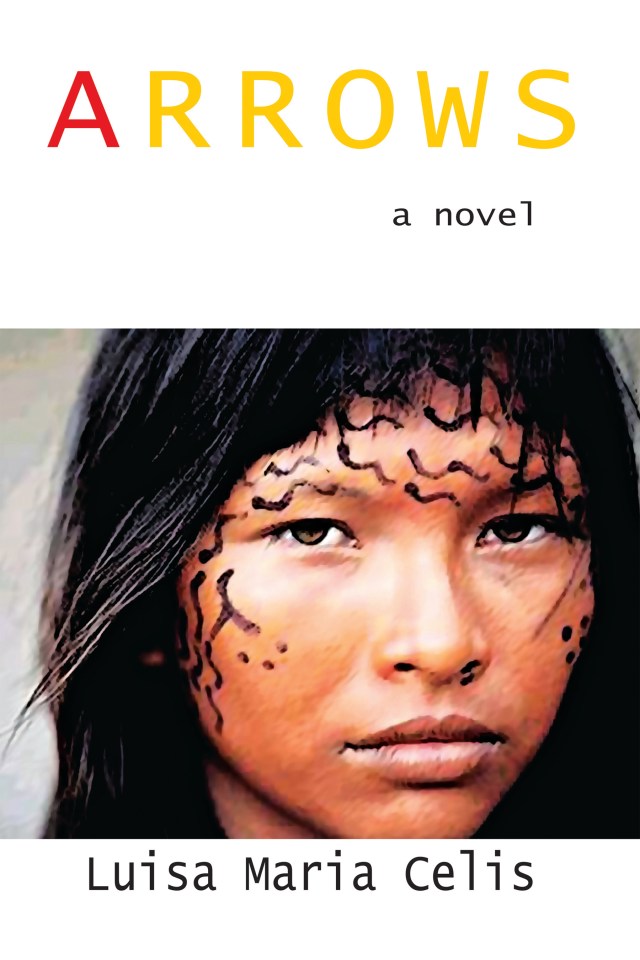
Arrows

excerpt

voices when the breeze allowed it. Looking for so long into the
distance, we were completely unprepared to turn and see five men
behind us.
Even before we could rise from our crouching positions, five big
warriors, scowling fiercely, materialized from the bushes, pointing
arrows at us.
“I looks like you may never get to know Guacaipuro, my friend,”
said Tamanoa.
I could not imagine ever responding with such aplomb. This was
his way of retaining control of himself, not showing fear. He was
showing me what to do, how to face death. Or to avoid it. I
mimicked Tamanoa’s stalwart behaviour, literally at ever step, as
the Indians led us into the village; two ahead of us and three behind.
In the days and months that followed, our captors would assume
Tamanoa was my servant because he was a half-breed, and yet it
would be Tamanoa’s ability to interpret their speech and their
behaviour that would keep me alive. Without Tamanoa, I would
never have been able to develop the language skills that enabled me
to talk to Apacuana, and I would never have survived to tell this
tale. But it was God’s will, or the way of Mareoka, to make everyone
assume I was the leader.

I was as lost as I have ever been as we marched to the village at
arrow point. People gathered on the trail and around an open space
dominated by the imposing figure of a man who could only be
Guacaipuro. The sun shone directly above our heads, gleaming
silver on the silky raven-black hair of Guacaipuro, whose face was a
mask chiselled in stone. His eyes were ominous black slits. The
hollows of his cheeks were elongated shadows.
He stood immobile, his chest heaved, and deep lines creased his
brow. The corners of his mouth were pulled down in outright
loathing. He held a spear, the butt resting on the ground.
As we approached, he held the spear almost to my chest, glaring

https://www.amazon.com/dp/0981073522

The Unquiet Land

excerpt

“Damn!” Finn said and rose slowly to retrieve the bottle that had come to rest against the granite hearth. “Damn, damn, damn,” he repeated, lifting the bottle to the light to see what was left. “Did you ever witness such a clumsy old fool?”
After a moment’s awkward silence, Padraig said, “You were talking about Caitlin.”
“I was, wasn’t I?”
“Is there really something between her and Michael?”
“I think so. It’s usually called love.”
Padraig failed to stop the thought before its shadow fell across his face. “She’s in love with Michael?”
“She appears to be. And I think she could do worse. Michael’s a good, steady, dependable lad. A farmer to the depth of his marrow. He’s one of the Carricks from Kildarragh. Thomas Carrick’s son, but as different from Thomas as a ripple from a tidal wave.”
“I’m glad.”
Finn smiled. “You’ve heard the stories about Thomas Carrick then.”
“As much as I want to hear.”
“You’ll hear worse, Padraig,” Finn said. “You’ll have to learn to accept life and people as somewhat lower creations than the idealized figments of your Christian imagination. But have no fears about Michael being Thomas Carrick’s son. I took Michael in on the recommendation of Seamus Slattery, Michael’s uncle. And it has worked out well for everyone: for Michael himself, for me, for Caitlin. Even for Jinnie who loves him like a son. As he appears about to become. He sneaks in here on his midnight adventures and thinks we don’t know.”
“On his what?” Padraig asked with surprise.
Finn smiled. His eyes had the faraway look of one who had dived deeply into the river of memory and was swimming joyfully. “His midnight adventures,” he repeated slowly, his attention not fully on what he was saying. “When he thinks I’m sound asleep he creeps like a thief to Caitlin’s room. Lusty young stallion.”
Padraig’s disbelief was genuine that a father could allow such conduct. But none of his prepared texts on the subject seemed appropriate to this man who had no idea of morality. How could he begin to reach through to the soul of one who denied God, despised chastity, and did not know the meaning of sin and salvation. “We change the soul, if we change it at all,” Clifford Hamilton had said that evening, “with words, thoughts, ideas…

https://www.amazon.com/dp/1926763203

The Circle

excerpt

BEVAN LONGHORN is in his office Monday morning, his desk covered in
paperwork that he has to get through before the day is over. His personnel have
just adjusted to Matthew Roberts’s absence and Bevan has been left with only two
middle managers to handle the work of three. He considers promoting one officer
to Matthew’s post, but there are twenty-odd people to choose from, all qualified for
the position. Bevan must give it more serious consideration.
He wants to make major changes to the structure of the office, but he has to
fight with the rest of the brass, particularly the ones well-connected with the
administration and the state department. He cannot put up any longer with the
way things are done and the way things they produce are used by the hawks in
higher places.
He has his own circle of people who would agree with him on certain
things; it would just be a matter of rallying the troops. His friend Jerry
Wolverton is the best example. He retired as a three- star general and left the
army seven years ago with pride and a sense of accomplishment after working
in Iraq for five and a half years, in charge of the reconstruction of public
projects that accommodated all Iraqi government personnel of various
departments. Jeremiah Wolverton got his extra star and a very good severance
package, and although retired, can still pull a lot of strings both in the state
department and within the ranks of the army.
Bevan decides to call him.
“Hello, Bevan, my old friend. Are you still in service?” Jerry jokes when he
hears who’s calling him.
“Of course I’m still in service. We cannot all retire at the same time; the army
wouldn’t know what to do without us”
“You’re right about that, my good, old friend; what makes you remember
me? Trouble?”
It’s Bevan’s turn to laugh at the general’s comment.
“No, no trouble at all; just the need to say hi to my good friend and see what
he’s up to these days.”
“Well, I’m doing okay. I play the odd golf game here and there, I walk a lot,
still take holidays with the old woman; other than that, nothing much.

https://draft2digital.com/book/3562817

https://www.amazon.com/dp/0978186524

In Turbulent Times

excerpt

‘And to an English girl,’ Caitlin added.
‘Oh it happens to the best people,’ Joe said.
‘You haven’t set your sailor’s sights on one of them flighty little Maltese chickens yet, have you, Joe?’ Michael asked with a wink.
‘What would Joe want with a Maltese chicken, Michael Carrick?’ Caitlin said.
‘Well, with Stephen bringing home an English wife, and Tom maybe landing himself a pretty, young girl from north Africa, if Joe brings one from Malta or Gibraltar or wherever, we could set up a minor League of Nations here in the village. Solve all the world’s problems.’
‘Cause more problems than solve more likely,’ said Caitlin. Then she lowered her knitting to her lap. ‘Joe, would you like a wee cup of tea? The kettle’s boiling.’
‘I would if you’re having a drop yourself. Thank you.’
‘Oh I dare say I could make room for another. Michael, reach me your mug. It’s down there by the fender.’
‘Is Nora not at home tonight, Mrs Carrick?’
Caitlin stopped on her way across the kitchen. She turned slowly to face Joe and cast a glance at Michael. Joe felt a sudden fear. He too looked at Michael, then back at Caitlin. For a moment no one spoke.
‘Nora?’ Caitlin said softly.
‘There’s nothing wrong, is there?’ Joe blurted out.
‘Joe, didn’t you get her letter?’ Caitlin asked apprehensively.
‘The last letter I got was written a couple of months ago. The post is very uncertain. Tell me, is she all right? Why have you got that look on your face? Both of you. What’s happened?’
‘Joe,’ Michael said, ‘Nora’s married.’
‘Nora’s married? No, she can’t be. It’s not true. My mother would have told me.’ Panic wailed like a siren in Joe’s voice. ‘Say it isn’t true, Mrs Carrick.’
Before Caitlin could say, ‘Yes, Joe, I’m afraid it is,’ Joe was sobbing, his head turned away. He did not even hear Caitlin’s confirmation.
Michael rose and put an arm around the young man’s shoulder. ‘Joe, I’m very, very sorry. We both thought you knew.’
‘She wrote to you, Joe,’ Caitlin said. ‘I know she did. And it nearly broke her heart. For the life of me I couldn’t understand it.’
Joe turned to face Michael and Caitlin again. ‘I’m sorry for breaking down like that. But what a shock. My God, I was going to propose to her myself before I left again this time.’

https://draft2digital.com/book/3562904

https://draft2digital.com/book/3562904

The Unquiet Land

excerpt

“That ideal has died, Padraig. The light has gone out. It goes out for many of us, I’m afraid. Because it’s only an idea, not a reality. The Greeks first had the idea when civilization was young. Didn’t they believe in the human community as commonweal? Didn’t they tell us we were all free equals linked by a shared concern for the common good? Come on, Padraig, you know more about these things than I do.”
Padraig swallowed a mouthful of wine and thought for a moment. He wondered if he really did know more about these things than Finn. “You mustn’t overlook the Christian component of your humanitas, Finn: humanity as a moral ideal rather than a biological fact. From Christianity, not from Greece, comes that conviction you mentioned that human life has value. Man was created in God’s own image and was precious enough in the sight of God for God Himself to become man. This is what gives human life its value, Finn, and human life must be protected, must be saved at all cost and returned to God transmuted into spirit, pure and undefiled.”
“Another ideal.”
“Another aspect of the same ideal.”
“But equally unrealistic.” Finn leaned forward and held Padraig in the grip of his eyes as the Ancient Mariner held the wedding guest. “You are still young. The torch you hold aloft to light your way through life still burns with the fierce brightness that youth demands. You are just starting out. But as your journey proceeds and the day wears on, the idealism that fuels your torch burns lower. The light grows dimmer, Padraig, till you no longer see your way with clarity. And you stumble and fall. And every time you stumble or fall you spill some of the fuel you still have burning. And the light grows even dimmer. Long before midnight it’s all gone. And you can’t see your way anymore. You look back for some idea of where you were heading, and of course it’s all darkness there too. The light is gone. The darkness reveals the idealism for what it was: a figment of the human imagination, a fiction born of the unique human capacity for creative thought and nourished by the unique human need to believe.”
“It’s too pessimistic, Finn,” Padraig argued. “The light that guides us really burns; it really exists. You can keep it burning brightly right to the end if you have faith. Faith is the fuel, Finn. Pick up your torch again and find the faith to relight it and keep it burning. It will show you freedom, truth, justice, goodness. It will show you love. It will show you God.”
Finn smiled. “As I said, Padraig, you are young. You have a fire in your head and in your belly. I am old. My head is cool, and my belly …

https://www.amazon.com/dp/1926763203

Poodie James

excerpt

town and the prospects. He listened carefully to the details of the
planning. The enthusiasm of his own replies still rang in Jeremy’s
mind.
“Dad, the state is only 13 years old. There’s opportunity everywhere.
East of the mountains, they’re bringing water to the land.
It’s going to bloom and it’s going to make people rich. It’s in the
center of the state, on the river, on the railroad that runs east and
west. They’re already shipping apples to Chicago and back east.
They’ll need a good newspaper. A paper can make a difference in
how that valley develops. The man who owns that paper will be an
influence.”
“And Winifred? Is it right to take your young wife away from all
she’s known, into a wilderness?”
“It is not a wilderness.” Jeremy reached into his breast pocket for
a post card and handed it to his father. Zeb Stone studied the
scene: A few buildings, a handful of carriages, a line of poles, the
blurred image of a man striding across a dirt street that stretched
into an infinity of sagebrush and bare hills. He looked up and contemplated
the club’s spread of gardens, fairways and trees. Jeremy
was determined to go west with or without his father’s approval,
but he ached for the endorsement. The perspiration and the dread
accumulated as he waited. The severity of the look his father
turned on him, his relief when a trace of a smile appeared and his
father offered to help with finances; it was all as clear as the day it
happened.
“As it is, sir, I’m going to use your money” Jeremy told him. “I
haven’t touched the trust fund since I turned 21. I’ll take money
from that and my savings and, if need be, Win will chip in from her
inheritance. We want to do this on our own.”
“If you ever decide to go back into banking, tell me,” Zeb Stone
said. “A growing town will need a good bank.”
Jeremy never dreamed that 25 years later he would turn his
newspaper over to his wife and plunge fully into banking. Winifred
had turned out to be as good a publisher as he was, and a better,
tougher editor. He had stayed out of the paper’s business since

https://draft2digital.com/book/3562868

https://www.amazon.com/dp/B08W7SHCMV