Blood, Feathers and Holy Men

excerpt

Eagle Talon and his son, Honiahaka Little Wolf, emerged from the forest with a
magnificent buck slung from a sapling pole between them. The two men paused to
rest and massage their aching shoulders. Below them stretched the mighty water,
birthplace of the sun and home to the great creatures who blew fountains into the
air. It was also home to the friendly man savers.
As Eagle Talon looked far out to sea, he remembered how his youngest son, Kosumi,
was washed out of his canoe by a savage wave. He thought he’d lost his son to
the sea, but two man-size sea creatures, those who blew fountains of water into the
air, came to Kosumi and swam him safely to shore.
From that day forward, the Nation declared these man-savers Friends of the First
Light People. Never again did they hunt them for food. Since that time, the sea mammals
leapt from the water to greet the young men whenever they sailed out to spear
the white fish or to dive for the clawed sea-cleaners.
Eagle Talon whispered his thanks once more for his son’s life. Then he whispered
his thanks to all the creatures of the sea that fed his family and his people.
Little Wolf saw it first and crawled on all fours to the edge of the embankment for
a better look and beckoned his father to join him. On the beach below was a great
canoe, big as a longhouse. Strange, white-skinned men with hairy faces shouted at
one another and banged at boards of split pine, inside. Outside, men were painting
the frightful beast whose head was a double serpent totem of scarlet, blue and green.
Eagle Talon and his son watched in awe. They must return quickly to the village.
Surely the sachem, White Eagle, would have an answer to the appearance of such
strange visitors.
Since Eagle Talon and his tribe greatly respected White Eagle as a wise elder, a
confederation of villages elected him sachem. He governed the people of his district,
upheld the law, allocated farmland according to the size of each family, collected
tribute, provided for widows and orphans, and taught all boys up to the age of sixteen
the arts of manhood. He also acted as arbitrator, whenever war threatened.
White Eagle sat erect. His grey hair flowed unadorned in long shiny strands to
his lower back. He wore a beaded doeskin jacket, pants and moccasins. The sachem
raised his hand to call for calm and addressed the gathering of braves.
“My brothers. These strangers have surely come in peace. Let us welcome them
with gifts of food, as is our custom. We will honour them with song and dance at our
Lodge Fire and celebrate Broken Wing’s success in the hunt. If they allow us, we will
help them repair their strange craft that they may soon be on their way.”
The gathered braves turned to one another in discussion. Then they voted by a
show of hands to follow the sachem’s advice.
White Eagle continued. “I will approach the strangers at their camp. Broken
Wing, Crow Foot and Eagle Talon will bring sweet corn, the gift of the gods, and
fresh salmon. I go to prepare my face and body with red earth as a sign we are men
of the earth.”
Freki, ever on the lookout, was the first to see the four Natives approach the fire.
They wore only tan breechcloths. Three of the Natives wore crow and turkey feathers
in long braids. They had their heads shaved except for a long strip of stubble…

https://draft2digital.com/book/3562826

https://www.amazon.com/dp/1926763106

Yannis Ritsos – Poems, Volume III

14th of November
As we focus our eyes to notice a difference
among the pieces of day, we don’t know how to get
a hold of ourselves, we miss the shape, the hour, colors,
faces. We only listen carefully so that we might
discern a sound that confirms the passing of time,
so we can reverse the performance, box, broom handle,
name, the dice that roll on the table,
the limping wind that stumbles onto the barbwire
the fork that hits the plate and its sound that continues
internally.
Otherwise a circle without a center remains, a whirl
in the air with no movement but its own;
it can’t become a car tire that crosses a forest
and if once it becomes a square
it’s not a window through which you look at the world
or the three lined carpentries in an unfamiliar
neighborhood,
but only the relativity of straight lines, the analogy of corners,
boring, very boring things. A mathematician and
an astronomer could create something concrete and
clear out of all these.
I can’t. Yet I always liked the Observatories; the dark
stairway, the clock, the telescope, those photographs
of stars in homely positions: Orion without his sword,
with no underwear, Verenice with her many freckles,
unwashed, frumpy, a whole urban kitchen
transferred to a metaphysical location, boiling cups,
jugs, casseroles, the grater, salt cellar, baking tins,
white spots, a bit of steam hanging onto the smoked
walls of the night.
Someone was talking of numbers and more numbers,
light-eons, leagues and leagues. I wasn’t listening.
Today a friend was telling me that when he was thirteen
he was selling oranges and lemons in Piraeus;
he also had a young Armenian friend who was selling
socks. During the summer afternoons they’d meet in the
harbour behind a pile of sacks, where they’d put down
their baskets and read poems; then they’d eat a sesame
bread ring and an orange and gaze at the sea, the jumping
fish, the foreign ships.
From today I also have a friend who smells of orange
and harbour. He keeps many evening whistles of ships
in his pockets. I see the movement of the big finger
of the big harbour clock on his hands. From today on,
I’ll love him, I’ll unbutton one of his coat buttons.
Now I think of going to find his young Armenian friend
to find a basket with socks on the road, to cry out, socks,
beautiful socks, cheap socks. At noon, I’m sure I’ll find
the Armenian youth behind the sacks, I’ll get to know him;
he’ll recognize me since we both have the traces of our
common friend’s eyes on the lips. If I missed that
basket with the socks and the one with the lemons I
wouldn’t know how to fill my day, my words,
my silence.
Yet I believe every comrade wishes to have such a basket,
only that I don’t know where to find it and I get angry and
I search.

https://www.amazon.com/dp/B096TLBNFK

Poodie James

excerpt

to the surface and throwing columns of water into the air. He
thought about being water, whipping into froth, rising to ride in
clouds above the world, dropping onto hills and fields, roaring
down mountainsides, lazing in lakes, plunging over dams and falls,
spreading to meet the ocean, enveloping rocks and logs and sunken
ships, fish swimming through you, sunlight playing on you.
He wondered if the world was alive and all of its plants and creatures
lived on it, as funguses and bacteria live on animals and people.
Poodie lay on his back in the sunshine and watched a hawk
circle in slow turns above the valley, soaring on updrafts. The only
effort he could see was a tilt of the wings now and then as the hawk
drifted up. It rose so high that wings and body blended into a speck
against the blue, then regained form as the hawk wheeled down to
float up again. He tried to imagine wind pushing against wings,
rushing over feathers, the thrill of the downward spiral, the elation
of being lifted atop a column of air. He wondered what the hawk
saw as it hung above the hills and orchards, the streets and houses,
people, the river. One of the books at the library said that hawks
and eagles could see a mouse from high in the air. He waved, in
case the hawk could see him. He wanted to know the currents of
the river the way the hawk knew the currents of the air. Swimming
the river, he had to work against the flow and eddies of the water
and fight his way across, as if the river didn’t want him there.
Sometimes it lulled him in its embrace, but the river’s power
frightened him. The air welcomed the hawk and bore it like a
mother carrying a child.
September 17
Swam the river today. Maybe last time this year. Air cold, water warm.
Very tired when finished. Getting old? Found a man looking in the
window when I came back. Showed me a card from the health department.
Said he had to inspect my cabin. Showed him inside. He took
notes. He wanted to look at the outhouse. More notes. Showed him my
apple trees, ready to pick. I gave him apples. Wrote my name for him. “I
know,” he said. Nice man.

https://draft2digital.com/book/3562868

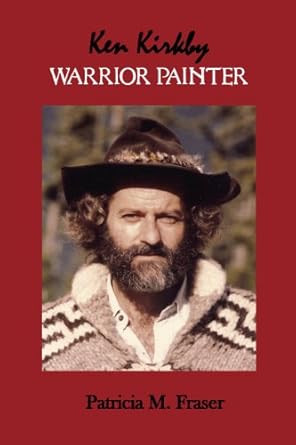
Ken Kirkby – Warrior Painter

excerpt

I’m aware that you are frequently faced with idiots and liars and
scoundrels but, in telling this story, I hope to explain that I am none of these
things. You need to know there are people in this world who actually do
give their entire lives to something bigger than themselves.”
“We have an hour,” she replied.
Fifty-nine minutes later, Ken had told the story of Isumataq and of the
cause of the Inuit. “That’s the preamble—now here’s the paperwork,” he
said, sliding neat folders of material across the table to her. “Here’s how the
money came in and here’s how it went out. For myself, I’ve always lived a
Spartan life. I’ve no real interest in possessions or material things. Money is
simply a necessary tool, like a hammer or a screwdriver—or a paintbrush.”
Some time later the Judge looked up and announced, “You don’t owe
a penny, Mr. Kirkby.”
“I know. If I did, I would pay it.”
When he emerged from the meeting, Ken felt as though his feet were
gliding above the rain-washed pavement. It had been worth the battle and
his sense of justification made him giddy. Karen was out of town again, but
when he phoned to share the good news, her bitter response was “Well, I
guess rules just don’t apply to you.”
He spent the evening in company with his long-time friend and fishing
buddy, Ron Gruber. Since Ken’s return to Vancouver, Ron had watched his
friend’s relationship deteriorate. He was increasingly concerned as he saw
Ken slide steadily into that solitary and dark place from which there seems
no escape. Ron was one of the few people in the world Ken could talk to
about personal matters and he told him of his concern that Karen seemed
determined to alienate her colleagues. As he put it, “It’s like watching
someone you care for deeply move dangerously close to the edge of the
cliff, and there’s no way to save her.” He harkened back to earlier situations
when Karen had set herself on collision course, and then dragged others
with her into disaster.
It was not Ken’s nature to give up without a fight, and it took several
months more before he would accept the end of their relationship. He’d
committed to change his life for Karen and he meant to do everything
humanly possible to retrieve the closeness he’d once had with her. But even
that steely resolve wilted when, before leaving on another business trip,
Karen voiced her opinion that they had nothing whatsoever in common…

https://draft2digital.com/book/3562902

https://www.amazon.com/dp/B00CB8W4CG

Yannis Ritsos – Poems, Volume II

A Little Sleep
The distant voice of the lottery vendor. The swaying of the tree.
A canteen steadied in the sand.
The west is burning. A purple reflection over the seashore.
The few houses painted crimson, silence and sundown.
You have a summer handkerchief in your pocket,
a sorrow you left behind on the ledge
like the ripped shoe of the spring that was left on
the rock
when the last group grabbed three meters of sea
and left stooping among the tents of the wind.
How fast the sun goes down in your eyes;
your coat is already smelling of moist,
you put your hands in your gloves like the trees
get in the clouds.
Where the tempest stops your glance is re-ignited
where the sky ends your song and your whole face
are reborn.
There is a yellow star in your silence
like a small daisy on the side table of the sick man
a little warmth on every yellow leaf that turns
the pages of time backward.
It is enough that you know. The other communication
doesn’t end at midnight.
The line is continued from deep inside and from afar
with a few stops, interruptions, accidents,
it continues
and autumn finds shelter on the railings of the station
or the fence wall of the Orphanage,
it listens to the call for silence on the damp roofs and
to the gramophone of the seashore bar,
that the moon turns,
a scratched vinyl, a very old tango. No one dances.
But you, turning the moon to its other side,
beyond midnight, further from the ledge,
you listen to the great music while you saunter
in the harbour with the twelve boat masts
like a speechless restaurant server who cleans
the autumnal tables
folding carefully the napkins of the night,
gathering the stack of plates with the leftover
fish bones.
The sea and the songs continue.
All these that the locked people left outside
belong to us:
the hurrah of the wind in the darkened rooms,
the music that descends in big waves and hits
the window shutters,
the silence that opens its purse and looks at itself
in her square little mirror,
and the woman who wraps herself with the army blanket
and sleeps next to her bag
and you too, as you light your cigarette with a star
over the calm plain of your soul
like the guard who stays vigil over the sleeping soldiers
and thinks of his woman
of the sea
the city with the flags
the trumpets
the sun-dust and the glory of men.
And next to you, you know it,
this big smile
like the circular alarm clock next to the asleep worker.
It’s time to sleep a little. Don’t be afraid.
The clock is properly wound up. It’ll get you up on time
with the bucket of dawn that draws water from the well,
with the crawl of a proclamation that noiselessly sheds
light under the door of your silence. Be assured.
It’ll wake you up.

https://draft2digital.com/book/3562968

https://www.amazon.com/dp/B0851M9LTV

The Circle

excerpt

“We can do a lot better if we change our direction and if we stick together,
Robert,” Peter says.
Robert Major, who has somehow got the picture and who cares only for
himself, asks, “Alright, you guys want to take it and drive it, where do you think
you can take it? How far do you think you can go without Lorne? What tells me
you can do better than he?”
Peter sips his beer, “We have a group of financiers on hand to bring in a good
chunk of fresh money. We have a public relations company ready to work with
us and we can get much more attention for our stock price. We can achieve a lot
more than what Lorne can; it’s as simple as that.”
“Alright boys, then tell me who is going to eat up all the stock that Lorne and
his pals have on hand? Are you going to let it float out in the market? If you do
that, you sign a death warrant for the price of the shares for a long time, you
know that,” Robert insists.
Hakim listens to their comments, and knowing this moment would have
come sooner or later, turns to Robert and lets him know that Lorne is not a
stupid man and has no ego problem. He tells Robert that Lorne will simply try to
get the best under the circumstances because he knows he and Ibrahim have a lot
more shares than all the others combined, and because he also knows he cannot
get into a proxy fight with a billionaire. He’ll simply stick around for the longest
time and try to grab the most shares possible from the market. That’s how Lorne
is going to play and they all agree on that. On the other hand, Hakim suggests
they can always offer him a golden carrot.
“Yes, but Lorne is not one who will take a carrot, Hakim. He knows the game
as well as you. Would you do what you expect him to do?”
“Yes, I would. There’s always another car coming down the tracks, as the
saying goes. But Robert, you have to understand this is a course we’d like to take,
no matter what it’s going to cost. The money is available and time is on our side.
The financiers Peter referred to are our people and money from them comes
only if and when we run the show. The public relations company is our reference
and they sign with us only when we run the show. We have the ability to take this
company to the shareholders’ meeting in a month and a half. However, if you
come along we don’t even need to call one; we can speed up the process and save
a tonne of the company’s money, in the process.”
Robert realizes that the blood is ready to be spread and wants to have his
share of the spoils. He can always play hard to get for a while and try to squeeze
them for something extra.
“In other words, you have to have me along. Okay then, what are you offering?”

https://draft2digital.com/book/3562817

https://www.amazon.com/dp/0978186524

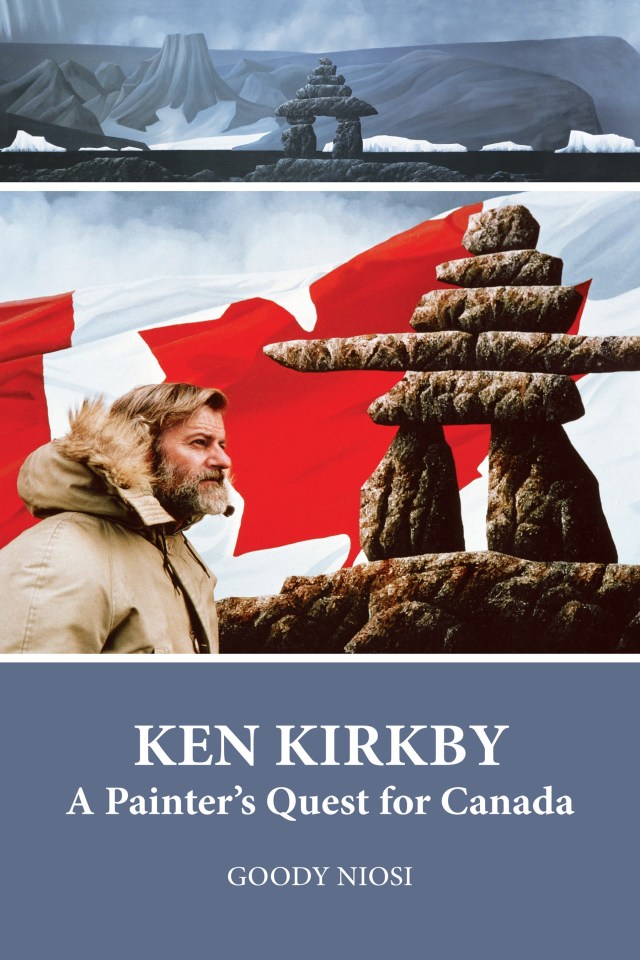
Ken Kirkby, A Painter’s Quest for Canada

excerpt

A painting that goes in hockey arenas, that is toured across the country
from one end to the other, telling the story.
Then a whole flood of ideas and memories came into my mind crystal
clear. Grandmother doing her dance and her song in the winter – becoming
mesmerized and overcome by heat and emotion – going outside and the
Northern Lights roaring overhead – and she came out and stood beside me
and put her arm in mine and told me that those were the spirits of her ancestors
dancing. And she sensed the difficulties I was having over the loss of the
two women that I had loved so profoundly. She had said, “It’s a good thing
to let them go and dance”.
During her song and her story, there had been the need of an Isumataq
– a person or an object in whose presence wisdom might show itself. The
painting would be called Isumataq. And the dream driving all of this was
Nunavut.
That was the moment in which the whole thing exploded in one clear vision.
It must have been working quietly in my brain all this time and now
here it was – all together. Now it poured out and it all came together like a
jigsaw puzzle – every piece moved into its proper slot.
Covered in sweat, Ken’s body shook with nervous energy. His whole
being thrilled and he felt himself to be outside his body – completely
outside space and time. The vision was so clear, so compelling, that it
possessed him. He knew it would come to own him – night and day – and
he didn’t care. He gave himself up to it. He paced back and forth, details
of Isumataq whirling in his mind and dropping into place like numbers
on a slot machine.
He drove home that night with a new excitement coursing through
him. When he told Marsha he was going to create a giant painting on
the scale of the Sistine Chapel, she smiled and shook her head. In the
morning he told Diane who began to plan a studio renovation to accommodate
such an enormous painting. While they were hunched over the
sketch, Salvador appeared in the doorway, a bottle of brandy in his hand,
and a smile on his face.
“I have the equipment, the idea, the staff, and the availability of rock.
How would you like a giant Inukshuk in your studio?”
Three days later, Salvador pulled up in a new Saab, followed by a flatbed
truck – groaning under the weight of massive blocks of granite – and
two extended cab pickups loaded with burly men. At two in the morning,
after hours of heavy labour, a seven-foot tall Inukshuk towered over
the studio. Salvador waved his arm at it like a magician wielding a wand.
“There. Is it to your liking?”
“It’s perfect,” Ken said.
Salvador’s next project was an Inukshuk at the Columbus Centre!
Dragging Ken and Joseph Carrier to the lobby, he gestured grandly…

https://draft2digital.com/book/3562830

https://www.amazon.com/dp/0981073573

In Turbulent Times

excerpt

had been told what to do if Nora Carrick took one of these seizures. Yet they all stood back along the grey walls, and the children ran to a safe distance and watched with eyes and mouths wide open while the young girl’s legs jerked up and down, and her head struck the ground, and her mouth opened and closed expelling a kind of froth like a rabid animal. Joe saw what was happening as he reached the square on his way home from the harbour. He rushed forward, wrapped Nora in his jacket and placed his pen-knife between her teeth. He remembered Dr Alexander’s saying she could bite her tongue during this stage of her fit unless something like a fountain pen was thrust between her teeth on one side of her mouth. With one knee on the ground, Joe held Nora against the other while her convulsive movements began to subside. He wiped her face clean with a handkerchief. He had seen that face so many times before but never till that moment did he notice how pretty it was. Her eyes below the straight-cut fringe of hair were closed. She had rather prominent cheek-bones and a dimple at each side of her mouth when she smiled. She was not smiling then. Her cheek rested against his dark-blue jersey as if she were listening to his heartbeat. Her black hair smelled sweetly with a soft fragrance as if freshly washed with a scented soap. That smell lingered in his nostrils for days, and each time it came back to him it brought exciting new feelings, like those he used to feel in his stomach at the approach of Christmas or a birthday or at the prospect of an outing. And yet different too. More subtle, more gentle, and somehow infinitely sweeter. And he would recall the pale, round face framed in its black, shiny, scented hair pressed against his heart, and the eyes flickering open, so dark and deep and troubled those young, serious eyes. Joe could not remember if he had felt then the same exquisite feelings he had had later when, unbidden, the picture of Nora’s face returned to fill his mind for days on end. Nor could he remember if he had noticed then the rounded outline of her young breasts which he later recalled as having been in contact with his heaving chest.
How momentous those few minutes had been for him, and yet how many of the minor details he had been oblivious to at the time. Perhaps the significance of the scene had been a later invention. He remembered how the crowd had closed in around him, and everyone looked at the peaceful body in his arms as Nora awoke from her frightening ordeal. Had she taken his hand and held it till Dr Alexander came and led her to his car? Joe thought she had but now he wasn’t sure. He remembered standing in the square with his jacket hanging over his arm, watching Dr Alexander’s car drive away …

https://draft2digital.com/book/3562904

https://www.amazon.com/dp/1926763270

Small Change

excerpt

The Best of Friends
ALL I KNEW ABOUT ETERNITY in those days came to me through the agency of its little cousin, boredom. It was Friday and it was spring. The big windows on the left side of our second floor classroom had been lifted as far as the old paint in their grooves would allow. All afternoon, an intermittent breeze came through the protective metal grill carrying coal gas and bus fumes and the oddly fishy odour of soap from the Colgate factory down by the river. It wasn’t much, but it was news from the world and I sniffed it with a perverse pleasure.
We weren’t allowed to look outside, but as often as I could I snuck a peek at the vacant lot with its bottle chips, rusty concrete, patches of crabgrass, and minute particles of coal that lay in thin drifts where the wind had blown them from the smoke of locomotives that passed all day on the elevated tracks across the street, beyond the wooden fence of the Delaware-Lackawanna coal yard.
Sister Violeta, with her lugubrious monotone and her black visions of life before death, seemed connected somehow to the nearly purple hills (piles, really) of pea coal, which I had a privileged view of at this height. They looked like black sand blown up into dunes in the desert landscape of an alien planet. I used to imagine she had been hatched there.
Father Brackendorf, who came every Friday to teach us religion, was fond of looking out toward the coal yard and explaining that our souls were like the snow before a train went by. Once we were born, the soot came down. Scrubbing did no good. You had to let confession melt the snow, and let the sin fall to the bottom. (The bottom of what, I wondered). Then a blast of grace would freeze it white again. This is what he was saying now. It made me feel empty and restless. The clock above his head, round and white and edged with black, was soft-clicking back and hard-clicking forward, minute by minute. And then the minute hand hit twelve and it was three o’clock, and we were free.
But there was this debt I owed to Danny Amoroso.
He was three or four years older than we were, but he was slow. And he seemed to enjoy it. Being slow, I mean. He was a titan among …

https://www.amazon.com/dp/1926763157

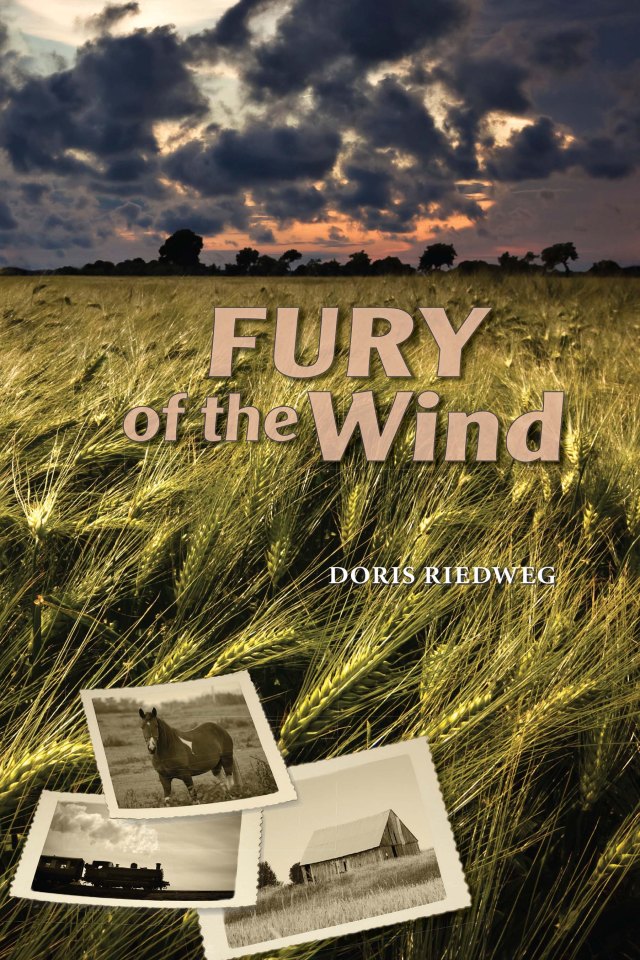
Fury of the Wind

excerpt

which Will had taken up his position at the desk. Only the monotonous
tick of the pendulum clock on the waiting room wall, and the
occasional tap tap of telegraph keys disturbed the quiet. And once
in a while Will Andrews cleared his throat.
Try as he would Will could not keep his eyes off her. His curiosity
grew with the minutes but he did not think it his place to ask
who she was waiting for. He just wished the tardy individual would
hurry up and get there. He didn’t think he should leave the young
woman alone to go to his quarters, although his feet now screamed
to be released from his boots, and his throat felt parched just thinking
about Molly’s lemonade.
He pulled his watch from the fob pocket of his trousers. Half past
four. Half an hour since the train had passed through town, and its
passenger – who had expected to be met – still waited.
A faint sound startled him and he looked up to see the woman
crossing the room towards the wicket. She appeared cool and composed
but Will could see the lines down her cheeks where rivulets
of sweat had streaked her face powder.
“Excuse me, Mr. ah ….”
“Andrews.”
“Mr. Andrews, I wonder if you could tell me if the train was early
today.”
“Nope, right on time as usual.”
“Oh … I see … thank you.” She bit her lower lip and turned away
but suddenly she swung around to face him again.
“Mr. Andrews, would you mind placing a telephone call for me,
please? It would be a local call.”
“Sure. Who to?”
“Fielding. Mr. Benjamin Fielding.”
Will’s mouth dropped open. “Ben Fielding?”
She brightened. “Yes. Do you know him?”
“Ben Fielding ain’t got a phone.”
“Oh.” She said it so quietly he scarcely heard her. Her lips trembled,
and the hand resting on the counter, still gloved, began to
shake just a little.
Again she turned to go but she stopped when he said, “Can I get
my missus to bring you a glass of lemonade? I was just going in for
some.”

https://www.amazon.com/dp/0981073530