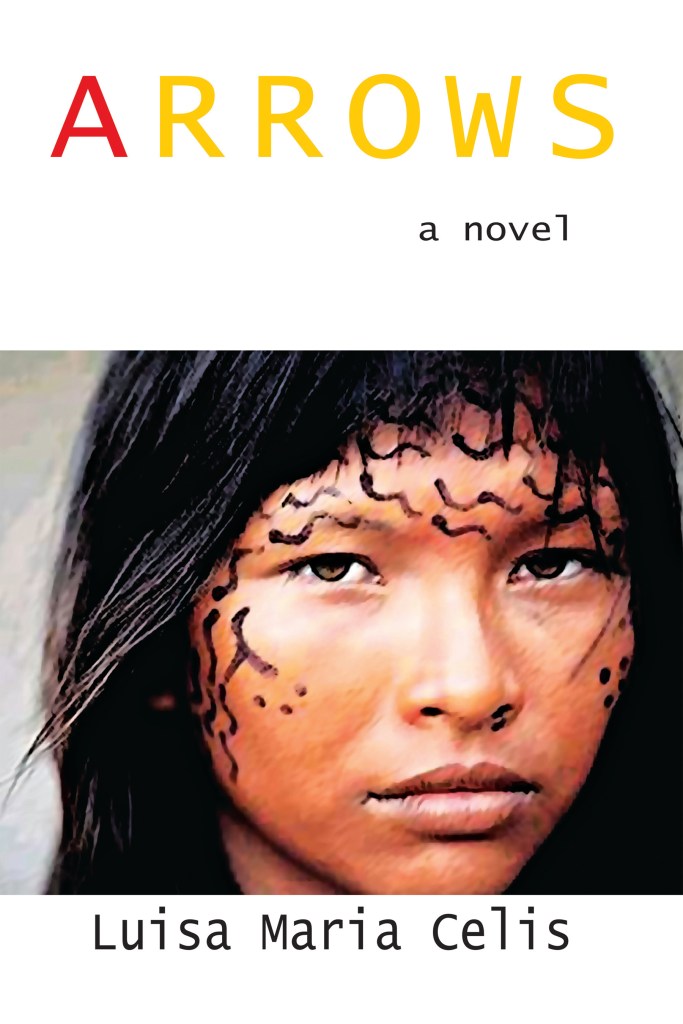
Arrows

excerpt

We followed the river until it converged with the same river
Guaire which ran the length of the valley.
We were one mile from our destination.
We crossed the Guaire from south to north, following the path of
those who had survived one of the two previous expeditions that
had made it this far. The Guaire was not deep, but, having lived all
my life near rivers, I knew how mighty it could become with the
proper amount of rain.
Soon after, we crossed a creek called Catuche, along which
soursop trees grew by the hundreds, hence the creek’s name, which
in Carib meant soursop. Tamanoa brought me one of its fruits and
ripped it open beforemyeyes. It was white, succulent and aromatic.
As the sun descended, the deep green of the cordillera mingled
now with soft blues and yellows. We had turned north and were
ascending the slope of the piedmont when Losada’s voice
resoundingly gave the order to stop. We had finally reached a
destination: the charred remains of what had been the settlement of
San Francisco, half-buried in the vegetation.
Francisco Fajardo had fled the settlement five years ago when he
knew the reinforcements he had pleaded for had been wiped out by
the Arbaco Indians of Terepaima. After painful losses, Fajardo had
divided his forces into two and fled in canoes and pirogues.
It was eerie being in that deserted place. The air smelled strongly
of rain, damp earth and plants. The howling monkeys, chachalacas,
parrots—they were all quiet. That night, as a full moon shone
through thick clouds, the ubiquitous night-song of frogs and
crickets was overridden by the deafening buzz of cicadas.
Losada paced nearly beyond range of the firelight, five strides to
the right, five to the left, hand combing his beard and moustache,
eyes fixed on the ground before him, his grizzled hair reflecting the
silvery moonlight. He anxiously awaited the return of the troupe led
by Diego de Paradas, who finally arrived after midnight, looking
seriously bedraggled.
“What happened?” asked Losada.
Diego de Paradas was wounded. Pánfilo spoke for him.

https://www.amazon.com/dp/0981073522

Ken Kirkby, A Painter’s Quest for Canada

Excerpt

Ken circled around the stone people, which he later learned were called
Inuksuit. Around and around he walked, occasionally reaching out a hand
to touch them in a dazed kind of wonderment and awe. For the first time
in many weeks, his spirit began to lift.
I thought I was quite a well-informed person on a variety of subjects,
given that in my upbringing, acquiring general knowledge was considered
important. General knowledge led you to being a generalist and it’s the generalists
that run the world so you want to have vast amounts of knowledge
in a variety of areas. So, you learn about the pyramids and the sphinx and
Stonehenge and Easter Island and all of that. But here were these strange
human-like figures made of stone that I had never heard of – and at that
point, I started to come out of my stupor. These figures got a hold of me. This
was something that captured my attention in a major way.
He set up his tent some distance from them, thinking perhaps they
were sacred symbols and while he struggled with his tent, he kept glancing
at the stone men, reluctant to look away even for a moment lest he
lose the magic. With his little tent tamed, and his camp set up on the
windy plain, he dug out one of his rolls of paper – from the depths of
his backpack – and began drawing. He rolled the paper farther after each
drawing and began another. He couldn’t stop; he was infused with the
same energy he had felt when he first began drawing, in Portugal, as a
young boy.
When his stomach let him know he was hungry, he walked down to
the river and caught a fish. Cooking was a challenge because there was so
little wood of any kind to burn. He had learned to start a fire with dried
moss and then add bits of shrubbery to get an intense blaze that lasted
mere minutes. He usually managed to cook one side of the fish over the
flame. Then he had to start a fresh fire to cook the other side. In time, he
learned to eat and enjoy raw fish because it was so much simpler.
While camped near the Inuksuit for several days, making drawing after
drawing, he noticed a group of people setting up camp some distance
from him near the river. The people on the west side of the river didn’t
acknowledge these people on the east side, and they in turn did not speak
to the people on the west bank. Ken concluded that these were Eskimos,
the people he had been searching for.
The Eskimos paid no attention to Ken and he did not try to make
contact. Instead, he continued to draw, fish and cook his meals. He was
consciously becoming a silent person and the deeper he fell into the stillness,
the greater the solace he found.
One day a woman with a deeply lined and weathered face carried some
fish and bannock on a flat stone to Ken’s tent, placed it on the ground and
walked back to her camp. Ken ate gratefully. “How shall I respond?” he
wondered.

https://www.amazon.com/dp/0981073573

Ken Kirkby, A Painter’s Quest for Canada

Excerpt

It might have been dropped into the harbour
directly from the China Seas. Ken explored the floating palace and then
stood on the railing leaning over the side, his eyes growing wider as they
passed under the Lions Gate Bridge and chugged into the open waters
of Georgia Strait. The sheer immensity of the snow-capped mountains,
forested islands and vast ocean staggered him. Gulls swooped by, eagles
soared overhead, seals and sea lions dived into the water.
After docking in Nanaimo, Ken drove north on a narrow gravel road,
badly rutted and peppered with potholes. The TR2, with its worn shocks,
rattled up the road that lay at the bottom of a canyon, its sides covered
in giant firs. When he arrived at Nile Creek and found the little cottage
he had been directed to, he knocked on the door and handed his letter of
introduction to the elderly couple who greeted him.
“We’ve heard a lot about you,” they said. “Monsieur Desjardines wrote
to us a number of times; telling us about you, and the wonderful times he
had with you in Portugal, and about how you want to be a Canadian.”
They took Ken out to the mouth of the creek where the water was so
thick with salmon it presented a solid wall.
The next morning they launched a rowboat and rowed out to the kelp
beds, that lay several hundred yards from shore. After tying up to the
outer rim of the semi-translucent mass, they cast their lures along the
edge of the kelp bed. The moment the lure hit the water a fish struck.
Then, miraculously the fish leapt into the air, dancing on the water. Listening
to the old man’s shouted instructions, Ken learned how to handle
Pacific salmon. They pulled in one fish after another, each cast of the line
producing another salmon. When the big box in the bottom of the boat
was almost filled they tossed them back, keeping two for their supper.
Ken spent the rest of the week fishing, and drawing fish – particularly
the cutthroat trout that fascinated him even more than the salmon.
His next trip was to the wild country near Kamloops. As he drew close
to Merritt the countryside grew arid with rugged rolling hills and tall
ponderosa pines, which gradually gave way to a vast grassland covered
with scrub.
He drove up the Nicola Valley, drinking in the smell of sage and basking
in the golden autumn sun. Bees buzzed lazily, half asleep in the golden
fields. Eventually he found the gravel road he was looking for that
climbed up and up into the mountains. He drove through the Stump
Lake Ranch and past the sign that said, “Peter Hope Fishing Camp”. He
drove on through mud puddles so deep that the water seeped through
the floorboards. When he could drive no farther, he parked and walked
across a small creaking bridge to an island with a tiny log cabin wearing
fresh golden logs on one side, and old weathered logs on the other.
Ken knocked on the door.

https://www.amazon.com/dp/0981073573