Arrows

Excerpt

The day of our departure came too soon. Entire families gathered
at the plaza to bid farewell to their most respectable sons. After a
year of preparation, don Diego de Losada had managed to convince
one hundred and fifty men to take their chances with him. No small
achievement, considering their prospects for survival.
Our expedition was bound for the province of Caracas—where
the town of San Francisco had briefly existed—and we were
destined to rebuild it in the name of Our Lord Jesus Christ for our
most gracious king, His Sanctified Catholic Majesty, Don Felipe II.
Less than five men out of each of the previous two expeditions into
the area had been left alive to tell the tale.
I had heard stories about battles, about how I would be lucky to
be killed at once. Cannibals liked to tie a Christian to a tree while
they danced in circles, possessed by the devil, chopping pieces out of
him every time they came about, cooking his parts under his nose or
even eating them raw, shooting arrows at him until his blood had
drained, blood they would collect in little bowls and drink as they
danced, smearing it on their bodies, spitting it on the ground.
One chief in particular, Guacaipuro, who commanded the Indian
forces of the valley of Caracas, put the fear of God into Spanish and
tame Indians alike, for it was said he had no mercy for either. All of
the other chiefs pledged their allegiance to him. On the land of one of
these, the settlement of San Francisco had been established almost a
decade ago, but Guacaipuro had burned it to ashes. It was to that
place we were heading.
Dressed in their feathered morions, coats of mail and cloaks,
twenty men on horseback under don Francisco Ponce’s command
melted stoically like butter in the sun, to be accompanied by fifty
harquebusiers with their pouches heavy with stone munitions,
eighty men on foot, eight hundred servants, two hundred beasts of
burden, several thousand pigs, four thousand sheep—all intended
to secure the beginnings of a new city.

https://www.amazon.com/dp/0981073522

Water in the Wilderness

Excerpt

Thank goodness for that.” She took a sip of coffee then put her cup down and sighed. “Working for Dr. Merkel has been good for him. He came home two days ago more animated than we’ve seen him since Barry died. He’d help deliver a calf that was coming backwards, he said.”
Tyne smiled. “We could have used him on the farm the other day.” And she related the details of Jezebel’s ordeal to her mother, not neglecting to mention her part in it, and how Morley had gotten after her for foolishly entering the pen.
“Well, I guess you deserved it. I’m glad someone is looking out for my headstrong daughter.”
Tyne wrinkled her nose, and they both laughed, but Tyne quickly sobered.
“How is Jeremy then? Do you think he’s getting better?”
Emily looked beyond Tyne to the living room, and took a deep breath. “I think so; that is, I hope so. The trouble is, your dad doesn’t have much patience with him. He thinks Jeremy should just snap out of it.”
Tyne toyed with the muffin on her plate. Oh yes, that was so like Jeffery Milligan – just buck up and get over it. But she wondered if it was simply her dad’s reluctance to show any weakness on his part – stiff upper lip, and all that. Lately, she had been inclined to allow him the benefit of the doubt.
She looked up. “Morley would like Jeremy to help him with the harvesting this weekend. Do you think he will?”
“Oh my yes, I think so. At least, he certainly enjoyed it last year, and it will give him a lift. Tell Morley thanks for thinking of him, dear.”
“I will. And Mom, I want you to know that Morley and I have been praying for Jeremy.”
Emily smiled and squeezed Tyne’s hand where it lay on the table. “Thank you, Tyne. I knew you would be.”

https://www.amazon.com/dp/192676319X

Savages and Beasts

Excerpt

Three months went by. July came with mischievousness and playfulness
from the hot afternoons that kept the city boys running
behind the ice cream truck to the stuffy nights that kept most
Kamloops residents awake and sweaty. And it was a stuffy place,
Kamloops, when the winds rejected every request for a blow
and the clouds refused to appear from the west where they came
most of the times; it was a stuffy place, Kamloops, with the nuns
and the priests waging their war against the savages while they
tried to teach them what they thought was necessary and useful
to them, alas they didn’t know that when you try to wash off the
black of a man trying to turn him into a white you only waste
your soap.
This was a celebratory Kamloops morning with the sun
half way up the invisible staff of nature’s flag when Anton imagined
it rising in tune with the joyous anthem of nature and all
the earth creatures stood in attention, from the tiny ants which
raised their antennae to the orcas in the pacific which raised their
dorsal fins straight up in the air as if slicing it in two pieces, from
the immense wings of the condors spread in salutation, to the
tiny wings of the hummingbirds balancing themselves in midair
as they gazed at the marvel of a fuchsia, and from the raised
tusks of the elephants in glorification of the rising flag to the
salutation of the injured soldiers in the muddy hutments of war,
such glorious was this morning in Kamloops when Anton drove
his GMC pickup towards the Indian Residential School before
seven o’clock.
He passed the quiet Thompson murmuring indecipherable
secrets to the shrubs and verdure standing on its two banks,
certainly in attention too, and soon he was parked at the School
parking lot. His glance went through the gap the big oaks were

https://www.amazon.com/dp/1926763602

Swamped

Excerpt

Asians, every kind of European and Latin American, Africans, and
of course the original First Nations people, the victims as Eteo considered
them. The First Nations people whom the ruthless Europeans
of two centuries ago, with their rifles and guns and chicken pox and
diphtheria and polio and alcohol, almost exterminated, slowly and
methodically. The Europeans who came with their tall ships ready to
carry out whatever barbarisms suited their purposes, all while proselytizing,
yes, the Europeans who wanted to turn the First Nations
people into good Christians such as themselves only to exterminate
them tribe after tribe, only to ostracize them clan after clan, only to
enclose them at the peripheries, closely guarded by the always repressive
word or sword, whichever worked best.
Eteo kept walking, now with a fire in his chest. His steps led him
to the familiar dock at the end of 22nd Street. He reached the edge
of the dock and leaned against the framed barrier, letting his gaze
travel over the shiny water. It at least reflected a natural balance, unlike
the human world, its natural balance permeating everything, part
of the balance cosmos has invented and into which even the unbalance
of people blends and gets absorbed. His eyes encompassed the
gleam of the water and the green background on the far side of English
Bay in the university neighbourhood, where more rich Vancouverites
lived, where houses sold in the millions and one wondered
why. Who had induced such lunacy in the housing market while
thousands in East Vancouver were homeless or paying half their meagre
incomes on rent? Whose game was being played in the Lower
Mainland housing market to favor one area against the other?
Eteo let his attention dive into the shallow water under the dock
where small crabs went about their business on the sea floor and the
small perch fed on the barnacles of the dock’s piles. A few starfish
decorated the sandy floor while seaweed floated left and right like
orchestra that a conductor directed its myriad violins in this naturally
balanced world beyond human influence, a balance suddenly interrupted
by his mobile phone. Yannis was ringing him.
“Hello, John.”
“Hi, how are you?” Yannis asked

https://www.amazon.com/dp/B08WP3LMPX

The Circle

Excerpt

Silence takes their thoughts and the surrounding area like when you stop before
the blooming hyacinth and your eyes become teary, or when you stare at the
orange sun at dusk before the sea takes him into her watery embrace, like when
the little chick chirps in the nest and its mother tries to teach it how to grasp the
worm from her beak and your eyes become teary, and you don’t know the
reason. It’s like that. The disappointment is obvious in Hakim’s face.
“When did they find my parents and what did they do with them?”
“The next day when I found out about the bombing, I ordered the search.
They found your father and mother in the rubble, and you as well. Your parents
were buried according to tradition, and I took you into my home.”
“What else happened on those days? Please tell me more about my parents,
about their property, what happened to it, how did the Americans manage to
bomb our home instead of someone else’s.”
“War, my dear boy, is a terrible thing. It brings out the worst in people. It’s
incredible to imagine what people do in times of stress, in times of fear, in times of
desperation. That’s what war does: it affects people in the worst possible way. You
see a brother killing a brother, you see friends who suddenly become the worst of
enemies, all for what, you may wonder, and there is no answer. It is unbelievable
what a person can do in the stress of war, when they don’t have means of feeding
their family, or when they are afraid for their lives, when one finds a rifle thrown to
the side of the road and takes it in his arms. At that moment, he becomes an enemy
of someone else, a killer capable of taking a life. This is why you see civil wars
erupting in every country after an event like this. The whole system is gone—the
security, the police, the courts, the justice system, all the apparatus of the country is
gone. In our case, even today after all this time, there are bombings and suicide
bombers killing people in the hotels, the plazas, even in the mosques. This is what
war creates, my dear boy, and you can only hope war won’t come your way ever
again. As far as what happened to your parents’ house, it’s still there, uninhabited,
still standing half-way; one day we have to address the issue of what to do with it.”
Hakim remembers now what he wanted to ask his uncle since yesterday.
“My uncle, how have you come to know these people, the Admiral and
Jennifer’s father, Matthew?”
Ibrahim laughs lightly.
“When you reach my age,my dear boy, you’ll understand I know a lot of people,
because I have met so many over the years; it is as simple as that. To satisfy your
curiosity I met the Admiral in Baghdad when he was a young officer at the American
Embassy before the days of the first Gulf War and Saddam Hussein. Matthew I met
yesterday, but I know he works for Bevan, who is Matthew’s boss.”
“What job do they do?”

https://www.amazon.com/dp/0978186524

He Rode Tall

Excerpt

the way that they were groomed, he guessed all of the stock in
this sale were show horses or show-horse prospects.
Rounding the corner of one aisle and starting up another to
continue his inspection, Joel saw a growing crowd of people forming
outside of the old mare’s stall. Joel was feeling pretty good
about this turn of events. With that kind of interest, he might
even get the three- or four-thousand dollars that Harry predicted
she would be able to attract. That was a lot of money for an old
mare, but darn, she was a real good looker. Joel wandered past the
group of admirers but wasn’t able to pick up on any of the
conversation.
Once the sale got started, time seemed to fly by. After reading
the rules and regulations of the sale, the auctioneer, a gravelly
voiced man in a big Stetson, rattled the numbers off. After a while
a pattern started to emerge. The auctioneer would call for a while
and then a man beside him in the auction booth would stop the
sale and take a few moments to go on about the breeding and performance
record of the horse in the sale ring. The auction would
then continue for maybe another minute or two, depending on
how the bidding was going, before the auctioneer would call out,
“Sold!” As the sold horse exited from one end of the ring another
horse would be led in from the other end and the process would
start all over again. But while the system remained consistent,
the prices didn’t. Joel could see that most of the horses were
going in the five- to ten-thousand-dollar range with the odd one
going over ten. This was encouraging to see, but these were
prized, well-bred show horses or talented show prospects of superior
breeding, and none of them were twenty-one-year-old mares.
In fact, other than the twenty-one-year-old mare, the next oldest
horse in the sale was twelve.
Even at the fast clip of the auctioneer and the efficiency of the
helpers moving the horses in and out, it was the end of the afternoon
when the crowd of 500 or so horse enthusiasts were reminded
that, despite what the catalogue said, there really was one more
horse. Number fifty-one, the old blonde mare was led in.

https://www.amazon.com/dp/0980897955

Still Waters

Excerpt

Carol Ann tossed her head. “I can’t think of anything better.”
Tyne grinned and glanced at her watch. “Hey look, gang, it’s getting
on to dinner time. I’d like to go have a peek at the roster before
we eat. So hurry up and change, then we can get to the cafeteria before
the rush. I’m starved.”
A few minutes later, as they hurried along the corridor, Tyne said,
“Did either of you see the menu board? What’s for dinner?”
“It’s Sunday. Need you ask?”
“Oh no, not beef stroganoff on my first day back?”
Moe poked her in the ribs. “No, sorry to disappoint you, kiddo.
Not beef stroganoff. That’s just their fancy name for it. It’s plain old
beef stew.”
Tyne groaned. The house mother, having overheard their comments,
looked up and scowled as they passed her desk.
As they spilled out the door onto the street, Tyne murmured under
her breath, “Oh, Mom, I sure miss you now.” 
Tyne stood at the nursing station on St. Francis and listened intently
as Sister Mary Louise assigned the graduates and student nurses
their duties for the day. Six of them gathered around the desk, two of
them third-year students. Joan Farr from the September class looked
nervous. She had just attained her third-year status, and probably
did not feel quite ready for the private patients on St. Francis, many
of whom were professional people, two of them doctors.
Tyne remembered Moe’s words as the three roomies ate breakfast
in the dining hall that morning. “It doesn’t matter how much money
they have, Tyne. Just remember that in bed with nothing on but a
skimpy nightshirt, they’re just the same as you and me.”
Tyne repeated the words to herself as she made her way down the
corridor with a tray of medications.

https://www.amazon.com/dp/1926763068

Jazz with Ella

Excerpt

The day’s itinerary included lessons, a visit to the Kremlin and Lenin’s tomb, followed by a trip to the Lenin Museum. Evening was reserved for the ballet.
“I’m thrilled about the Kremlin,” whispered Paul, “but frankly I don’t want to see the Lenin Museum.”
“It’s early days yet,” Jennifer whispered back. “Don’t start an international incident.” She speared a wedge of sausage that sat in a grease slick beside a rubbery poached egg. “The bus is leaving at 9. Let’s eat this delightful repast and get going.”

Yawning and groaning, the group boarded the bus under Natasha’s watchful eye, then waited while Paul was dispatched to round up the twins who had already found the hotel’s souvenir shop. “Just ask if they’ve seen two copies of Liza Minnelli wandering about,” Hank called after him. The twins certainly resembled the movie star although with an extra twenty pounds of weight per twin.
They waited again while Professor Chopyk delivered a brief but pompous speech of welcome. Aaargh! Why does he do things like that? Jennifer thought. It’s so irritating.
The bus took them across Red Square and parked two minutes later at one of the Kremlin gates.
“That was hardly worth the ride,” grumbled Marty.
“Arriving by bus marks us as foreign visitors,” said David, who was laden with camera equipment, “and we get privileged treatment on the tours.” It was true. Natasha marched them behind the Kremlin walls, past the many line-ups, ignoring the passive stares of the crowds, and ushered them into each historic location. They visited the quiet, simple Church of the Assumption, examined the Tsar’s Bell that had never been rung and the Tsar’s Cannon that had never been fired, and they gazed across a closely guarded, cobblestoned courtyard at the imposing edifice of the Supreme Soviet.
The Kremlin’s armoury museum was not a house of weapons as Jennifer had expected. Instead, it was a dazzling display of fine crafts, jewellery, ornate costumes, royal regalia and richly decorated carriages.

https://www.amazon.com/dp/1926763246

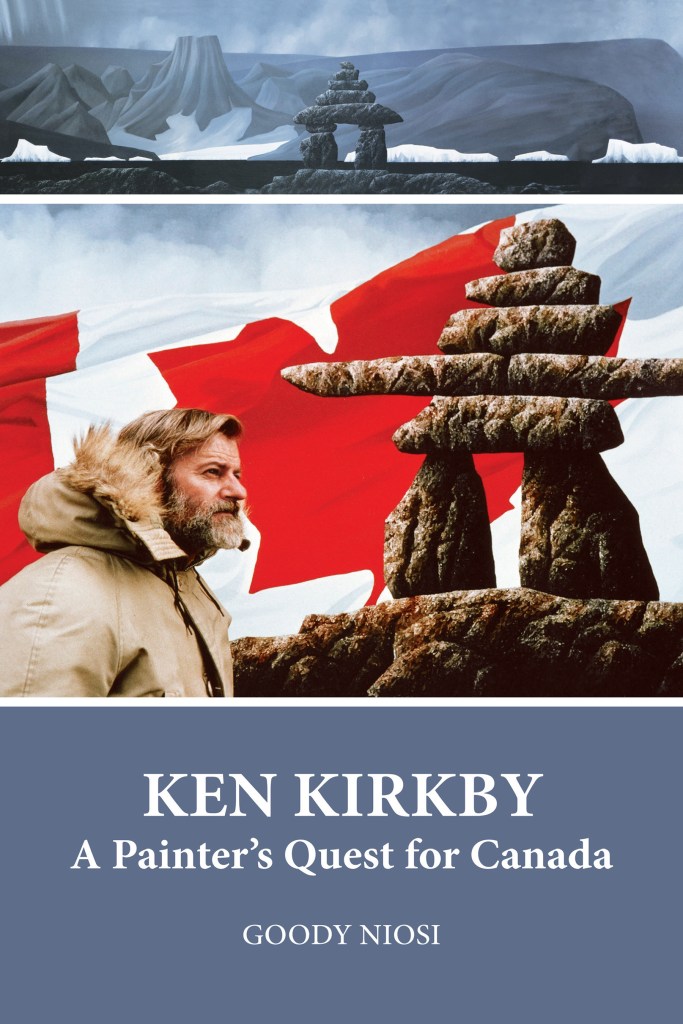
Ken Kirkby, A Painter’s Quest for Canada

Excerpt

The bush pilot told Ken that there was no such place as the Arctic – it
was an arbitrary dotted line drawn on a map, by people who had never
been there. The Arctic was a hundred thousand million places, he said,
with an enormous variety of climates and vast distances between small
communities. You might find a few people on the land, he said, but not
many. Most of them had been rounded up and put into camps built like
villages. The idea of the Eskimo as one homogenous group of people was
as big a myth as to say that all Europeans were one race.
Nevertheless, the government had decided that the Eskimos had to be
gathered together – regardless of tribe or dialect – and placed in communities,
which they would use as a base to go out and trap fur animals
for the Hudson’s Bay Company. Then they depended on the company for
their survival and were, in fact, essentially owned by it. Each Eskimo had
been given a number and a letter. Those west of Coppermine River were
assigned the letter W and a number. Those East of the area were given an
E and a number, and in some cases, those letters and numbers were tattooed
on their arms.
Ken was horrified. He repeated to Jessica, Patrick, and Long John what
the pilot had told him. John was furious, not at the government, but at
Ken and his wild dreams. “You’re on a wild goose chase! You’re mad!” he
shouted. “There’s nothing to go to – thousands of square miles of absolutely
nothing but ice, wind, and rocks – lots of frozen rocks and no
people. I tell you, there are no people there. The place is a bloody, frozen
desert. You’re made of flesh and blood – you’re not a god! What is it with
you English and your half-baked need to go to desolate places? As if life
isn’t difficult enough without going looking for trouble!”
“For someone who’s never been to the Arctic you seem to have a helluva
lot of knowledge about it,” Ken said. “How do you know there’s nothing
there?”
“I don’t need to go there,” John said. “I can read. There’s a place called
“The Barrens” and I imagine it’s called that for a good reason, don’t you
think?” John pulled out a map and pointed to the place. “Read it – it’s
right there. The Barrens – there’s nothing there. When he first looked at
the place, one of the explorers wrote in his diary, ‘This is the place that
God gave to Cain’. All I can see is that the place is going to kill you – not
much different from every other Englishman who’s gone up there. I can
see a small headline in some small newspaper somewhere, ‘The Arctic
wastes claim another Englishman.’”
“It didn’t kill Francisco,” Ken argued.

https://www.amazon.com/dp/0981073573

Savages and Beasts

Excerpt

Mary Goldberg, just twenty-five years old, who had graduated
from the McGill University of Toronto, daughter of a very
affluent Toronto family with Jewish roots, after a disappointing
erotic relationship with a young man of Jewish roots too, and
against the wishes of her parents, and against the wishes of her
best friend Rosalyn, had decided to travel across the country
and after she spent a few months on the road, and after she lived
temporarily in a few Canadian cities, she ended up in this Indian
Residential School, in Kamloops BC, where she was hired as an
administrator assistant; Mary, who stood almost six feet high
with long black hair that fell on her back almost to her waist,
was a clever eyed young woman with fair attitude; her characteristics
were complimented by her hazel eyes and full lips, an
aesthetically shaped nose and a very shapely body.
This body, hidden under the tight outfits, which Mary
liked to wear was easily discerned by the piercing eyes of Father
Jerome, who never missed noticing such things especially since
he was appointed the head of this facility in Kamloops BC,
here, where no one would ever come to check what was going on
and how the Indian Residential School was run. He knew
of course that he had some guidance from the church and the
Federal Canadian Minister on issues pertaining to education
and curricula, yet the rest of the details were up to him and him
alone, which placed him at the top of a heap he would never ever
step down from. And he made sure all members of the teaching
personnel as well as everybody else, from the British Columbia
Provincial Legislators to the Mayor of Kamloops, to the rest of
the citizens knew who he was and what his goals were; therefore
no one could ever interfere with his decisions regarding the daily
affairs in the running of the school, and the savage kids he was
meant to educate, come hell or high water.
“I wish you peaceful days and nights, Anton,” Mary said,
and her lips showed a faint tremble.

https://www.amazon.com/dp/1926763602