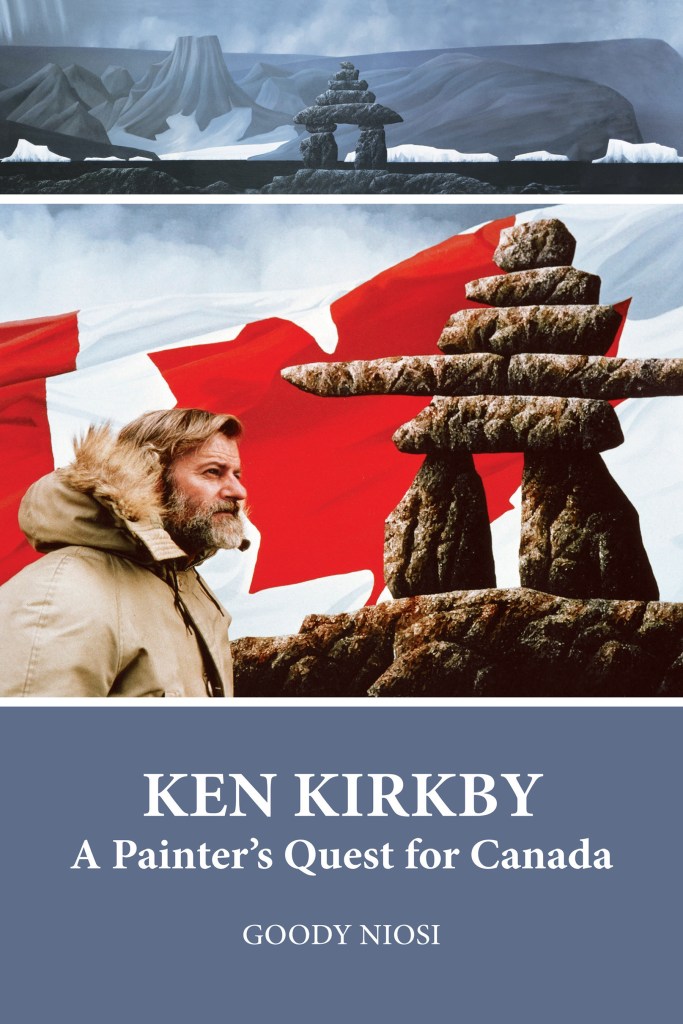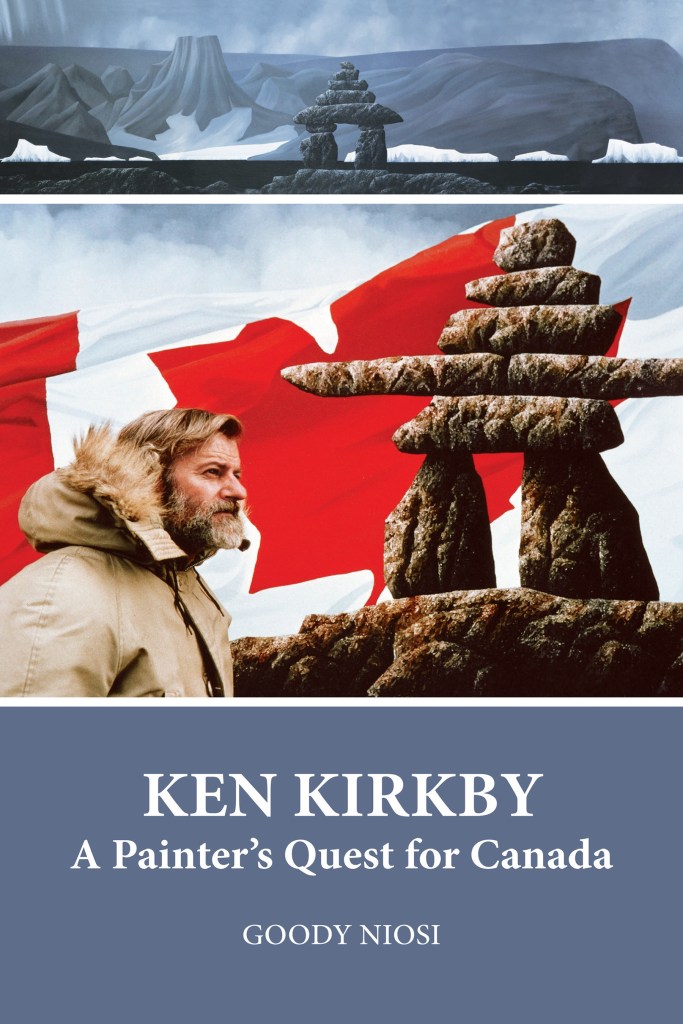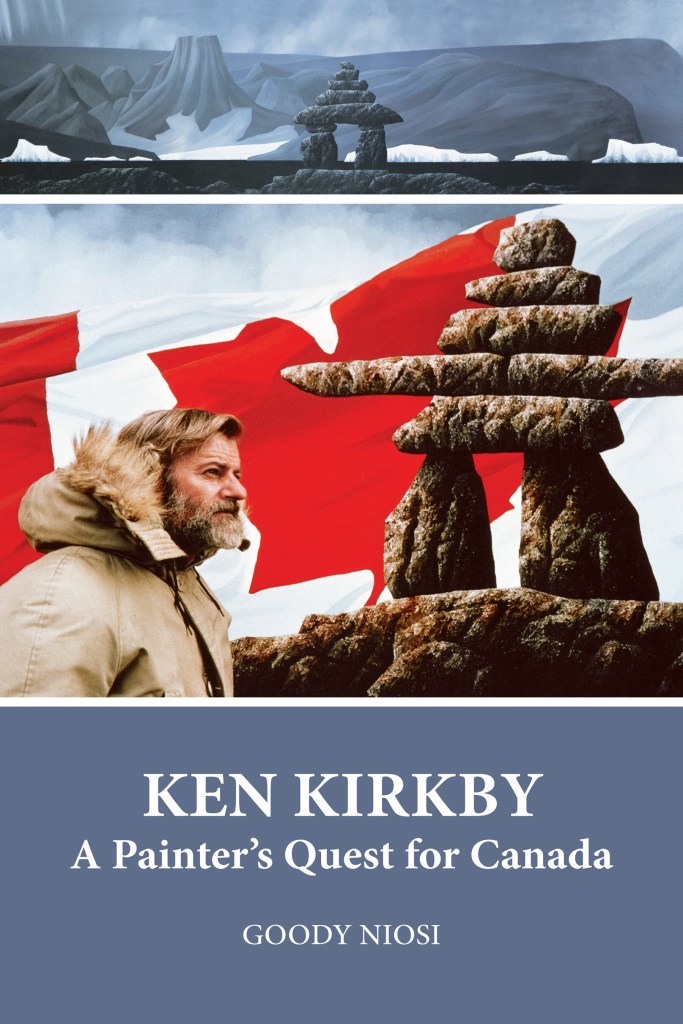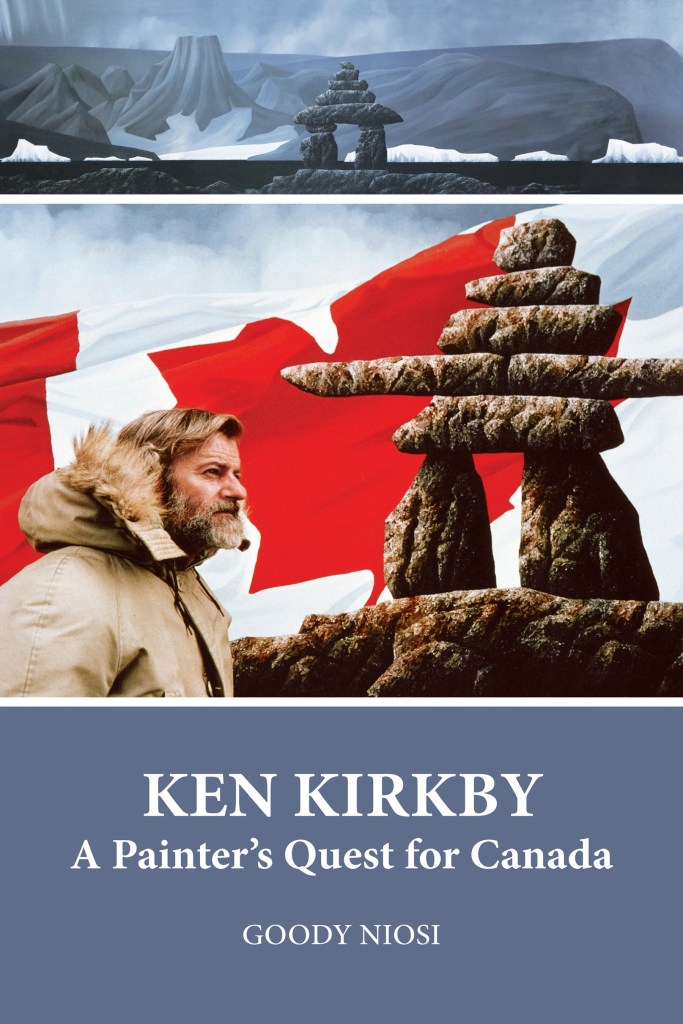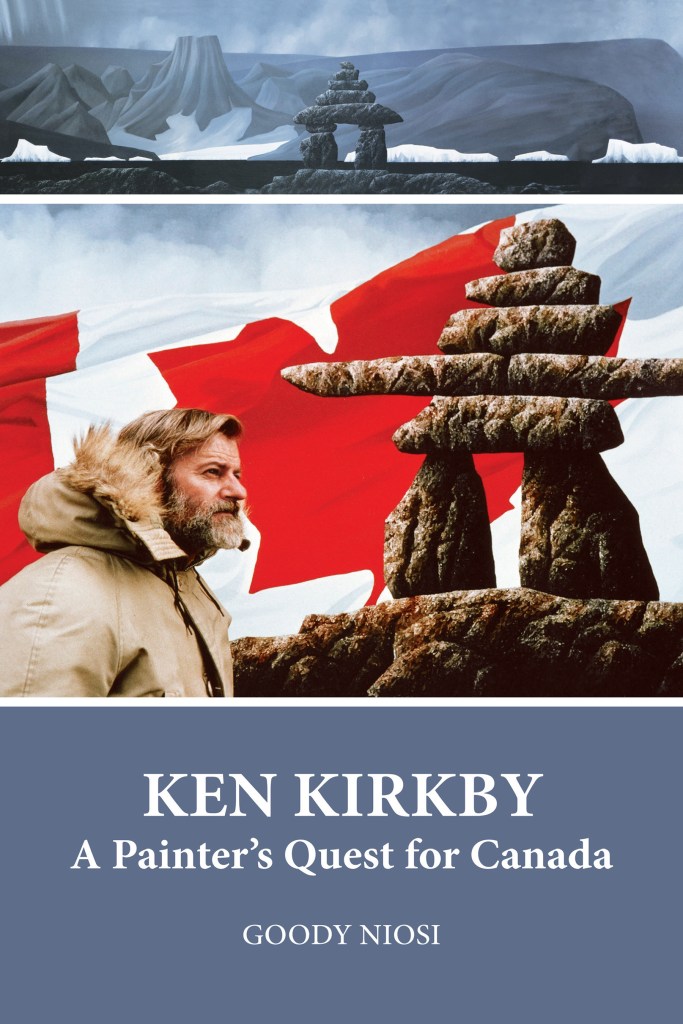
Ken Kirkby, A Painter’s Quest for Canada

excerpt

assion doesn’t come from this generation.”
“I was. I was raised in an ancient place by somewhat ancient people.”
“So, what do you propose I do?”
“I propose you find out whether I am telling you the truth.”
As he and Rocco left, Ken turned and said, “By the way, I think the gallery
should be called The Joseph D. Carrier Gallery.”
Carrier smiled. “Of course.”
Once work on the gallery began, Ken and Carrier met frequently. When
Carrier discovered that Ken’s paternal grandmother, Constanze Inocente,
was from Genoa, he declared that the connection made Ken Italian, and a
member of the community. With Carrier’s urging, Ken joined the Canadian
Italian Business and Professional Association, a dynamic and diverse
group that included doctors, lawyers, carpenters, and bricklayers.
As opening night of the Carrier Gallery approached, Ken suggested a
show of his Arctic paintings, on a massive scale.
“You haven’t sold any and you want to start off with a huge explosion?
Rocco asked. “What if it fails?”
“You’re sounding like my mother. What if…”
“I love the idea, but what a risk!”
“When you jump off a cliff, make sure you do it head first. Be honourable.
Do it big.”
What about the cost?” Rocco asked. “Who will pay for it?”
“All we have to do is commit to the vision and the rest will follow.”
Ken rented the warehouse next door to the framing factory, a space
large enough for his Arctic paintings. He painted the ceiling black, the
walls white, and the floor battleship gray. Then, he went to work on the
giant paintings. Rocco focused on the show. They needed a sponsor, Ken
said. The show had to be unique. Canadians didn’t care about the Arctic
so everything about it had to be special.
“If Canadians don’t care, why are we doing this?” Rocco asked.
“Because this story has to be told,” Ken said, explaining that the entire
saga had begun on a beach in Portugal. And that’s when it struck him –
Portugal would be their sponsor.
He wrote a letter to Dr. Antonio Tanger Correia, the Portuguese Consul
General.
Correia called. “Mr. Kirkby. As if you had to explain yourself! What a
delight to get your letter. We must have lunch!”
They met for a lunch that extended into dinner. Ken explained that he
wanted the invitations for the exhibition to come from the Portuguese
people, meaning the Consul General and the Portuguese Ambassador to
Canada. “I’m not asking for money,” he said. “I simply want you to issue
the invitations.”

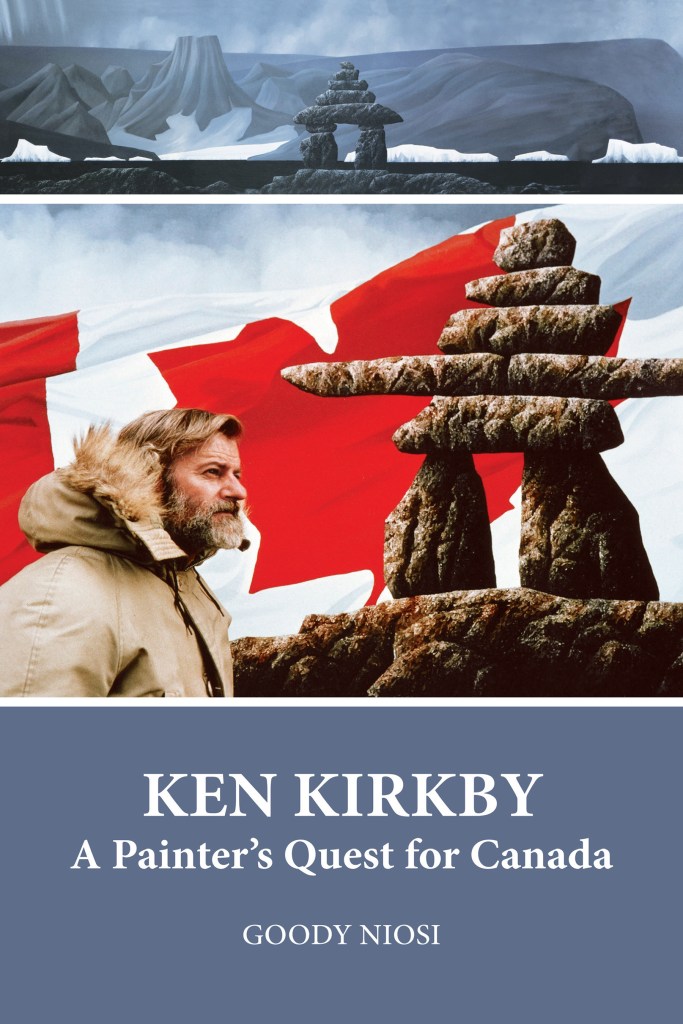
https://www.amazon.com/dp/0981073573

Ken Kirkby, A Painter’s Quest for Canada

excerpt

When he entered the classroom, he sat on the teacher’s desk, his feet
dangling, and told stories about the Arctic. The children listened raptly.
He received another speaking request, and then another, and another.
He accepted all of them. His talks were a training ground for what was to
come. Fraser had been right. “”We’re not selling paintings; we’re selling
stories.”
He spoke to classrooms of elementary students and to older students in
high schools. One time he began with, “Before we get going I want to tell
you, just so that no fraud is committed here – I never went to school.”
The children gasped.
“It’s kind of weird, isn’t it – that I’ve been asked to come and talk to
you but I didn’t go to school? Now, make of that what you will. I’m not
suggesting that you don’t get a formal education, but I am suggesting that
there are those of us who probably fare better if we don’t.”
He shared his thoughts on education – what it is and what it is not. He
wove his ideas into stories of the Arctic, stories of politics, and stories of
old mythology. His stories posed questions. “Why do we think things are
right and why do we think other things are wrong? Where did we get all
this stuff? Who wrote it down? Who says it’s true?”
His speaking invitations multiplied, until he could accept no more. He
met with the principal of one school that had made a request, and said,
“I want to speak to the whole school. Give me your auditorium. This is
a performance, and I don’t want forty-five minutes – I want the entire
afternoon.”
He asked that the banners in the auditorium be taken down, all the
lights turned off, and the windows curtained. He asked for one microphone,
with a long cord, and a spotlight on centre stage. There would be
no adults in the auditorium, although teachers could position themselves
out of sight where they could hear. The children were to come in and sit
on the floor. When they were seated, the room would be plunged into
total darkness, and the children would sit for three minutes in silence,
before he walked on the stage.
“Are you out of your mind?” the principal said. “These aren’t children
– they’re little animals! It will be chaos! You obviously don’t understand
children!”
“I probably do,” Ken said. “I was one once and I probably still am.”
“It can’t be done.”
“Fine. I live in a world where apparently everything can’t be done.
Have you ever tried this?”
“No.”
“Then, you’re educating children and giving them advice based on
things you’ve never done. That’s one hell of a way of going about things.
Well, that’s my offer – take it or leave it.”

https://www.amazon.com/dp/0981073573

Ken Kirkby, A Painter’s Quest for Canada

excerpt

“Why?”
“A painting that is given is all but worthless. It’ll be up in the attic or
down in the basement before you know it. A painting must always be
well paid for and it will be up above the mantel quicker than you can
snap your fingers – and it will stay there. And another thing you need to
know – you never give wealth a gift. It’s one of the ‘middle classes’ really
bad habits.”
When Ken walked into the gallery in Kelowna, Jack Hamilton took
him into the back office and handed him an envelope. “I see you keep
very fancy company,” he said.
Ken tore it open. The premier had written that he would be delighted
to visit the gallery the next morning at eight.
At seven-fifty, Jack staggered down the steps from the apartment above
the gallery, in his rumpled pyjamas, unlocked the front door to let Ken
in, and shuffled back up the stairs. At eight sharp, a chauffeur driven car
pulled up, and Bennett stepped out. He gave Ken a hearty handshake, sat
down at a small table near the front of the gallery and asked to hear stories
of the Arctic. “I thought you were just going up there for a month or
two, but you seem to have gotten yourself lost up there.”
“In a way, I did,” Ken replied. “It’s a long story.”
“I want to hear it.”
He told the Premier about his adventures and the atrocious conditions
the people lived with. He talked about the famine and the disease, and the
autocratic rule of the church, the RCMP, and the Hudson’s Bay Company.
When he finished, he asked if there was anything the Premier could do to
help the people up there.
Bennett stood. “Let’s see your paintings,” he said.
They walked through the gallery.
“What do the red dots signify?” Bennett asked.
“It means they’re sold.”
“It looks like they’re all sold.”
“Yes, they are.”
“You must be doing very well.”
“Yes I am – I’m very lucky.”
“I’d say there’s more than luck involved. I know nothing about art but
I do like what you’re doing, especially that one,” pointing to a landscape
of rolling grasslands. “I’d be interested in owning that one.”
“I’m sorry,” Ken said. “I’m afraid the entire exhibit was sold before it
got here.”
He led him into the back office where three paintings leaned against
the wall. “These are not sold,” he said.
Bennett pointed to one of the high plateau on the Douglas Lake Ranch.
“I like that one. Where is that?”

https://www.amazon.com/dp/0981073573

Ken Kirkby, A Painter’s Quest for Canada

excerpt

“Sure. I’ll be happy to try that, but you know that while I’m doing that
I won’t be painting.”
“Don’t worry about that,” Fraser said.
“I’m not worried. I just don’t want you to get in a huff about not having
enough paintings.”
“I said don’t worry. I’ll make it worth your while.”
“That’s not what I mean. I’m happy to do it for you in return for what
you’re doing for me. And I don’t want any money for it.”
“You don’t want any money! Well, I never – a man who doesn’t want
money. So what do you want?”
“I just don’t want you to get upset when my painting production falls
off because I’m doing other things for you.”
“Of course, I’ll be upset at your lack of paintings. Why wouldn’t I be?”
“But that’s not reasonable!”
“It’s quite reasonable in light of how you present yourself – as the one
apart – the one to whom the rules don’t apply – the one who walked in
here without an appointment. There isn’t a painter in the country that
would dare do that. And, your shenanigans in the Peace River Country
– and your wanderings in the Arctic – as if you owned the bloody place.
You put yourself forward, with a quiet aloofness, as the man who can do
everything and anything, so I’m sure it won’t be any kind of a trick for
you to be in two places at the same time, doing two different things at the
same time.”
“Well,” Ken said. “That’s not how I see myself.”
“Fine. But I’m only telling you how you portray yourself.”
“If I was who you say I am, I’d be able to get my Arctic paintings and
stories out to the public, and I can’t.”
“Your Arctic paintings are the only tentative part of you. You haven’t
come to terms with that subject. You’re unsure and it shows. Everything
else you paint is clear, simple, strong and sure-footed. But don’t be concerned.
In good time, all of this will look after itself. With your confidence
and your bloody single-mindedness, you’ll work your way through it. But
right now, you’re not there and I will neither show them nor recommend
them. In that area you have a long way to go.”
That evening, he related the conversation to Helen.
She laughed. “Don’t tell me you’re surprised. You have an ego as big as
the world. You’re full of yourself. The long and short of it is that you’re
arrogant. Alex is right. You wander into a place, you give it the once-over
and all of a sudden, you’re going to fix everything, you’re in control, and
you’ll take care of it. That’s what it looks like from the outside.”
“It does?”
“Yes, it does. And what do you have in mind anyway? Where are you
heading with all this?”

https://www.amazon.com/dp/0981073573

Ken Kirkby, A Painter’s Quest for Canada

excerpt

Then he reached to the side, and turned on the
tap of the small bar sink, and filled a pitcher with water. Lastly, he opened
another cupboard, lifted down two tumblers, poured a goodly measure
of whiskey into both, and splashed water into the glasses.
“This is how you and I are going to do business,” he said. “We’re going
to drink.”
‘In the middle of the day?” Ken asked.
“What’s that got to do with anything? We’re going to drink.”
“Why do we have to drink?” Ken eyed the whiskey with revulsion. “My
guess is it’s to do with, ‘get a man drunk and you’ll find out who he is.’”
“Who told you that?”
“My father.”
“I’d like to meet your father.” He took a large swallow. “So, tell me
about yourself.”
Ken told his story, while he watched Fraser drink until the bottle was
empty. He drank a bottle every day, he said, and he was as proud of that
as the fact that he was a one match a day man. He struck a match in the
morning to light his first cigarette, and every subsequent cigarette, for the
rest of the day, was lit from the stub of the last. “It takes discipline to do
that.”
“I want you to come to the gallery two or three days a week. I want to
hear your story. I want you to tell me your feelings, your thoughts, your
understanding of the universe – everything. I want to listen to you. I want
to hear you.”
For several weeks, Ken visited and talked, while Fraser downed a bottle
of rye and smoked an eternal chain of cigarettes. “You have a passion that
is white-hot and I love it,” he said. “We have all these artists around, and
they’re all limp. I want to see a man with a paintbrush in one hand and a
sword in the other. That’s you.”
One day, Ken asked Fraser why he never saw the paintings he sold to
him. “Where do you put them?”
“I’ve sold them.”
“All of them?”
Yes, all of them.”
“Oh my gosh. Well, that’s terrific.”
“You look surprised.”
“I am.”
“That’s not a very nice thing to say to me. Of course, they’re sold. So,
bring me some more. Go and paint.”
“There’s a limit to my speed.”
“I’m sure there is and I want to find it. I suspect the faster you paint the
better you get. You’re thinking too much. Don’t think. Painting isn’t about
thinking. This is not an intellectual exercise.

https://www.amazon.com/dp/0981073573

Ken Kirkby, A Painter’s Quest for Canada

Excerpt

Ken closed his eyes, his lids like coarse sandpaper scraping against
his eyeballs. Opening them was worse. The woman tied a piece of soft
hide over his eyes and all he could do was bear the agony and wait. For
days, he travelled as a blind man, in pain and nauseated from the gentle
rocking of the sleigh. When the pain eased, he took off the hide, and the
old woman gave him a pair of goggles with a small slit, explaining that he
would have to carve them to fit his face. He carved with great care so they
barely touched his skin. Close contact would freeze them to his pores.
They had been travelling a long time, when a golden glow appeared
on the horizon. As they drew nearer, the golden fire resolved into a large
group of igloos. The dogs heralded their approach, and people streamed
out of the igloos to welcome them. The first questions were about food.
The caribou had not crossed their path this season. Did the new people
have caribou? Yes, they had much caribou and it would be shared.
A feast was prepared for the newcomers, who entered the largest igloo
in the centre of the village. In the anteroom, they took off their parkas
and beat them vigorously before entering the main room, where layers of
caribou hides were spread on ice benches that circled the room. Kidney
shaped seal oil lamps provided warmth and light. When they had eaten
and told stories, people dispersed to their own igloos. Ken and his people
crawled under many layers of hides and slept. The old woman had told
the people that Ken was a quiet Kabluna. “He is a friend,” she had said.
“He is now Inuk.”
The next morning while the men built igloos, Ken pulled out his roll of
sketch paper and drew them, as they searched for the right sort of snow
by poking deep into it with a knife or a long sharpened piece of bone.
When they found the right spot, they drew a circle and began cutting out
uniform chunks of hard-packed snow, beginning at what would become
the entrance. They lifted the blocks into place, bevelling the edges, and
chinking the spaces between with loose snow.
Ken was invited to accompany the men on the next hunt. For the Inuit,
hunting is the essence of life. The animals must be revered and not offended.
Kablunat don’t understand this, the old woman told him, but Ken
was now Inuk – no longer a Kablunat. She convinced the hunters that
Ken was an exception. They set off onto the frozen sea that was covered
with a thin layer of transparent ice that moved in front of the sled teams
like a rubbery wave. Underneath them, thousands of air bubbles bounced
and rolled.
When they spotted a seal in the water beneath them they searched for
the beast’s breathing hole and waited. When the seal was forced up to
gasp for air one of the men heaved a long spear and the water stained
crimson.

https://www.amazon.com/dp/0981073573

Ken Kirkby, A Painter’s Quest for Canada

Excerpt

never been a connection between those people and the Inuit and yet here was
an original seminal idea being spoken by a woman in a completely different
time and space and place. All these things were like jolts hitting me. Here I
was living with an ancient people that were speaking to me directly. This was
not something being told to me by a teacher or a relative. I was getting the
original story and it affected me very profoundly.
When the old woman finished her story, silence enveloped the igloo like
a down blanket. Quietly, Ken stood and walked outside. The sky was filled
with as many stars as Ken’s mind was filled with thoughts. In one instant,
his life had changed. Knowingly or not, the old women had answered his
question about his role in this place, and in the lives of the Inuit.
She joined him, and he linked his arm through hers. Together they
stood gazing at the sky. Icy crystals of thought invaded his heart, while an
avalanche of ideas roared through his mind.
This was that crystal moment when everything that had happened before
made sense. I now had a clear purpose. I had gone to the Arctic because of
the stories that had been told to me in that cave in Portugal, but now, I felt
an urgency to gather as much information as possible – and to disseminate
it. It was clear to me how brilliantly I had been prepared. From this moment
on, I was no longer pursuing childhood dreams. I had a white-hot fire burning
inside me.
One day, the sun reappeared over the horizon and Ken felt as though
he was awakening from a dream. For a seemingly endless amount of time,
he had lived in darkness, listening to stories and legends, and the line between
waking and dreaming had blurred. And now the sun – a cause for
celebration – a reason for feasting!
Feasting also served to remind them of their great good fortune. They
had food, warmth, and clothing. Even more important, others had been
helped and they were grateful to have been able to help them. The young
man who had amputated his toes had survived, and that was even further
cause for thanksgiving.
As the days grew longer, the polar bears came out of hibernation. One
had been spotted nearby and men quickly prepared for the hunt. Once
again, grandmother prevailed upon the hunters to include Ken. When
the dogs picked up the scent they were released from their traces, and the
men followed their high-pitched howling.
When the dogs found their quarry they surrounded it, darting in close,
and then running back, staying out of reach of its lethal claws. Finally,
overheated and exhausted, the bear collapsed. The hunters fired at the
downed body until it lay still in a pool of blood, and then they began the
enormous task of skinning and butchering it. The oldest hunter stood
back. “In my day, that’s not how we hunted bears,” he said. “When we
hunted, it was one man with a spear and one bear with his claws.

https://www.amazon.com/dp/0981073573

Ken Kirkby, A Painter’s Quest for Canada

Excerpt

The days and nights blended one into another, and long
periods of quiet contemplation were interspersed with intense bouts of
hunting. Ken learned to breathe differently. Taking in great gulps of the
frigid air would have burned his lungs, so he inhaled slowly and measurably
through his nostrils, calculating each breath.
One day another group of people arrived at their camp with several
dog teams. Among them was a boy in his early teens. He too had recently
come from a residential school and was sullen and spoke to no one.
The group brought word that the caribou had not come their way and
they were here to join Ken’s group and hopefully share in what they had.
Ken’s group agreed to travel together and to share their abundance. They
planned to move further east, to where they hoped to find enough seals
and walrus to provide meat for the long winter.
One day before setting out, the troubled youth was particularly disrespectful
to one of the elders and was quietly chastised. He walked away
from the camp and had gone only a short distance before several people
went in search of him. No one could survive long in this cold. The wind
began to howl picking up ice crystals and blowing them across the land
and the searchers hurried back to the tents. Within minutes the world
was white; taking even one step outside the tent was certain death.
They waited in silence and Ken found himself feeling both disconcerted
and exhilarated by their patience and lack of anxiety. He was unsettled
because he had lost all sense of reference and elated because each moment
was perfect. He was alive in the now and nothing else mattered. The
long hours of silence gave Ken only one point of focus – himself. He was
meeting himself for the first time and the self he was meeting was neither
good nor evil – he just was – and Ken embraced that self with his mind
and heart, quietly blessing every event that had led him on this journey
to this place.
The white storm lasted for several days and when it ended, the people
left their tents to resume the search. There was no sign of the dogs,
just small mounds of snow scattered around the tents. When the people
nudged the mounds, the dogs emerged from their igloos, shaking the
snow off and wagging their tails furiously. They untethered several of
them to assist in the search, and their acute sense of smell led them to
another mound of snow under which they found the frozen boy.
There was no crying or wailing. They wrapped him in caribou hide
and with great effort moved rocks, that the wind had swept bare, to form
an oval. Gently, they placed the boy in the oval, placing some of his possessions
with him. Then they walked away. They had eaten animals all
their lives; in death, they completed the circle and returned their bodies
to the beasts.

https://www.amazon.com/dp/0981073573

Ken Kirkby, A Painter’s Quest for Canada

Excerpt

Ken’s people were caribou people.
When the last of the caribou had passed, they dragged the fresh carcasses
to several large piles of rocks that they lifted to reveal deep pits
lined with more rocks. They lowered the meat into the pits and replaced
the rocks. The main danger to their food reserves was marauding wolverines.
By caching their meat under rocks too heavy for the wolverines to
move, they guaranteed a food supply for the season to come.
The days changed. The shiny green bearberry that covered the tundra
turned blood red and when Ken gazed across the land he saw a river of
crimson. One morning the snow geese flew across in the hundreds of
thousands. When they settled on the land a down blanket covered the
scarlet sea.
The days grew shorter and the temperature dipped dramatically. Ken
shivered in his sleeping bag and the old woman gave him two caribou
hides – one to put under his bag and one to cover it. He developed a new
understanding of the word “cold”. Cold was not simply a word here – it
was a palpable, physical thing, which assaulted every sense – it was the
god that controlled the land.
A few days after giving him the caribou hides, the old woman presented
him with a caribou parka lined with Arctic fox. Through her son,
she explained that this was to be worn without undergarments, next to
the skin. The parka was light, soft and astonishingly warm.
They continued to travel east until they came to a lake dotted with a
number of small islands, where they had left sleigh dogs that had whelped
in early summer. The animals were wild, ferocious, and pugnacious. They
took them back to the mainland where they pegged them to the ground,
placing the lead dog at the front of the pack. Once a day someone tossed
a frozen fish to each dog, which it consumed ravenously. The dogs were
born to pull sleighs and once in the traces would run across the ice until
they dropped from exhaustion.
With the dogs in tow, they continued trekking to the place the old
woman called home. She was a Netsielik, People of the Seal. Her husband,
who had died of TB, was People of the Caribou. TB had become epidemic
among the Inuit. Several people in the group had severe coughs and often
spit up bloody phlegm.
Snow began to stream across the land, blowing from the west in a million
little rivulets. The temperature, already chillingly cold, continued to
drop. The old woman gave Ken a pair of trousers made from caribou hide
and sewed a wolverine hide along the edge of the hood of Ken’s parka.
To the amusement of the Inuit, Ken sat on the frozen tundra in his new
clothes, watching the snow dance across the land. He felt fortunate. He
was living his childhood dreams. This was the Arctic he had envisioned –
the land of Francisco’s stories.

https://www.amazon.com/dp/0981073573

Ken Kirkby, A Painter’s Quest for Canada

Excerpt

On shore, Ken’s friend took out a sharp knife and slit open the belly of
one of the big fish exposing a white strip of pure fat. He peeled it off, put
the end in his mouth and cut it off with his ulu. He passed Ken a piece of
the precious fat that melted deliciously on one’s tongue.
Ken became mesmerized by the minutiae of Inuit life. Everything they
did was alien to his previous experience. He watched one of the men
make a drum from the hide of a young caribou. Only the skin of a young
animal would do, the man explained. It was shaved clean, soaked with
water and spread out in the hot sun where it bleached white. It was then
stretched over several pieces of wood that had also been soaked, bent to
make a circle and bound together with strips of leather. The skin was
sewn on to the hoop and left out in the sun again, this time to shrink.
Watching the process, Ken understood how important each piece of
wood was to these people. Where he came from people would have used
just one piece of wood to form the hoop. Here, the circle was made of
many small pieces of wood. Trees didn’t grow on the tundra. There might
be the occasional knee-high shrub and very rarely, willows that grew waist
high in protected gullies. Every scrap of wood was hoarded and used with
care and precision.
The Inuit had to obtain additional wood from the south where the
sub-Arctic Indians lived. The old woman told Ken that there had been
an uneasy truce between the Indians and the Inuit, which was often not
honoured. Raids and massacres had taken place for years.
When the woman told stories through her son, she often said words
that she asked Ken to repeat. When he learned a new Inuktitut word, she
smiled and when he began to put words together to form a sentence, she
beamed. It was the most difficult language he had ever learned, but then
the people were like no others he had ever encountered. They didn’t make
eye contact when they spoke and they had no word for me, mine or I.
Raising your voice, particularly to children, was taboo. Children were
expected to learn by the example others set. They ate when they were hungry,
slept when they were tired, and played when they wanted to. Adult
displeasure was shown in the smallest facial expressions – the wrinkling
of a nose or a slightly raised eyebrow.
One day a young man named John joined the camp. He was about
sixteen years old and he spoke excellent English. He told Ken that he was
on holiday from the residential school in the south but he had decided
not to return. They had cut off his hair and had beaten him for speaking
his language. The old woman was his grandmother, and John told Ken
that she and others were trying to get their children back. But this was not
easy. While they needed to be stationary so that they could be contacted,
they also needed to keep moving …

https://www.amazon.com/dp/0981073573