
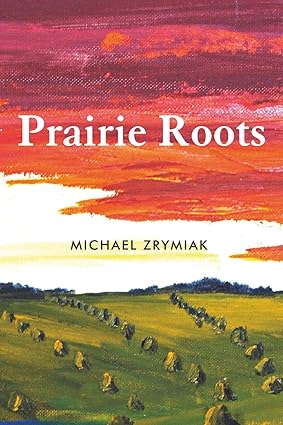
Prairie Roots

excerpt

ridiculously low prices; even the children may not have fetched
much, being offspring of immigrants. Life was indeed a struggle,
as the first four boys arrived into their care.
My initial memories of that farm include a vague vision of a gray
two-storey frame house and chickens all over the yard. The chickens
I remember looking at in some puzzlement, from an upstairs
bedroom window, and wondering as to their relationship to me. I
also remember the big blocks of “relief” cheese which mother sliced
on the kitchen table; however, I do not remember whether or not I
liked it. It seemed to me that the weather was always sunny, perhaps
because we were only let out when the sun shone.
My most vivid early memory is associated with the 1938
Beeston school Christmas concert at which time I was three and a
half years old, having been born in May of 1935. I remember not
the concert itself, having slept through most of it, but being awakened
in my Uncle Mike’s arms by the noise of Santa’s arrival. Obviously
my name was called and my Uncle hastened forward with
me to see Santa, who scared me half to death before presenting me
with a red toy truck. I have liked trucks and have been leery of
long-haired men ever since!
We lived in our home until the spring of 1940 at which time my
parents bought a 320 acre tract of virgin land from the Hudson Bay
Company, seven and one half miles north of Hubbard. Where is Hubbard,
you ask? Half way between Goodeve and Ituna or, to locate it another
way, about 100 miles northeast of Regina. The new land had not seen a
plough. The neighbors had pastured cattle on it over the years, otherwise
not a tree had been cut nor a stone picked. All this was about to change.
But first a house had to be built to …

https://draft2digital.com/book/3562900

https://www.amazon.com/dp/0980897920

Jazz with Ella

excerpt

“Sit with me here on this bench,” he said, taking her hand gently. “You asked to know about me and my family. So look around you. Except for my mother and aunt, most of my family are here. My father fought the fascists—just outside of the city. He wasn’t a brave man. He had no choice. To serve in the army was better than dying in Leningrad.”
“And your mother?”
“She survived the siege. She had no food except the ration. She didn’t get skinny though. She puffed up, she told me, her legs swollen—and her face, too—with disease.”
At that moment, Jennifer could feel a disease working through her own body in sympathy, a horrible nausea, her head heavy, her arms like lead, then only emptiness.
Volodya went on: “That first winter, 1941, she told me that many people froze to death on the streets. Those who survived were too weak to bury the others. So they just stepped over the dead on their way to stand in the food lines.”
“But she lived?”
“Somehow she lived. When the city was liberated, my father returned and nursed her back to health. He had an army ration; it was only a little more food than the usual ration. He died two years after I was born in 1947. He had been wounded in the chest. He couldn’t breathe.”
“That’s ghastly. So your mother had to raise you by herself?”
“Yes, she and her sister. But I don’t tell you for pity. This is what I want to tell you.” He stood up. “Look around here—at this memorial. All the memorials around town are built in honour of our glorious fallen comrades. So many memorials for the dead.”
Jennifer had a glimmer of understanding now. She shook off the nausea.
“A few years ago I looked at how my mother was living—how damp is her apartment, how she still stands in line for food, and I decide to write to Comrade Brezhnev. I asked him how come so many things are done for the dead and so little for the living.” Jennifer shifted uneasily. “Soon two special men came to my mother’s door. You know what this means, special men?”
“KGB,” she whispered.
“Yes, they question my mother. What is her son doing? Does he make trouble? The neighbours see these men come to the apartment.

https://www.amazon.com/dp/1926763246