He Rode Tall

excerpt

Sure, he had been gone for many years and there was no doubt
that the Circle H held some harsh memories for him. At the
same time, there was no doubt about it: for him, Joel Hooper, the
Circle H was home. And if there was any doubt in his mind, it
seemed as if nature was reassuring him that he was home with a
magnificent display of a spectacular sunset awash in all kinds of
tones of baby blue and soft pastel pinks. This truly was the legendary
land of the living skies. Alive with all kinds of colors. The
kinds of colors that were capable of temporarily extinguishing
even the gravest worries from one’s mind.
Two days after his trip into Willow Springs for the mail, he was
back up in the hills, sitting on the big buckskin gelding surveying
what must be close to fifty head of Smith’s cattle helping themselves
to his grass. This time he could see where the fence was
down. The cattle had torn the fence down to get at the richer
grass in his pasture. Poor creatures, Joel thought. They must be
half-starved with the slim pickings they have in their own pasture.
With all of the land that Smith has, he must have some
better pasture to move these cattle to. What was he waiting for?
For their ribs to show? Heck, some of them were at that stage
already.
Joel would be the first to admit that he did not know much
about cows, but he did know enough to realize that this was a sad
and sorry lot of cattle.
Realizing that this was going to be more of a major production
than his earlier experience that involved only three heifers, Joel
rode the buckskin back to the ranch and solicited the help of
Harry and Tanya. Harry headed up to the pasture in the old
truck, which he had stocked with a few fence posts, a bale of
barbed wire, and all of the fencing equipment, including a wire
stretcher and post-hole auger. Tanya was just about to finish
working with her last horse of the day, a little bay mare, so she
rode her up to the hills alongside Joel on the buckskin. On the
way to the fence, Joel and Tanya started to round up the intruders,
and in the distance, Harry was busily repairing the fence.

https://www.amazon.com/dp/0980897955

Arrows

excerpt

We followed the river until it converged with the same river
Guaire which ran the length of the valley.
We were one mile from our destination.
We crossed the Guaire from south to north, following the path of
those who had survived one of the two previous expeditions that
had made it this far. The Guaire was not deep, but, having lived all
my life near rivers, I knew how mighty it could become with the
proper amount of rain.
Soon after, we crossed a creek called Catuche, along which
soursop trees grew by the hundreds, hence the creek’s name, which
in Carib meant soursop. Tamanoa brought me one of its fruits and
ripped it open beforemyeyes. It was white, succulent and aromatic.
As the sun descended, the deep green of the cordillera mingled
now with soft blues and yellows. We had turned north and were
ascending the slope of the piedmont when Losada’s voice
resoundingly gave the order to stop. We had finally reached a
destination: the charred remains of what had been the settlement of
San Francisco, half-buried in the vegetation.
Francisco Fajardo had fled the settlement five years ago when he
knew the reinforcements he had pleaded for had been wiped out by
the Arbaco Indians of Terepaima. After painful losses, Fajardo had
divided his forces into two and fled in canoes and pirogues.
It was eerie being in that deserted place. The air smelled strongly
of rain, damp earth and plants. The howling monkeys, chachalacas,
parrots—they were all quiet. That night, as a full moon shone
through thick clouds, the ubiquitous night-song of frogs and
crickets was overridden by the deafening buzz of cicadas.
Losada paced nearly beyond range of the firelight, five strides to
the right, five to the left, hand combing his beard and moustache,
eyes fixed on the ground before him, his grizzled hair reflecting the
silvery moonlight. He anxiously awaited the return of the troupe led
by Diego de Paradas, who finally arrived after midnight, looking
seriously bedraggled.
“What happened?” asked Losada.
Diego de Paradas was wounded. Pánfilo spoke for him.

https://www.amazon.com/dp/0981073522

Savages and Beasts

excerpt

They walked back into the emergency waiting room.
Nothing was different in there. They walked into the hallway
and reached the area where Dylan was kept. The attending nurse
told them to stay only for a few minutes since the patient was
due for a few tests. They nodded their understanding. Dylan was
breathing a bit easier since they had hooked him on an oxygen
tube. Upon seeing them he smiled.
“They’ll do a few tests soon, and then I’ll go back home,”
he mentioned.
“We’ll wait to see the results of the tests,” Anton said.
A few minutes later the nurse came back and told them to
leave. They walked out to the grounds again. They found a bench
where they sat. A multitude of birds were flying from tree to tree
from branch to branch making their presence known with their
fluttering and with their chirping.
Time passed with the bird chirps and the flying from
branch to branch, Anton and Mary enjoyed their morning as
they sat for a while, chit-chatted for a while, walked around for
a while, until an hour later they went inside to check on the old
man. He wasn’t in his partition, obviously having a test. They
walked to the waiting room again. Mary used the public telephone
and informed Sister Gladys about the progress they had
made up to that time. She told her that soon as they’d know the
results from the test she will inform Sister Gladys and then they’ll
return to the School. Sister Gladys understood and said there was
no rush for them to return before they would be informed about
the issues pertaining to Dylan.
One hour later the doctor came to the reception area and
called them.
“Based on your description of his symptoms, his own narrative
we suspected a heart attack in fact his oxygen level

https://www.amazon.com/dp/1926763602

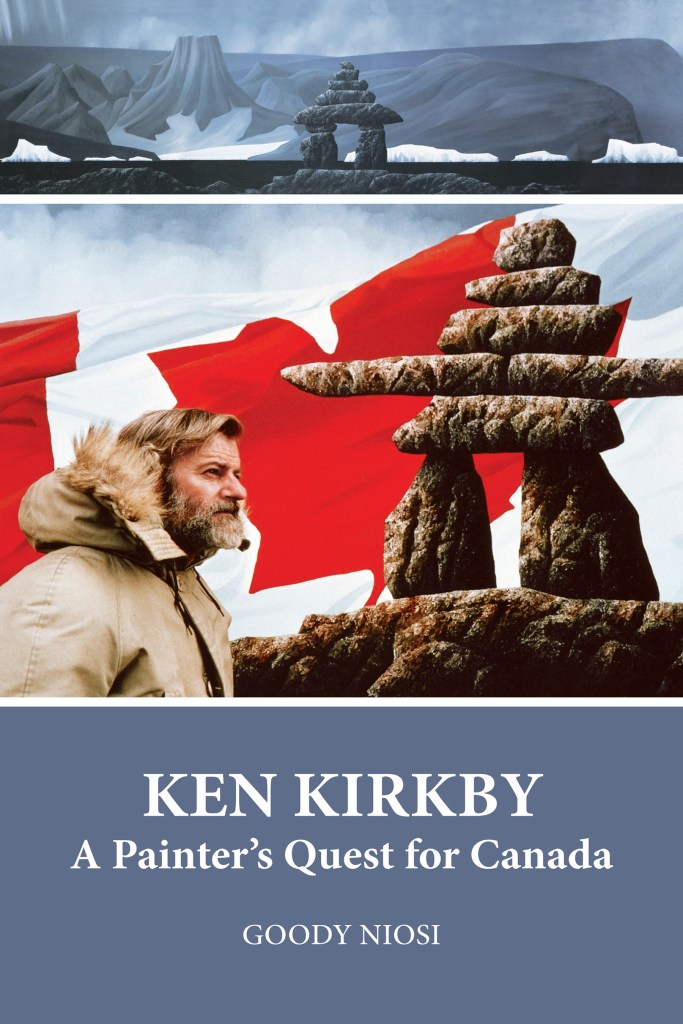
Ken Kirkby, A Painter’s Quest for Canada

Excerpt

distance away observing him. When they saw that he had noticed them,
they came to sit beside him. The man said, “My mother says you are a
very quiet Kabluna.”
“Maybe all Kablunat are quiet,” he said.
The man translated for his mother and said, “She says that all other
Kablunat that she has known are noisy. They talk a lot.”
“Maybe I don’t have much to say,” he replied. “Maybe I don’t know
very much.”
When Ken questioned the old woman about the Inuksuit she told him
a story that began a long, long time ago when there were very few human
beings. They travelled over the vast land in small family groups, following
the herds of caribou that were the source of their food, their tents,
their clothing, and their utensils. They could not afford to deplete their
energy by chasing the food. Instead, they made stone human beings and
called them Inukshuk, which means, like a person or acting in the place
of a person.
The people placed the Inuksuit in V-shaped formations. The caribou
with their poor eyesight, thought the Inuksuit were hunters and so it required
only a very few people to herd them into a trap. The closer they
came to the end of the V, the closer together the Inuksuit were placed.
At the point of the V, hunters hid behind boulders while women
and children lay on the ground beside the Inuksuit. As the caribou approached,
the women and children jumped up, waved their arms, and
danced about, to give the appearance of many, many hunters. The caribou
would then stampede to the end of the V, which was usually at the
junction of a lake and a river. When the caribou plunged into the lake,
the hunters hidden behind the boulders would jump into their kayaks
and paddle after them, spearing them in the water. Then they would haul
them back to shore where the entire family, even the children, would
clean and gut the animals.
Inuksuit also took on many other shapes, the old woman said. The one
on the river’s edge where they were sitting was a fishing Inukshuk. She
knew this because it was topped with a smooth stone taken from the riverbed.
It indicted that the fishing was good here. Other shapes had other
meanings and the configurations of Inuksuit had meaning also.
To my mind, what I was hearing sounded like language but they didn’t
write the language on a piece of paper – they wrote it directly on the land.
And I was beginning to get the picture of absolute practicality. Here you
could live with minimum technology if you knew how. To think that you
could direct an entire way of life by putting a few stones together just so,
so that other people coming would be able to read the significance of these
things. The degree of sophistication of this began to seep into me and I realized
there was much to learn here. And this way of life was like the people

https://www.amazon.com/dp/0981073573

Swamped

Excerpt

He switched over to the local news: a serious accident on the road
down to the Second Narrows Bridge. He had better take Lions Gate
Bridge this morning. The pileup on the approach to Second Narrows
would make it impossible for traffic to resume for at least two hours,
according to the news anchor.
The phone rang. It was Herb on the other end. After the briefest
of greetings, he brought up today’s buy order. He told him that a man
he knew, someone who seemed to have good connections in Europe
and other places, had assured him this was a good one, Platinum
Properties Inc, to play with for the next few months. Eteo listened to
Herbert Swanson attentively, but when he expressed some skepticism,
Herb said he would pass by the office around ten to talk about
it. He smiled. Herb always had a link to someone with information,
and in the Vancouver Stock Exchange in those days, with its mining
fliers and dubious promoters, information was of great value. Even
if the information was often questionable at best, decisions were
based on it, and today’s bet that Herb had placed on this new company,
Platinum Properties, wasn’t any different from many others. For
years, Herb had worked his way around each and every regulation in
order to survive the debacle called investing in V.S.E. listed companies.
In most cases, they lacked anything of substance, yet they could
fly high for a few days, even a few months, before sinking into nothingness
or simply going out of fashion. Sometimes they were still at
the reorganizing stage, a lengthy process that provided a second
chance for companies that had been unsuccessful in proving the
value of their first mining asset and raising funds on that basis. This
involved a reverse split of their shares, or consolidation, in other
words, issuing new shares to raise new capital. It was usually an opportunity
to turn their focus to a new asset, sometimes even to
change course and concentrate on a new line of business. When a
company was in that reorganizing stage, it wasn’t unusual for it to
take a good twelve months to achieve its goal, and investors who
didn’t like to wait that long rarely invested in such a company.

https://www.amazon.com/dp/B08WP3LMPX

Ken Kirkby, A Painter’s Quest for Canada

Excerpt

It might have been dropped into the harbour
directly from the China Seas. Ken explored the floating palace and then
stood on the railing leaning over the side, his eyes growing wider as they
passed under the Lions Gate Bridge and chugged into the open waters
of Georgia Strait. The sheer immensity of the snow-capped mountains,
forested islands and vast ocean staggered him. Gulls swooped by, eagles
soared overhead, seals and sea lions dived into the water.
After docking in Nanaimo, Ken drove north on a narrow gravel road,
badly rutted and peppered with potholes. The TR2, with its worn shocks,
rattled up the road that lay at the bottom of a canyon, its sides covered
in giant firs. When he arrived at Nile Creek and found the little cottage
he had been directed to, he knocked on the door and handed his letter of
introduction to the elderly couple who greeted him.
“We’ve heard a lot about you,” they said. “Monsieur Desjardines wrote
to us a number of times; telling us about you, and the wonderful times he
had with you in Portugal, and about how you want to be a Canadian.”
They took Ken out to the mouth of the creek where the water was so
thick with salmon it presented a solid wall.
The next morning they launched a rowboat and rowed out to the kelp
beds, that lay several hundred yards from shore. After tying up to the
outer rim of the semi-translucent mass, they cast their lures along the
edge of the kelp bed. The moment the lure hit the water a fish struck.
Then, miraculously the fish leapt into the air, dancing on the water. Listening
to the old man’s shouted instructions, Ken learned how to handle
Pacific salmon. They pulled in one fish after another, each cast of the line
producing another salmon. When the big box in the bottom of the boat
was almost filled they tossed them back, keeping two for their supper.
Ken spent the rest of the week fishing, and drawing fish – particularly
the cutthroat trout that fascinated him even more than the salmon.
His next trip was to the wild country near Kamloops. As he drew close
to Merritt the countryside grew arid with rugged rolling hills and tall
ponderosa pines, which gradually gave way to a vast grassland covered
with scrub.
He drove up the Nicola Valley, drinking in the smell of sage and basking
in the golden autumn sun. Bees buzzed lazily, half asleep in the golden
fields. Eventually he found the gravel road he was looking for that
climbed up and up into the mountains. He drove through the Stump
Lake Ranch and past the sign that said, “Peter Hope Fishing Camp”. He
drove on through mud puddles so deep that the water seeped through
the floorboards. When he could drive no farther, he parked and walked
across a small creaking bridge to an island with a tiny log cabin wearing
fresh golden logs on one side, and old weathered logs on the other.
Ken knocked on the door.

https://www.amazon.com/dp/0981073573