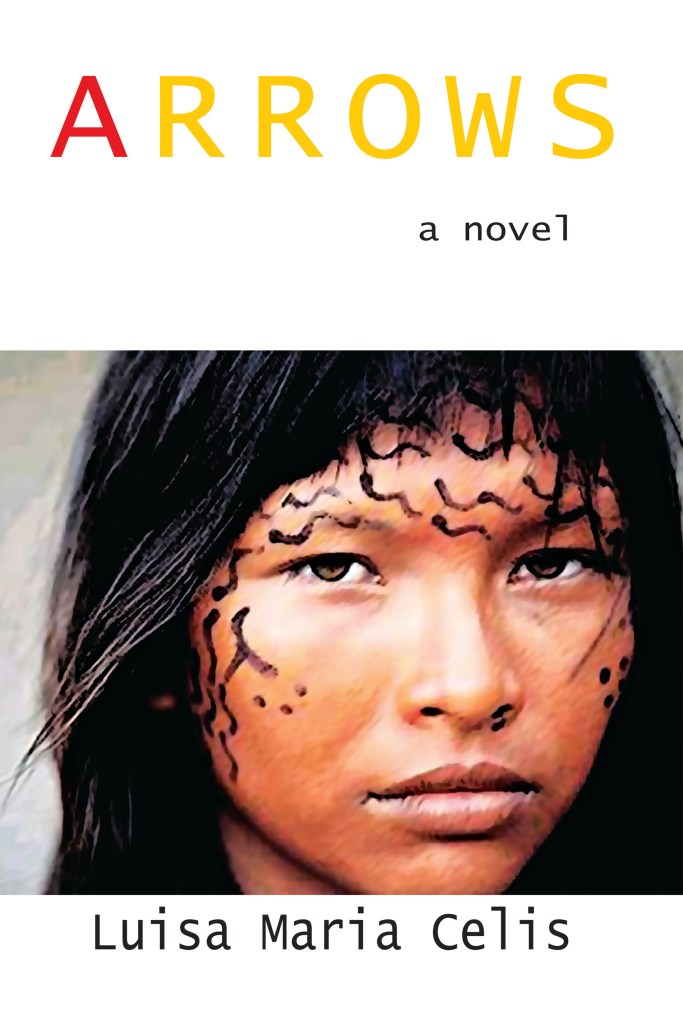
Arrows

Excerpt

Fresh tears filled her downcast eyes and rolled over her cheeks as
she blinked.
“How did you come to be here, Pepa?”
“I was one of five daughters. The last one,” she said softly.
I glanced at her husband, who had stirred in his sleep and
mumbled noisily before resuming his snoring. I knew exactly what
she meant. A daughter could mean the opportunity for a good
alliance or a financial burden on her father. In a household of five
daughters, the father would be happy to find anyone to take them.
Without a dowry, a girl would likely never be able to marry, or to be
choosy about it. Pepa told me her husband had agreed to marry her
without a dowry, despite her knowing how to read.
Gregorio awakened at the sound of her voice. He was listening. I
couldn’t help that. In her town, she said, everyone thought her
strange because she could read. It had been a relief to accompany her
husband in his quest for fortune in the Indies.Her mother had tried to
convince him to leave her in a convent, but he wouldn’t hear of it.
Gregorio kept watching her, sympathetically. He might have
consoled her himself had her husband not awakened at that instant.
Gregorio narrowed his eyes and shot him a loathsome look from
head to toe. “I’ll have something brought for you, señora,” Gregorio
said. “You’ll need your strength.”
“Gregorio is right, you should eat,” I said.
This unexpected attention seemed to perk her spirits. “I can read
something to you all, if you like,” she said, eyes lowered.
“Of course,” I said, breaking the silence. “What do you have
there?”
“It’s the Lazarillo de Tormes,” she said, taking a small book out
from under the folds of her skirt. The corners of her mouth trembled
as she tried to smile. She must have been protecting that book like an
amulet.
“This is a story about a rascal who is a blind man’s guide. Do you
know it? Here, listen: Fainting and dying of hunger, I staggered along the
street, and while passing by the Barley Square I found an old praying
woman with more tooth than a wild boar . . .”

https://www.amazon.com/dp/0981073522

Arrows

Excerpt

In the general direction of the enemy, Indian servants placed
forked poles to hold the muzzles of the heavy harquebuses. The
horses whinnied and stamped their hoofs, rustling the foliage as
they tugged at their halters. Somewhere farther away, I could hear
sheep bleating; closer the squealing of pigs.
Losada had mounted his black horse and was now whirling in
circles and bellowing orders, sword raised high over his head. I
glimpsed an Indian woman scampering into the bush with a toddler
on her back, suspended on a thick band hanging from her head. The
Indian servants scurried about, grabbing whatever they could and
herding the animals. All the riders mounted, and the dust cloud
thickened, forcing me to hold my breath. Gregorio ran past me,
balancing a harquebus in his hand.
“Don’t just stand there, hide!” he bellowed, his voice almost
drowned out by the racket.
“Where is she?” I yelled back.
But he was gone to join the harquebusiers gathering behind the
riders. I hunched into myself, rosary tight in my right hand. I came
upon the fire, blinking to clear the smoke from my eyes, and found
the last place I’d seen her. I stumbled over a basket and nearly fell. In
the name of all saints, I didn’t even know her name!
The servants had disappeared. I was the only idiot awaiting the
arrows. At the sound of grunting, I looked down to see a pig
careering into the heart-shaped leaves of a huge philodendron. I
followed the pig.
It took a moment for my eyes to grow accustomed to the dimness
in the jungle. I could discern crouching human silhouettes. Indian
women were huddled together on the ground, some crying, others
staring vacantly while frightened children clutched at them, some
finding oblivion at their mothers’ breasts. I made hushing sounds
and touched a shoulder here, another there, gesturing toward the
trunk of a big mahogany tree and mimicking the arrows falling

https://www.amazon.com/dp/0981073522

Arrows

Excerpt

Sweat broke out on my nape and forehead. The woman watched
me closely, giving me the annoying feeling that she could read my
thoughts. Perhaps she was a witch.
When a gourd filled with a milky beverage of uncertain origin
arrived under my nose, I began to miss my countrymen. Tamanoa
held it while the rest awaited my reaction. The children giggled and
I smiled, raising one eyebrow at them. I took the gourd out of
Tamanoa’s grasp, noticing the quizzical expression in his eyes.
“It’s chicha,” he informed me.
I sat down on the ground and crossed my legs, minding the
Seraphic Rosary so that it rested on the cloth of my cassock stretched
between my knees. I raised my eyes to heaven, as much to bless the
chicha as to ask for help. Well, Salvador, if you want the dog, you’ll
have to accept the fleas, I told myself, and took a gulp.
It wasn’t completely unpalatable. Had I known that its
fermentation was aided by the spittle of the women who concocted
it, I might have been less inclined to drink it. I passed it along,
fighting the urge to retch, eyes watering. Mater Dei, please tell me
that gourd never covered anyone’s genitals, I prayed.
The sight of another male with his foreskin neatly strangled with
a cord that went about his hips, his balls—wrinkled and
saggy—hanging like a cockerel’s wattles, made me regurgitate the
devil-sent chicha. I kept swallowing it back until, able to escape
unnoticed, I hid behind a tree and vomited my guts out.

We neared Nueva Segovia de Barquisimeto, a city founded in 1552,
along a murky river the Caquetíos Indians had called Variquesemeto
long before the Spaniards began renaming everything.
Diego de Losada led the way on his magnificent black
Andalusian horse, which seemed to share its master’s dreams of
greatness. All horses except my Babieca were proud, elegant beasts
with thick necks, strong chests and powerful, arched croups. Bred
from the first horses to arrive from La Española,

https://www.amazon.com/dp/0981073522

Arrows

Excerpt

The day of our departure came too soon. Entire families gathered
at the plaza to bid farewell to their most respectable sons. After a
year of preparation, don Diego de Losada had managed to convince
one hundred and fifty men to take their chances with him. No small
achievement, considering their prospects for survival.
Our expedition was bound for the province of Caracas—where
the town of San Francisco had briefly existed—and we were
destined to rebuild it in the name of Our Lord Jesus Christ for our
most gracious king, His Sanctified Catholic Majesty, Don Felipe II.
Less than five men out of each of the previous two expeditions into
the area had been left alive to tell the tale.
I had heard stories about battles, about how I would be lucky to
be killed at once. Cannibals liked to tie a Christian to a tree while
they danced in circles, possessed by the devil, chopping pieces out of
him every time they came about, cooking his parts under his nose or
even eating them raw, shooting arrows at him until his blood had
drained, blood they would collect in little bowls and drink as they
danced, smearing it on their bodies, spitting it on the ground.
One chief in particular, Guacaipuro, who commanded the Indian
forces of the valley of Caracas, put the fear of God into Spanish and
tame Indians alike, for it was said he had no mercy for either. All of
the other chiefs pledged their allegiance to him. On the land of one of
these, the settlement of San Francisco had been established almost a
decade ago, but Guacaipuro had burned it to ashes. It was to that
place we were heading.
Dressed in their feathered morions, coats of mail and cloaks,
twenty men on horseback under don Francisco Ponce’s command
melted stoically like butter in the sun, to be accompanied by fifty
harquebusiers with their pouches heavy with stone munitions,
eighty men on foot, eight hundred servants, two hundred beasts of
burden, several thousand pigs, four thousand sheep—all intended
to secure the beginnings of a new city.

https://www.amazon.com/dp/0981073522

Arrows

Excerpt

“We cultivate corn, roots and cacao,” he said. I remembered the
sweet, delicious aroma of a cup of hot chocolate. He must have read
my mind or heard my stomach rumble. “You must be famished!” he
said. “We ought to find you something to eat. Let us pay doña
Perpetua a visit in the kitchen.”
I followed him into the parish house. It looked like one of those
straw lofts we had in Spain. The inside was austere. Brother Carvajal
invited me to take a seat on a chair made of hide that smelled
strongly of its previous owner. A table, two chairs and a cabinet
completed the furnishings. The house was spacious, with a thatched
roof nine or ten feet high. It had a muggy, earthy smell to it. The
interwoven wattles protruding from the mud walls were
disconcerting.
He opened a trunk and produced a bottle of wine and two silver
cups.
“It’s wine from an outstanding harvest,” he said, “a present from
the new governor, don Ponce de León. Do you care for wine?”
I had little knowledge on the subject beyond colour and
sweetness and was going to say so, but he continued.
“It’s my only indulgence,” he said, chuckling at the double
meaning. I smiled, because we both knew an indulgence was a
pardon of sins granted—or sold—by the Church to the faithful. He
sniffed the open bottle. “These hazel-coloured wines are vigorous
enough to survive the crossing of the ocean without detriment to
their quality. The ones from La Mancha are the favorites in court.”
He filled the cups and handed me one. He waved his cup under
his big nostrils, then sunk his nose into it. “But, please, let us toast
the joyful arrival of another labourer to this field and the merits of
our allotted toils. May the Almighty bless them and give us drink
from the abundant flow of the fountain of his sacred heart.”
“How long have you been here?” I asked.
“Ten years, my son! Ten years of unremitting struggle to build
this.” His eyes scanned the wattle and daub walls,

https://www.amazon.com/dp/0981073522

Arrows

Excerpt

“My mother always worked in a household.”
“Why is it bad to ask your name?”
“You didn’t ask my name. Say the words again, and I’ll tell you
what they mean.”
The horse had begun to graze, and Tamanoa took hold of the
bridle again.
“Matircom yeunatir ueipano dauquir” I repeated slowly.
“Breasts, nipples, whore . . .” His voice trailed off as he signalled
the meaning of the last word by pointing to his crotch. “And what
was the other thing you said? Ah, yes. Guecenar onque. That means
give me your . . .” Again his voice trailed off, and he turned and
pointed to his rear end.
Heat rushed to my face. I massaged my eyes with the heels of my
hands and heard him giggle.
Torn between anger and laughter, I laughed. Benjamin, Benjamin.
He had taught me words I would never have dreamed of saying,
and I had repeated them like a parrot. No wonder we had gotten so
many looks. I was laughing so hard I removed myself and my horse
from the convoy.
“It was Benjamin,” I said. “So it’s your turn to help me. How do I
ask your name?”
“It depends. There are Indians from far away who have been
brought here to work, and we all speak different languages. But in
mine it would be atiyeseti?”
“What language is yours?”
“Cumanagoto. Carib. It comes from the eastern coast. It’s the
most common. My mother came from the region of Cumaná.”
“Are the families brought here together? As husband and wife?”
He shook his head. I looked at the Indians around me. That could
explain much of their sullenness.
In the year 1511, the Church had proclaimed the equality of men
and denounced the Spanish debauchery in La Española. But in that
same year, King Fernando El Católico had declared the branding of
cannibals. For the Spaniards, natives out of range of missionary
protection were cannibals. They were raided and sold as slaves.

https://www.amazon.com/dp/0981073522

Arrows

Excerpt

Bartolomé let him go, patting him on the shoulder. Pánfilo bent over
and coughed, hand on his throat as though choked instead of rattled.
I crouched beside Antonio and tilted the flask. I wasn’t sure how
much would suffice; a few drops would have to do as more would
kill him. I concentrated on balancing against the movements of the
ship and tilted the flask just a little more until a few droplets fell into
Antonio’s limp mouth. The potion squirted between Antonio’s lips.
He coughed from the bitterness and tried to sit up.
I gasped and tried to clean the excess with a rag, but it was too
late. Antonio had swallowed it all. I uttered unconfessable
commentaries under my breath and glanced at Bartolomé. He
looked at me, and I shrugged helplessly. We took our positions in
silence. I buried my nostrils in my armpit while positioning my
hands on Antonio’s chest, bewildered by the stench.
Benjamin knelt beside me, arms straight down, squashing
Antonio’s good leg. I was sweating, we all were.
Bartolomé produced a leather bundle and carefully spread it on
the floor, revealing a number of surgical instruments. Rag strips
were neatly folded in a small pocket. In the monastery, Fray
Bernardo had taught us to cure wounds. A few times we saved the
life of one of the animals by cutting an infected limb. We had always
proceeded faster when we placed a board underneath for support. I
found one and put it under the leg with a subtle nod to my brother.
He acknowledged with the sharp knife, ready to cut.
“Lord, have mercy.” I said.
In the uncertain light given off by two candles, Bartolomé crossed
himself and began cutting with long swift movements. Antonio’s
drunkenness and my potion failed to stop him from becoming a
struggling, swearing beast, but finally he passed out when
Bartolomé began sawing the bone.
We loosened our grip. Pánfilo gawked at the wound. Better he
keep his mouth shut for, whenever he talked or breathed, the foul
odor of his remaining teeth made me want to vomit.

https://www.amazon.com/dp/0981073522