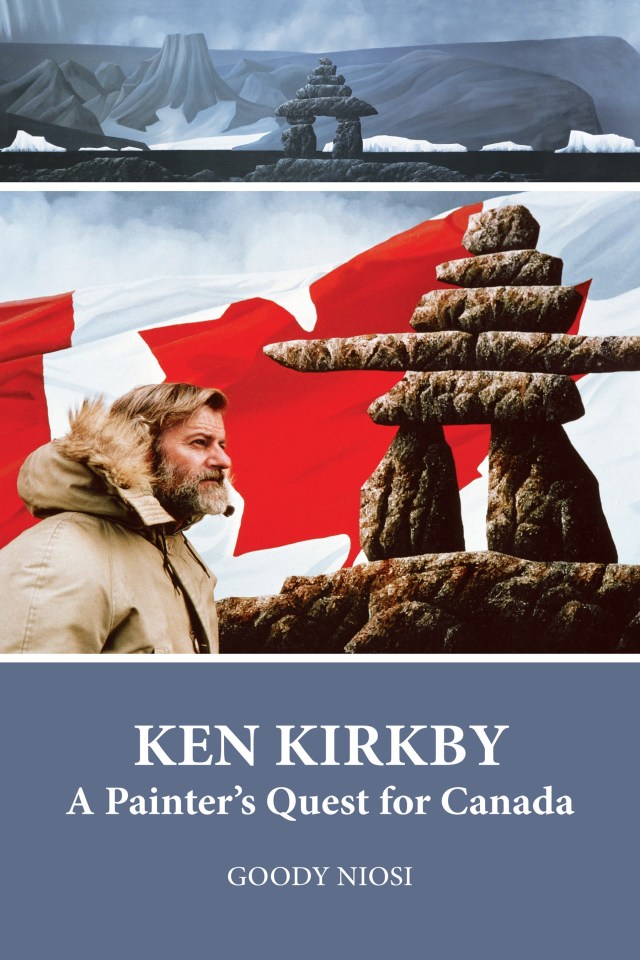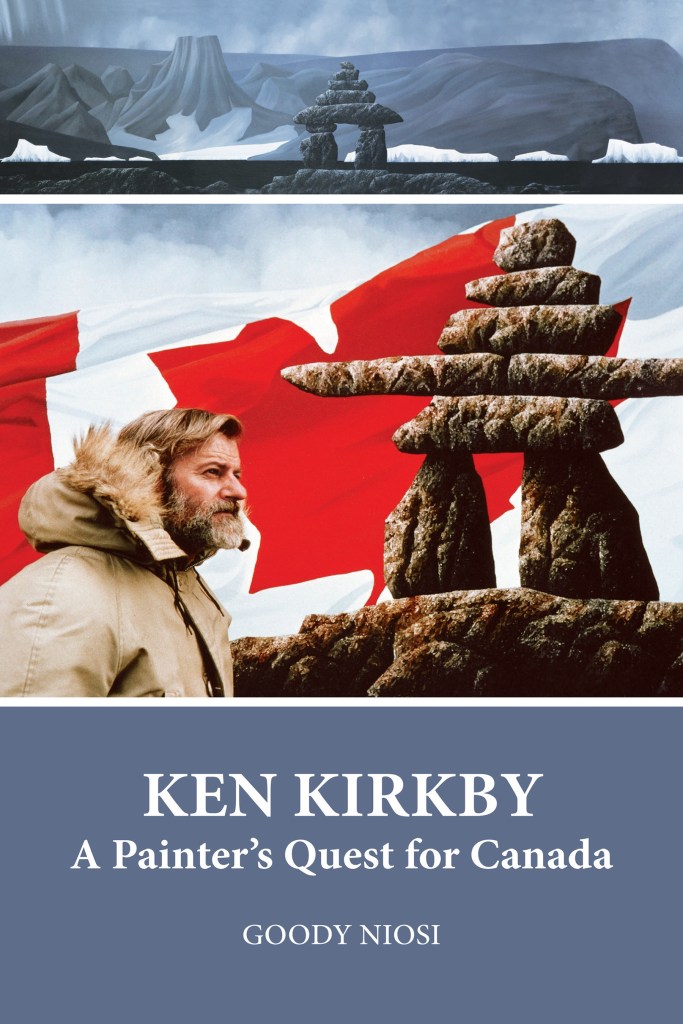
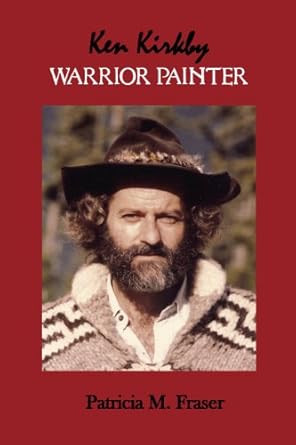
Ken Kirkby, A Painter’s Quest for Canada

Excerpt

On shore, Ken’s friend took out a sharp knife and slit open the belly of
one of the big fish exposing a white strip of pure fat. He peeled it off, put
the end in his mouth and cut it off with his ulu. He passed Ken a piece of
the precious fat that melted deliciously on one’s tongue.
Ken became mesmerized by the minutiae of Inuit life. Everything they
did was alien to his previous experience. He watched one of the men
make a drum from the hide of a young caribou. Only the skin of a young
animal would do, the man explained. It was shaved clean, soaked with
water and spread out in the hot sun where it bleached white. It was then
stretched over several pieces of wood that had also been soaked, bent to
make a circle and bound together with strips of leather. The skin was
sewn on to the hoop and left out in the sun again, this time to shrink.
Watching the process, Ken understood how important each piece of
wood was to these people. Where he came from people would have used
just one piece of wood to form the hoop. Here, the circle was made of
many small pieces of wood. Trees didn’t grow on the tundra. There might
be the occasional knee-high shrub and very rarely, willows that grew waist
high in protected gullies. Every scrap of wood was hoarded and used with
care and precision.
The Inuit had to obtain additional wood from the south where the
sub-Arctic Indians lived. The old woman told Ken that there had been
an uneasy truce between the Indians and the Inuit, which was often not
honoured. Raids and massacres had taken place for years.
When the woman told stories through her son, she often said words
that she asked Ken to repeat. When he learned a new Inuktitut word, she
smiled and when he began to put words together to form a sentence, she
beamed. It was the most difficult language he had ever learned, but then
the people were like no others he had ever encountered. They didn’t make
eye contact when they spoke and they had no word for me, mine or I.
Raising your voice, particularly to children, was taboo. Children were
expected to learn by the example others set. They ate when they were hungry,
slept when they were tired, and played when they wanted to. Adult
displeasure was shown in the smallest facial expressions – the wrinkling
of a nose or a slightly raised eyebrow.
One day a young man named John joined the camp. He was about
sixteen years old and he spoke excellent English. He told Ken that he was
on holiday from the residential school in the south but he had decided
not to return. They had cut off his hair and had beaten him for speaking
his language. The old woman was his grandmother, and John told Ken
that she and others were trying to get their children back. But this was not
easy. While they needed to be stationary so that they could be contacted,
they also needed to keep moving …

https://www.amazon.com/dp/0981073573

Ken Kirkby, A Painter’s Quest for Canada

Excerpt

distance away observing him. When they saw that he had noticed them,
they came to sit beside him. The man said, “My mother says you are a
very quiet Kabluna.”
“Maybe all Kablunat are quiet,” he said.
The man translated for his mother and said, “She says that all other
Kablunat that she has known are noisy. They talk a lot.”
“Maybe I don’t have much to say,” he replied. “Maybe I don’t know
very much.”
When Ken questioned the old woman about the Inuksuit she told him
a story that began a long, long time ago when there were very few human
beings. They travelled over the vast land in small family groups, following
the herds of caribou that were the source of their food, their tents,
their clothing, and their utensils. They could not afford to deplete their
energy by chasing the food. Instead, they made stone human beings and
called them Inukshuk, which means, like a person or acting in the place
of a person.
The people placed the Inuksuit in V-shaped formations. The caribou
with their poor eyesight, thought the Inuksuit were hunters and so it required
only a very few people to herd them into a trap. The closer they
came to the end of the V, the closer together the Inuksuit were placed.
At the point of the V, hunters hid behind boulders while women
and children lay on the ground beside the Inuksuit. As the caribou approached,
the women and children jumped up, waved their arms, and
danced about, to give the appearance of many, many hunters. The caribou
would then stampede to the end of the V, which was usually at the
junction of a lake and a river. When the caribou plunged into the lake,
the hunters hidden behind the boulders would jump into their kayaks
and paddle after them, spearing them in the water. Then they would haul
them back to shore where the entire family, even the children, would
clean and gut the animals.
Inuksuit also took on many other shapes, the old woman said. The one
on the river’s edge where they were sitting was a fishing Inukshuk. She
knew this because it was topped with a smooth stone taken from the riverbed.
It indicted that the fishing was good here. Other shapes had other
meanings and the configurations of Inuksuit had meaning also.
To my mind, what I was hearing sounded like language but they didn’t
write the language on a piece of paper – they wrote it directly on the land.
And I was beginning to get the picture of absolute practicality. Here you
could live with minimum technology if you knew how. To think that you
could direct an entire way of life by putting a few stones together just so,
so that other people coming would be able to read the significance of these
things. The degree of sophistication of this began to seep into me and I realized
there was much to learn here. And this way of life was like the people

https://www.amazon.com/dp/0981073573

Ken Kirkby, A Painter’s Quest for Canada

Excerpt

back to camp, where he presented them to the old woman. She nodded
and smiled, laying them out in a row and then producing a half-moon
shaped object made of iron. Pointing to it she said, “Ulu.”
“Ulu,” Ken repeated.
Deftly, she skinned the animals with the homemade knife and cut
them into sections. Another woman shuffled over carrying a large pot
into which they placed the meat.
And everything was unspoken. This was a world in which each person
knew what to do. You didn’t; have to chatter about it. It seemed you only
talked if there was something really important that needed to be said. There
was something very appealing about that. I wondered how much of what we
talked about was utter nonsense.
Ken asked the hunter about the silence.
“No, we don’t talk much,” he said.
“How did you learn English?” Ken asked.
“Hospital.”
“Hospital?”
“TB. I was in the hospital.”
After a long silence he said. “Good rifle.”
Ken nodded.
“Too expensive,” he said. “The bullets – too expensive.”
“Twenty-twos are cheaper?”
“Yes.”
“Where do you get them?”
“It’s very hard to get them.”
“Do they sell them in the village across the river?”
“Yes.”
“So why don’t we go over there?”
The man didn’t answer.
“I can go over there,” Ken suggested.
“Good idea,” the man said.
“Would you like me to go over there?”
“Yes.”
“How do I cross the river?”
The man walked to a clump of willows, growing waist high on the
riverbank, where a big freighter canoe was hidden. Ken shouldered his
backpack, tucked a wad of money into his pocket, and climbed into the
canoe. The current carried them swiftly downriver. The man steered with
the tiller and his paddle, angling them toward the opposite shore. On the
bank, they pulled the canoe ashore and dragged it into another clump of
willows. Ken shouldered his pack and walked into town.
The village was a ramshackle collection of caribou hide tents, canvas
tents, and buildings cobbled together from the flotsam and jetsam

https://www.amazon.com/dp/0981073573

Ken Kirkby, A Painter’s Quest for Canada

Excerpt

Ken circled around the stone people, which he later learned were called
Inuksuit. Around and around he walked, occasionally reaching out a hand
to touch them in a dazed kind of wonderment and awe. For the first time
in many weeks, his spirit began to lift.
I thought I was quite a well-informed person on a variety of subjects,
given that in my upbringing, acquiring general knowledge was considered
important. General knowledge led you to being a generalist and it’s the generalists
that run the world so you want to have vast amounts of knowledge
in a variety of areas. So, you learn about the pyramids and the sphinx and
Stonehenge and Easter Island and all of that. But here were these strange
human-like figures made of stone that I had never heard of – and at that
point, I started to come out of my stupor. These figures got a hold of me. This
was something that captured my attention in a major way.
He set up his tent some distance from them, thinking perhaps they
were sacred symbols and while he struggled with his tent, he kept glancing
at the stone men, reluctant to look away even for a moment lest he
lose the magic. With his little tent tamed, and his camp set up on the
windy plain, he dug out one of his rolls of paper – from the depths of
his backpack – and began drawing. He rolled the paper farther after each
drawing and began another. He couldn’t stop; he was infused with the
same energy he had felt when he first began drawing, in Portugal, as a
young boy.
When his stomach let him know he was hungry, he walked down to
the river and caught a fish. Cooking was a challenge because there was so
little wood of any kind to burn. He had learned to start a fire with dried
moss and then add bits of shrubbery to get an intense blaze that lasted
mere minutes. He usually managed to cook one side of the fish over the
flame. Then he had to start a fresh fire to cook the other side. In time, he
learned to eat and enjoy raw fish because it was so much simpler.
While camped near the Inuksuit for several days, making drawing after
drawing, he noticed a group of people setting up camp some distance
from him near the river. The people on the west side of the river didn’t
acknowledge these people on the east side, and they in turn did not speak
to the people on the west bank. Ken concluded that these were Eskimos,
the people he had been searching for.
The Eskimos paid no attention to Ken and he did not try to make
contact. Instead, he continued to draw, fish and cook his meals. He was
consciously becoming a silent person and the deeper he fell into the stillness,
the greater the solace he found.
One day a woman with a deeply lined and weathered face carried some
fish and bannock on a flat stone to Ken’s tent, placed it on the ground and
walked back to her camp. Ken ate gratefully. “How shall I respond?” he
wondered.

https://www.amazon.com/dp/0981073573

Ken Kirkby, A Painter’s Quest for Canada

Excerpt

“Like physical punishment?” Ken asked.
“Yes, but of a horrible kind.”
“Well, I decided to take them on and use myself as the whipping boy.”
“That’s one of the things that interests me about your story and about
you,” Patrick said. “Are you sure you aren’t an Indian? That’s the kind of
thing we do.”
“No, it was just a way of achieving a goal I wanted. It was a mixture
of vengeance and proving myself smarter. What were the other horrible
things that were done to you?”
Patrick looked away. “I really don’t want to talk about it.”
On his trips with Patrick, Ken discovered a new world, so far removed
from the one he had grown up in, it might have been on a different planet.
I began to have the sense that I had left the shadow of my own people
and of my own world. I was not in that world and I was not in this world
and that has been a familiar place my whole life. In fact when I look at the
paintings that I make, they are actually portraits of that. I’m incredibly interested
in the places in between. I remember painting an old barn when I
was going through the barn phase, as everyone does. I noticed at one point
that the barn itself was not it. The barn was there so that I could paint the
cracks in it. I began to get the idea that time is short and the journey is long
and there is only one way to go in the journey. Imagine a giant sitting on a
beach surrounded by huge boulders and he has picked up two of them and
he’s banging them together. Every time he bangs them together a grain of
sand is created. If he goes on for long enough, at some point, there will be
a beach. That concept pleased me no end – that there was no quick way of
creating a beach. Consequently, there could be no quick way of getting anything.
Whatever it is that I was doing was going to take a very long time and
that was okay. There was something very pleasing about the fact that it was
going to take a very long time. The times in my life when I have been in some
form of contentment are when I have been immersed in a project, the end of
which I cannot see. And my mind stops worrying or considering what I will
do next. I have paddled from one giant project to the next.
He absorbed Patrick’s stories and tried to fit them into a logical context.
There had to be a reason for the actions the Europeans had taken.
One day while they were motoring on the river he asked Patrick, “Why
do you think the newcomers tried to deal with the native population this
way? The residential schools seem to be a complexly bizarre notion. We
know that if you say to someone, ‘This is my castle and you can’t come in’,
they’re going to bash the door down to gain entrance.”
“Yes. It’s bizarre,” Patrick said.
“When you force people to do anything – well we know what the reaction
to that is going to be.”

https://www.amazon.com/dp/0981073573

Ken Kirkby, A Painter’s Quest for Canada

Excerpt

It might have been dropped into the harbour
directly from the China Seas. Ken explored the floating palace and then
stood on the railing leaning over the side, his eyes growing wider as they
passed under the Lions Gate Bridge and chugged into the open waters
of Georgia Strait. The sheer immensity of the snow-capped mountains,
forested islands and vast ocean staggered him. Gulls swooped by, eagles
soared overhead, seals and sea lions dived into the water.
After docking in Nanaimo, Ken drove north on a narrow gravel road,
badly rutted and peppered with potholes. The TR2, with its worn shocks,
rattled up the road that lay at the bottom of a canyon, its sides covered
in giant firs. When he arrived at Nile Creek and found the little cottage
he had been directed to, he knocked on the door and handed his letter of
introduction to the elderly couple who greeted him.
“We’ve heard a lot about you,” they said. “Monsieur Desjardines wrote
to us a number of times; telling us about you, and the wonderful times he
had with you in Portugal, and about how you want to be a Canadian.”
They took Ken out to the mouth of the creek where the water was so
thick with salmon it presented a solid wall.
The next morning they launched a rowboat and rowed out to the kelp
beds, that lay several hundred yards from shore. After tying up to the
outer rim of the semi-translucent mass, they cast their lures along the
edge of the kelp bed. The moment the lure hit the water a fish struck.
Then, miraculously the fish leapt into the air, dancing on the water. Listening
to the old man’s shouted instructions, Ken learned how to handle
Pacific salmon. They pulled in one fish after another, each cast of the line
producing another salmon. When the big box in the bottom of the boat
was almost filled they tossed them back, keeping two for their supper.
Ken spent the rest of the week fishing, and drawing fish – particularly
the cutthroat trout that fascinated him even more than the salmon.
His next trip was to the wild country near Kamloops. As he drew close
to Merritt the countryside grew arid with rugged rolling hills and tall
ponderosa pines, which gradually gave way to a vast grassland covered
with scrub.
He drove up the Nicola Valley, drinking in the smell of sage and basking
in the golden autumn sun. Bees buzzed lazily, half asleep in the golden
fields. Eventually he found the gravel road he was looking for that
climbed up and up into the mountains. He drove through the Stump
Lake Ranch and past the sign that said, “Peter Hope Fishing Camp”. He
drove on through mud puddles so deep that the water seeped through
the floorboards. When he could drive no farther, he parked and walked
across a small creaking bridge to an island with a tiny log cabin wearing
fresh golden logs on one side, and old weathered logs on the other.
Ken knocked on the door.

https://www.amazon.com/dp/0981073573

Ken Kirkby, A Painter’s Quest for Canada

Excerpt

“It’s true.” Francisco explained that she had fallen ill while visiting her
family in the north. She paid no attention to her illness, and by the time
she returned and went to the hospital, it was too late.
Ken tore out of the shack and ran to the hospital, Francisco following.
If he talked to the doctor, surely he would confirm that Miloo was alive.
Someone had made a terrible mistake.
The doctor explained that Miloo’s appendix had burst and she had
died of acute peritonitis.
At that moment, Ken’s world ended. He staggered to his feet and
opened the door to the corridor. Francisco was waiting for him. He took
a few stumbling steps and a nurse rushed up to him. “You bastard,” she
hissed. “You killed her.”
Francisco grabbed Ken’s arm and began to push past her.
“What do you mean?” Ken asked.
“She was pregnant!”
Ken’s legs wobbled. He turned, braced himself against the wall and
groped his way back to the doctor’s office. “She was pregnant?” he asked.
“Yes, she was,” he said. “But in the very early stages of pregnancy.”
“How early?”
“Perhaps a month.”
“Was this the cause of her death?”
“Absolutely not.”
“How can I be sure of that?”
“You can consult any doctor you wish and he will tell you that. Her
pregnancy just happened to coincide with this.”
The days and nights blended into one another. Ken wouldn’t talk and
he couldn’t eat or sit still. He could not bear to be inside his own body –
a body with an enormous empty, echoing cavern where a heart used to
be. He walked, pacing endlessly up and down the beach, on the village
streets, and on the sidewalks of Lisbon.
The emptiness of his body lay on him like a massive stone. He could not
swallow past the obstruction in his throat. It blocked the emptiness where
there used to be a stomach, lungs, kidneys – there was nothing left inside
him and since he felt nothing, he thought about ending his own life.
One minute he was numb and then a wrenching sadness swept over
him, threatening to drown him in its endless ocean. A minute later white-hot

anger engulfed him and flared into a murderous rage.
When the stone moved from his throat long enough to let air through,
he talked to Francisco but even that led to despair. He knew that nothing
Francisco could say could ever bring her back.

https://www.amazon.com/dp/0981073573

Ken Kirkby, A Painter’s Quest for Canada

Excerpt

“I’m interested in one gemstone,” he said.
“Which one?”
“If you let me see them, I’ll pick out the one I’m interested in.”
In his father’s den, he looked through the collection and chose one.
The next day he gave it to Miloo. She put her arms around him and held
him tight, shivering and crying against him.
“This is only a minor token of the way I feel about you,” Ken said. “I
love you beyond words and this is only a symbol of that love.”
“I’m so frightened of the feelings I have,” she cried.
“I’m going to ask you not to be,” Ken said. “Don’t be frightened. It’s
fear that kills us. I’ve been talking with the Canadian ambassador about
going to Canada and I want you to come with me.”
“Canada? It sounds so far away. It sounds so dangerous.”
“Yes, it is far away, but how could it be any more dangerous than where
we are right now? Look at what’s going on here. There are more people
disappearing every day and everyone is pretending that nothing is happening.
No one is doing anything about it. Everyone goes home at night,
looking around corners and holding their breath – wondering if they’ll
get a knock on the door at three in the morning and disappear too. I
won’t live that way.”
“What can you do about it?”
“There are always things you can do if you don’t let fear get in the way.
If you stop thinking you shut the door on fear. When you start to think
about things you get fearful. You just have to have the simplest of plans
and stop thinking. Carry it out. For instance, these people who are informing
– what on earth are they informing on in a village like this? What
could the local people be doing that could possibly be of any danger to
anyone? This is corruption beyond the imagination. This is madness. My
grandmother told me one of her Spanish sayings – not all those who are
in the madhouse are mad and not all those who are out aren’t. From what
I see, I think that the lunatics are out and they’ve put us in the asylum.”
He took her hand. “Will you come to Canada with me?”
“I’d have to leave my family.”
“You and your family don’t get along.”
“But, they are still my family.”
“Would you like to live in a country where we have the freedom and
the right to be who we are?”
“Yes, I would.”
“Would you like to live with me?”
“Yes.”
“Do you love me?”
“Yes.”
“Enough to come?”

https://www.amazon.com/dp/0981073573