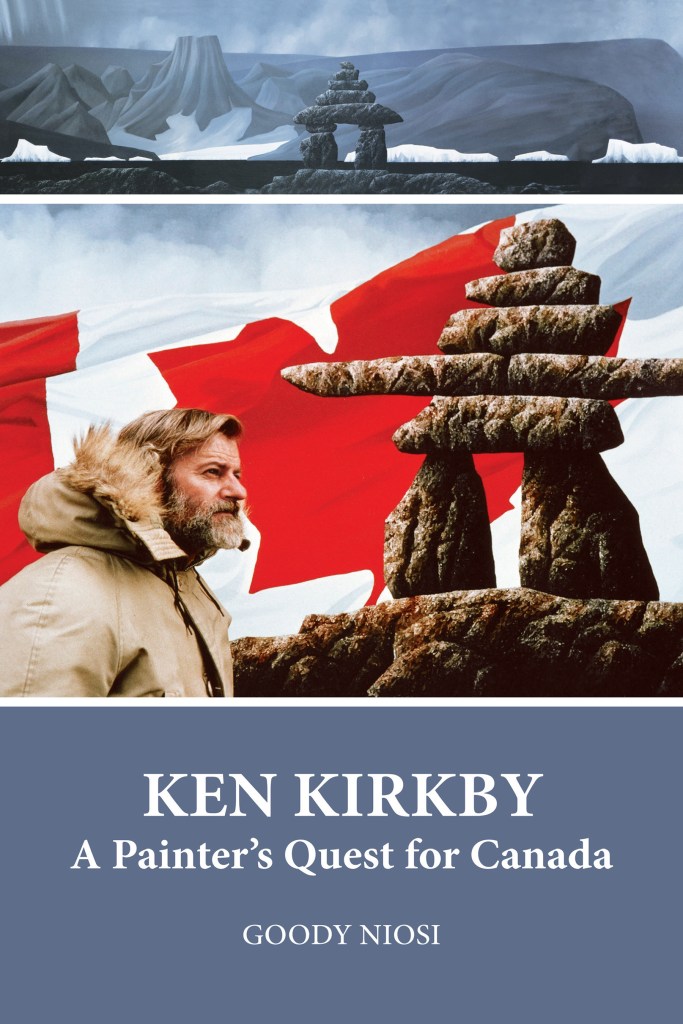
Ken Kirkby, A Painter’s Quest for Canada

excerpt

The media continued to be fascinated by him, the way an audience is
mesmerized by a performer who embarrasses himself inadvertently, on
a talk show. Ken had stepped so far outside the boundaries, had put on
a show so over the top, right down to the Inuksuit painted on the streets,
that the media haunted his studio just to see what would happen next. Ken
continued to feed them quotable lines that seemed to come effortlessly to
his lips, but that he had, in fact, been practising for months and years.
But, tidbits wouldn’t feed them forever. Eventually they would want to
stop nibbling and indulge in another meal – and the next banquet would
have to be bigger and better than the last.
He met Salvador Grimaldi for lunch again at Boccacio Restaurant, in the
Columbus Centre, and once again the architect came bounding into the
room, perfectly dressed in understated, expensive clothing, his eyes sparkling,
and his smile spreading goodwill around the room. Ken had a plan.
He told him that his next project had to be an even larger success than
the last, and described the two immense paintings he was currently working
on: one was a sixteen by sixteen foot canvas, featuring an Inukshuk set
against an enormous white cloud, that was intended for the Reichmanns.
Why the Reichmanns? Salvador asked.
“They are a very prominent family which the media and the public
have become very interested in,” Ken said. “They’re secretive and almost
impossible to approach. I’ve been studying them, and the information is
very sparse. I know they spent time in Valencia after leaving Eastern Europe,
and then they spent time in Morocco, and then from Morocco they
moved to Toronto: they started a tile business that immediately turned
into a raging success. Then, they went into high-end real estate development,
in which they have achieved even greater success. They are an
intriguing family – and just what I need. I need a Lorenzo de Medici.”
“I want to get to a place where other people cannot go. I want to sell
a painting to a man who doesn’t buy paintings and see it hung in the
foyer of the tallest building in the British Commonwealth – and have that
become a media event – even though they don’t like the media, that is
what I am after. What do you know about the Reichmanns that you feel
comfortable passing on to me? I get the idea you’re pretty close to them.”
Salvador allowed that he was close to Albert Reichmann, who preferred
to be called Mr. Albert. He had done his corporate landscaping and was
currently working on his personal property. “He’s a prince,” Salvador said.
“A merchant prince. He is a man of many talents, and I find it interesting
that you would have, instinctively, known that.’
Ken took Salvador to the studio to see the Reichmann and Yellowknife
Airport paintings, in progress. When he unlocked the door and switched
on the bank of lights, Salvador froze. The larger painting was nearing
completion while the other was only half finished.

https://draft2digital.com/book/3562830

https://www.amazon.com/dp/0981073573

Ken Kirkby, A Painter’s Quest for Canada

excerpt

When they immigrated to Canada, and settled in Toronto, they founded
a tile company and then became real estate developers. Their flagship
building was First Canadian Place, the tallest building in the Commonwealth.
Ken talked about them and gnawed on the information he had
like a dog on a marrow bone.
“Forget about them and come into business with me,” Henri said.
“Why try to sell paintings to people who don’t buy paintings?”
Ken finally looked at the books, which revealed that the frame factory
was struggling to stay alive.
“You can buy half,” Henri offered.
“Why would I buy half of a sinking ship?” Ken asked. But, he agreed
to become a partner. Perhaps, it would be a good idea to be seen as a
businessman instead of an artist. He might be viewed with more respect
and given more credibility. He would buy his half with orders for frames.
Henri agreed to build Ken a studio across the top of the factory.
Within six months, Ken had paid off the fifteen thousand dollars he
owed and moved into his new studio where he began work on two large
Arctic paintings – one for First Canadian Place, measuring sixteen by
sixteen feet, and one measuring slightly less, for the new international
airport planned for Yellowknife.
Marsha said, “You have no money and you’re going to create two giant
paintings that no one wants to buy. It makes no sense!”
It made sense to him, even though he had no explanation to give. He had
learned to listen to his inner voice, and it was telling him to paint the canvases.
Nobody’s doubts could stop him. He was going to show the world!
The new studio was too small for the massive paintings and so were all
the conventional canvases. He joined four lengthened panels with invisible
seams by bevelling the wood, squeezing the stretchers together with
clamps and creating knife-edges that melded together. Through painstaking
experimentation with a torque wrench, Vise-Grips and a canvas
stretcher he created a unique design that produced perfect tension on
every square inch of canvas. When the tension was perfect, he hosed the
canvas down to shrink it. One of his first canvases exploded, and one flew
off spinning like a propeller, but he finally got it right and made a sixteen
by sixteen and a twelve by fourteen foot canvas.
He was still mystified by his inability to sell paintings of the Arctic.
One day, while he was driving on Steeles Road near the Allen Expressway
a question leapt into his mind. “If you were limited to one image – one
object from all your experiences in the Arctic, and that was all you were
allowed to portray, what would it be?”
Inukshuk!
Ken was stopped at a red light. The light turned green…

https://www.amazon.com/dp/0981073573

Ken Kirkby, A Painter’s Quest for Canada

excerpt

There is a deep hunger to have the sunshine of their former
homes, and of their great-grandparents’ former homes. There are these
stories that persist about how wonderful life was, and how sunny it was,
and how warm it was. But, with the exception of this little coastal strip,
this is a very cold country. You’re trying to give paintings of vast, distant
places that are freezing cold, to Canadians. Why would anyone, with the
psyche I’ve described, even think of buying one? They won’t even come
out to look at them.”
“Well, Jesus!”
“Go ahead – break my argument.”
“What else about these paintings then?
“One word – pretty. The Canadian art scene is almost non-existent,
but what passes for imagery in the public mind at large is pretty. Doreen!
Doreen! Bring some magazines!”
Fraser grabbed the top one, from the stack Doreen delivered, and
opened it at random. He turned two pages and pointed. “Look – here’s an
ad – it’s perfect. Isn’t that a pretty photograph? Do you notice that it has
a white, sandy beach, a scantily clad couple, and palm trees? People work
very, very hard to make money, so they can save some up and go to that
place – and it’s very pretty. That’s what is in their minds. You and I are the
children and grandchildren of peasants, and we have their tastes.”
Fraser reached into his pack of cigarettes, pulled out a fresh one, and lit
it from the butt that had almost burned down to his fingertips.
“It’s taken Europe an eon to get to its appreciation of art. You’re expecting
too much, too quickly.”
“But, if we don’t push we won’t get anywhere,” Ken said.
“It’s not just a matter of pushing the public. We have to find individuals
who will get behind this. It’s not just good old Alex and Ken who are
going to go and foist this on the country. It’s a much bigger story.”
Ken left the gallery deep in thought. Yes, there was truth in what Fraser
had said but it wasn’t the whole truth. Canada was ready for his paintings.
The Group of Seven was proof. Fraser thought they were rubbish too. If
he wanted to tell his story through his paintings, it wouldn’t be with Alex
Fraser by his side.
Unexpectedly, Ken received a letter from his Aunt Vicki in Madrid. She
had taken the photographs he had sent her, of his latest paintings, and
shown them to a popular gallery owner who wanted to exhibit them.
He tapped the note against his desk, read it again, and picked up a
pen. He wrote a letter to Mr. McEachern, the Minister of Foreign Affairs,
describing his good fortune in coming to Canada, and telling him how
he had arrived in this country. He wrote about his art and said that he
wished to go back to Europe for an exhibition in Madrid.

https://www.amazon.com/dp/0981073573

Ken Kirkby, A Painter’s Quest for Canada

excerpt

“Why?”
“A painting that is given is all but worthless. It’ll be up in the attic or
down in the basement before you know it. A painting must always be
well paid for and it will be up above the mantel quicker than you can
snap your fingers – and it will stay there. And another thing you need to
know – you never give wealth a gift. It’s one of the ‘middle classes’ really
bad habits.”
When Ken walked into the gallery in Kelowna, Jack Hamilton took
him into the back office and handed him an envelope. “I see you keep
very fancy company,” he said.
Ken tore it open. The premier had written that he would be delighted
to visit the gallery the next morning at eight.
At seven-fifty, Jack staggered down the steps from the apartment above
the gallery, in his rumpled pyjamas, unlocked the front door to let Ken
in, and shuffled back up the stairs. At eight sharp, a chauffeur driven car
pulled up, and Bennett stepped out. He gave Ken a hearty handshake, sat
down at a small table near the front of the gallery and asked to hear stories
of the Arctic. “I thought you were just going up there for a month or
two, but you seem to have gotten yourself lost up there.”
“In a way, I did,” Ken replied. “It’s a long story.”
“I want to hear it.”
He told the Premier about his adventures and the atrocious conditions
the people lived with. He talked about the famine and the disease, and the
autocratic rule of the church, the RCMP, and the Hudson’s Bay Company.
When he finished, he asked if there was anything the Premier could do to
help the people up there.
Bennett stood. “Let’s see your paintings,” he said.
They walked through the gallery.
“What do the red dots signify?” Bennett asked.
“It means they’re sold.”
“It looks like they’re all sold.”
“Yes, they are.”
“You must be doing very well.”
“Yes I am – I’m very lucky.”
“I’d say there’s more than luck involved. I know nothing about art but
I do like what you’re doing, especially that one,” pointing to a landscape
of rolling grasslands. “I’d be interested in owning that one.”
“I’m sorry,” Ken said. “I’m afraid the entire exhibit was sold before it
got here.”
He led him into the back office where three paintings leaned against
the wall. “These are not sold,” he said.
Bennett pointed to one of the high plateau on the Douglas Lake Ranch.
“I like that one. Where is that?”

https://www.amazon.com/dp/0981073573

Ken Kirkby, A Painter’s Quest for Canada

excerpt

While he studied, he periodically found himself distracted by the
thought of the one art gallery in Vancouver he had not approached with
his paintings – the Alex Fraser Gallery. Stories of Alex Fraser, and his
treatment of artists in his London and Vancouver galleries, had circulated
through the art community for years. Ken was angry with himself. He
was rarely afraid of anyone and had met no one in Canada yet who had
intimidated him. Alex Fraser’s reputation did.
He had heard that the man was irascible – so what? He had heard he
was powerful. Was it in his power to judge his work? What if he found it
wanting?
The only thing worse than his fear was the prospect of his disappointment
in himself if he refused to face it, so one day he screwed up his
courage, loaded his truck with paintings, and drove to 41st Avenue near
Boulevard in Kerrisdale.
He walked into the gallery, where an attractive middle-aged woman
asked if she could help him.
“Yes, I’m here to see Mr. Fraser if he’s about.”
“Mr. Fraser doesn’t see people without an appointment.”
“Oh, that’s a shame. I’m here and I have some paintings. Please, can
you ask if he’ll see me?”
She smiled and walked into a back room. A few minutes later, a small
man with slicked-back hair and icy, blue-green eyes walked out. He was
dressed in a perfectly fitted gray pinstriped suit, with knife pleats in the
trousers and shoes that shone like mirrors.
Exhaling a great puff of smoke, he lowered himself into a big armchair,
and placed two packages of Players unfiltered cigarettes and an ashtray
on the little gate-legged table beside it. Taking a fresh cigarette from one
of the packages, he lit it from the one in his yellowed fingers, and crushed
the stub in the ashtray.
Turning to the woman who had followed him out of the back room he
called, “Doreen! Doreen, I want you to tell the young man about manners.
Ask him does he understand the meaning of manners?”
“Mr. Fraser would like to know if you understand the meaning of manners,”
she said, turning to Ken.
“Indeed I do,” Ken said. “And I apologize for coming in without an appointment
but I was nervous and I managed to screw up all my courage
to come in – and here I am.”
“Doreen! Doreen, tell him he is quite right to be nervous in approaching
me. Ask him what it is that he wants.”
“I have some paintings and would like to show them to Mr. Fraser.”
“Tell the young man that I can’t bloody see his paintings, anywhere.
Where are his paintings?”

https://www.amazon.com/dp/0981073573

Ken Kirkby, A Painter’s Quest for Canada

excerpt

With the Group of Seven paintings as
a template, he taught himself to paint again, working only on southern
landscapes. He took several to the owner of The Golden Key Gallery who
placed one in the window and sold it within two days. More sold during
the next few months, but then the gallery owner sold his business and
Ken was once again without an outlet.
Still, he persisted and one day, while sketching the bent shapes of driftwood,
in the dunes near the airport, it occurred to him that he could make
a profit from the abundance of wood on the beach. He purchased a pickup
truck and two chain saws, cut up the wood, wrapped velvet ribbons
around the most attractive pieces, and attached a card with his telephone
number. He left the wood on the front steps of the city’s grand homes
and within days, the orders came in. While he delivered and stacked the
firewood, he told the homeowners his stories of the Arctic, and when
they asked about his paintings, he would display the canvases he carried
in the cab of his truck. The Arctic paintings didn’t sell but the southern
landscapes were a hit.
He taught himself to become a storyteller, rehearsing every anecdote
he had, practising his tone, volume, order of words and, most importantly,
his choice of words. Where was the power of the story?
His clients listened, but showed little interest, so he made a list of every
service club in the city. Would they like a guest speaker at their next
meeting? Yes, they would like to hear about the Arctic, and so, Ken did
the rounds. Each audience contained a handful of people who showed
mild interest – the rest were bored, and often antagonistic. Sometimes
he was heckled, and a red tide of anger would creep up from his chest to
flush his neck and cheeks. Once someone shouted that he, and the rest of
the people there, resented an immigrant telling Canadians how to live in
their country and run their lives.
“That is hardly what I am doing,” Ken retorted. “I intend no disrespect.
I am simply here bringing information from a faraway place.”
His words dropped like ragged bits of paper to lie discarded on the
floor. Perhaps his stories were so outside the experience of most Canadians
that they seemed like tall tales – unlikely and unbelievable. There had
to be a better way to tell people about the Arctic but what was it?
His father told him that he was involving himself in matters that were
none of his business. He was not a citizen of Canada and until he was,
he should keep his opinions to himself. He responded that he was only
doing what he had learned at his father’s knee, in Portugal. He reminded
his father that Ken Sr. had not been a citizen of Portugal and yet he had
become deeply involved in the affairs of that country and had worked
hard to help the people. The Inuit were human beings in great distress, he
said, and he was trying to help.

https://www.amazon.com/dp/0981073573

Ken Kirkby, A Painter’s Quest for Canada

Excerpt

“That’s an awkward and difficult subject,” she said. “I don’t want to talk
about it right now.”
Miloo became the central focus of his life and as their friendship deepened,
Ken confessed that he liked her – but far more than the word implied.
He liked her very deeply.
“You can’t like me that much,” she said. “You come from one world and
I come from another and there is no hope that we could ever be more than
just passing friends. It would be nothing but trouble for everybody.”
Ken felt a familiar rebel anger stirring in him. “Why? Did somebody
make a rule?”
“Yes,” she said. “Those are the rules.”
“But if the rules are bad, do you still accept them?”
“It’s everybody,” she said. “It’s everywhere you turn. That’s the way it is.”
“Well, I don’t accept it.”
“You’ll get into a lot of trouble.”
“I don’t care. It seems that all the best things in my life are trouble and
I just won’t accept it.”
Ken’s father noted the growing friendship between his son and Miloo.
Perhaps thinking to distract him, he asked him one late summer day what
he would like for his next birthday. Ken opened his Michelangelo book to
the photograph of David. “I want to see that,” he said.
“Why that?” his father asked.
“It’s probably the most perfect thing I have ever seen. It has only one
flaw.”
“And what’s the flaw?”
“Look at his hand,” Ken pointed to the picture. “He’s holding a stone in
his hand and that’s the stone he was putting in a sling to throw at Goliath.
Everything else is perfect but this hand is weird. Why would he do that?
Why would he make such a strange hand on such a beautiful body?”
“I don’t know,” his father admitted. “So, that’s what you really want to
do?”
“Yes. I want to go to Florence.”
On the morning of his thirteenth birthday, he and his father boarded
the train to Italy. In Florence, they stepped into a line that seemed
to stretch to infinity outside the gates of the Accademia delle Belle Arti.
Slowly the line inched its way to the spot where the colossal 17-foot statue
towered over the crowd. Ken wanted to feast his eyes, but the relentless
throng forced him to walk by it after only a passing glance.
As they left the museum, his father asked, “Did you like it?”
“How can you look at something that way?” Ken asked. “I want to
spend a lot of time there.”

https://www.amazon.com/dp/0981073573

Ken Kirkby, A Painter’s Quest for Canada

Excerpt

“I’ll give it to you,” Ken said.
“No,” he said. “You have to learn about artwork. You don’t give it away.
If you do, it becomes worthless. Things that are given, such as works of
art, tend to sit on the shelf for a while and then they go into a bedroom
somewhere and before you know it they’re in the basement and they become
part of the flotsam and jetsam of people’s lives. But if you pay a
great sum of money for something it goes over the mantel and you hold
cocktail parties to boast about your acquisition. That is one side of the art
world you’re going to have to learn about. How do we attribute value to
something in a world that understands very little? Everything is quantified
in our world. Therefore, if it has a big number attached to it, it must
be of great value.”
Ken and Rui agreed on a sum of money that was not too great but that
seemed like a great deal to Ken. With great pride he told his father that he
had sold a drawing to Rui.
“Did you offer to give it to him?” His father asked.
“Yes, I did and he wouldn’t take it,” Ken said and repeated what Rui
had told him.
Ken Sr. smiled. “Yes, that’s probably quite wise,” he said.
One day, When Francisco and Ken came out of the shack to go fishing
they noticed a young woman walking on the beach. Ken had seen her
from time to time walking to or from the hospital where she worked, or
climbing down the cliffs to the ocean. On this day, as so often happened,
the beach was empty, save for themselves and the marine life that scurried
about the rocks. The young woman had not seen the old man and the boy
and thinking herself utterly alone, took off her clothes and walked into
the water. Ken was mesmerized; she was the most beautiful creature he
had ever seen. “Look at that,” he whispered to Francisco.
“Yes,” he said, as though reading his thoughts, “She is very beautiful.
She has a limp, you know.”
“What does a limp have to do with anything?”
“It’s a long and complicated story – and we should not be interfering
here. She thinks she’s alone so let’s let her be alone.”
From that day on she became Ken’s passion. He discovered that she
was a nursing student and that she had come from a village several miles
away. Her family were peasants but she had studied hard because she was
determined that she would not become a servant for rich people.
He also became friends with Dawn Coates, a girl who was being tutored
at the same small school he attended each day. Her parents were
divorced – her mother, American, and her father, English. She was one
of the first children he had ever admired. She was strong and direct and
seemed fearless.

https://www.amazon.com/dp/0981073573