
Yannis Ritsos – Poems, Volume III

14th of November
As we focus our eyes to notice a difference
among the pieces of day, we don’t know how to get
a hold of ourselves, we miss the shape, the hour, colors,
faces. We only listen carefully so that we might
discern a sound that confirms the passing of time,
so we can reverse the performance, box, broom handle,
name, the dice that roll on the table,
the limping wind that stumbles onto the barbwire
the fork that hits the plate and its sound that continues
internally.
Otherwise a circle without a center remains, a whirl
in the air with no movement but its own;
it can’t become a car tire that crosses a forest
and if once it becomes a square
it’s not a window through which you look at the world
or the three lined carpentries in an unfamiliar
neighborhood,
but only the relativity of straight lines, the analogy of corners,
boring, very boring things. A mathematician and
an astronomer could create something concrete and
clear out of all these.
I can’t. Yet I always liked the Observatories; the dark
stairway, the clock, the telescope, those photographs
of stars in homely positions: Orion without his sword,
with no underwear, Verenice with her many freckles,
unwashed, frumpy, a whole urban kitchen
transferred to a metaphysical location, boiling cups,
jugs, casseroles, the grater, salt cellar, baking tins,
white spots, a bit of steam hanging onto the smoked
walls of the night.
Someone was talking of numbers and more numbers,
light-eons, leagues and leagues. I wasn’t listening.
Today a friend was telling me that when he was thirteen
he was selling oranges and lemons in Piraeus;
he also had a young Armenian friend who was selling
socks. During the summer afternoons they’d meet in the
harbour behind a pile of sacks, where they’d put down
their baskets and read poems; then they’d eat a sesame
bread ring and an orange and gaze at the sea, the jumping
fish, the foreign ships.
From today I also have a friend who smells of orange
and harbour. He keeps many evening whistles of ships
in his pockets. I see the movement of the big finger
of the big harbour clock on his hands. From today on,
I’ll love him, I’ll unbutton one of his coat buttons.
Now I think of going to find his young Armenian friend
to find a basket with socks on the road, to cry out, socks,
beautiful socks, cheap socks. At noon, I’m sure I’ll find
the Armenian youth behind the sacks, I’ll get to know him;
he’ll recognize me since we both have the traces of our
common friend’s eyes on the lips. If I missed that
basket with the socks and the one with the lemons I
wouldn’t know how to fill my day, my words,
my silence.
Yet I believe every comrade wishes to have such a basket,
only that I don’t know where to find it and I get angry and
I search.

https://www.amazon.com/dp/B096TLBNFK

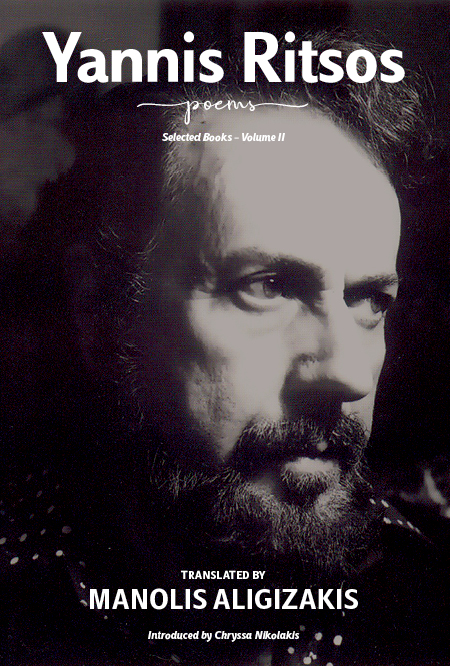
Yannis Ritsos – Poems, Volume II

A Little Sleep
The distant voice of the lottery vendor. The swaying of the tree.
A canteen steadied in the sand.
The west is burning. A purple reflection over the seashore.
The few houses painted crimson, silence and sundown.
You have a summer handkerchief in your pocket,
a sorrow you left behind on the ledge
like the ripped shoe of the spring that was left on
the rock
when the last group grabbed three meters of sea
and left stooping among the tents of the wind.
How fast the sun goes down in your eyes;
your coat is already smelling of moist,
you put your hands in your gloves like the trees
get in the clouds.
Where the tempest stops your glance is re-ignited
where the sky ends your song and your whole face
are reborn.
There is a yellow star in your silence
like a small daisy on the side table of the sick man
a little warmth on every yellow leaf that turns
the pages of time backward.
It is enough that you know. The other communication
doesn’t end at midnight.
The line is continued from deep inside and from afar
with a few stops, interruptions, accidents,
it continues
and autumn finds shelter on the railings of the station
or the fence wall of the Orphanage,
it listens to the call for silence on the damp roofs and
to the gramophone of the seashore bar,
that the moon turns,
a scratched vinyl, a very old tango. No one dances.
But you, turning the moon to its other side,
beyond midnight, further from the ledge,
you listen to the great music while you saunter
in the harbour with the twelve boat masts
like a speechless restaurant server who cleans
the autumnal tables
folding carefully the napkins of the night,
gathering the stack of plates with the leftover
fish bones.
The sea and the songs continue.
All these that the locked people left outside
belong to us:
the hurrah of the wind in the darkened rooms,
the music that descends in big waves and hits
the window shutters,
the silence that opens its purse and looks at itself
in her square little mirror,
and the woman who wraps herself with the army blanket
and sleeps next to her bag
and you too, as you light your cigarette with a star
over the calm plain of your soul
like the guard who stays vigil over the sleeping soldiers
and thinks of his woman
of the sea
the city with the flags
the trumpets
the sun-dust and the glory of men.
And next to you, you know it,
this big smile
like the circular alarm clock next to the asleep worker.
It’s time to sleep a little. Don’t be afraid.
The clock is properly wound up. It’ll get you up on time
with the bucket of dawn that draws water from the well,
with the crawl of a proclamation that noiselessly sheds
light under the door of your silence. Be assured.
It’ll wake you up.

https://draft2digital.com/book/3562968

https://www.amazon.com/dp/B0851M9LTV

Hours of the Stars

Sirius
We saw her unfold the spin wheel of time
opposite the wind
and the pashas we saw
the beak of day touching her sun tied
on the iron stake of a rock and the eagle
coupled her sides. There she armed herself
while each of her gods stood forty yards high and
started talking to children and geraniums
at times even men got teary. Then you would think
they tossed barley into the fire or dice
on the chess of virgin Mary as
time takes away time and brings back
her sea-kerchiefs and the vigils of the north wind.
Time unfurls the flutes of colors and
the blouses of girls that into their eyes
convoys of birds and flowers travel.
At the lower levels the olive tree leaves
embitter us and at the higher level
pines breath signals a shiver
of guilt sprouting on her skin and platoons
of cypresses climb up the hill
as the hours start to blaze she offers
atonement libations to the fair weather; she assumes
the ephebe July and establishes the new crops like Aeneias
white horses thresh Logos and the golden plains
from end to end
fever spreads into her veins for hours and hours
like weather does to grapevines
that the performance of a group of disorder
appears straight by the edge of the precipice.
The hours stagger on their red heels and on their faces
intensifies the blushing aroused by their hearing
focused on the far away when silence
announces inexplicable oracles and
truth demands ransom as
years go by she becomes an orphan and
hangs over the waters when she seeks to
blindly attach herself onto something as
the camel driver gets fooled by the mirage
of the desert and assumes seeing far away
the sword of Alexander the Great pushed
into the scabbard of the Dead Sea.
We saw her floating over waters and ruins
like a big star when the mermaid
rejoiced in tearing up the forgetfulness
of the sea floor and during the night
Glaucus fought against the hours striking
them one by one over the castle of Astropalia
and the bell of Virgin Mary.

https://www.amazon.com/dp/1926763408

Ken Kirkby, A Painter’s Quest for Canada

excerpt

The day before the exhibit, he helped hang the paintings;
only one in each room of the gallery. Opening night resembled a Hollywood
premier. People gathered in the street and, when a chauffeur
driven limousine drew up to the curb, the media descended. Ken parted
the crowd and opened the door, guiding the Duchess into the gallery. The
crowd inside fell back as though God himself had made an entrance.
Ken led her through the rooms, telling the stories of the Canadian
North. She nodded, smiled, listened attentively, and left as quickly as she
had come. Forty-five minutes later every painting wore a sold sticker.
Ken extended his stay, in order to accept all the invitations he was besieged
with. He had been in Madrid for six weeks, when his father called.
“You must come home right away.”
“What happened?”
“Just, come home immediately. It looks like the trust company has
gone under.”
He flew home the next day and took a cab directly to his father’s apartment,
where he found him more agitated than Ken had ever known him
to be. “This is real trouble,” he said. “We tried to get into the office and it’s
locked – the locks have been changed and nobody is there.”
In his own office, he discovered several key files missing. He arranged
a meeting with other clients of the trust company. There were rumours.
Some said the company principal had moved to the Fraser Valley, where
he had set up an Arabian horse farm and purchased a Rolls-Royce. Others
said he had simply vanished without a trace.
Ken called the RCMP commercial crime division and drove to the station
with his father. The officer explained that the department was aware
of the issue. “It’s a complicated mess,” he said. “We’re going to have to
investigate you and your activities, the same as everyone else.”
The police found many of the missing files but not a trace of the company
president and CEO. Rumours continued to circulate. One claimed
that the head of the trust company had had nothing to do with the missing
funds. It was Ken Kirkby. He was crazy, and smart, and out of the
country when disaster struck. He was the one who had masterminded the
plot. The media ran with it and reporters parked their cars and vans in
front of his house waiting for one glimpse – to take just one picture with a
telephoto lens. Two professional hockey players, convinced that Ken had
taken their money, filed a lawsuit. The judge threw it out of court. Ken
threw himself into the investigation, working with the police day after
day to piece together what had happened.
The RCMP interviewed the victims of the fraud and examined the
documents. Sorting through his own papers became a full time job, and
there were many times he gave up all hope of making sense of them.
His greater despair was the loss of his friends.

https://www.amazon.com/dp/0981073573

Nikos Engonopoulos – Poems

Fellow Traveller in Melancholy
As she realized how much my tragic love for her overtook my heart, she invited me, among the ruins of the London Tower, for a cup of tea from the same hands, named by the killers of her lovers, depending on the season, sometimes “shovels”, other times “shiners”. She accompanied her offer with the only word she had kept inside her for years like something precious, she said, more than her life, like a secret gift of her breasts in the tempest of my lust. I raised my eyes and looked, as an unexpected shiver shook my body: she was naked before the year’s fountain, the fans of a nighty fire sprouted out of her belly and the wall was splattered with blood. I felt that the famous, “better tomorrow” had arrived, was a present reality. It was obvious that everything from the past was already erased, the nightmare of the tropics and the harbour had already vanished. I was a gigantic red eagle that saw, from a young age, the closing eyes of the opposite sun. She was the big, dark forest spread among the chandeliers, the chest and the big hallway mirror used for official palace events. Her thought was crown, her glance renaissance, her glance a beak. Her name was Rodamne. She had lived in faraway lands from where she had come to meet me. I told her I freaked out, thinking we hadn’t met earlier. How could she have, via the measure of the beautiful woman she was, replaced her eyes with two green Egyptian scarabs and she didn’t see me when I passed her? She had probably cut her long hair short so that the words that escaped from my mouth were one cathedral church built, for the only purpose of executing at the site and a specific moment, the unknown archbishop, and seller of small items, from an irregular Mexican squad. She didn’t talk, she didn’t stir, she only took in her embrace the flowers that decorated the room and scattered them in the fresh ravines, in orchards with the delayed hunter, at the foothills of the Memories Mountains. The candles burned joyously on the graceful bronze candelabras and the song she sang teary-eyed had the same meaning with the phrase “time for Shaba” in the Hebrew neighbourhoods of Thessaly cities.

https://www.amazon.com/dp/1926763734

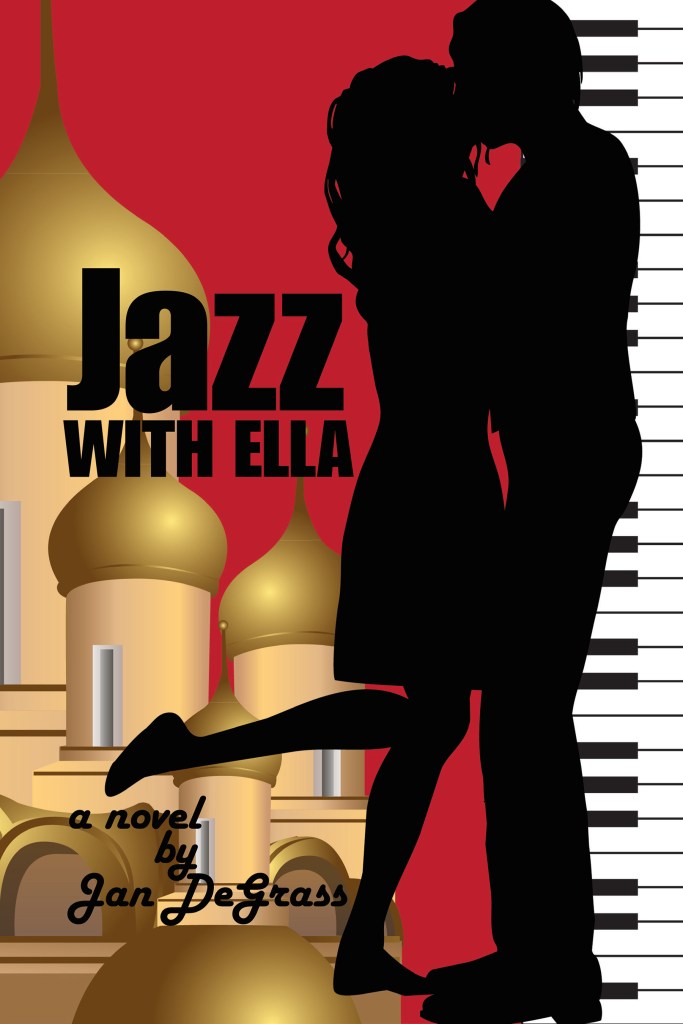
Jazz with Ella

excerpt

said Chopyk with only a hint of irony. He stroked his beard and stared at her with curiosity in his eyes. “I understand from Maria that you have a class scheduled for this morning.”
“Yes,” replied Jennifer tersely. Don’t explain, don’t apologize. Last night is none of his business. “I want to hear the students’ experiences in Leningrad. I have my own to share, too.”
“But I also know that you have been cancelling classes while in Leningrad….”
“As we discussed that first night,” she broke in quickly, starting across the lobby.
“Yes, agreed…but….” Chopyk followed, taking small, deliberate steps beside her. She matched his fussy gait. What is this nonsense all about? Surely he isn’t going to punish me?
“Since I have been carrying on with classes while in Leningrad for any who care to study,” he sniffed, “I think it only right that you should lead both groups, juniors and seniors, while on the Volga cruise.”
So that was it. Once again, he had hit her at her most guilty moment. He wanted to lounge on the sundeck reading his academic papers and not have to deal with a pack of rowdy students.
“Certainly. I’d be happy to do that,” she answered. “I know how one’s research suffers when class prep is a priority,” she added archly. He appeared not to notice her tone of voice. They entered the dining room in silence.

That morning she ended her class by presenting a poem that Volodya had written out for her: an excerpt from “Spring in Leningrad” by the Russian war poet, Margarita Aliger. Jennifer told the students the story of the Leningrad mother who had suffered during the siege and how her son, Volodya, had been moved by this poem. Despite her own sense of loss, Hank’s bad mood and Ted’s hangover, the students rallied and they recited it in Russian, then took a stab at translating it.
“O city without light, without water!
One hundred and twenty five grams of blockade rationed bread…
Savage rumbling of trouble
from the pitiless, dead sky.

https://www.amazon.com/dp/1926763246

Nikos Engonopoulos – Poems

Dyadic Automation
Careful! Cover yourselves! Be careful! The blowing winds have already brought the mysterious messages to our ears. Everything around us is just another threat. There wasn’t any neighbourhood not blanketed by fear, each object hides a soul inside it. Come, let’s go. The time is now. The rusty weathercock calls us wildly in the night. The draw-well stopped and the blind horses became one with the begonia flowers. Let’s go, march! To go far away to Galvana. The saviour plank is hidden from the wind harbour of forgetfulness, peace is there. Sacrificial victims of love, ascetic wanderers of the night, proud dawn walkers light up the sea lamp. Whoever has the strength, whose heart truly dares, let him come. But let us not delay in futile reviews of the past. The time is uncertain. The roads aren’t safe at all and the flood drenched many places. The Caryatid girls have crowded erotically the dark ditches, the lustful maidens of our erotic years. Their famous smile flew away and now it blooms in some abandoned islands. The thunderbolt shows us the way. Let’s go! To the Lycaonian Galvana, there we shall rest. After our kind foreheads are decorated with rose flowers, we offer the libations due to the birds. There, in the graceful wooden temples of the old capital, we shall slaughter the young bull and a fiery column will spring out from its shed blood. There, wrapped around phallic banners, girls are more beautiful than sudden conclusions of dynamite. There lives the Hellene Pantelas among the wild Soudanese. The flowers there are wise and sunlit leftovers of dead beauties. The tears of the shark and the enigmatic prayer of Zacharia are useless there along with the frosty embrace of the penguin.
The erotic spasms of the last emperors and their fiery tears belong to the same person. The offer of the boatswain to the footprints of the hypotenuse of anomalous attractions is accompanied by the angelic harp, and our imposing stature means the spread of freedom and the longing for freedom all over the globe.

https://www.amazon.com/dp/1926763734

Neo-Hellene Poets, an Anthology of Modern Greek Poetry

IV

                        Argonauts

And the soul

if it is to know itself

must look

into its own soul

the stranger and the enemy, we have seen him in the mirror.

They were good boys, the comrades, they didn’t complain

about the tiredness or the thirst or the frost

they had the behaviour of the trees and the waves

that accept the wind and the rain

that accept the night and the sun

without changing in the middle of change.

They were good boys, for days on

they sweated at the oars with lowered eyes

breathing in rhythm

and their blood reddened a submissive skin.

Sometimes they sang, with lowered eyes

when we passed by the deserted island with the prickly pear trees

toward the west, beyond the cape of the dogs

that bark.

If it is to know itself, they said

it must look into its own soul, they said

and the oars struck the gold of the sea

in the sunset.

We passed by many capes, many islands, the sea

that brings another sea, gulls and seals.

Sometimes grieving women wept

lamenting their lost children

and others angrily sought Alexander the Great

and glories lost in the depths of Asia.

We moored on shores filled with night fragrances

with bird chirps, with waters that left on our hands

memory of a great happiness.

But the voyages did not end.

Their souls became one with the oars and the oarlocks

with the solemn face of the prow

with the rudder’s wake

with the water that shattered their image.

The comrades died one by one

with lowered eyes. Their oars

point to the place where they sleep on the shore.

No one remembers them. Justice.

https://www.amazon.com/dp/1926763513

Ken Kirkby, A Painter’s Quest for Canada

Excerpt

“That’s an awkward and difficult subject,” she said. “I don’t want to talk
about it right now.”
Miloo became the central focus of his life and as their friendship deepened,
Ken confessed that he liked her – but far more than the word implied.
He liked her very deeply.
“You can’t like me that much,” she said. “You come from one world and
I come from another and there is no hope that we could ever be more than
just passing friends. It would be nothing but trouble for everybody.”
Ken felt a familiar rebel anger stirring in him. “Why? Did somebody
make a rule?”
“Yes,” she said. “Those are the rules.”
“But if the rules are bad, do you still accept them?”
“It’s everybody,” she said. “It’s everywhere you turn. That’s the way it is.”
“Well, I don’t accept it.”
“You’ll get into a lot of trouble.”
“I don’t care. It seems that all the best things in my life are trouble and
I just won’t accept it.”
Ken’s father noted the growing friendship between his son and Miloo.
Perhaps thinking to distract him, he asked him one late summer day what
he would like for his next birthday. Ken opened his Michelangelo book to
the photograph of David. “I want to see that,” he said.
“Why that?” his father asked.
“It’s probably the most perfect thing I have ever seen. It has only one
flaw.”
“And what’s the flaw?”
“Look at his hand,” Ken pointed to the picture. “He’s holding a stone in
his hand and that’s the stone he was putting in a sling to throw at Goliath.
Everything else is perfect but this hand is weird. Why would he do that?
Why would he make such a strange hand on such a beautiful body?”
“I don’t know,” his father admitted. “So, that’s what you really want to
do?”
“Yes. I want to go to Florence.”
On the morning of his thirteenth birthday, he and his father boarded
the train to Italy. In Florence, they stepped into a line that seemed
to stretch to infinity outside the gates of the Accademia delle Belle Arti.
Slowly the line inched its way to the spot where the colossal 17-foot statue
towered over the crowd. Ken wanted to feast his eyes, but the relentless
throng forced him to walk by it after only a passing glance.
As they left the museum, his father asked, “Did you like it?”
“How can you look at something that way?” Ken asked. “I want to
spend a lot of time there.”

https://www.amazon.com/dp/0981073573

Ithaca Series, Poem 705

a second

My hands are cold.

                                              I’ve gone out into the street,

I’ve settled the minor matter

and returned home to take again

my place at this table.

                                              I then discovered

the coldness of my hands,

                                              a sign

which disturbs me perhaps without justification,

it’s just a little thing to have cold hands.

This cold of November

is in my hands, nothing else.                

                                                              It’s me:

I see the simple Greek vase

and the usual evening around me.

But it’s very rare for me to have cold hands.

In a fleeting second, my thought has seen

the probable fog, the filled out gray leaf

where the name I have would be crossed out

with the frosty ink of the end.

ΔΕΥΤΕΡΟΛΕΠΤΟ

Τα χέρια μου είναι κρύα

                              βγήκα έξω στο δρόμο

να ταχτοποιήσω κάτι ασήμαντο

γύρισα σπίτι κι έκατσα στο τραπέζι

                               Τότε διαπίστωσα

πόσο κρύα είναι τα χέρια μου

                                σημάδι

που μ’ ανησυχεί ίσως δίχως λόγο

ασήμαντο να `χεις κρύα χέρια.

Το κρύο του Νοέμβρη

στα χέρια μου, τίποτε άλλο.

                                Εγώ είμαι:

Βλέπω το απλό Ελληνικό βάζο

και το συνήθες βράδυ ένα γύρο μου.

Μα σπάνια έχω κρύα χέρια.

Μια φευγαλέα μου σκέψη παρατηρεί,

μες στην ομίχλη, το γκρίζο φύλλο

με τ’ όνομα μου ξεγραμμένο

με την κρύο μελάνι του τέλους.


Μετάφραση Μανώλη Αλυγιζάκη//Translated by Manolis Aligizakis

Antonio Cabrera, Spain, (1958 – 2019)