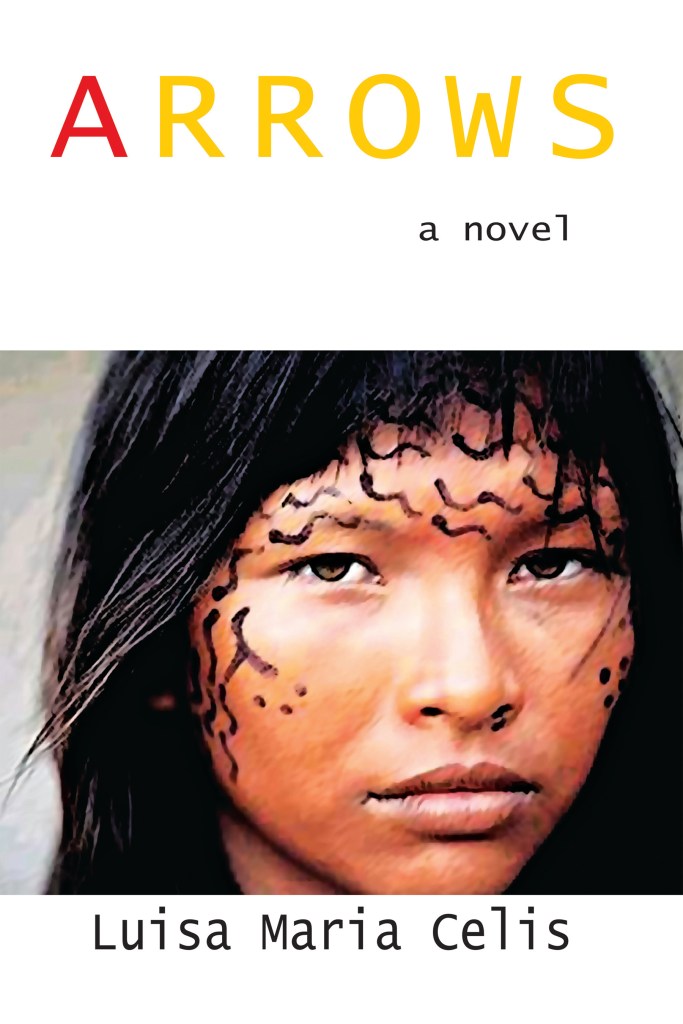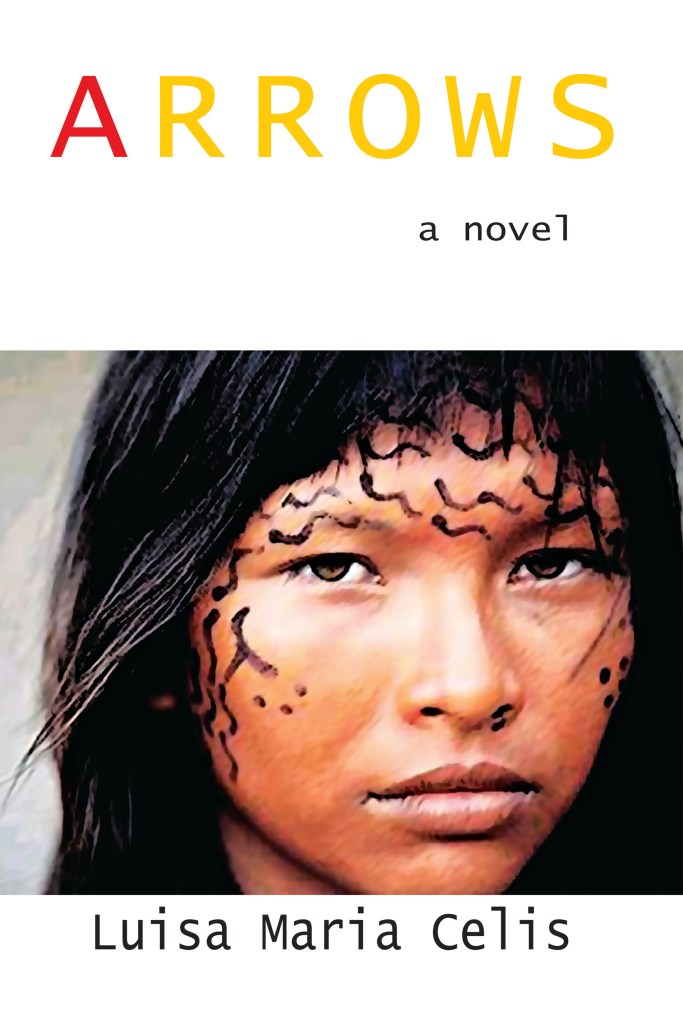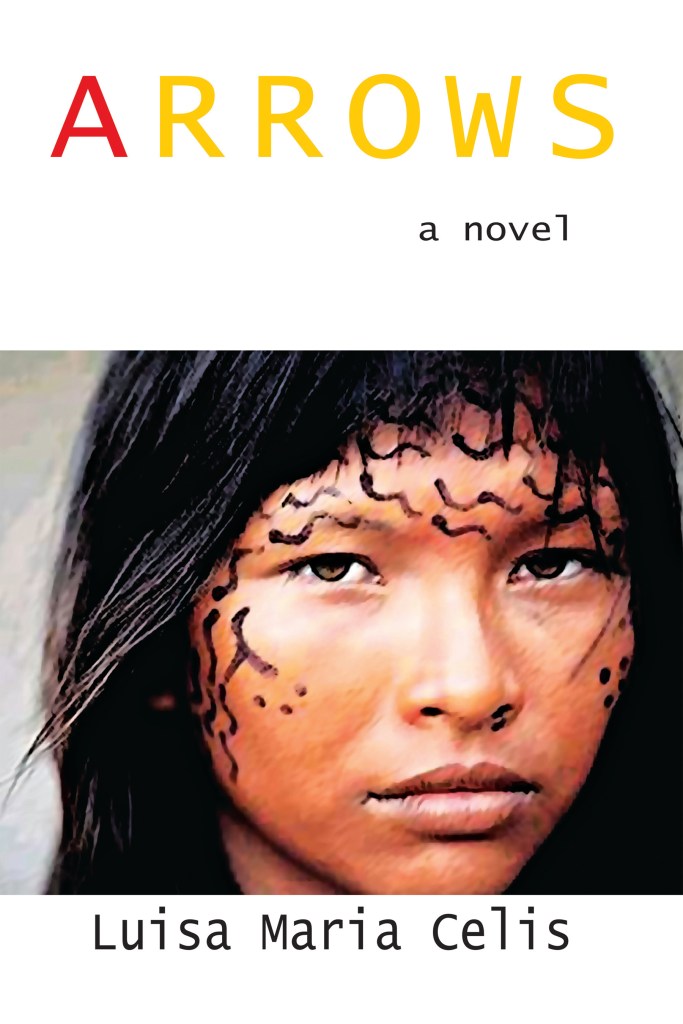
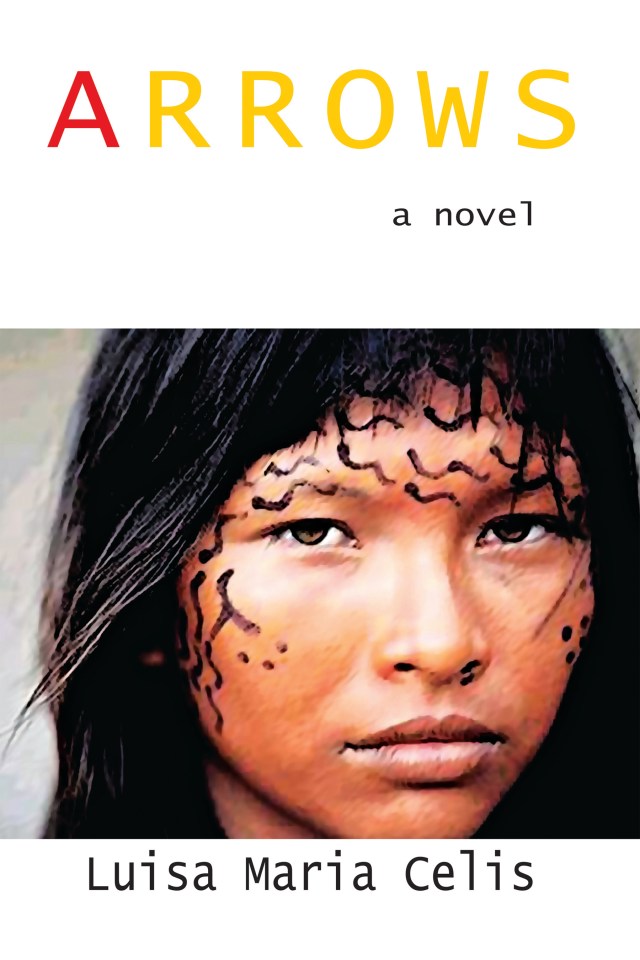
Arrows

excerpt

We hobbled jerkily, as directed, like some pathetic, three-legged
creature, until gradually we learned to swing our shared leg in
unison. In this humbled manner we were brought before the war
council of caciques.
The caciques were seated in a circle, with Guacaipuro given no
special place of honour. I was surprised to find Baruta among them.
Apacuana later told us that he had recently been made a cacique and
his body still bore the scars of the tests he had completed.
These were men who exuded confidence and authority, not the
kind of men one would cross unnecessarily. Their reputation for
bloodthirstiness coloured my apprehensions. I wondered if perhaps
we were meant to be slaughtered before them, as some sort of
ceremonial prelude to war.
I knew as well as Tamanoa that these Caribs were warriors,
conquerors in their own right. For generations, they had moved
from the south of the mainland to the northern coast, fighting their
way and conquering the gentler Arawaks.
Caribs fought among themselves, too, and made trading
incursions to the islands north of the mainland from which they
obtained not only goods, but also women. Not surprisingly, such
men were not inclined towards plans for surrender.
Though most of these men wielded authority over vast expanses
of land, Guacaipuro was chief of six other villages besides Suruapo.
Consequently it was the military strategist Guacaipuro who had
summoned the caciques of seven neighboring nations.
Whispering, Tamanoa quickly explained the gist of the
situation: Losada had founded the city of Santiago de León de
Caracas upon the settlement of San Francisco, and for the natives,
this had but one meaning: war.We were present because a cacique
called Mamacuri from the coast was arguing in favour of using the
shaman of the white men to obtain inside information about
Losada and his party.
Other caciques, like Paramaconi, great chief of the Toromaynas
from the valley where the new city had been founded, were more
inclined to kill me. Catia agreed with Paramaconi.

https://draft2digital.com/book/3562848

https://www.amazon.com/dp/0981073522

Arrows

excerpt

voices when the breeze allowed it. Looking for so long into the
distance, we were completely unprepared to turn and see five men
behind us.
Even before we could rise from our crouching positions, five big
warriors, scowling fiercely, materialized from the bushes, pointing
arrows at us.
“I looks like you may never get to know Guacaipuro, my friend,”
said Tamanoa.
I could not imagine ever responding with such aplomb. This was
his way of retaining control of himself, not showing fear. He was
showing me what to do, how to face death. Or to avoid it. I
mimicked Tamanoa’s stalwart behaviour, literally at ever step, as
the Indians led us into the village; two ahead of us and three behind.
In the days and months that followed, our captors would assume
Tamanoa was my servant because he was a half-breed, and yet it
would be Tamanoa’s ability to interpret their speech and their
behaviour that would keep me alive. Without Tamanoa, I would
never have been able to develop the language skills that enabled me
to talk to Apacuana, and I would never have survived to tell this
tale. But it was God’s will, or the way of Mareoka, to make everyone
assume I was the leader.

I was as lost as I have ever been as we marched to the village at
arrow point. People gathered on the trail and around an open space
dominated by the imposing figure of a man who could only be
Guacaipuro. The sun shone directly above our heads, gleaming
silver on the silky raven-black hair of Guacaipuro, whose face was a
mask chiselled in stone. His eyes were ominous black slits. The
hollows of his cheeks were elongated shadows.
He stood immobile, his chest heaved, and deep lines creased his
brow. The corners of his mouth were pulled down in outright
loathing. He held a spear, the butt resting on the ground.
As we approached, he held the spear almost to my chest, glaring

https://www.amazon.com/dp/0981073522

Arrows

excerpt

She was scrutinizing me as though willing herself to see
my soul.
Her hand came up to my cheek, and her thumb followed the line of
my cheekbone. An insurrection was taking place inside me. I wanted to
be close to her. Closer. My hands hurt with desire to touch her. My
breathing became jerky, and I felt myself grow hard in the way I knew I
must not, and the urge to satiate that hunger was ruining my
judgment. She said something, but I could only admire the fascinating
movements of her mouth—a ripe fruit, sweet and yielding.
Thank God she buried her face in my neck, though her breath,
warm on my skin, only added to the mayhem inside me, for it gave
me the time I needed to rally my wits about me. I pushed her softly
away. “Noli me tangere,” I breathed in Latin. Do not touch me. Her
big, dark pupils looked up at me, searching my face. I swallowed
awkwardly, conscious of the movement of my throat. “Chi’ka,” No, I
added in Carib. But it came out more like a strangled plea.
She knelt back, her hand on my thigh. I pushed it off, noticing as I
did the stake lifting my frock obscenely. She saw it, too. I pushed my
knees up, giving my privates the only touch and pressure they
would get. I breathed deeply, swaying softly back and forth.
Thoughts of Jesus on the Cross, at Calvary, flooded my mind,
slowing my heart.
Apacuana left me, a bit confused, I dare say, by my pushing her
away as I did. She fumbled for a long time at the entrance, building
some sort of barrier. I found it a sweet demonstration of her care for
me, but then began to worry she might have a more solid reason for
taking such precautions. I was left with a small fire burning and
enough kindling within reach to feed it.
I slept like the dead but woke up suddenly, certain I had heard
something. I tossed a handful of twigs into the glowing embers and,
moving gingerly, poked the fire until a timid flame revived. I
listened with expectation. Had I dreamed it? No, there it was again,
as if someone were shuffling at the entrance. My spirits lifted at the
thought of Apacuana’s return. But why not come in? I called to her.
Was it perhaps a beast instead?

https://www.amazon.com/dp/0981073522

Arrows

excerpt

A numbing chill crept up my legs. Something warm wet my
backside. It must have been the pain that made me lose
consciousness, because afterwards it became apparent the arrow
had not gone deep. It had been stopped by the bone inmyshoulder.
The last thing I remembered was seeing Apacuana running
towards me.

“Apacuana! Apacuana!”
It had to be a dream. A strange girl’s voice startled me back into
consciousness. I was lying on the ground. I kept still with my eyes
closed, drifting back into sleep, when I heard Apacuana’s voice
much closer to me, answering back. Merciful heaven! What was going
on? A sharp pain shot from my neck to my shoulder, reminding me
that I had nearly been killed by stampeding horses and an arrow. I
turned my head gingerly. My head slid over the polished surface of
the big leaves upon which I lay—plantain leaves. I unglued my
eyelids and looked around me. What was this place? A cave?
The dirt floor was damp and cool, the air musty with a slight
pungency. I glanced in the direction of two young women who were
talking fast. I could see their figures silhouetted against the bright light
of the entrance. I gathered that the other girl was urging Apacuana to
go with her. The word Baruta came through several times, always
accompanied by a certain apprehension in their manner.
Apacuana was holding a small gourd, which she handed to the
girl while signalling in my direction. The other girl glanced at me
apprehensively, but her eyes sparkled when she discovered I was
awake. Apacuana left the cave, crawling through the opening. The
other girl, whose voice I had heard first, came towards me, gourd in
hand. She knelt beside me and stirred the gourd’s contents, her
young breasts pointing downward as though weighted by the many
loops of the seed necklace she wore.

https://www.amazon.com/dp/0981073522

Blood, Feathers and Holy Men

excerpt

The captain merely laughed. Finten continued, “I should have known your words
were false. I will not submit to be collared like a dog. I am a priest of God.”
“Yes, you sound like one.” The Norse leader stepped into the pen and came face
to face with the fiery Finten. “I am Hjálmar, Captain Hjálmar.” Taller by far and
stripped to the waist, he lunged at Father Finten, pinning the scruffy priest to the
deck. The captain grinned at his victim and spoke almost in a whisper. “You are
about to have your first bath and trim, my hairy friend, and I am delighted to be your
bather. Washing priests is my specialty.”
The Norse crew gathered to watch the sport. They shouted encouragement to
their captain like rowdy boys at a schoolyard fight. Finten struggled, kicked and
punched. Momentarily, he gained his freedom, but was tackled and held down by
the Norse captain once more.
“Never will you force such an unholy and unchristian rite on me. Bathing is immoral
and evil and unnatural,” Finten howled. He thrashed at his opponent, but was
no match for the powerful wrestler.
Captain Hjálmar stripped him of his cassock and sat sideways on his heaving
chest. He was forceful but almost gentle at the same time, addressing his remarks to
Finten in a calm, steady voice. “No different than any other man I have known. You
do have all your parts I see. I had been told that priests of Rome were snipped of
their manly marvels to keep them from a woman’s bed.”
“I’ll snip you of your manly marvels, you boastful pagan beast,” Finten yelled.
He struggled to cover his privates but two Norse crewmen held his arms to the deck
while another two grabbed his feet. Finten squirmed wildly from side to side while
Hjálmar snapped the cord of twine that held a copper Celtic cross around the priest’s
neck. The captain flung the metal object in an arc to the white-capped waves. “By
Aegir, ruler of the seas, no thrall of mine will spread his fleas and stench of sweat and
piss and shit upon my ship.” Then, he tossed the priest’s garment to his lieutenant,
“Here, Bjorn, boil this nest of fleas for rags while I rid this Roman monk of sanctimonious
stink. Phew.” Dipping into the sudsy bucket of salt water, Hjálmar lathered
a sheepskin cloth with a block of bright yellow soap and proceeded to scrub Finten’s
heaving torso, still talking to him in the same steady tone.
“Ah, you should be bathed by a woman. Then you would no longer wish to be
so full of vermin. We men of the Danelaw, bathe, comb our hair, and change our
woollen garments on every Laugerdag, which you call Saturday. We scrub no matter
the season, even when we are absent months on end from wives and sweethearts.”
The Norseman looked around to his crew who were enjoying such sport on a chilly
morning at sea. “Ah, yes. Our wives and sweethearts – may they never meet.”
“I will not submit to pagan practices,” the struggling monk bellowed.
“You, my friend, were created by the god Ríg to be a servant to all. And so you will
be, and work among my other thralls. Only those in mourning need not wash. It is
said that Odinn, king of the gods, left his hair unwashed as a sign of mourning for
the death of his son, Baldr. You are neither a god nor in mourning.”
“Of course I’m in mourning. I’m in mourning for dead friends and lost liberty.”
Father Finten’s quick reply did nothing to change his situation. Alternating between
the sheepskin cloth and a brush of pig bristles, Hjálmar scrubbed the struggling
monk from head to toe.

https://www.amazon.com/dp/1926763106

Arrows

excerpt

She could barely restrain herself from making a second
public accusation.
“You might get the answer to your question if you asked our
friend, Gregorio,” I replied, looking at Gregorio instead of Josefa.
Gregorio immediately understood. He grabbed Josefa by the arm
to forcibly remove her. I stood rooted to the ground, hoping he
would drag her away and that could be the end of it. But Josefa
remained feisty and broke away from him, running to me with a
pained expression. She leaned forward and whispered devilishly in
my ear, so that only I could hear. “I know what happened at the
river,” she said. “I know everything. I know you let her touch you!”
I jerked back from her, as though she had slapped me in the face.
The servant, she had seen me, and Josefa could barely contain the
power she had over me. There was no point in trying to deny
anything. I walked away, horrified by Josefa’s misplaced jealousy,
and dumbfounded by my inability to eradicate her secret
knowledge.
Right then, I decided I did not want to learn whether Apacuana
had bitten Josefa or not. There was a part of me that hoped she had.

In the morning, when Losada was notified of the incident, he
preferred to dismiss it as mere female hysteria rather than discern
which party was responsible. It was the prudent decision: to
concentrate on completing his negotiations with the cacique Chacao.
After mass, Losada ordered the captives brought to him and untied.
“We want to be your friends. You see we have not harmed you,”
Losada told Chacao. “We can decide to do this in peace, or we can do
it in war. We are powerful. To show you my goodwill, I give you all
your people back.”
Chacao was a middle-aged man with deep lines running down
the sides of his nose to his mouth in a permanent scowl. He did not
answer, just stood there, hands folded in front of him. It was
important for him not to appear grateful for Losada’s benevolence.

https://www.amazon.com/dp/0981073522

Arrows

excerpt

amazement, our eyes locked often, for my face was in darkness and
my eyes half-closed. She somehow sensed my gaze. My heart
rushed a little every time, as if some strange and invigorating
connection had established itself between us.
The men had been tied around a tree, including the boy who
had fought to free Apacuana. I wondered who he was, likely her
brother.
Losada, along with Gregorio and Pánfilo, had entertained himself
in pacifying the Indian boy, but the youth’s courageous rejection of
every kindness didn’t amuse Losada long, and he had ordered him
tied up with the men.
My head throbbed. I was feverish again. I lay with my back to
the fire, concentrating on the frogs and crickets singing their night
song, hoping their music could distract me from my growing
queasiness. The fire crackled as sap pockets exploded, sending
fiery dots into the sky.
The moon was full, though there were some clouds. I was still
learning to read the signs of the sky in this new land. The rainy time
had just begun, and I was surprised at how suddenly the water
poured from the heavens and, just as suddenly, stopped and the
skies cleared.
My head felt ready to burst. I put a hand to my head. A moan of
agony and desperation stuck in my throat, and I sat up, closing my
eyes and swaying with dizziness. My breathing had gone from
heavy and deep to shallow and fast.
I crawled on all fours to the nearest tree and puked bile that made
me shudder with its bitterness. I had nothing in my stomach in the
way of food. A temporary moment of relief came over me, and I sat
with my back against the trunk, blinking owlishly, until I
remembered Apacuana again. What would become of her?
A head popped up in front of me, silhouetted against the fire. It
was Tamanoa. “What is the matter?” he asked. “You are sick again!”
“I’ll be all right in the morning. Don’t worry, I know these pains. I
get them occasionally.”
“What pains? Where does it hurt?”

https://www.amazon.com/dp/0981073522

Arrows

excerpt

Gregorio, mounted on Babieca, joined half a dozen riders who
were pursuing the runaways. Several of the riders were herding the
natives with the points of their spears. There were older men among
the natives, but no warriors.
In the distance, Gregorio chased a young woman who refused to
stop. He took his foot out of the stirrup and landed a kick on her back
that sent her flying. She fell head over heels in the tall grass. When I
saw Gregorio leap off Babieca and throw himself upon the girl, my
legs began moving before I had time to think.
I could see Gregorio’s back in the tall grass and I feared he would
rape her. Beneath him, the girl shrieked. From a distance, I could not
see her face. Losada had explicitly forbidden any harm to the
natives, as the king had forbidden their enslavement, apparently to
the same effect.
I could see them struggling. I called him again and again, still
forty long paces away. He fumbled at his breeches, while keeping
her down one-handed, and pushed against her. Again she shrieked.
Damn his soul. He was not much better than Pánfilo. I came from
behind and kicked him in the ribs, which thudded like a broken
drum. I tumbled over him. He fell on his side. I scrambled away and
got a glimpse of his disgusting member besmeared with blood.
Gregorio stood up, furious, and grabbed a handful of her hair. He
raised her by the hair, and I beheld her face as she threw up her
hands, her eyes round with terror. A dead weight sank inside me.
Horror, mixed with a shameful joy, gave way to a surge of wrath as I
took in what had happened. It was the girl by the river, the girl with
eyes like the setting sun.
Something moved in the grass at her feet, something with
grey-brown fur. The monkey. My hands curled into fists. As I fought
the urge to punish Gregorio, the monkey clambered up his side and
bit him on the ear.
With a swift motion, Gregorio let go of the girl and grabbed the
monkey by the feet. He swung it against the trunk of a massive
rubber tree as it howled and whined, eyes unfocused but terrified.

https://www.amazon.com/dp/0981073522

Arrows

excerpt

We followed the river until it converged with the same river
Guaire which ran the length of the valley.
We were one mile from our destination.
We crossed the Guaire from south to north, following the path of
those who had survived one of the two previous expeditions that
had made it this far. The Guaire was not deep, but, having lived all
my life near rivers, I knew how mighty it could become with the
proper amount of rain.
Soon after, we crossed a creek called Catuche, along which
soursop trees grew by the hundreds, hence the creek’s name, which
in Carib meant soursop. Tamanoa brought me one of its fruits and
ripped it open beforemyeyes. It was white, succulent and aromatic.
As the sun descended, the deep green of the cordillera mingled
now with soft blues and yellows. We had turned north and were
ascending the slope of the piedmont when Losada’s voice
resoundingly gave the order to stop. We had finally reached a
destination: the charred remains of what had been the settlement of
San Francisco, half-buried in the vegetation.
Francisco Fajardo had fled the settlement five years ago when he
knew the reinforcements he had pleaded for had been wiped out by
the Arbaco Indians of Terepaima. After painful losses, Fajardo had
divided his forces into two and fled in canoes and pirogues.
It was eerie being in that deserted place. The air smelled strongly
of rain, damp earth and plants. The howling monkeys, chachalacas,
parrots—they were all quiet. That night, as a full moon shone
through thick clouds, the ubiquitous night-song of frogs and
crickets was overridden by the deafening buzz of cicadas.
Losada paced nearly beyond range of the firelight, five strides to
the right, five to the left, hand combing his beard and moustache,
eyes fixed on the ground before him, his grizzled hair reflecting the
silvery moonlight. He anxiously awaited the return of the troupe led
by Diego de Paradas, who finally arrived after midnight, looking
seriously bedraggled.
“What happened?” asked Losada.
Diego de Paradas was wounded. Pánfilo spoke for him.

https://www.amazon.com/dp/0981073522

Arrows

excerpt

Tell him I promise his village won’t be damaged, nor his
fields touched. Tell him.”
Losada dismounted and the others followed suit, but he stopped
them with a gesture of his hand. “Infante, Ávila, Galeas,
Maldonado, Pedro and Rodrigo Ponce, Gregorio de la Parra, with
me. Ten harquebusiers and ten pikemen, come forward as well.
Carlos.”
He snapped his fingers, then turned to me. “Friar Salvador, if you
please, come with me. The rest of you, stay where you are, don’t let
your guard down. It wouldn’t be the first time they welcome and
then betray and kill. Keep an eye on your surroundings. At the first
sign of trouble, Juan Suárez, sound the charge. All of you! Diego de
Paradas will command in my absence. Camacho! You are second.
Good luck and may God be with us.”
“Harquebusiers, check your priming!” yelled Diego de Paradas.
Losada put a hand on the hilt of his sword at his hip, as if to
reassure himself. Behind him, the harquebusiers grabbed their
powder flasks and rammed the charges down the muzzles. A flock
of parrots cawed overhead.
“Take good account of everything, Friar Salvador,” said Losada.
“I have a mind to have you write a record of this expedition.”
Recording the expedition would be considered a great honour and a
great responsibility. I nodded. But I knew immediately it would be
impossible to record the truth.
I admired the orderly arrangement of the village. The streets were
smooth under my feet, the houses skilfully made. Earthen pots
steamed over the embers of fires; hammocks were neatly
distributed; baskets and heads of plantain hung from the wooden
structures. Strings of yarn were stretched over primitive looms. On
the sloping thatched roofs, dozens of round cassava cakes dried in
the sun. Human and animal skulls and bones hanging among the
baskets and plantains reminded me of macabre tales of cannibalism.
The Indians stepped aside as we entered the village. They stared
at my feet and then at the rest of me, for I was the only barefooted
Spaniard, let alone one wearing a frock.

https://www.amazon.com/dp/0981073522