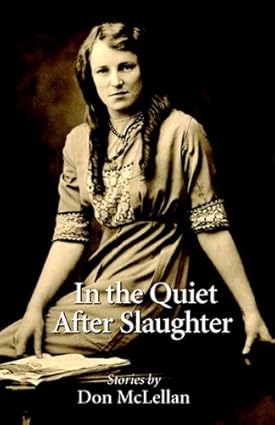
In the Quiet After Slaughter

excerpt

I possessed neither the strength to stop the torment nor the courage
to try.
– I’m going for more wood.
When I return Larry is flicking lighted matches at Lenore. Her
cheeks are stained with tears.
– Burn, witch!
Larry exits for a pee. Lenore and I face each other across the campfire.
I wonder what it would take to make the poor girl smile, so I use
my roasting stick to scratch a happy face in the dirt. Lenore uses hers
to erase the upturned mouth and replace it with a frown.
– Fee-fi-fo-fum, we hear Larry carolling. Wisely, Lenore retires.
Larry and I decide to sleep outside. We arrange our sleeping bags
around the fire.
– I’m going to move to the States one day, Larry says.
– That would be neat.
– I’m going to join the Marines. Special Forces, probably.
– Wow!
A log tumbles into the flames; a glowing ash disappears into
the star-spangled Washington night. People disappear from our
lives all the time. They move away, promise to write, don’t. They
go wacko, drop dead, find God. You say something stupid and
you’re ostracized for life. It doesn’t take much for us to abandon
each other.
When we were young my mother enrolled Burt and me in free
swim lessons in Stanley Park. The bus ride took an hour each way;
the lessons lasted 20 minutes. Hundreds of kids from East Van sat
shivering on the seawall at Lumberman’s Arch waiting their turn to
blow bubbles in the frigid surf. My brother always pissed in the
water. Later Mom would buy us fish and chips.
– I dreamed about Marilyn Monroe last night, Larry says. His
hands are folded behind his head.
– She’s something, that’s for sure.
– She was bare naked, he said. Just standing there with a tube of
coconut butter, begging, Do my thighs, Larry.
The next day we saw Cindy and Corrine riding in a convertible with
some older guys. They were racing along one of the back roads.
Cindy was standing up in the front seat, arms outstretched,

https://draft2digital.com/book/3562874

https://www.amazon.com/dp/0980897971

Poodie James

excerpt

“What are you going to do?”
“If the railroad says there was sabotage, I’ll have my people run a
full investigation.”
“If they don’t?”
“I’ll give the mayor my report.”
“And?”
Spanger grinned.
“Thanks for your help, Paul. See you in court. Or somewhere.”
As he passed the checkers players, the old cackler was eyeing his
partner across the board.
Piles of broken ties, twisted rails and fragments of the blasted tank
car bordered Gellardy’s orchard. A section gang was tamping new
ties into place. The smell of creosote was heavy in the air. Spanger
saw the locomotive upright on the track near the hobo jungle, a
section of its cab wall bowed out, a sheet of steel dangling from it.
The crane, engine roaring and cables screeching, was beginning to
ease the distorted chassis of the tank car out of the depression
alongside the track. Spanger walked toward a half dozen men who
stood watching. He recognized all but one. As two of them greeted
him and moved aside to make room, he saw Poodie James. Poodie
looked up and made glottal sounds of greeting. The chief looked
from Poodie’s eager face to the blackenedwreckage and back again.
“It’s good to see you safe and sound today, Mr. James,” he said.
The inspector introduced himself as Lawrence Hall. Spanger
made small talk with the group of railroaders, then took the man
from Spokane aside.
“What have you found so far, Mr. Hall?”
“I’ve found a mess, Chief. There are no orderly derailments. I’ll
tell you, though, the fire department here did everything right and
kept this from becoming a first class disaster. Worst thing, of
course, is that we lost a good man. First death in a wreck since I’ve
been with the company. The coroner did an autopsy this afternoon
at my request and found that Mo d’Aleppo’s heart gave out. Massive
failure. I guess the crash triggered it. He’d had a couple of mild …

https://draft2digital.com/book/3562868

https://www.amazon.com/dp/B08W7SHCMV

Poodie James

excerpt

Spanger stepped back.
“If there’s evidence to support your suspicion, we’ll decide what
steps to take. The law mentions probable cause.”
Torgerson’s face darkened.
“I think, Mr. Police Chief, that when you take a closer look at
those tracks and that wreck that killed a man, you’ll find probable
cause to hold those two for a while. Now, why don’t you just have
some of your men round them up?”
“And charge them with what?”
“Suspected criminal activity. Material witnesses to a wrongful
death. Mopery. What do I care? Just get them in jail. The town’ll
be a better place with them off the street.”
“Mr. Mayor,” Spanger said. “We ought to discuss this with the
city attorney. It could lead to a lot of legal trouble. You can’t just
invent charges and lock people up.”
“Oh, those two don’t strike me as jailhouse lawyers, Darwin.
Don’t worry about that. Hell, one of ’em can’t even speak.”
“Mr. Mayor,” Spanger said, “I won’t help you use this train
wreck to make Poodie James and the hobos part of your election
campaign.”
Torgerson smiled and turned away from the wreck toward his
police chief. His eyes are the color of dirty ice, Spanger thought.
“Why, Darwin, I haven’t even decided to run again. You just go
ahead and investigate. You’ll find enough to lead you to your duty.
I expect you to protect the citizens of this town.”
Torgerson turned and strode down the tracks toward 13th
Street. Spanger watched until the mayor got into his big blue
Packard and drove away.
Albert Swan, the city attorney, cleared his throat and raised his fingers
to smooth his tie. As he spoke, he looked past the police chief.
Spanger turned to see if someone had entered the office. They
were alone.
“Darwin,” Swan said, “we don’t much get into criminal matters
in this office. It’s mostly city business, you know.”

https://draft2digital.com/book/3562868

https://www.amazon.com/dp/B08W7SHCMV

In the Quiet After Slaughter

excerpt

Sgt. McManus, as promised, delivered Fender to hismotherwith the
promptness of a pizza. Mrs. Rhodes, when she opened the door that
night, thought she was hallucinating. Reeking of animal scent, face and
hands coated in a layer of slime, Fender had the beginnings of a moustache
and appeared to have grown a few inches. And though he had
been in hiding for most of the summer, he seemed especially vigorous.
His weight gain puzzled the policeman considerably.
It later came out that Fender had used the hour The Fugitive aired
on Tuesday evenings to switch hideouts, moving from one refuge to
another as the populace gathered around their TV sets. Employing a
stealth rare in one so young, he inhabited an abandoned car and then
a child’s treehouse. He camped out in the brambles that grew along
the banks of Still Creek and took advantage of the Bartons’ garage
hideaway. The night of his apprehension, Fender was returning to his
new abode, a raccoons’ lair under the school portables. In his pocket
they found peanut butter cookies baked by the Widow Nighs.
Fender Rhodes accompanied the social worker Lois Daniels to the
group home. He stayed two years. It was said he learned to tolerate
the routine there and that he became a talented billiards player.
Eventually, however, the approach to mental health care evolved. It
was now thought progressive to integrate Fender into the community
that had formerly sought his detention.
A young man now, tall and broad in the shoulders, Fender has
returned to his old street corner. He has re-established business relationships.
I understand he leaves telephone poles alone, although he
has been seen anxiously eyeballing the heights of an old favourite.
If you take a drive through the Project you can see him most days.
He’s probably there now. Maybe you’ll find him discussing hockey
standings. Or — not that anyone would believe him — describing
what it’s like living with a family of raccoons.

https://draft2digital.com/book/3562874

https://www.amazon.com/dp/B00731WSPE

Poodie James

excerpt

to the surface and throwing columns of water into the air. He
thought about being water, whipping into froth, rising to ride in
clouds above the world, dropping onto hills and fields, roaring
down mountainsides, lazing in lakes, plunging over dams and falls,
spreading to meet the ocean, enveloping rocks and logs and sunken
ships, fish swimming through you, sunlight playing on you.
He wondered if the world was alive and all of its plants and creatures
lived on it, as funguses and bacteria live on animals and people.
Poodie lay on his back in the sunshine and watched a hawk
circle in slow turns above the valley, soaring on updrafts. The only
effort he could see was a tilt of the wings now and then as the hawk
drifted up. It rose so high that wings and body blended into a speck
against the blue, then regained form as the hawk wheeled down to
float up again. He tried to imagine wind pushing against wings,
rushing over feathers, the thrill of the downward spiral, the elation
of being lifted atop a column of air. He wondered what the hawk
saw as it hung above the hills and orchards, the streets and houses,
people, the river. One of the books at the library said that hawks
and eagles could see a mouse from high in the air. He waved, in
case the hawk could see him. He wanted to know the currents of
the river the way the hawk knew the currents of the air. Swimming
the river, he had to work against the flow and eddies of the water
and fight his way across, as if the river didn’t want him there.
Sometimes it lulled him in its embrace, but the river’s power
frightened him. The air welcomed the hawk and bore it like a
mother carrying a child.
September 17
Swam the river today. Maybe last time this year. Air cold, water warm.
Very tired when finished. Getting old? Found a man looking in the
window when I came back. Showed me a card from the health department.
Said he had to inspect my cabin. Showed him inside. He took
notes. He wanted to look at the outhouse. More notes. Showed him my
apple trees, ready to pick. I gave him apples. Wrote my name for him. “I
know,” he said. Nice man.

https://draft2digital.com/book/3562868

In the Quiet After Slaughter

excerpt

infant, the swell of faraway traffic, but not a peep from the boy. The
gate opened and slammed shut again as though instructed to do so
by an invisible hand.
He’ll be home by dinner, they told Esther Rhodes. He’s at that age,
they said. But the assumption that Fender would soon saunter
home, as Lois Daniels predicted, proved groundless.
– Call me when he turns up, the social worker said. She left her
card on the table.
By early evening the stifling summer air had cooled, shadows
lengthened in the yards. I was told to peddle to the drugstore and
get Mrs. Rhodes’ prescription refilled.
The All-Stars, their practice cancelled, gathered around our
kitchen table. They divided themselves into groups and assigned
duties, filing out the front door solemnly in their black and silver
club jackets.
A few teammates sat with Esther as she worked the phone. She
called kids Fender had gone to school with, fellow idiots, people
he’d done odd jobs for. When, at 9 p.m., he still hadn’t returned, she
called the police.
Others fanned out across the neighbourhood. They knocked on
doors and scoured the woods. The All-Stars aimed their flashlights
into garages and yards, under parked cars, behind every bush. They
rang bells and blew whistles.
Sgt. McManus turned up at the house to explain to Esther that police
don’t file reports until someone has been missing 24 hours. People in
the Project respected the veteran policeman.He had fought at Dieppe.
–We’ll find him, he said. I’ll bring him straight home when we do.
But they didn’t find Fender that night or the following evening
either. Esther Rhodes looked like she was about to unravel. I think
she had so many pharmaceuticals coursing through her bloodstream
that she no longer knew what was going on, which was, I
suppose, their purpose. After three days the All-Stars declared a
moratorium: no more frames tossed until Fender was found.
– Esther has already lost a husband and a baby, a team member
reminded. She might not have the strength to survive the loss of
her angel.
A week passed without a sighting. It was as if the boy had
https://www.amazon.com/dp/B00731WSPE

Poodie James

excerpt

town and the prospects. He listened carefully to the details of the
planning. The enthusiasm of his own replies still rang in Jeremy’s
mind.
“Dad, the state is only 13 years old. There’s opportunity everywhere.
East of the mountains, they’re bringing water to the land.
It’s going to bloom and it’s going to make people rich. It’s in the
center of the state, on the river, on the railroad that runs east and
west. They’re already shipping apples to Chicago and back east.
They’ll need a good newspaper. A paper can make a difference in
how that valley develops. The man who owns that paper will be an
influence.”
“And Winifred? Is it right to take your young wife away from all
she’s known, into a wilderness?”
“It is not a wilderness.” Jeremy reached into his breast pocket for
a post card and handed it to his father. Zeb Stone studied the
scene: A few buildings, a handful of carriages, a line of poles, the
blurred image of a man striding across a dirt street that stretched
into an infinity of sagebrush and bare hills. He looked up and contemplated
the club’s spread of gardens, fairways and trees. Jeremy
was determined to go west with or without his father’s approval,
but he ached for the endorsement. The perspiration and the dread
accumulated as he waited. The severity of the look his father
turned on him, his relief when a trace of a smile appeared and his
father offered to help with finances; it was all as clear as the day it
happened.
“As it is, sir, I’m going to use your money” Jeremy told him. “I
haven’t touched the trust fund since I turned 21. I’ll take money
from that and my savings and, if need be, Win will chip in from her
inheritance. We want to do this on our own.”
“If you ever decide to go back into banking, tell me,” Zeb Stone
said. “A growing town will need a good bank.”
Jeremy never dreamed that 25 years later he would turn his
newspaper over to his wife and plunge fully into banking. Winifred
had turned out to be as good a publisher as he was, and a better,
tougher editor. He had stayed out of the paper’s business since

https://draft2digital.com/book/3562868

https://www.amazon.com/dp/B08W7SHCMV

In the Quiet After Slaughter

excerpt

But their censure didn’t weaken her resolve. She savoured my
father’s embarrassment — and cursed his having been conceived
every step of the way home.
He drank with old navy buddies at one of the Canadian Legion
branches and foolishly denied doing so. He attempted to disguise
the alcohol on his breath with Halls Cough Drops. Tobacco fumes
clung to his clothes like an invisible lint. Sometimes my mother
alleged the scent of woman.
On occasion, it was true, my father would take off for a few days
—to where, no one knows. Going absent without leave guaranteed
an intensified resumption of their conflict at some future date. The
air in our house crackled in anticipation of the rematch.
Once, to regain entry, he claimed to have gone angling with
friends.Mymother circled him warily, a dog sniffing a fire hydrant.
– Lying bastard!
Punishment often entailed his eviction from their bedroom. Banishment
could stretch from three days to three months, depending.
He appeared relieved to be sentenced to an air mattress on the living-
room floor. Because mybrother Burt and I often took myfather’s
side, it was self-serve in the kitchen until a truce was reached. Our
body weights fluctuated accordingly.
I viewed my father’s carousing like this: he was born during the
First World War and orphaned in the Depression. He spent the best
part of his 20s fighting the Second World War. I reckoned the occasional
disappearance was his way of making up for lost time.
People sometimes remarked that my parents seemed to have little
in common. This may have been the case. But there had to be a reason
they were able to cohabit for as long as they did. I think they
were joined together, as many unions are, by the sum of their unfulfilled
expectations, and because as the years passed, options
decreased and habits fossilized.
My parents, you see, were either in love or at war. Rancour
seemed an aphrodisiac. There was no Switzerland, no neutral
ground. It was the one thing they seemed to agree on: the enemy of
love is indifference.
My mother, in anticipation of their evening fete, had passed the afternoon
tethered to the dresser. Her features had been transformed by …

https://draft2digital.com/book/3562874

https://www.amazon.com/dp/B00731WSPE

Poodie James

excerpt

Poodie saluted. Spanger hesitated, then returned the salute
before he wheeled the cruiser around and headed toward the station.
Pete Torgerson cranked the steering wheel knob as he crossed the
Great Northern tracks and guided the Packard along the dirt road
between the river and town. His headlights swept the curves, illuminating
sagebrush and bunch grass. A jack rabbit bounded in
front of him for a few yards and faded into the blackness of the
road’s margin. Ahead, a few cars rested in a dusty parking area
around a pole supporting a flickering red neon sign that identified
Ted and Angie’s Chicken Inn. George Pearson’s Lincoln, and
Fred Lawrence’s Cadillac were there. He didn’t recognize the
other cars. Inside the two-story log heap, the air was heavy with
smoke and “Tuxedo Junction.” Ted waved from behind the bar. A
man Torgerson recognized as a clerk from the J.C. Penney mens
department pumped nickels into the juke box. At a corner table,
Angie was taking a dinner order from a man who sat alone. Slim
ankles and high heels were just disappearing from the top of the
stairs into the upper hallway. Torgerson heard a slur of a male voice
loudly ask, “Which room?” In a circle of light, four men studied
their cards at a table whose green cover was embellished with stains
and cigarette burns.
“Mr. Mayor,” Pearson greeted him, with a hint of derision,
Torgerson thought, “we just got started. Seven-card stud. Throw
in. It should be an interesting game.”
Torgerson nodded to Pearson, Lawrence and two orchardists
from the north side of Lake Chelan. The growers materialized at
Ted and Angie’s every fall when packing house business with Lawrence
provided an excuse for an overnight stay in town. Angie
delivered the mayor a whiskey sour. Nothing to eat, he told her, he
wouldn’t be staying long. Torgerson anteed. Lawrence dealt.
Torgerson examined his hand. Next time around he called, and
threw two dollars in the pot. The game was underway, and the
mayor got down to business.

https://draft2digital.com/book/3562868

https://www.amazon.com/dp/B08W7SHCMV

Poodie James

excerpt

The chief reminded himself to be charitable
tonight and think of the A-rabs’ good works for crippled and burned
children when the Shriners and their bottle-fed mischief overflowed
from the hotels into the street. A mass of purple, white and brass, the
high school band and drill team crossed the intersection and the band
broke into “I’ll Be With You In Apple Blossom Time.” The drum
major blew his whistle, strutted and kicked toward the sky. Thirty
batons twirled high and back into the hands of the girls, whose smiles
had yet to reach the pasted-on stage. The parade was off to a good
start, Spanger thought as he watched two youngsters sitting on the
curb wide-eyed and laughing, gripping their popsicles. The first float,
a confection of white, pink and green, bore the festival queen and
princesses in their satin gowns. Princess Marcie Welch, her tiara a
double band of apple blossoms, waved to the crowd. When she saw
Poodie standing beside his wagon, she blew him a kiss. Grinning
broadly, he waved back. Well, Spanger thought, the kids in town do
seem to love that strange little man.
On the side of the blue Packard convertible that followed the
queen’s float, signs with block letters a foot high proclaimed
“Mayor and Mrs. Pete Torgerson.” The mayor perched atop the
backrest of the back seat, turning toward one side of the street then
the other, moving his arm in the way Spanger had seen in the
newsreels when the Pope blessed crowds in St. Peter’s Square.
Sue-Anne Torgerson now and then glanced at the onlookers and
lifted her hand, her head just visible above the side of the convertible.
Torgerson waved the chief to the side of the car.
“Did you see that?” he shouted over the band.
“What, Pete?”
“Poodie James, that’s what.”
Poodie had waved and smiled at the mayor’s car as it went by.
That smile, Torgerson thought, that mocking smile. Sure as hell,
he knows. He remembers.
“He’s watching the parade,” Spanger said, striding alongside the
car. Even with Torgerson sitting on the backrest, the chief’s head
was nearly level with the mayor’s.

https://www.amazon.com/dp/B08W7SHCMV