The Circle

Excerpt

“How about we meet at Starbucks by Westport Mall?”
She’s ready to agree, but suddenly hears herself asking, “Why don’t you come
over and we can have coffee here?”
Who said these words? Why were these words said? What is Emily’s purpose
this rainy morning in September? Perhaps the hope and knowledge that there is
always sun behind the clouds? But, of course, this is why she invites him to her
house. Talal’s mind runs to their sweet exchange in the restaurant, and he smiles
as he says, “That’s a better idea. I’ll be there, shortly.”
“Do you know where I live?” she asks, surprised.
“Of course, I do. I’ll be there in ten minutes.”
She’s very excited now. Her mind won’t let her relax. Anticipation turns like a
sweet song in her mind, and on her lips she has a thirst for his, like the song of the
poplar to the sunlight sieved amid its leaves. She stands still, holding the receiver,
overtaken by excitement. She realizes she’s still wearing her robe. She definitely feels
aroused, her sexual hunger captivates her once more. Matthew is coming home
tonight. If he didn’t work so hard, so long, if he wasn’t so far away for so long. She
desperately tries to find a justification for all the thoughts of wild sex she’s dreaming
of with this young Iraqi man, because Emily Roberts knows very well what is going
to happen in her house very soon. It’s inevitable, it’s desired, it’s anticipated, it’s
something she has thought of so many times—the young Iraqi man with the
charming accent, with the lovely smile, and all this sadness in his dark eyes.
She runs upstairs, undresses, and steps into the shower. She puts on her
jogging pants and light sweatshirt. Now she is ready, but for what? What’s she
getting ready for? Perhaps, they’ll have coffee and that’ll be it.
He’s there within ten minutes and rings her doorbell, making her heart race
like it wants to leave her chest and fly to the clouds, where her mind has been for
the last few minutes. She opens the door and he stands before her with his
enchanting smile.
“Hi, Emily.”
“Hello, Talal, come in,” she says, softly, and as soon as he steps into her foyer,
their lips lock in a passionate kiss, Emily exploring his mouth and Talal
exploring the fine lines and contours of her body. Before they know what’s
happening, they are by the couch and they have no clothes on. She guides him to
the floor and gets on top of him, while Talal enjoys the view of her breasts
bouncing as though singing a heavenly song that only the nymphs of the forest
know; those nymphs who have come into her living room and guide Emily to the
zenith of her eroticism and to her fantastic orgasm. Her face shows such
satisfaction, and the softness of such a completion ends with her soft relaxing
moan, a moan that could rise the dead from their graves.

https://www.amazon.com/dp/0978186524

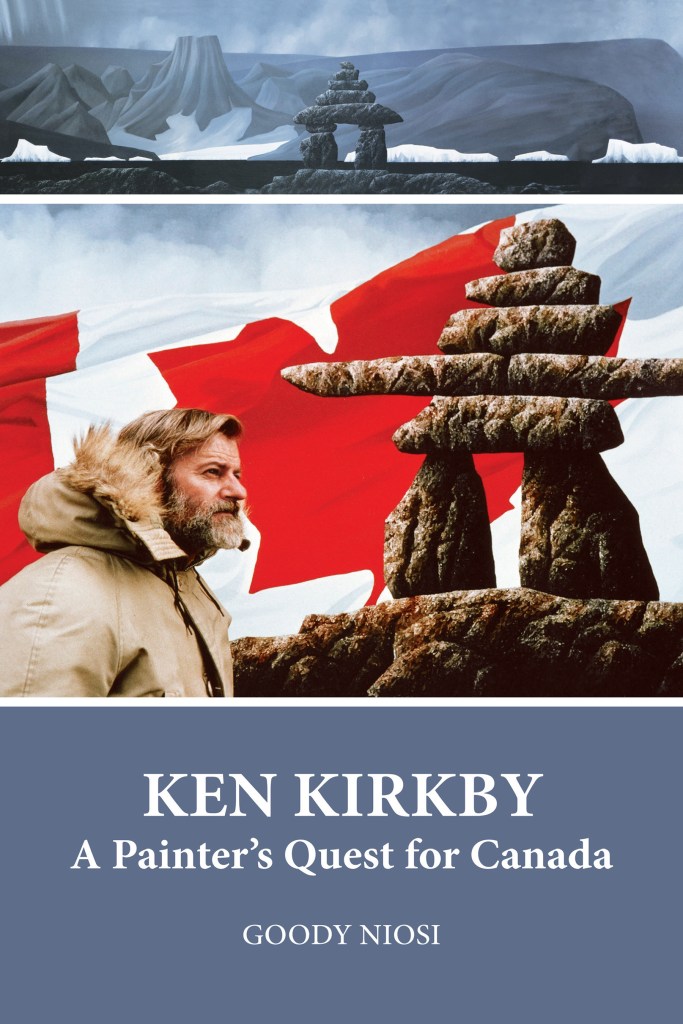
Ken Kirkby, A Painter’s Quest for Canada

Excerpt

The bush pilot told Ken that there was no such place as the Arctic – it
was an arbitrary dotted line drawn on a map, by people who had never
been there. The Arctic was a hundred thousand million places, he said,
with an enormous variety of climates and vast distances between small
communities. You might find a few people on the land, he said, but not
many. Most of them had been rounded up and put into camps built like
villages. The idea of the Eskimo as one homogenous group of people was
as big a myth as to say that all Europeans were one race.
Nevertheless, the government had decided that the Eskimos had to be
gathered together – regardless of tribe or dialect – and placed in communities,
which they would use as a base to go out and trap fur animals
for the Hudson’s Bay Company. Then they depended on the company for
their survival and were, in fact, essentially owned by it. Each Eskimo had
been given a number and a letter. Those west of Coppermine River were
assigned the letter W and a number. Those East of the area were given an
E and a number, and in some cases, those letters and numbers were tattooed
on their arms.
Ken was horrified. He repeated to Jessica, Patrick, and Long John what
the pilot had told him. John was furious, not at the government, but at
Ken and his wild dreams. “You’re on a wild goose chase! You’re mad!” he
shouted. “There’s nothing to go to – thousands of square miles of absolutely
nothing but ice, wind, and rocks – lots of frozen rocks and no
people. I tell you, there are no people there. The place is a bloody, frozen
desert. You’re made of flesh and blood – you’re not a god! What is it with
you English and your half-baked need to go to desolate places? As if life
isn’t difficult enough without going looking for trouble!”
“For someone who’s never been to the Arctic you seem to have a helluva
lot of knowledge about it,” Ken said. “How do you know there’s nothing
there?”
“I don’t need to go there,” John said. “I can read. There’s a place called
“The Barrens” and I imagine it’s called that for a good reason, don’t you
think?” John pulled out a map and pointed to the place. “Read it – it’s
right there. The Barrens – there’s nothing there. When he first looked at
the place, one of the explorers wrote in his diary, ‘This is the place that
God gave to Cain’. All I can see is that the place is going to kill you – not
much different from every other Englishman who’s gone up there. I can
see a small headline in some small newspaper somewhere, ‘The Arctic
wastes claim another Englishman.’”
“It didn’t kill Francisco,” Ken argued.

https://www.amazon.com/dp/0981073573

Jazz with Ella

Excerpt

Jennifer suddenly realized she was the hostess. “Listen, let me order some drinks or coffee. Tell me about yourselves. Do you live here in Moscow?” She moved to the phone then realized that room service might be a foreign concept in the Soviet Union.
“No need,” said Misha, pulling two tall bottles of fizzy water from his satchel. “We cannot stay very long and we have brought some drinks. May I pour?”
“Yes, please.” She picked up the two cups that sat beside a metal teapot on a corner table, and Misha poured and passed the drinks to his wife and Jennifer. He took a swig from the bottle.
“We live in Tula,” Marta said. “It’s about 60 miles south of Moscow. You know about it?” Jennifer shook her head. “The traditional samovar town—we make the finest samovars for all of the Soviet Union there. It’s also close to Tolstoy’s estate, Yasnaya Polyana. You are a language student, correct? Surely you will be visiting the home of such a great author?”
Misha cut in, “You must come to visit us. Tula is 100 kilometers east of the village where my father and your mother were born.”
“Yes, I’d like that,” Jennifer replied. She had so many questions. “When my mother got to England and met my father it was the start of a whole new life. She wouldn’t have known that her brother was still alive. Did he go back to the village after the war?”
“Only to find everyone gone: father and mother dead, sisters missing,” Misha replied. He fell quiet for a few seconds. “He said it was the saddest moment of his life.”
Misha continued to describe their family background, Marta chipping in occasionally and smiling fondly at Jennifer. Even little Nadya left her magazine and put her arms around Jennifer’s neck, calling her “auntie.”
I could grow quite fond of these people, Jennifer thought.
“We have applied to leave the country,” Misha told her. “As you know, Jews are allowed to leave—some of them. We will go to Israel.” He looked about uncomfortably. “But perhaps it’s best not to speak of these things here.” He nodded at the wall indicating a grating with a tilt of his head. Of course, microphones. They had been told that the hidden spying devices were in all the hotels that catered to foreign tourists.

https://www.amazon.com/dp/1926763246

Swamped

Excerpt

known how to handle the new reality at first, but he was a fast learner,
and he had stayed afloat despite all the rough spots along the way.
Like the night Logan had come home late with a bunch of his high
school friends and while his father, brother, and cousin were asleep,
one of those friends had stolen all his credit cards. Luckily, he had
found out the next day when the credit card company called inquiring
about some unusual purchases.
Yes, there had been a few rough spots, but he had faced up to
them. He had stood tall and made things work. Logan was doing well
in the office as a junior stockbroker, and he had already made plans
for Alexander after he graduated in a couple of years. As for Jonathan,
he was due to graduate soon with a first-class degree and a bright future
awaiting him back in Greece.
His attention was caught by the green leaves of the gardenia plant
in the office. A flower had bloomed and the fragrance filled the room.
He got up and walked over to the pot, leaned in a little, and savored
the aroma. He remembered how his mother had always kept a couple
of gardenia plants in the house. Back then they used to plant them
in rectangular metal containers; it was said the metal was good for
the plant, especially after the container had rusted due to the watering.
He touched the soil and noticed that it was dry. He called Helena
in from the outside office where her desk and Logan’s were located.
“It feels dry, Helena” he said, pointing to the plant.
“I’ll take care of it,” Helena said and went to get water.
Helena Poulos was the daughter of a Greek family that he didn’t
know personally but of whom he had heard. Her family was in the
food business, with two restaurants, one in North Vancouver and one
in Kitsilano, but Helena hadn’t been interested in that, and when the
opportunity arrived to work for a stockbroker downtown, she had
jumped at the chance. He had been very happy with her work ethic
and commitment, and she had also brought all her family members
and a few friends in as new clients.
The rest of the morning flowed uneventfully, but when the time
came for lunch, his mind ran to Susan. He dialed her internal number.
“Want to go a catch a bite?” he asked her.

https://www.amazon.com/dp/B08WP3LMPX

Still Waters

Excerpt

Jeff ’s head snapped up, and he looked full at Morley for the first
time that evening.
Unlike Millie, the young man did not wait to be asked for his opinion.
“I don’t agree with you either, sir,” he said quietly.
Tyne could not imagine whose face turned more crimson – her
own or her dad’s. She glanced helplessly at Millie, praying that her
wise aunt would quickly offer a word to diffuse the impending explosion.
But, to her horror, she saw Millie’s sparkling eyes riveted on
Morley’s face, her lips twitching upwards.
Tyne looked back at her dad. He sat with his mouth open, his fork
poised in mid-air. Beside him her mother tensed noticeably and stared
at her husband with wide, fearful eyes. Jeremy, prodded to life by Morley’s
statement, raised his head and looked from their dad to Morley
then back again, his features animated for the first time that evening.
“No sir,” Morley continued, although Jeff had not said a word, “I
believe we do need a hospital in Emblem.”
“Aye, do you now?” Tyne did not miss the sarcasm in her dad’s
voice. “And on what do you base this belief, if you don’t mind?” Jeff ’s
Northern England accent, usually barely detectable, became more
pronounced with the level of his irritation.
“I’m sure I don’t need to point out to you, Mr. Milligan, that our
community is growing.” Morley leaned slightly forward. “Some
towns, as you know, have been going backward since the end of the
war, but not this one. That’s probably because we’re becoming a bedroom
community of some of the larger centres.”
Jeff put his fork down. “Then let the larger centres build the hospitals
to take care of their own.”
“But that’s just it,” Morley said earnestly, “most of them already
have institutions. But they’re becoming so crowded that they’re
threatening to turn away patients from outside a radius of thirty
miles. And Emblem’s closest hospital, as you well know, is in Medicine
Hat, forty miles away.”
“The point is,” Jeff said, “why should the taxpayers of Emblem dig
into their pockets to finance an institution in order to accommodate
the people who’re moving out here?”
Morley looked at Jeff keenly. “Are you against progress, sir?”
“Certainly not! I have never even hinted at such a thing in any of
my editorials.”

https://www.amazon.com/dp/1926763068

The Circle

Excerpt

“Are you okay? You look like something is bothering you.”
“Hakim, do you ever think about home? Do you miss home?”
“Yeah, I think about home, why?”
“For a long time now I’ve been having these dreams. I’m losing sleep because
of nightmares.”
Hakim’s eyes get cloudy while he browns the prawns in a pan. He turns and
looks deeply into Talal’s eyes and asks, “Why do you have nightmares? What
kind of nightmares?”
“Things from back home in Falluja, the war, the destruction,
things like that. I have nightmares about my parents when they died in front of
our house, their bodies badly burned. I see them in my dreams all the time.”
Hakim becomes agitated when he hears Talal’s description of his dead
parents. He finishes cooking the prawns and checks the rice in the cooker; it will
be ready in a few minutes. He knows very well about nightmares—he has his
share of them. He has had his own nightmares for a long time now, and hasn’t
said anything to anybody, not yet. Not even to Talal, who opens the discussion
about nightmares as if they were his monopoly. He knows too well the
devastating images from home, during those dark days of the war. He has seen
himself under the rubble of his house, covered by pieces of cement blocks and
broken furniture, the night when the American bombs fell from the sky like lava
from heaven and destroyed most of Baghdad. He takes his wine glass and raises it
to Talal’s glass.
“Don’t worry, bro. Don’t let these nightmares control your life. Here’s to
you!”
Talal doesn’t answer. Instead, he goes to the fridge and takes out the lettuce
for the salad. He starts to cut the lettuce, “I see the images of my parents over and
over in my head, as if they are in front of me, like the day it happened.”
“Tell me how your parents died, Talal.”
“It was that offensive; I think it was 2004, at the beginning of the war, when
the Americans fought against Falluja, against what they used to call insurgents.
Do you remember?”
“Yeah, those were the days of hell. I remember well. I was with Uncle Ibrahim
during that time. By then, our house was already destroyed.”
“Well, in our case the Americans tried white phosphorous against the
insurgents. They used chemicals that burned the bodies like fire. That is how my
parents died, because they didn’t leave their house. So much damage was done to
the people who stayed behind instead of leaving as they were advised to. People’s
flesh got burned up right on the spot. That’s how my mom and dad died. We
were a couple of kilometers away at my grandfather’s house,

https://www.amazon.com/dp/0978186524

Ken Kirkby, A Painter’s Quest for Canada

Excerpt

“Like physical punishment?” Ken asked.
“Yes, but of a horrible kind.”
“Well, I decided to take them on and use myself as the whipping boy.”
“That’s one of the things that interests me about your story and about
you,” Patrick said. “Are you sure you aren’t an Indian? That’s the kind of
thing we do.”
“No, it was just a way of achieving a goal I wanted. It was a mixture
of vengeance and proving myself smarter. What were the other horrible
things that were done to you?”
Patrick looked away. “I really don’t want to talk about it.”
On his trips with Patrick, Ken discovered a new world, so far removed
from the one he had grown up in, it might have been on a different planet.
I began to have the sense that I had left the shadow of my own people
and of my own world. I was not in that world and I was not in this world
and that has been a familiar place my whole life. In fact when I look at the
paintings that I make, they are actually portraits of that. I’m incredibly interested
in the places in between. I remember painting an old barn when I
was going through the barn phase, as everyone does. I noticed at one point
that the barn itself was not it. The barn was there so that I could paint the
cracks in it. I began to get the idea that time is short and the journey is long
and there is only one way to go in the journey. Imagine a giant sitting on a
beach surrounded by huge boulders and he has picked up two of them and
he’s banging them together. Every time he bangs them together a grain of
sand is created. If he goes on for long enough, at some point, there will be
a beach. That concept pleased me no end – that there was no quick way of
creating a beach. Consequently, there could be no quick way of getting anything.
Whatever it is that I was doing was going to take a very long time and
that was okay. There was something very pleasing about the fact that it was
going to take a very long time. The times in my life when I have been in some
form of contentment are when I have been immersed in a project, the end of
which I cannot see. And my mind stops worrying or considering what I will
do next. I have paddled from one giant project to the next.
He absorbed Patrick’s stories and tried to fit them into a logical context.
There had to be a reason for the actions the Europeans had taken.
One day while they were motoring on the river he asked Patrick, “Why
do you think the newcomers tried to deal with the native population this
way? The residential schools seem to be a complexly bizarre notion. We
know that if you say to someone, ‘This is my castle and you can’t come in’,
they’re going to bash the door down to gain entrance.”
“Yes. It’s bizarre,” Patrick said.
“When you force people to do anything – well we know what the reaction
to that is going to be.”

https://www.amazon.com/dp/0981073573

Arrows

Excerpt

We threw together in a childish competition
that entertained not only us but also the lads kneeling in groups of
four holystoning the deck.
“Hey!” I turned and saw the weather-worn face of Pedro Mendez,
the ubiquitous bosun, obscured by the sun at its zenith, as he
glowered down at us from the quarterdeck. Already, everyone
knew better than to provoke him.
“Ballast is for ballast,” he snapped. He marched toward us, bare
feet turning inwards, glared at the bucket, snatched the stone from
my hand and shoved the bucket at Bartolomé’s page, a boy
nicknamed the Canary for his constant whistling. As the bosun
returned to his duties, my fellow passenger chortled, half-covering
his mouth with his hand. He took a big step back and bowed with
one hand on his belly, the other on his back.
“Gregorio de la Parra, at your service.”
I had seen Gregorio a couple of times before but had never talked
to him. To my surprise, I quite liked him. He was different from the
man who stood apart with a haughtiness around his jaw and neck
that went all too well with his inquisitive brown eyes.
“What did you do back in Spain?” I asked.
“I studied Canon Law in the University-College of Santa María de
Jesus in Seville,” he said. “But my godfather, who lives in Havana,
wanted me to join the next expedition to the land of the Caracas
Indians.”
“Why, God must have something in store for us, my friend!” I
said, “I was sent to join the same expedition!”
I assumed we might become friends but instead he briefly
frowned and looked me over as though for the first time.
“Did you finish your studies, then?” I asked, changing the subject
but keeping the smile in place. He pulled at his leather doublet to
make it fit more comfortably.
“No,” he muttered, straightening his back and looking away.
“Are you planning to finish them?”
I was mystified by his sudden solemnity. His eyes took on a
piercing intensity.

https://www.amazon.com/dp/0981073522

Jazz with Ella

Excerpt

Natasha’s face broke into a smile as she followed the unruly man’s path. Her eyes pierced Jennifer. “Welcome to Moscow. Here is one of our efficient Soviet comrades at your service.”
Irony or not? Jennifer wasn’t quite sure. This woman would be the group’s constant companion for the whole three weeks. Jennifer suddenly found herself a little shy. What should she say to her?
“Did you have a pleasant flight?” Natasha asked in faintly accented English, one eyebrow rising and falling in interrogation.
“No, actually the last stretch was rough! We flew through a storm.”
The eyebrow went up again and Natasha frowned. “Statistically, you were safe,” she said. “Only safe landings have been recorded at this airport for the past 15 years.”
Jennifer stifled the urge to ask about the unrecorded flights, and she and Natasha stood in silence until the others began to trickle through the gate.

The highway into Moscow was wide with very few cars, some antiquated buses that belched black soot and many putty-coloured military vehicles, each displaying a stencilled number. Massive concrete bus shelters lined the curb, their panels dwarfing the few pedestrians. There were no houses. On the outskirts of town a sea of apartment buildings loomed, blocks of boxy housing, surrounded by paving stones between which weeds sprouted. Above, clotheslines were strung across the many balconies. At street level, the store windows displayed no colourful signs, no advertising, and not many goods behind the glass panels. Over each storefront was written a single word describing the store’s contents: Footwear, Produce, Dairy. As their bus left the suburbs and entered the city, they saw their first statue on a street corner. Almost two storeys high, it could easily be identified as Vladimir Ilyich Lenin by the pointed beard and round, smooth head.
“King Fred,” giggled Len Whalen, one of the undergrads. Natasha’s gaze soon silenced him.
Several of the group brought out their cameras, but Natasha called out, “No photos yet, please. Save your film for Red Square, coming up on your right.” The famous square flashed past in a blur—the Kremlin walls, the mausoleum, the striped onion domes of St. Basil’s Cathedral.

https://www.amazon.com/dp/1926763246

He Rode Tall

Excerpt

“Joel,” Mr. Lee replied calmly. “I met with our client’s entire
management team at the terminal yesterday and they are fully
behind the decision. In fact, they were very critical of me for not
acting on this earlier, but I thought I would just give you one
more chance. I know you are capable of so much more. It is so
frustrating watching you waste your talent and poison yourself
the way that you do.”
“Bloody hell, you bastard. What are you talking about? Just
because you don’t know how to have a little fun once in a while
doesn’t mean that other people can’t have a good laugh now and
again.”
“Joel, I can see that this conversation isn’t getting us anywhere,”
interrupted Mr. Lee. “But why should I expect it to be
any different than any of our other conversations? Everyone I talk
to on this addiction problem of yours tell me that you won’t be
ready to make the changes you need to make until you hit your
bottom. I just hope it doesn’t take you much longer to hit your
bottom. There might not be much left. Could you please give me
your key to the office and your security pass?”
“Screw you!” screamed Joel as he slammed his office key and
security pass on the desk in front of him. “You are going to be
very sorry. You’ll see. You will be crawling to me asking for me to
come back and clean up after the kid. There is no way I’ll ever
work for this damn rotten company ever again after the way
they’ve treated me. You’ll all be sorry,” he blurted to anyone who
cared to listen as he strode across the office, opened the door, and
walked into the sweltering heat of the day.
If Joel was feeling pretty rough at the start of the day, he certainly
wasn’t feeling any better now.

https://www.amazon.com/dp/0980897955