
Yannis Ritsos – Poems, Selected Books, Volume IV

REPETITIONS, SECOND SERIES

Themistocles

               And they secretly brought his remains to Attica

                                                                        Thucydides

He, who glorified his land like no other, he, who knew deep

inside that each freedom resulted in another new slavery worse

         than the first,

he, with the great plans, the most successful achiever, now

suspicious to all, misunderstood by all, chased by Athenians and

Lacedaemonians too, he couldn’t find refuge not even in Corfu

(who considered him their benefactor). Thus, having no other

recourse, he went and seek his safety at his enemies’ land (and

he knew that this was what the others waited: “here is the proof

of his guilt; what else do we need? His treason is obvious for all

         to see”

And, he, stooped there on the side, with the baby of Admetus

in his arms, he fell at his feet so his enemy would take pity

         on him.

Then, in the land of Artaxerxes — what bitter welcoming for him,

what speeches and what promises — and gifts and honors from

          the barbarians:

Magnesia would be his bread, Lampsacus his wine and Myounta

          his appetiser;

but he postponed, he asked for more time with excuses: firstly

to learn Persian, to be able to talk directly to the king with no

third people in between, without translator and the unavoidable

          mistakes;

he had in mind to tell all to him, the what, the when, he won’t

hide anything — the secret defence lines, the weak points —

          until, finally,

the night of the “important meeting” and while Artaxerxes was

          waiting for him anxiously,

wearing his official attire, he got dressed in his Hellenic cloths

          which he had brought from his homeland,

by then totally worn out, and he neared serenely to the multi-

engraved table and wrote a short note: “transfer my bones

somewhere to Attica without informing the Athenians” Then

he gulped all the contents of the glass.

                                                             There they found him

the same night in his humble cloths, motionless, serene at last.

The Persians mourned him in a big way. His great monument

is still standing in the Agora of Magnesia. As far as the other

is concerned, I mean his short note, we never learned if

his bones ever reached Attica.

https://www.amazon.com/dp/B0CGX139M6

Θένια Πραντίκου – Μαρία Μπουσδέκη

Titos Patrikios – Selected Poems

A DIFFERENT LOVE

A different love

without the name of the beloved

without the memory or dream of a woman

insatiable, unappeasable love

with bones of our dead comrades

with feverish eyes

with a black wind that spreads its fiery metal

on words, in jails and exile camps.

Thus the words become metal

that you can hardly touch

or mold.

https://www.amazon.com/dp/B08L1TJNNF

Yannis Ritsos – Poems, Selected Books, Volume I

We Continue

Every time he says “I’m finished” he never finishes

Sometimes it is the window with the long flowing curtain

sometimes the fourth leg of the chair sometime the glass

left under the bed next to the shoes

especially the inside part of the fridge – so artificially white –

with the bitten red apple still preserved

showing clearly traces of the same teeth

https://www.amazon.com/dp/1926763076

Wheat Ears – Selected Poems

Experts

Pundits left after doling out

negative expertise

asserting no prescription but

it can’t be done

pundits had their turn

and in the middle of the plaza

we stood alone

holding hands and celebrating

thoughts that nothing can go wrong

nothing is unaccomplished

when you hold onto the stars

when you float in dreams

the achroous when you color

on water when you walk

https://www.amazon.com/dp/B0BKHW4B4S

Ithaca # 555

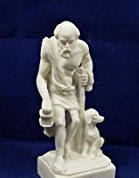
ΔΙΟΓΕΝΗΣ

Προχωρεί

με το λύχνο του

μέσα στο δάσος.

Οξιά πες μου

πού είναι

το ελάφι ο αδερφός σου;

Στο χωριό ρωτά:

σκύλε πού είναι

ο φίλος σου;

Στην πόλη ρωτά:

ανθρώποι, πού είναι

ένας άνθρωπος;

Μετάφραση Μανώλη Αλυγιζάκη//translated by Manolis Aligizakis

Diogenes

goes
with his lantern
through the woods:

oak,
where is your brother
the elk

goes
through the village:
dog,
where is
your friend

through the city:

people,
where is
a human
Viacheslav Kuprianov (Russia 1939)

Yannis Ritsos – Poems, Selected Books, Volume IV

REPETITIONS, SECOND SERIES

The End of Theseus

Returning from his last deed, his greatest deed, his descend

         to Hades —

no one welcomed him in the roads of Athens, as it was

        customary

and as he expected. Mnistheas (long as the hero was away

        glorifying his motherland)

managed with promises, flatteries, with popular demagogue

to turn the people against him.

                                                 And him, sad and pissed off

sent his two sons to Elphenor, king of Avanda, exiled too

and he ran to the village Gargitos, which since then they called

         Aratirio

in other words place of worship. Then, unescorted, he went to

Skyros to meet his old friend Lycomedes, king of the Dolopians,

hoping to find a bit of hospitality and protection, to reclaim a few

fields that his father had left him.

                                                        He dreamed that there he’d

escape from useless concerns, the futility of glory, and the empty

          words

the conniving, the double-faced people, the slander, working

          the lands,

barefoot, with ripped undergarments (and this with plenty of

          sadness for himself          

and like revenge against something general and faceless).

He even imagined, with pleasure, during the summer noon,

that he’d moist his dry bread in a clear creek. And suddenly

he remembered: fresh, ripen, black figs and he felt his appetite

         was aroused;

and perhaps he had a dog to keep him company. And the sparrows

picking the crumbs from around him. And when the evening star,

like a slivery drop, would come among the pine trees.

                                                                                     However

Lycomedes, say because of the fear of the Athenians, say

due to his personal hatred, led him to a high mountain,

supposedly to show him a few fields — “look how green

they are, how fertile — I looked after them for many years”

and there he pushed him down to his death.

https://www.amazon.com/dp/B0CGX139M6

Ithaca # 550

Threshold

At which zone
erogenous
of this language
nomad,
tattoo the star of absence?

The poem,
a shelter without roots
open
for the obscure appeal
of the roads.

Idriss OUADOUL, Morocco (1962)

ΚΑΤΩΦΛΙ

Ποιό ερωτικό σημείο

αυτής της νομάδας γλώσσας

αποτυπώνει

τ’ αστέρι της μοναξιάς;

Το ποίημα

καταφύγιο δίχως ρίζες

απέραντο

στην ατέλειωτη έλξη

του δρόμουΜετάφραση Μανώλη Αλυγιζάκη//translated by Manolis Aligizakis

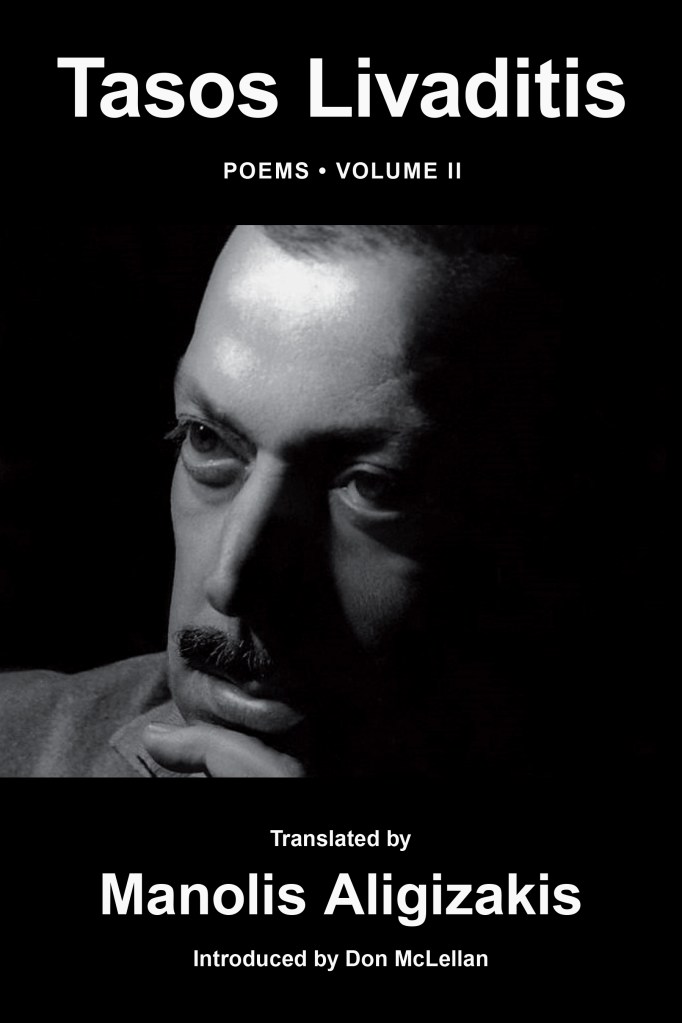
Tasos Livaditis – Poems, Volume II

Long Listed for the 2023 Griffin Poetry Awards

Symphony I

And suddenly the last firings of the surrendered

            city

as the wind brought footsteps and rifle shootings

              and out of tune songs

many soldiers were wearing civilian cloths and

              ran over the walls

houses resembled dead faces in the moonlight frost

unburied corpses on the roads, left to the dogs

              and God

and the shooters, stood by the corners hugging

their rifles like the body of a woman who

               had betrayed them.

Then, again the same road, among the dead horses

               and the broken rifles

women were sitting by the entrance of each burnt up

               village and cried

moistening a little flour in their palm to feed

               the babies.

https://www.amazon.com/dp/1926763564

Yannis Ritsos – Poems, Selected Books, Volume III

LIGHTHOUSE KEEPER

A clay pitcher is moulded, remolded like flowing light,

experimenting with itself, still hasn’t decided to exist

and you hear the semicircle dance of its handle that curls

more and more, then less and less, touching the body of

the pitcher momentarily, again to distance itself quite

independently, looking elsewhere, meaning something

else, floating in the intoxication of its lissomness, like

a winged serpent, like an autonomous flower made of

              rosy silver.

And they all wait, in their beautiful palindrome,

for you to undertake their responsibility, to create them,

to give them meaning, shape, and to name them and

place them in their positions. Yet, absorbed as you’re

in the vague and useless, you delay; then, at the time of

the last forgetfulness, the time you have to light the lamp,

the horrible ringing echoes in your sleep like a punctual

alarm clock that stops sleep, like an erotic spasm that

stops lust. You stand up and the rays of the lamp you’re

about to light have already wrapped around your neck,

like ropes your hands lifting you up, and outside.

And, in the light you put on to guide the ships,

you see the ships which look at your lamp

you see your golden, miraculous and useful  hands.

https://www.amazon.com/dp/B096TLBNFK