Fury of the Wind

excerpt

He had fallen silent again, and Sarah felt too weary to bother
with small talk. She had done her part – the rest was up to him. She
could not understand him, and surely had not expected this indifference.
Had she done something wrong?
She wondered if his reticence was caused by nervousness. If so,
he certainly did not show it. His long, lean hands rested easily on
the steering wheel and his lanky body slouched in the seat.
Sarah sighed and turned her head to watch the passing landscape.
Mile after mile of wheat fields rolled by the window, their uniformity
broken only by an occasional stand of poplar trees. Reddish
bristly spikes of foxtail lined the roadside, and clumps of Russian
thistle struggled in the wind to be free of the barbed wire of the
picket fences. Poking their heads above the couch grass on the borders
of the fields, and dotting the billowing carpets of grain, were
numerous yellow flowers of the wild mustard plant.
She marvelled at the flatness of the prairie. The horizon seemed
to stretch to infinity, the sky so big and blue that Sarah felt she could
float up and into it.
A lone gopher emerged from the underbrush and skittered across
the road. A hawk wheeled and dived overhead. Sarah wondered idly
if the rodent’s flight was an effort to escape the mechanical menace
bearing down on it, or the winged menace from above. She turned
her head to mention her observation to Ben but the set of his lips
did not encourage conversation. She focussed again on the scenery.
They passed two or three farms, and Sarah noted with astonishment
that none of the houses or outbuildings showed signs of having
been painted. They stood out on the prairie like beacons but,
rather than giving a sense of welcome to the traveller on the road,
they appeared drab and cheerless.
The roar from the old motor and the stifling air inside the pickup
were making Sarah feel ill. She closed her eyes but they were jolted
wide open by Ben’s sudden announcement.
“Mrs. Thompson can’t come ’til tomorrow.”
Sarah stiffened. Her mouth went dry and she felt her stomach
heave. “You said she would come tonight.”

https://www.amazon.com/dp/0981073530

Savages and Beasts

excerpt

a few minutes to pretend of listening to their pleas and needs,
then the elections are over the politicians disappear as they have
done before and the Indians carry on living their substandard
life with no light anywhere to be seen. These are the people the
Anglos have to give a voice and a sense of what freedom means
by way of example and by way of re-distributing part of this
country’s wealth and share some of it with the Indians. However
I can’t see the Christian Anglo ever getting to that point
of psycho-spiritual advancement that he’ll accept this idea as
something doable. Then, they talk of racism and that they stand
against any form of it but not by example: only in their hollow
talk and the promises which they don’t keep.”
Anton’s father sighed and stirred in his chair. Then he
continued.
“Here we have two different cultures, totally opposite to
each other and each of them preaching their ways to the members
of their society and the hatred one feels for the other which
results only to a short-lived victory for either side thinking they
each make some progress while in reality the fundamental differences
remain and are perpetuated and all this because there
is no dialogue. None of the two sides truly want to sit down and
talk since each side distrusts the other and as long as that distrust
exists between them there won’t ever be a dialogue, there
won’t ever be an embracement. The only way forward is that
small room for dialogue, the exchange of ideas, views, thoughts,
images, and perhaps one day something positive will emerge; this
is the chance both sides must take because there isn’t any other
way forward, except of hatred, enmity, endless doubt, hell.”
He stopped again and took a deep breath; yes it was much
to take for anyone; besides the truth always hurt the ones who
didn’t like it.

https://www.amazon.com/dp/1926763602

The Unquiet Land

excerpt

a while, but we don’t get along all that well. She’s a straitlaced Puritan like many here in the village. And I hate Belfast, don’t you? There’s a brother and his wife in Liverpool, but I’m never going to England. I have a good friend in Derry. You know her. Molly McEvoy. Her husband was killed last year. She has often said that she and I should live together.”
“Derry’s not much improvement on Belfast,” Finn pointed out.
“No,” said Mother Ross, “but it might have to do. I don’t have a great deal of choice.”
“Come home with me, Jinnie,” Finn said impulsively. “I need someone to look after the twins. They’re nearly six years old now, and Una Slattery’s finding them too much of a handful with four children of her own. Caitlin’s a self-willed little imp who needs some of the wildness spanked out of her. Hard to believe they’re sisters, let alone twins. My house is comfortable, and there’s plenty of room. Come on. I’ll take you up there right away. I’ve the pony and trap on the road beyond.”
That was twenty years ago—twenty-one come June—and Mother Ross had lived in Finn MacLir’s house ever since. Six months after moving in as the keeper of his house and the childminder of his two young daughters, six months of slander-scandaled tongue-wagging in the village of Corrymore, Mother Ross became the second wife of Finn MacLir. Arthur Hamilton, as justice of the peace, married them in the dining room of the large, stone house. A party began on that first Friday in December, 1898, that people still talked about two decades later. And the first Friday of every month since then, whenever he was home, Finn and his friends met to celebrate yet again the night he married the widow, Sinead O’Neill, otherwise known as Mother Ross. Though she was Mrs Finn MacLir by law, she was, and remained, Mother Ross by custom. Even Caitlin never stopped calling her by the only name she had ever known her by.
“My mother was Annie Hogan before she married Jimmy Ross,” Mother Ross once related to Caitlin. “She was the midwife here in Corrymore for many years. I was the youngest of her seven children and I used to help her at the birthing. I was with her that terrible night when you and Nora were born, Caitlin. When the arthritis crippled my mother’s fingers, I took her place. I never had any children of my own.” A sad, faraway look had come into her eyes. “I was pregnant when my husband was drowned at sea, and I lost the baby in a miscarriage. I survived on my own after Jimmy’s death using midwifery skills learned at my mother’s side. I not only took

over her job, I was given her name at the same time. Mother Ross. It has stuck to me ever since.”

https://draft2digital.com/book/3562888

https://www.amazon.com/dp/1926763203

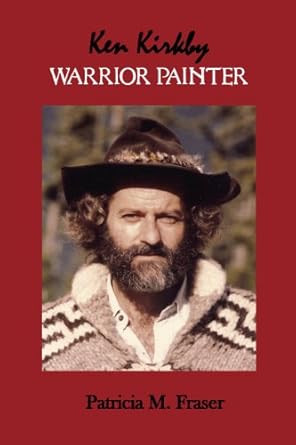
Ken Kirkby – Warrior Painter

excerpt

lobsters and many varieties of fish. Francisco would light a fire on the
rocky floor and the smoke would rise through the gap overhead while
we prepared a feast. Monsieur Desjardines thought this secluded spot
was heaven. We’d spend the day fishing, eating lobster over an open
fire and sharing stories. There was something deliciously daring about
being in a place feared by the locals—if the weather blew up a storm,
as it could easily do, the magical hiding spot could well become a
watery tomb.
Ken’s young life was idyllic but Portugal was changing. At the close
of three decades in power, the once-benevolent dictatorship of Antonio
de Oliveria Salazar was losing favour. In an effort to maintain control as
opposition coalesced behind the dissident Henrique Galvoa, Salazar’s
secret police grew more and more vicious, and by 1956, the country was
under siege.
Lisbon was the kind of city that attracted unusual people: the brilliant,
the demonic and those who drifted on the fringes of society. Spies abounded.
Ordinary people were recruited to inform on their friends and neighbours,
and paid according to the value of their information. Many innocent people
were ruined and the ensuing chaos heightened Ken’s determination to get
himself and his family out of the country.
Although his employees revered Kirkby, Sr. his position as a major
industrialist was unpopular with the authorities. It was no secret he had ties
with the exiled Galvoa. The contents of their ongoing correspondence was
less public and this was a double-edged sword: the Salazar supporters were
suspicious of his connection with the agitator, but totally unaware of the
extent to which Kirkby, Sr. was being kept apprised of problems brewing
within the country.
By early 1957, the Kirkby business empire was showing signs of
imploding under the intensified attentions of the secret service. Sixteen-year-
old Ken had an extensive network of friends at all social levels. When
he realised that time was running out for his dad he managed, with their
help, to orchestrate his father’s escape via a private plane in the gloom of an
early morning with government enforcers hard on their heels.
Monsieur Desjardines arranged the necessary paperwork for Kirkby, Sr.
to enter Canada. However, it took many months and the official intervention

https://draft2digital.com/book/3562902

https://www.amazon.com/dp/B00CB8W4CG