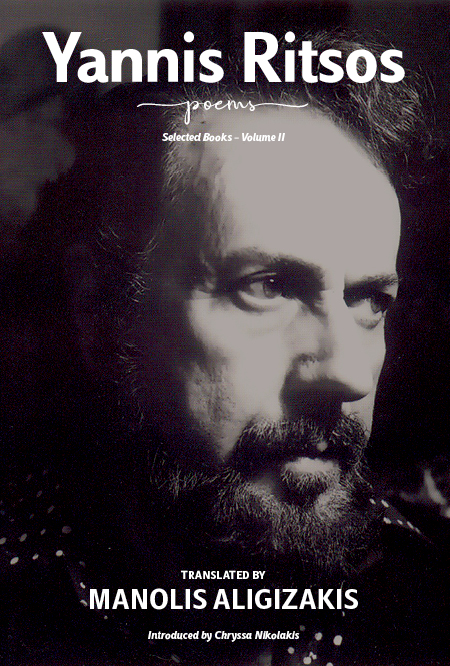
Yannis Ritsos – Poems, Volume II

Encounter
The light has a yellow shade on the facades of the houses.
The shadow of the leafless trees on the walls and in the street
resemble the shadow of foreign soldiers with the machine guns.
The shadows have changed
the voices have changed — they’ve become hesitant, like
someone who is trying to find a street number, he makes two
steps, looks at the window, where is the doorbell? What
sound would the doorbell make in the hallway with
the unfamiliar stairs?
When you say tomorrow is as if you want to console someone.
You don’t talk. The rooms feel sleepy in the silence.
The fingertips of silence remain on the shelves, the chairs,
the railings of the bed, like a sick woman who gets up
in the night to get a glass of water. She can’t stand. She leans
on the furniture, she trips on her nighty and falls again
on her bed before she finds the water pitcher.
We were thirsty.
Loneliness never had a glass of water.
Her trembling fingertips still stay on the dusty surfaces.
Back then we had time. We watered the rose-garden.
We chit-chatted.
It isn’t the same anymore. Now you count words and colors.
You can’t establish their weight.
Alice died. She will never be in our company anymore,
as during those afternoons when we dreamed of things.
Her summer shoes
will remain under her bed like two white dead birds and
her little watch, stopped, on the empty table, like a star
you see through the window shutters of the desolate
house.

https://draft2digital.com/book/3562968

https://www.amazon.com/dp/B0851M9LTV

The Circle

excerpt

“Iraq is very hot place, Jennifer, but it is a beautiful. So far, everything looks
good, although one can see all the destruction still in a lot of places. It’s so sad to see
how some people live, so sad.”
“Oh, I’m sorry to hear that. Are you having a good time, though?”
“Well, yes, I suppose. We’ll be going scuba diving in the gulf in the next couple of
days. I will not be able to talk to you from there, I suppose; however, I’ll talk to you
when I get back, okay?”
“Yes, Mom. Take a lot of pictures, remember?”
“Yes, Jennifer. Bye for now; I love you.”
“I love you, too, Mom.”
Hakim hugs her and says, “There you are. They’re doing fine; my uncle also
sounded good, and Talal sounds good, too.”
“Why do you wonder how Talal is doing?”
“I have always worried how he would feel returning to his home and how he
would find it after all this time.His house has been uninhabited for a long time, the
same as mine.However, Talal hasn’t gone to the old house yet; he saw his sister and
young brother, though. His sister will be getting married next summer.”
“Oh, that’s nice. What are the weddings like there, honey?”
“It all depends, sweetie.”
“What do you mean?”
“Well, for the people who follow religion, it’s different from the ones who do
not follow it as much like us; my uncle and Mara have been quite liberal when it
comes to religion and we just don’t follow strict church rules of any kind.”
Jennifer looks him in the eyes and asks, “Have you ever thought of getting
married, honey?”
He’s silent for a while. This is a question he hasn’t thought about before, and
now he must answer her.
“No, I haven’t thought of it, sweetie. Have you?”
“No, I haven’t. But now that the subject of marriage has been brought up, it
made me think of it.”
“Maybe one day, sweetheart. Maybe one day, I’ll think about it.”
Jennifer gets up and makes their breakfast; they sit quietly and eat their toast
with marmalade. She thinks Hakim probably has too much on his mind right
now to think of marriage; he’s worried about his uncle and he has to get together
with Peter before their important meeting.

https://draft2digital.com/book/3562817

https://www.amazon.com/dp/0978186524

In the Quiet After Slaughter

excerpt

The group visited a cultural village. They were greeted by locals
wearing heritage garb and playing traditional instruments. Theirs
was not the only vacationing group in attendance. Her travel companions
tallied the number of languages overheard in the gift shop.
Harold was hungover, Winnie exhausted. She felt the ground
rotate beneath her feet. That morning they took turns using the bathroom.
– Are you feeling all right? Karen asked her. They’d been ushered
into an uncovered grandstand and left to dehydrate.
– I know it can be a little overwhelming the first time.
– Better keep an eye on Harold, Winnie said. His ancestors were
Norwegian.
A translation was read aloud about the importance of the dance.
All Winnie remembered of it, she told the gals back home, was that
the jig had been enacted for thousands of years. The steps told a
story. Through a slit in the curtains she could see the performers
extinguishing cigarettes and changing out of their western clothes.
It surprised her to learn that in this troubled land much was made
of longevity. Repetition seemed sacrosanct; the past, one’s forefathers,
were worshipped like deities. As the dancers stomped across
the stage she considered how different it was from the true north
strong and free, where there was a 12-step program for every misfortune,
where one was encouraged to forget, to move on, let go. To
erase people and things as though they’d never existed.
And stitch quilts.
Their last night she decided to say something. She’d promised herself
she wouldn’t, but she couldn’t help herself. Days she neglected
to take her prescription, Winnie was quick to boil.
– I thought, she said to Harold, we’d do something together.
We’re going home tomorrow.
He sulked through dinner and complained afterwards of heartburn.
It disappeared when Phil came by.
She decided not to wait up or visit Donna’s room, where some of
the others would be comparing what they believed were bargains…

https://draft2digital.com/book/3562874

https://www.amazon.com/dp/0980897971

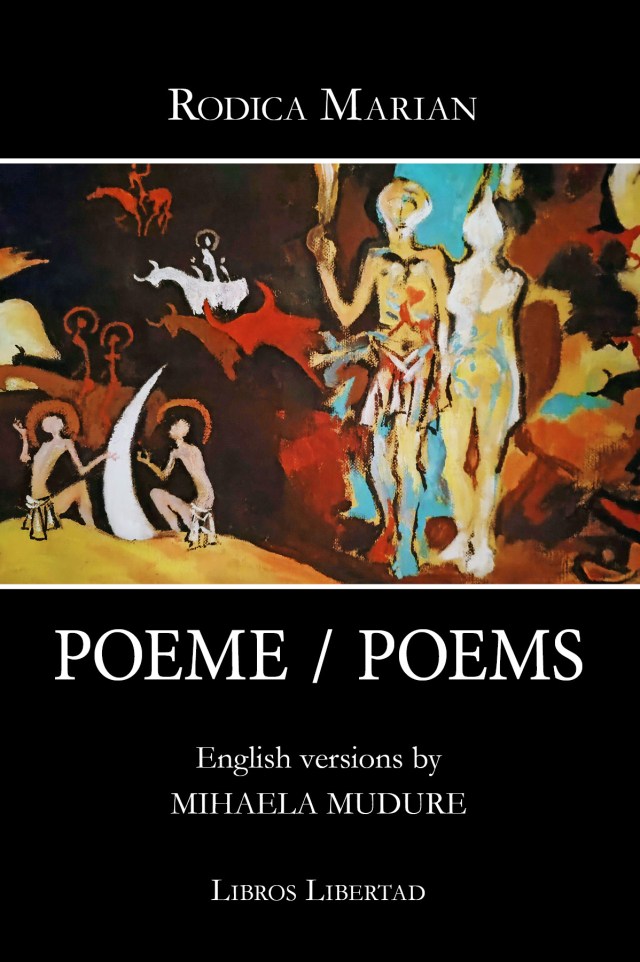
Rodica Marian – Poems

THE TRANSLATOR’S NOTE
The complexity of the translation act has often been talked about. Making
a text cross over the confines of a language and culture within the
borderlines of another language and culture is a deed of pride as the
translator re-creates the original text and a deed of humility and obedience
because translation is always a Luciferic fall. It is a subordinate(d)
text that has to admit the limits imposed upon itself by the original.
Translation is joy and pain.
Rodica Marian’s poetry is the work of an intellectual influenced by
her culture, by her knowledge as a linguist, semiotician, specialist in poetics.
Rodica Marian’s poetical exercise obviously belongs to a creator
aware of the linguistic mechanisms contributing to the creation of the
poetic. The unwareness of her talent goes hand in hand with the scholar’s
consciousness that she can no longer look at the world, at the artistic
act innocently. Rodica Marian’s poetry is laden with cultural allusions.
The well driven religious trend conceals profound experiences, regrets,
difficult questions about the individual’s destiny. Rodica Marian is a poetess
who has committed the sin of knowledge and she cannot return
to the pure, naive experience of living without cultural references. Numerous
voyages have offered her the occasion to re-read the world using
an intertextual key. Rodica Marian writes about and among her inner
and outer travels with the joy that only an authentic scholar carrying the
burden of her readings everywhere can have.
The selection of the poems from this volume points to the taste and
preferences of the translator who was happy to give Rodica Marian a
voice in the language of William Shakespeare and Sylvia Plath. The bitter
joys of this effort, which can always be improved, were special.
MIHAELA MUDURE

https://www.amazon.com/dp/1926763696