Charioteer You took the main road that dashes down from the dark thighs of Delphi like the arrow’s lissome quiver symmetrical to their questionable stature you vibrated its unruffled gravel-road with polemic sandals and the waterfall thunder you held tight in your hands the reigns of the sea and a reddish coppery gleam. Arriving you talked about the serenity of the god who suckles the nipple of a star.
Adulthood If I write my biography someday, I won’t forget to report my hatred for dye houses; they are spiteful, and when they returned the last children’s clothes, without wings, we got quite ill and when we recovered, we felt awkward and strange, like the ones who have disappeared for years, and when they return, they make excuses that the garden was far away. Where had they gone? Unknown. Only now, mother cries more often.
Kraskolkyn pulls delicately at the creases of an expensive grey mohair suit, but his tie is loose, his smart shirt is open, the hairy fruit of his paunch sports a chunky gold chain. He’s adorned with gold—wristwatch, rings, tieclip, fountain pen. Fancy leather luggage bulges on the back seat. Pauline would have been appalled at this display of conspicuous affluence. That dongle on the chain has a phallic shape. This is not a correct person. “Never mind, it don’t matter . . . I get everyone out of the shit, know what I mean? I put ’em in deep. Oh yeah! But I get ’em out again . . .” The laughter bellows on and on. Lucas can’t find the correct verbal register for dealing with this big Kraskolkyn. His fellow-traveller is delving into a pocket and pulling out cigars. Lucas is queasy about smoking, he’s only tried timid experiments with Wicked Trevor’s hash behind the gym at Westway, but now he feels obliged to take part in another kind of machismo, its camaraderie, matches, blue smoke, coughs, expectorations. Kraskolkyn slaps him on the back. “Crazy damn kids. Always on the run. Give bastards the runaround . . . Just have a nice cigar . . . then you be OK. Enjoy the sights.” Lucas isn’t OK. All he can hear is this bullying laughter. “You gonna love those sights, I tell you. Better than any nutty house, you know? I put loadsa money inna sights, believe me kid, crazy peoples gonna love it all over the Seaside.” Mr. K chuckles, chews purposefully on his cigar, as if waiting for a confession; and Lucas realises that he should have the willpower to keep silent. The slopes are becoming thickly wooded. He doesn’t know this edge of the Moor, nor can he relate it to the location of distant Oakhill—or the coastal resorts. His rescuer (abductor?) is asking him if he wants to learn any good jokes. Lucas moves his head ambiguously. Too late, a fruity narration is already underway: a Ukrainian, a Serb, an Englishman and a Croat went to the toilet. In the toilet, see, there was this big telly— The car lurches over potholes, compounding his difficulties in following Mr. K’s polyglot diction, so he can only nod weakly at the gaseous explosions of mirth. His head starts to throb with the noise and tedious obscurity of it all. They’ve just roared past the darkened ruins of a station. He thinks the crooked signboard said Abbots Oakham—for Oakhill Hospital. There, there’s no way back, not now, it’s too late, best to close down that area, keep his eyes open.
The Enemy He not only fought against loneliness and isolation, but against his whole identity, been in constant rupture and orgiastic sectoral emotions that couldn’t settle in his pneumatic completeness, but always took him to the immense void, lurking behind every set concept, that rendered him unable to position one against the other or choose one so he could annul the other; his vision was multifaceted and plethoric opposite the metallic and unbendable silence which destroyed every effort for relaxation and acceptance of the regular, the common-sensical with his pride unable to settle down, as he was not only against the world but against his viscera that demanded the impossible of him
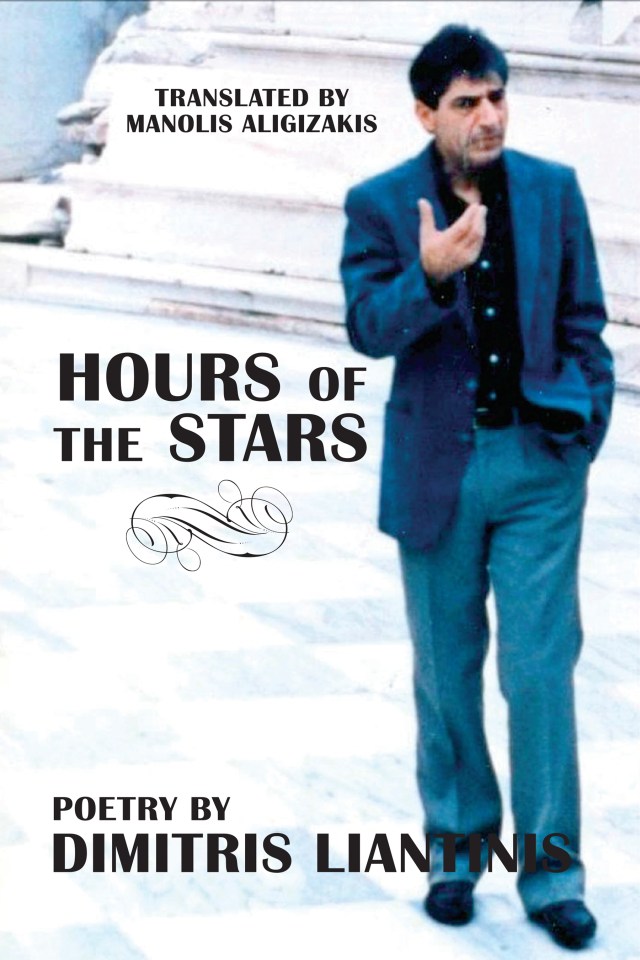



 Manolis Aligizakis