Cretan Canadian Poet, Author, Translator, Publisher
Author: vequinox
BIOGRAPHY
Manolis (Emmanuel Aligizakis) is a Greek-Canadian poet and author. He was recently appointed an honorary instructor and fellow of the International Arts Academy, and awarded a Master’s for the Arts in Literature. He is recognized for his ability to convey images and thoughts in a rich and evocative way that tugs at something deep within the reader. Born in the village of Kolibari on the island of Crete in 1947, he moved with his family at a young age to Thessaloniki and then to Athens, where he received his Bachelor of Arts in Political Sciences from the Panteion University of Athens. After graduation, he served in the armed forces for two years and emigrated to Vancouver in 1973, where he worked as an iron worker, train labourer, taxi driver, and stock broker, and studied English Literature at Simon Fraser University. He has written three novels and numerous collections of poetry, which are steadily being released as published works. His articles, poems and short stories in both Greek and English have appeared in various magazines and newspapers in Canada, United States, Sweden, Hungary, Slovakia, Romania, Australia, and Greece. His poetry has been translated into Spanish, Romanian, Swedish, German, Hungarian languages and has been published in book form or in magazines in various countries. He now lives in White Rock, where he spends his time writing, gardening, traveling, and heading Libros Libertad, an unorthodox and independent publishing company which he founded in 2006 with the mission of publishing literary books. His translation book “George Seferis-Collected Poems” was shortlisted for the Greek National Literary Awards the highest literary recognition of Greece.
Distinguished Awards
Winner of the Dr. Asha Bhargava Memorial Award, Writers International Network Canada, 2014
“George Seferis-Collected Poems” translated by Manolis, shortlisted for the Greek National Literary Awards, translation category.
1st International Poetry Prize for his translation of “George Seferis-Collected Poems”, 2013
Master of the Arts in Literature, International Arts Academy, 2013
1st Prize for poetry, 7th Volos poetry Competition, 2012
Honorary instructor and fellow, International Arts Academy, 2012
2nd Prize for short story, Interartia festival, 2012
2nd Prize for Poetry, Interartia Festival, 2012
2nd Prize for poetry, Interartia Festival, 2011
3rd prize for short stories, Interartia Festival, 2011
Books by Manolis
Autumn Leaves, poetry, Ekstasis Editions, 2014
Übermensch/Υπεράνθρωπος, poetry, Ekstasis Editions, 2013
Mythography, paintings and poetry, Libros Libertad, 2012
Nostos and Algos, poetry, Ekstasis Editions, 2012
Vortex, poetry, Libros Libertad, 2011
The Circle, novel, Libros Libertad, 2011
Vernal Equinox, poetry, Ekstasis Editions, 2011
Opera Bufa, poetry, Libros Libertad, 2010
Vespers, poetry by Manolis paintings by Ken Kirkby, Libros Libertad, 2010
Triptych, poetry, Ekstasis Editions, 2010
Nuances, poetry, Ekstasis Editions, 2009
Rendition, poetry, Libros Libertad, 2009
Impulses, poetry, Libros Libertad, 2009
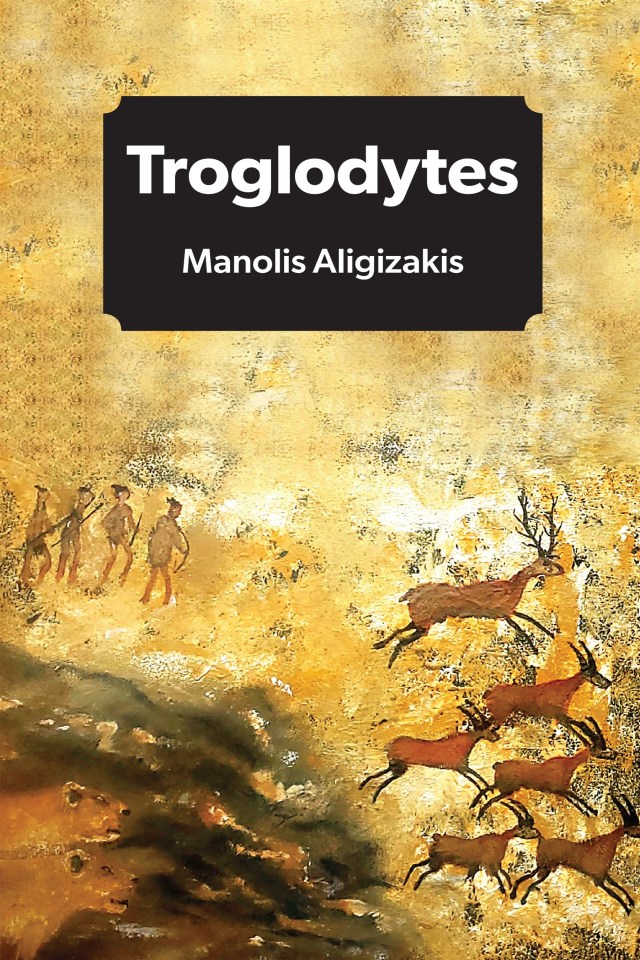
Troglodytes, poetry, Libros Libertad, 2008
Petros Spathis, novel, Libros Libertad, 2008
El Greco, poetry, Libros Libertad, 2007
Path of Thorns, poetry, Libros Libertad, 2006
Footprints in Sandstone, poetry, Authorhouse, Bloomington, Indiana, 2006
The Orphans - an Anthology, poetry, Authorhouse, Bloomington, Indiana, 2005
Translations by Manolis
Idolaters, a novel by Joanna Frangia, Libros Libertad, 2014
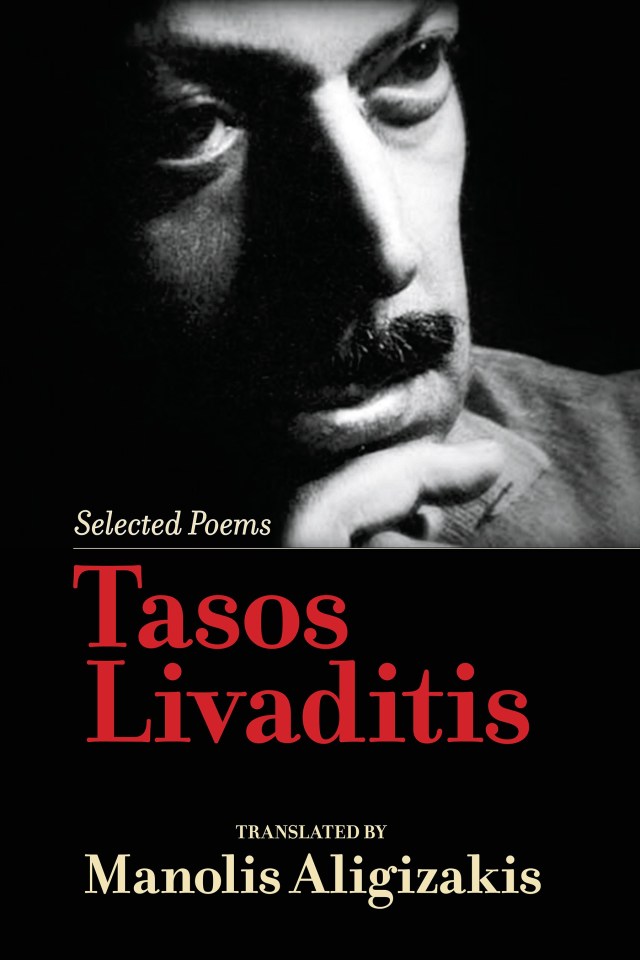
Tasos Livaditis-Selected Poems, Libros Libertad, 2014
Yannis Ritsos-Selected Poems, Ekstasis Editions, 2013
Cloe and Alexandra-Selected Poems, Libros Libertad, 2013
George Seferis-Collected Poems, Libros Libertad, 2012
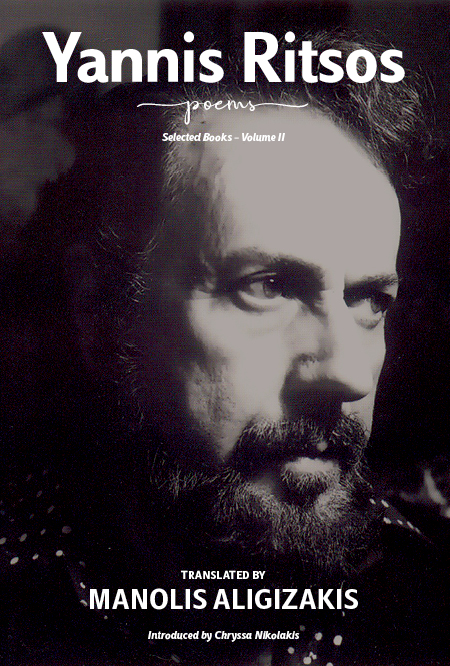
Yannis Ritsos-Poems, Libros Libertad, 2010
Constantine P. Cafavy - Poems, Libros Libertad, 2008
Cavafy-Selected Poems, Ekstasis Editions, 2011
Books in other languages
Eszmelet, (Hungarian), poetry by Manolis Aligizakis, translated into Hungarian by Karoly Csiby, AB-ART, Bratislava, Slovakia, 2014
Hierodoules, (Greek), poetry, Sexpirikon, Salonica, Greece, 2014
Yperanthropos,(Greek), poetry, ENEKEN Publications, Salonica, Greece, 2014
Übermensch (German), poetry by Manolis Aligizakis, translated into German by Eniko Thiele Csekei, WINDROSE, Austria, 2014
Nostos si Algos, (Romanian) poetry by Manolis Aligizakis, translated into Romanian by Lucia Gorea, DELLART, Cluj-Napoca, Romania, 2013
Tolmires Anatasis, (Greek) poetry, GAVRIILIDIS EDITIONS, Athens, Greece, 2013
Filloroes, (Greek ) poetry, ENEKEN PUBLICATIONS, Thessaloniki, Greece, 2013
Earini Isimeria, (Greek) poetry, ENEKEN PUBLICATIONS, Thessaloniki, Greece, 2011
Stratis o Roukounas, (Greek) novel, MAVRIDIS EDITIONS, Athens, Greece, 1981
Magazines
Canadian Fiction Magazine—Victoria, BC
Pacific Rim Review of Books—Victoria, BC
Canadian Poetry Review—Victoria, BC
Monday Poem, Leaf Press-Lantzville, BC
The Broadkill Review, Milton, Delaware
Ekeken, Thessaloniki, Greece
Envolimon, Beotia, Greece
Annual Literary Review, Athens, Greece
Stigmes, Crete, Greece
Apodimi Krites, Crete, Greece
Patris, Crete, Greece
Nyxta-Mera, Chania, Greece
Wallflowers, Thessaloniki, Greece
Diasporic Literature Spot, Melbourne, Australia
Black Sheep Dances, California, USA
Diasporic Literature Magazine, Melbourne, Australia
Spotlight on the Arts, Surrey, BC
Barnwood, International Poetry Magazine, Seattle, USA
Unrorean, University of Maine, Farmington, Maine, USA
Vakhikon, Athens, Greece
Paremvasi, Kozani, Greece
Szoros Ko, Bratislava, Slovakia
Mediterranean Poetry, Sweden
Apostaktirio, Athens, Greece
Life and Art, Athens, Greece
Logos and Images, Athens, Greece
Contemporary Writers and Thinkers, Athens, Greece
Palinodiae, Athens, Greece
Royal City Poet’s Anthology, 2013, New Westminster, BC, Canada
To parathyro, Paris, France
Ragazine C.C, New Jersey
Artenistas, Athens Greece
Deucalion the Thessalos, Greece.
Literary Lectern, Athens, Greece
Homo Universalis, Athens Greece
Behind the family tree of eternity retreats the golden fleece and the tragedy of the distant signal to the center of the inexplicable the heart of zero becomes One having always rained flashes in there tides with enigmatic wavelengths emigrate the alpha-beta of wandering intensifies ink made of stardust groping on the hair of the woman it writes words since the time she was a girl along with the hieroglyphics of dusk quay of the night lampposts of Eros galloping of innocence I walk next to me, over the piers emotions flow in eternity tomorrow is already upon us what can one decipher? Each star is one word on the path to the labyrinth an old wound that doesn’t heal secret keys to the galaxy the covenant of kites many goodbyes thrown out goodbyes without any recipient
Epode III Heavens still reside in the ghetto’s heart yet logos stay imprisoned in the maze of a code and its ever-fast whip like an ape standing outside the big door of salvation bigots holding him at bay and the crystal stars on the horizon sing the hymeneal again. Logos as in a maze of twisted minds is torn between a lustful moon and the freshness of a spring song light of freedom in sunless cells and headmaster still walks around headless or heartless as he’s commanded by his insatiable greed who sees value in the control in the protocol and in the fear fed to the mortals like manna. Troglodytes of the Middle Ages.
…lack of ambition contrasted remarkably with that of Clifford Hamilton who had different aims on human brains. Yet when Caitlin thought about it, she could not avoid the conclusion that maybe Liam’s desire to fill young brains with learning was more worthy, if less prestigious, than Clifford Hamilton’s desire to open them up for medical probing. She admired Liam all the more for his altruism. He was indeed a true disciple of his idol, Father Padraig. Beyond the school the pebble-dashed, two-storey rectory stood back a bit from the lane. Lamplight shone through the window of Padraig’s room upstairs; the rest of the house was in darkness. Padraig shared the rectory with Father Donagh Costello, the priest of the neighbouring parish “over the bridge” in Aughnashannagh. The pious widow, Brid O’Flaherty, lived in the same house as servant and cook to the two parish priests. Caitlin paused outside the rectory, then passed by and climbed the rough-cut steps to the church. Aligned along the ridge, Our Lady Star of the Sea church occupied a spread of flat ground covered with the same beach-pebbles as the footpath from the road. Caitlin paused in the doorway at the west end of the church, stayed for a moment by the clarity and peace of the evening. She gazed out over the gravestones and the grass to the errant line of the cliff-top. Dark grey was the sea beyond, and blue the sky above. The blueness of the sky paled to limpid opalescence where the sun had set. No sound. No movement. Only a shiver in the short grass where the breeze blew across it. Inland the evening shadows darkened the purple hills, the green fields, the grey stone walls, the yellow flowers of spreading whins. Lights in farmhouse windows twinkled like stars. Thin twines of smoke uncoiled from cottage chimneys. Caitlin felt a surge of joy within her. No-one knows how much I love this land, she thought. She opened the church door with a click of the latch and closed it gently behind her. The hush of the evening out of doors deepened between the white walls and the dark, varnished roof-beams of the church. Three small windows high up along each wall admitted light by day but they were gloomy now. Below each window a picture hung. Padraig had told Caitlin their stories. Along the right-hand wall that overlooked the sea the first picture showed Jesus calling the disciples Andrew and John as they worked at their nets by the shore; the second showed Him in a crowded boat ordering the stormy waters to be calm; and the third showed Him walking upon the sea, holding an outstretched hand to Peter. Along the opposite wall the first picture was of Jesus pulling ears of corn as He walked through a field with…
…people in the movies revive others in these situations, so he plugs the boy’s nose and blows into his mouth with all his might, once, twice, and then asks Anthony to compress the chest, until after a minute or so the boy gasps and expels water from his mouth as he comes to his senses. Anthony and Eteocles turn him face down as he continues to cough and spit out water, and in a few moments he is well enough to recognize the women. “Mom” he says quietly, looking up at one of the two women. She sobs and embraces him. The other woman can’t stop thanking and praising the two young heroes. She takes a couple of figs from her bag, peals them, and gives one to each of the boys. Eteocles and Anthony bite into the sweet fruit and thank the woman. As they walked back to their football game, Anthony looks at his cousin as well as all the other boys who crowd around and ask Eteocles where he learned to resuscitate drowning victims. “At the movies,” Eteocles tells them, his chest swelling with pride and happiness. He has brought someone back to life.
one One thousand years of darkness one thousand years of twilight one thousand lonely writers weren’t enough to hide knowledge one thousand painters didn’t bring a Renaissance tens of thousands of sculptors the ancient Hellenes too idolized the body and the Fourth Racism suddenly appeared
Daring The man with the thick eyeglasses and the gigantic moustache dared his creator and challenged his claim over the sickly thin body, an auspicious gift could return to its maker at any time; death never took hold of his undying soul and creative pneuma, the man sitting at the end of the dining room, of whom the other patrons of the humble pension hashed words of wonder and awe, who could have done it or other wondering phrases people say before the superhuman mind, the Übermensch of his creator, who dared challenge his maker and who reached the ultimate step of the abyss and dared it too, the man who each time the hammer struck him the echo of his unyielding strength reciprocated with a thud more deafening than the first, the man who stood upon the human greatness and made it stronger and more enduring, the man with the thick eyeglasses and the gigantic moustache sitting at the edge of the dining room and staring at the people eating or in the hallway, no need to look outside the window, his battle was always waged against his internal enemy, himself
You can’t replace the whole forest with a wooden statuette on the table. The wind howls. The wind is looking for us. Its steps are heard even in our sleep, like the steps of the soldiers in the domed hallway of the baths when we took off our last garment and the orphan nakedness was left undefended; the silent confrontation, the awkward laughter opposite the certain one, the joyous curse and the curse that tries to be a curse the timid palm that still hesitates to hide — We were like children in the shrubs of steam we weren’t children so ambitious, ambitious we create our Sunday cloths out of nakedness. But now, there’s not any confrontation with you, or him, we’re all naked. We have to confront this wind. Have you lost your leg, my brother? Lean on me. When you lean on me, I lean on the world. We all lean on the world. The wind howls. How beautiful we all walk together in the wind. The sun will rise soon as we go over that mountain.
The Blind Man With The Oil Lamp It was dark, and I had taken the biggest decision of the century: I would save the world! But how? Thousands of thoughts pounded my mind when I heard footsteps; I opened the door and saw the blind man from the opposite room holding an oil lamp, and, walking in the hallway, he was ready to go down the stairs. “What does he need the oil lamp for?” I ask myself when suddenly the thought came to me: I had found the solution, “my brother,” I said to him, “God has sent you.” And we both eagerly commenced our duty.
About the Death of the Spanish Poet Federico Garcia Lorca on the 19th of August 1936 in the Ditch on Camino De La Fuente …una accion vil y disgraciado art and poetry don’t help us live art and poetry help us die absolute disdain fits all noises research comments over comments that often state the unemployed vain writers under mysterious and lewd conditions of the execution of the fateful Lorca by the fascists but finally: everyone knows that for a long time especially during these bad years they make it a habit of murdering poets
Eyebrows Time stays still on your eyelids colorless wave lapping on the shore chirp of the last bird unfolds musical notes onto my tympanums sea waves and windless emotion when the canvas turns bloody like the horizon at sundown crickets start their arias about lovemaking under the moon’s promises the tired sun searches for its bed and us two in the embrace of the evening try to turn our dream into reality






 Manolis Aligizakis