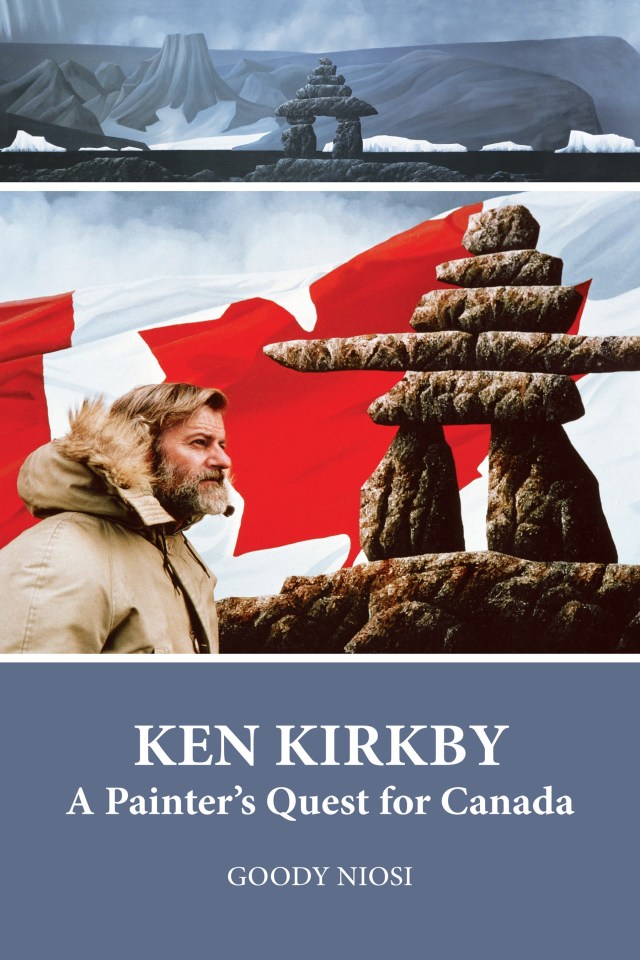
Ken Kirkby

excerpt

It was years later that I actually saw the book itself. I felt such
specialness to share this history with my grandfather who was a giant
of a man, loved by many and respected by all.
According to the National Geographic magazine, (Vol. 167, No. 3,
March 1985) Dr. Robert Paul Jordan confirms that the Viking traders known
as the Rus created Russia’s “first organized state and gave their name to a
future empire.” And the story that Ken learned as a wide-eyed boy seems to
support that claim.
As his maternal grandfather told the story, and as Ken passed it on to
his own son—who, at this point, is the last of the Kirkby line—the tale of
Rurik of the Rus goes like this:
Rurik was the eldest son and he chose to become a sailor, an adventurer
and an explorer. Like the Norwegians, the Danes were Vikings—an Old
Danish word which means ‘to dip your oar’ or in our terms, ‘traveller’.
Norwegians became known as the Norse, and Danes, the Rus.
Occupants of the Scandinavian countries realised early that to split the
farms into small holdings for their sons would make the land useless. So,
in order to preserve that livelihood, only one would inherit the land and
the others had to make their fortune elsewhere. The sea was the obvious
alternative. Through dint of need, the majority of them became mariners
and shipbuilders. They were a strong and courageous people and became
the Masters of the Seas as traders and mercenaries. The majority were
literate and highly industrious.
Those who became mercenary soldiers, a reputable occupation of the
day, were known also for their ferocity. They returned from the Middle East
with the knowledge of metalworking and equipped with this expertise, they
produced exceptionally fine swords and weaponry. This proved to be a great
advantage. A fierce minority banded together to form raiding parties and
this resulted in the Viking reputation for rape, slaughter and pillage.
Much like the dream of the Arctic that drew his future and distant
relation to northern Canada, Rurik also had a powerful dream of a vast
land beyond the ice; a land shaped by three great rivers. He was determined
to sail to that land one day. Rurik was an able navigator and commander
of several ships, and eventually he and his fellow mariners set out on a
long and arduous journey that took them east and north through the Arctic

https://draft2digital.com/book/3562902

https://www.amazon.com/dp/B00CB8W4CG

Ken Kirkby, A Painter’s Quest for Canada

excerpt

The media continued to be fascinated by him, the way an audience is
mesmerized by a performer who embarrasses himself inadvertently, on
a talk show. Ken had stepped so far outside the boundaries, had put on
a show so over the top, right down to the Inuksuit painted on the streets,
that the media haunted his studio just to see what would happen next. Ken
continued to feed them quotable lines that seemed to come effortlessly to
his lips, but that he had, in fact, been practising for months and years.
But, tidbits wouldn’t feed them forever. Eventually they would want to
stop nibbling and indulge in another meal – and the next banquet would
have to be bigger and better than the last.
He met Salvador Grimaldi for lunch again at Boccacio Restaurant, in the
Columbus Centre, and once again the architect came bounding into the
room, perfectly dressed in understated, expensive clothing, his eyes sparkling,
and his smile spreading goodwill around the room. Ken had a plan.
He told him that his next project had to be an even larger success than
the last, and described the two immense paintings he was currently working
on: one was a sixteen by sixteen foot canvas, featuring an Inukshuk set
against an enormous white cloud, that was intended for the Reichmanns.
Why the Reichmanns? Salvador asked.
“They are a very prominent family which the media and the public
have become very interested in,” Ken said. “They’re secretive and almost
impossible to approach. I’ve been studying them, and the information is
very sparse. I know they spent time in Valencia after leaving Eastern Europe,
and then they spent time in Morocco, and then from Morocco they
moved to Toronto: they started a tile business that immediately turned
into a raging success. Then, they went into high-end real estate development,
in which they have achieved even greater success. They are an
intriguing family – and just what I need. I need a Lorenzo de Medici.”
“I want to get to a place where other people cannot go. I want to sell
a painting to a man who doesn’t buy paintings and see it hung in the
foyer of the tallest building in the British Commonwealth – and have that
become a media event – even though they don’t like the media, that is
what I am after. What do you know about the Reichmanns that you feel
comfortable passing on to me? I get the idea you’re pretty close to them.”
Salvador allowed that he was close to Albert Reichmann, who preferred
to be called Mr. Albert. He had done his corporate landscaping and was
currently working on his personal property. “He’s a prince,” Salvador said.
“A merchant prince. He is a man of many talents, and I find it interesting
that you would have, instinctively, known that.’
Ken took Salvador to the studio to see the Reichmann and Yellowknife
Airport paintings, in progress. When he unlocked the door and switched
on the bank of lights, Salvador froze. The larger painting was nearing
completion while the other was only half finished.

https://draft2digital.com/book/3562830

https://www.amazon.com/dp/0981073573

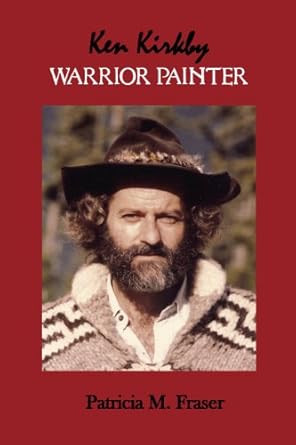
Ken Kirkby – Warrior Painter

excerpt

Warriors Come in Many Shapes
“We all grow up with the weight of history on us.
Our ancestors dwell in the attics of our brains as they
do in the spiraling chains of knowledge hidden in every cell of our bodies.”
(Shirley Abbott, Writer)
~~
Ken Kirkby inherited genes from a thousand years of determined and
intelligent men and the clever women who worked beside them. In each
generation, the face of the world inhabited by his ancestors was left
improved. If he feels some pressure to leave his own imprint on his world,
he chooses to do so by inspiring others as he has been inspired; by restoring
what has been spoiled and by righting what is wrong. Justice is an important
word in his vocabulary.
His father, Ken Kirkby, Sr. turned his back on both a fortune and his
influential British steel family as a young man. He left his assured place
in Britain to make a successful life in Australia and eventually returned to
England with a reputation for a sound ability to turn failing companies into
profitable ventures. With World War II on the horizon, he was seconded by
Winston Churchill’s team to transform the venerable but struggling Rover
Motor Company into an efficient, profit-making war machine.
In 1938, he met and married Ken’s mother, Louise May Chesney. Her
father was a respected Spanish industrialist whose family traced their roots
back to Rurik of the Rus, a Dane whose history was recorded in written
form in 746 AD. Ken was born in 1940 and his sister three years later. The
Kirkby and Chesney families left recession strapped Britain for Spain in
1946 and the Kirkby family ultimately settled in the Portuguese village of
Parede, a coastal village south of Lisbon. Their neighbours were diplomats
or professional elite, but Ken’s father preferred to do his own gardening and
knew the children of all his employees by their first names.
Ken’s childhood was unorthodox by any measure. Their family home
on the Avenue of Princes welcomed many of the brightest minds of the
European world at the time, but he ran barefoot with the Gypsy kids, bartered
his drawings in the marketplace and escaped his mother’s restrictions

https://draft2digital.com/book/3562902

https://www.amazon.com/dp/B00CB8W4CG

Ken Kirkby, A Painter’s Quest for Canada

excerpt

same feeling about you as I had about where that puck would be.”
“I want to help you,” he said one day over lunch.
“I’d appreciate all the help I can get,” Ken said. “There hasn’t been a
helluva a lot of it at this point.”
“Yes, so I gather.”
Virgil Pires, a tall Portuguese man, became another frequent visitor.
“You come from my country,” he said when he introduced himself.
“You’re almost Portuguese. I love what is in the papers and on TV. You
talk about my country with so much love.
“I wasn’t born in Portugal,” Ken said. “But I think that part of my soul
is Portuguese.”
The collection of paintings for the show grew, most of them featuring
an Inukshuk standing sentinel over the stark Arctic landscape. Irving and
Virgil visited almost daily, moving the paintings around, discussing the
merits of each one, and arguing about who should purchase which. Virgil
liked to say proudly, “He’s Portuguese, you know.”
Irving argued, “Portuguese, my ass. He’s no more Portuguese than
I am. He’s a mongrel – Danish, Irish, Spanish, French, Italian, Jewish
grandmothers, Christian grandfathers – grew up in Portugal – I tell you,
he’s a mongrel!”
“Oh no!” Virgil protested. “This is brilliant! This is magnificent! It was
written in heaven! This man has a place in heaven!”
Ken painted, working in a world he was entering for the first time.
These visions of the Arctic had been bottled up inside him for years, and
a great dam had burst open, spilling out a Niagara of creativity. The faster
he painted, the more powerful the pictures.
The week before the show, Irving and Virgil began to choose the paintings
they wanted, arguing good-naturedly over several of them. “You
can’t have them all,” Ken said. “You can only have twenty paintings!”
“Between us or each?” Virgil asked.
Were they serious? Ken wondered, beginning to feel excited. “Each,”
Ken said.
He had completed ninety-six canvases. Virgil and Irving fell on them
with the glee of schoolboys who had just been told they could choose a
dozen of any sort of candy in the store. They argued, talked, and wrangled
possessively over one or two of the larger paintings, until each had a
pile of twenty. “How much?” they wanted to know.
Ken forced his voice to remain calm. He studied each painting and methodically
wrote the price on a slip of paper. The forty canvases totalled
eighty-five thousand dollars.
Neither man flinched. Instead, they insisted on a celebration, and over
a bottle of good wine, Ken explained that their paintings would be part of
the exhibit – and he recalled one of Alex Fraser’s pieces of advice.

https://www.amazon.com/dp/0981073573

https://draft2digital.com/book/3562830

Ken Kirkby, Warrior Painter

excerpt

To have the warmth and companionship fade away now that he had time
to devote to her in the pursuit of her dreams seemed to be nothing short of
cruel. Whatever it took to appease Karen would be done.
~~
Now, in Bowser, Ken was faced with the sudden realisation that he had
been living life on autopilot. It was a severe jolt for the man who prided
himself on being attentive at all times to what was going on, both within
himself and in the world surrounding him. As a quicksilver dawn slipped
above the scattering of islands offshore, Ken made a fresh pot of coffee and
realized he’d made a breakthrough. It had been a long night coming to grips
with the situation. Self-awareness was a fundamental state of mind for him,
but as he replayed the recent years, he could identify countless occurrences
that had ultimately reduced him to this astonishing loss of control.
His elusive mind was stubborn in its refusal to follow an orderly chain
of thoughts, and he became aware that for months, perhaps even years,
his overloaded brain had taken refuge in the distractions provided by an
intelligent mind. No matter how vigorously he attempted to discipline it to
the process, it slid sideways into something less conflicting.
The act of thinking had become busy work, necessary in order to avoid
the bleak despair that filled him, most especially intensified when Karen had
withdrawn. But he now recognised it was an escape mechanism that needed
to be meticulously managed. For the first time in a long while, he was
looking with a clear eye at the core of his anguish rather than retreating from
it. Gradually he was being filled with certainty that, with this awakening, he
was exactly where he should be.
My real job now was to be painstaking in programming my healing,
much as I did in Portugal when my dad turned the problem of beating
my recurring childhood illness over to me.
Ken was frequently ill in his early years. Although no medical expense
was spared, the ailment remained unnamed. He had grown weaker, thinner
and yet more tired following relocation from Britain to Spain. However,
in his mother’s Spanish culture, weakness—whether physical or mental—
was never to be acknowledged. It was only after the family rejoined Ken’s
dad in Parede, Portugal that the six-year-old was permitted to articulate…

https://www.amazon.com/dp/B00CB8W4CG

https://draft2digital.com/book/3562902

Ken Kirkby, A Painter’s Quest for Canada

excerpt

The day before the exhibit, he helped hang the paintings;
only one in each room of the gallery. Opening night resembled a Hollywood
premier. People gathered in the street and, when a chauffeur
driven limousine drew up to the curb, the media descended. Ken parted
the crowd and opened the door, guiding the Duchess into the gallery. The
crowd inside fell back as though God himself had made an entrance.
Ken led her through the rooms, telling the stories of the Canadian
North. She nodded, smiled, listened attentively, and left as quickly as she
had come. Forty-five minutes later every painting wore a sold sticker.
Ken extended his stay, in order to accept all the invitations he was besieged
with. He had been in Madrid for six weeks, when his father called.
“You must come home right away.”
“What happened?”
“Just, come home immediately. It looks like the trust company has
gone under.”
He flew home the next day and took a cab directly to his father’s apartment,
where he found him more agitated than Ken had ever known him
to be. “This is real trouble,” he said. “We tried to get into the office and it’s
locked – the locks have been changed and nobody is there.”
In his own office, he discovered several key files missing. He arranged
a meeting with other clients of the trust company. There were rumours.
Some said the company principal had moved to the Fraser Valley, where
he had set up an Arabian horse farm and purchased a Rolls-Royce. Others
said he had simply vanished without a trace.
Ken called the RCMP commercial crime division and drove to the station
with his father. The officer explained that the department was aware
of the issue. “It’s a complicated mess,” he said. “We’re going to have to
investigate you and your activities, the same as everyone else.”
The police found many of the missing files but not a trace of the company
president and CEO. Rumours continued to circulate. One claimed
that the head of the trust company had had nothing to do with the missing
funds. It was Ken Kirkby. He was crazy, and smart, and out of the
country when disaster struck. He was the one who had masterminded the
plot. The media ran with it and reporters parked their cars and vans in
front of his house waiting for one glimpse – to take just one picture with a
telephoto lens. Two professional hockey players, convinced that Ken had
taken their money, filed a lawsuit. The judge threw it out of court. Ken
threw himself into the investigation, working with the police day after
day to piece together what had happened.
The RCMP interviewed the victims of the fraud and examined the
documents. Sorting through his own papers became a full time job, and
there were many times he gave up all hope of making sense of them.
His greater despair was the loss of his friends.

https://www.amazon.com/dp/0981073573

Ken Kirkby, A Painter’s Quest for Canada

excerpt

While he studied, he periodically found himself distracted by the
thought of the one art gallery in Vancouver he had not approached with
his paintings – the Alex Fraser Gallery. Stories of Alex Fraser, and his
treatment of artists in his London and Vancouver galleries, had circulated
through the art community for years. Ken was angry with himself. He
was rarely afraid of anyone and had met no one in Canada yet who had
intimidated him. Alex Fraser’s reputation did.
He had heard that the man was irascible – so what? He had heard he
was powerful. Was it in his power to judge his work? What if he found it
wanting?
The only thing worse than his fear was the prospect of his disappointment
in himself if he refused to face it, so one day he screwed up his
courage, loaded his truck with paintings, and drove to 41st Avenue near
Boulevard in Kerrisdale.
He walked into the gallery, where an attractive middle-aged woman
asked if she could help him.
“Yes, I’m here to see Mr. Fraser if he’s about.”
“Mr. Fraser doesn’t see people without an appointment.”
“Oh, that’s a shame. I’m here and I have some paintings. Please, can
you ask if he’ll see me?”
She smiled and walked into a back room. A few minutes later, a small
man with slicked-back hair and icy, blue-green eyes walked out. He was
dressed in a perfectly fitted gray pinstriped suit, with knife pleats in the
trousers and shoes that shone like mirrors.
Exhaling a great puff of smoke, he lowered himself into a big armchair,
and placed two packages of Players unfiltered cigarettes and an ashtray
on the little gate-legged table beside it. Taking a fresh cigarette from one
of the packages, he lit it from the one in his yellowed fingers, and crushed
the stub in the ashtray.
Turning to the woman who had followed him out of the back room he
called, “Doreen! Doreen, I want you to tell the young man about manners.
Ask him does he understand the meaning of manners?”
“Mr. Fraser would like to know if you understand the meaning of manners,”
she said, turning to Ken.
“Indeed I do,” Ken said. “And I apologize for coming in without an appointment
but I was nervous and I managed to screw up all my courage
to come in – and here I am.”
“Doreen! Doreen, tell him he is quite right to be nervous in approaching
me. Ask him what it is that he wants.”
“I have some paintings and would like to show them to Mr. Fraser.”
“Tell the young man that I can’t bloody see his paintings, anywhere.
Where are his paintings?”

https://www.amazon.com/dp/0981073573

Ken Kirkby, A Painter’s Quest for Canada

Excerpt

Ken closed his eyes, his lids like coarse sandpaper scraping against
his eyeballs. Opening them was worse. The woman tied a piece of soft
hide over his eyes and all he could do was bear the agony and wait. For
days, he travelled as a blind man, in pain and nauseated from the gentle
rocking of the sleigh. When the pain eased, he took off the hide, and the
old woman gave him a pair of goggles with a small slit, explaining that he
would have to carve them to fit his face. He carved with great care so they
barely touched his skin. Close contact would freeze them to his pores.
They had been travelling a long time, when a golden glow appeared
on the horizon. As they drew nearer, the golden fire resolved into a large
group of igloos. The dogs heralded their approach, and people streamed
out of the igloos to welcome them. The first questions were about food.
The caribou had not crossed their path this season. Did the new people
have caribou? Yes, they had much caribou and it would be shared.
A feast was prepared for the newcomers, who entered the largest igloo
in the centre of the village. In the anteroom, they took off their parkas
and beat them vigorously before entering the main room, where layers of
caribou hides were spread on ice benches that circled the room. Kidney
shaped seal oil lamps provided warmth and light. When they had eaten
and told stories, people dispersed to their own igloos. Ken and his people
crawled under many layers of hides and slept. The old woman had told
the people that Ken was a quiet Kabluna. “He is a friend,” she had said.
“He is now Inuk.”
The next morning while the men built igloos, Ken pulled out his roll of
sketch paper and drew them, as they searched for the right sort of snow
by poking deep into it with a knife or a long sharpened piece of bone.
When they found the right spot, they drew a circle and began cutting out
uniform chunks of hard-packed snow, beginning at what would become
the entrance. They lifted the blocks into place, bevelling the edges, and
chinking the spaces between with loose snow.
Ken was invited to accompany the men on the next hunt. For the Inuit,
hunting is the essence of life. The animals must be revered and not offended.
Kablunat don’t understand this, the old woman told him, but Ken
was now Inuk – no longer a Kablunat. She convinced the hunters that
Ken was an exception. They set off onto the frozen sea that was covered
with a thin layer of transparent ice that moved in front of the sled teams
like a rubbery wave. Underneath them, thousands of air bubbles bounced
and rolled.
When they spotted a seal in the water beneath them they searched for
the beast’s breathing hole and waited. When the seal was forced up to
gasp for air one of the men heaved a long spear and the water stained
crimson.

https://www.amazon.com/dp/0981073573

Ken Kirkby, A Painter’s Quest for Canada

Excerpt

never been a connection between those people and the Inuit and yet here was
an original seminal idea being spoken by a woman in a completely different
time and space and place. All these things were like jolts hitting me. Here I
was living with an ancient people that were speaking to me directly. This was
not something being told to me by a teacher or a relative. I was getting the
original story and it affected me very profoundly.
When the old woman finished her story, silence enveloped the igloo like
a down blanket. Quietly, Ken stood and walked outside. The sky was filled
with as many stars as Ken’s mind was filled with thoughts. In one instant,
his life had changed. Knowingly or not, the old women had answered his
question about his role in this place, and in the lives of the Inuit.
She joined him, and he linked his arm through hers. Together they
stood gazing at the sky. Icy crystals of thought invaded his heart, while an
avalanche of ideas roared through his mind.
This was that crystal moment when everything that had happened before
made sense. I now had a clear purpose. I had gone to the Arctic because of
the stories that had been told to me in that cave in Portugal, but now, I felt
an urgency to gather as much information as possible – and to disseminate
it. It was clear to me how brilliantly I had been prepared. From this moment
on, I was no longer pursuing childhood dreams. I had a white-hot fire burning
inside me.
One day, the sun reappeared over the horizon and Ken felt as though
he was awakening from a dream. For a seemingly endless amount of time,
he had lived in darkness, listening to stories and legends, and the line between
waking and dreaming had blurred. And now the sun – a cause for
celebration – a reason for feasting!
Feasting also served to remind them of their great good fortune. They
had food, warmth, and clothing. Even more important, others had been
helped and they were grateful to have been able to help them. The young
man who had amputated his toes had survived, and that was even further
cause for thanksgiving.
As the days grew longer, the polar bears came out of hibernation. One
had been spotted nearby and men quickly prepared for the hunt. Once
again, grandmother prevailed upon the hunters to include Ken. When
the dogs picked up the scent they were released from their traces, and the
men followed their high-pitched howling.
When the dogs found their quarry they surrounded it, darting in close,
and then running back, staying out of reach of its lethal claws. Finally,
overheated and exhausted, the bear collapsed. The hunters fired at the
downed body until it lay still in a pool of blood, and then they began the
enormous task of skinning and butchering it. The oldest hunter stood
back. “In my day, that’s not how we hunted bears,” he said. “When we
hunted, it was one man with a spear and one bear with his claws.

https://www.amazon.com/dp/0981073573

Ken Kirkby, A Painter’s Quest for Canada

Excerpt

One day the dogs heralded the arrival of a new family. They staggered
into camp with barely enough dogs to pull the sleighs. The animals’ ribs
stood out through their fur, and they lay down exhausted, their eyes
glazed. The people had to be helped from their sleds. Inside the big igloo,
they explained that they had come from far away and had left most of
their people behind. They had not found caribou this season and had run
out of food. They had no seal oil for heat. They were dying.
One young man’s toes were badly frostbitten. The elders determined
that they would have to be removed to prevent gangrene, a common condition
in the North where blood circulation to the extremities slowed.
There was no hospital – not even a doctor. The old woman said she
would select the person to perform the operation, but the young man
said he would do it himself.
The old woman stopped Ken as he turned to leave. “No,” she said.
“Kabluna wants to go everywhere and experience everything. This is part
of everything.”
The young man honed a knife and with immense concentration and
deliberation, selected the correct place to amputate the toes. One by one,
he sawed through flesh, sinew, and bone. He did not complain, cry, or
moan, taking the same impassive, measured care that he would if he had
been skinning an animal.
It shocked me. How can someone do that in that way and not fall into
paroxysms of agony? And I knew I had something to learn. I had to investigate
what pain was and how it was dealt with. I knew these people were not
superhuman but their understanding of humanness was very different from
mine and it probably came from eons of living in that environment.
These things set me on a very different track in my own head. They led me
to deal with our concepts of possible/impossible, difficult/not difficult and
so on. Nature is neither good nor bad. Nature is neither kind nor unkind.
Nature simply is. Possible and impossible are things of the imagination –
just as the pain is in our imagination. And seeing as we don’t know enough
to make these judgments, we shouldn’t even consider worrying about them.
If there is something in you to be done that is powerful then you set about
doing it and you take out all the imaginings of the dark monsters you might
meet on the road ahead. They may, in fact, never materialize. These concepts
were the golden door through which I walked toward a completely different
understanding, an understanding that has made it much more difficult for
me to live in our culture.
A council was held to decide the fate of those who had been left behind
to starve to death. Four dog sleighs were loaded with food, blankets, and
other necessities, and when it seemed that Ken was to be left behind…

https://www.amazon.com/dp/0981073573