
The Unquiet Land

excerpt

“That ideal has died, Padraig. The light has gone out. It goes out for many of us, I’m afraid. Because it’s only an idea, not a reality. The Greeks first had the idea when civilization was young. Didn’t they believe in the human community as commonweal? Didn’t they tell us we were all free equals linked by a shared concern for the common good? Come on, Padraig, you know more about these things than I do.”
Padraig swallowed a mouthful of wine and thought for a moment. He wondered if he really did know more about these things than Finn. “You mustn’t overlook the Christian component of your humanitas, Finn: humanity as a moral ideal rather than a biological fact. From Christianity, not from Greece, comes that conviction you mentioned that human life has value. Man was created in God’s own image and was precious enough in the sight of God for God Himself to become man. This is what gives human life its value, Finn, and human life must be protected, must be saved at all cost and returned to God transmuted into spirit, pure and undefiled.”
“Another ideal.”
“Another aspect of the same ideal.”
“But equally unrealistic.” Finn leaned forward and held Padraig in the grip of his eyes as the Ancient Mariner held the wedding guest. “You are still young. The torch you hold aloft to light your way through life still burns with the fierce brightness that youth demands. You are just starting out. But as your journey proceeds and the day wears on, the idealism that fuels your torch burns lower. The light grows dimmer, Padraig, till you no longer see your way with clarity. And you stumble and fall. And every time you stumble or fall you spill some of the fuel you still have burning. And the light grows even dimmer. Long before midnight it’s all gone. And you can’t see your way anymore. You look back for some idea of where you were heading, and of course it’s all darkness there too. The light is gone. The darkness reveals the idealism for what it was: a figment of the human imagination, a fiction born of the unique human capacity for creative thought and nourished by the unique human need to believe.”
“It’s too pessimistic, Finn,” Padraig argued. “The light that guides us really burns; it really exists. You can keep it burning brightly right to the end if you have faith. Faith is the fuel, Finn. Pick up your torch again and find the faith to relight it and keep it burning. It will show you freedom, truth, justice, goodness. It will show you love. It will show you God.”
Finn smiled. “As I said, Padraig, you are young. You have a fire in your head and in your belly. I am old. My head is cool, and my belly …

https://www.amazon.com/dp/1926763203

Poodie James

excerpt

town and the prospects. He listened carefully to the details of the
planning. The enthusiasm of his own replies still rang in Jeremy’s
mind.
“Dad, the state is only 13 years old. There’s opportunity everywhere.
East of the mountains, they’re bringing water to the land.
It’s going to bloom and it’s going to make people rich. It’s in the
center of the state, on the river, on the railroad that runs east and
west. They’re already shipping apples to Chicago and back east.
They’ll need a good newspaper. A paper can make a difference in
how that valley develops. The man who owns that paper will be an
influence.”
“And Winifred? Is it right to take your young wife away from all
she’s known, into a wilderness?”
“It is not a wilderness.” Jeremy reached into his breast pocket for
a post card and handed it to his father. Zeb Stone studied the
scene: A few buildings, a handful of carriages, a line of poles, the
blurred image of a man striding across a dirt street that stretched
into an infinity of sagebrush and bare hills. He looked up and contemplated
the club’s spread of gardens, fairways and trees. Jeremy
was determined to go west with or without his father’s approval,
but he ached for the endorsement. The perspiration and the dread
accumulated as he waited. The severity of the look his father
turned on him, his relief when a trace of a smile appeared and his
father offered to help with finances; it was all as clear as the day it
happened.
“As it is, sir, I’m going to use your money” Jeremy told him. “I
haven’t touched the trust fund since I turned 21. I’ll take money
from that and my savings and, if need be, Win will chip in from her
inheritance. We want to do this on our own.”
“If you ever decide to go back into banking, tell me,” Zeb Stone
said. “A growing town will need a good bank.”
Jeremy never dreamed that 25 years later he would turn his
newspaper over to his wife and plunge fully into banking. Winifred
had turned out to be as good a publisher as he was, and a better,
tougher editor. He had stayed out of the paper’s business since

https://draft2digital.com/book/3562868

https://www.amazon.com/dp/B08W7SHCMV

Savages and Beasts

excerpt

Yet the evil pouring out
of that entry shook him up as if a powerful tempest unlocks a
house off its foundations, such was the thunderous burden put on
his mind to comprehend the atrocity the details of which he read.
“Why, father? Why a man would end up doing these evil
things?” Anton asked.
“Most of these behaviours relate to the man’s psycho-spiritual
essence or level of human’s advancement but in this particular
case it all flows out of what these people who run the Residential
Schools believe, on what philosophical basis they have been
brought up, what values they have been taught in their schools,
and believe me, in the era we live in this country, the Anglos, still
live with the colonial era mentality. They still consider themselves
occupiers rather than co-existent people next to other
people they see themselves as the archon class and everyone else
down under them. That’s where all this misery springs from.”
“Dad, how could that be possible, we live in the 20ieth
century, this is an advanced country, this is not Africa,” Anton
resisted his dad’s negativity.
“Yes, son, it is true this is Canada, yet think of it seriously,
how did these evil things could ever occur? Where would their
origin be but in the colonial era mentality of the people? Because
when we supress we follow in the steps of tyrants who declare in
speech after speech their desire to bestow freedom to all and to
work for the betterment of people’s lives whereas they indulge
in self-deception and monologues which have themselves as the
only audience, satisfying themselves and their ideologies, whereas
when we reject suppressing others and accept others the way they
are we transcend deception and become true societal citizens.”
Anton said nothing. He felt his father was right. He felt
it in his heart and he only hoped that one day things might get

https://www.amazon.com/dp/1926763602

Hours of the Stars

Sirius
We saw her unfold the spin wheel of time
opposite the wind
and the pashas we saw
the beak of day touching her sun tied
on the iron stake of a rock and the eagle
coupled her sides. There she armed herself
while each of her gods stood forty yards high and
started talking to children and geraniums
at times even men got teary. Then you would think
they tossed barley into the fire or dice
on the chess of virgin Mary as
time takes away time and brings back
her sea-kerchiefs and the vigils of the north wind.
Time unfurls the flutes of colors and
the blouses of girls that into their eyes
convoys of birds and flowers travel.
At the lower levels the olive tree leaves
embitter us and at the higher level
pines breath signals a shiver
of guilt sprouting on her skin and platoons
of cypresses climb up the hill
as the hours start to blaze she offers
atonement libations to the fair weather; she assumes
the ephebe July and establishes the new crops like Aeneias
white horses thresh Logos and the golden plains
from end to end
fever spreads into her veins for hours and hours
like weather does to grapevines
that the performance of a group of disorder
appears straight by the edge of the precipice.
The hours stagger on their red heels and on their faces
intensifies the blushing aroused by their hearing
focused on the far away when silence
announces inexplicable oracles and
truth demands ransom as
years go by she becomes an orphan and
hangs over the waters when she seeks to
blindly attach herself onto something as
the camel driver gets fooled by the mirage
of the desert and assumes seeing far away
the sword of Alexander the Great pushed
into the scabbard of the Dead Sea.
We saw her floating over waters and ruins
like a big star when the mermaid
rejoiced in tearing up the forgetfulness
of the sea floor and during the night
Glaucus fought against the hours striking
them one by one over the castle of Astropalia
and the bell of Virgin Mary.

https://www.amazon.com/dp/1926763408

Ken Kirkby, A Painter’s Quest for Canada

excerpt

The day before the exhibit, he helped hang the paintings;
only one in each room of the gallery. Opening night resembled a Hollywood
premier. People gathered in the street and, when a chauffeur
driven limousine drew up to the curb, the media descended. Ken parted
the crowd and opened the door, guiding the Duchess into the gallery. The
crowd inside fell back as though God himself had made an entrance.
Ken led her through the rooms, telling the stories of the Canadian
North. She nodded, smiled, listened attentively, and left as quickly as she
had come. Forty-five minutes later every painting wore a sold sticker.
Ken extended his stay, in order to accept all the invitations he was besieged
with. He had been in Madrid for six weeks, when his father called.
“You must come home right away.”
“What happened?”
“Just, come home immediately. It looks like the trust company has
gone under.”
He flew home the next day and took a cab directly to his father’s apartment,
where he found him more agitated than Ken had ever known him
to be. “This is real trouble,” he said. “We tried to get into the office and it’s
locked – the locks have been changed and nobody is there.”
In his own office, he discovered several key files missing. He arranged
a meeting with other clients of the trust company. There were rumours.
Some said the company principal had moved to the Fraser Valley, where
he had set up an Arabian horse farm and purchased a Rolls-Royce. Others
said he had simply vanished without a trace.
Ken called the RCMP commercial crime division and drove to the station
with his father. The officer explained that the department was aware
of the issue. “It’s a complicated mess,” he said. “We’re going to have to
investigate you and your activities, the same as everyone else.”
The police found many of the missing files but not a trace of the company
president and CEO. Rumours continued to circulate. One claimed
that the head of the trust company had had nothing to do with the missing
funds. It was Ken Kirkby. He was crazy, and smart, and out of the
country when disaster struck. He was the one who had masterminded the
plot. The media ran with it and reporters parked their cars and vans in
front of his house waiting for one glimpse – to take just one picture with a
telephoto lens. Two professional hockey players, convinced that Ken had
taken their money, filed a lawsuit. The judge threw it out of court. Ken
threw himself into the investigation, working with the police day after
day to piece together what had happened.
The RCMP interviewed the victims of the fraud and examined the
documents. Sorting through his own papers became a full time job, and
there were many times he gave up all hope of making sense of them.
His greater despair was the loss of his friends.

https://www.amazon.com/dp/0981073573

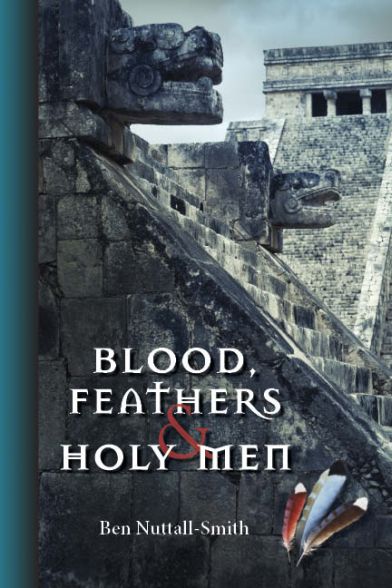
Blood, Feathers and Holy Men

excerpt

Perils of the Sea
As if the wind heeded Finten’s prayer for a quick return to Ireland, a stiff breeze
blew the tiny craft steadily southeast, along the coast of Mull. By noon, they were
in sight of Colonsay but the wind died before they came close to Islay. Now they’d
definitely not reach Kintyre before dark when the North Channel currents would be
most treacherous.
Rordan felt miserable that Finten had chosen to sit next to him as if to make sure
he said his prayers aloud with the other Brothers. Why can’t we just pray silently
on our own. I’m not up to all this chatter when we’re cramped together like this. In
chapel it’s different, I don’t have someone breathing down my neck. He tried shifting
away from the priest but Father Finten just seemed to lean in closer.
As evening approached, a chill wind whipped up waves and enclosed the craft in
clinging fog. The monks bobbed around until they lost all sense of direction. For a
few brief moments, the moon appeared through the mist and, by her position, the
seamen knew they were heading north instead of south.
Keallach exclaimed, “My God, we’re sailing in the wrong direction.” He pulled in
the sail while Laoghaire manoeuvred the side rudder to bring the currach around.
The turn took all of fifteen minutes, an eternity in the choppy sea.
The moon hid behind a black cloud as the sky darkened. Chilly sleet drifted over
the huddled crew and icy rivulets seeped down their necks. Finten crawled between
furs, shivering violently, praying his Pater Nosters and Ave Marias. Brother Ailan slid
a cover loosely over his cauldron. He had just gathered the uneaten supper from
wooden plates to be saved for a later meal and had secured the supplies in leather
bags against the mounting storm. The currach began to be walloped by waves, as she
moved up one side and down the other of each mounting swell.
The dizzying lift and drop made Finten nauseous. Soggy bread that had slipped
from its package swished about in the seawater among smelly slices of semi-preserved
whale meat and kippers. All that and the stench of the dying hermit priest
were more than Finten could stand. He grabbed the wooden bucket knowing he
was about to throw up before he could reach the side. “Out of my way.” He knocked
Rordan from his seat as he leaped up dropping the bucket. “Lord, Lord of the Seas.
Ohhh! My churning gut.”
Father Finten stumbled to the leeward and heaved his stomach contents to the
sea. Swiftly, Brother Ailan moved and grabbed his priest to save him from being
washed overboard. He led him gently back to his seat amidst the furs next to Brother
Rordan who turned his head away to avoid the sickly smell of the priest’s breath.
“Brother Rordan, for the love of Jésu, what have you in your bag to soothe this
wretched sickness?” Finten groaned.

https://www.amazon.com/dp/1926763106

The Unquiet Land

excerpt

Two doors opened off this part of the landing. One led to Caitlin’s room. The other had led to Nora’s room, but Nora was married now and had a home of her own in the village. Caitlin and Nora, night and day, his sisters in all but blood.
The priest turned sharply to the right and followed the landing alongside the stairwell to the front of the house. The old, brown wood of a large cupboard glowed in the lamplight. The door of the bedroom to the right of the cupboard stood half-open, and heavy, catarrhal breathing rasped in the dark interior.
Old Finn has feasted well and sleeps like a king, thought the tired priest. Better not disturb him.
The priest turned to the door of the bedroom to the left of the cupboard. His old room. The room in which he had lived as a boy, laboured over his books with the patient Caitlin, grew to be a man, a young, raw man, dedicated to God. Was the room the same as when he had left it? Yes, it would be. Nothing ever changed here. Tonight, or what was left of the night, he would sleep again in the old iron bed with the patchwork quilt. Nostalgic remembrance pierced the priest’s heart. The blood drained out into his belly and down into his loins. The hot blood chilled and made him shiver. The hair rose on the nape of his neck.
Seven years ago last September. Seven momentous years. Seven long strides from aspiring youth to zealous priest.
He turned the handle, and the door opened without a sound. He stepped inside, pushed the door shut behind him, and walked with silent tread across the polished wooden floor to the bed. He set the lamp down on the dresser.
“Caitlin,” he said in involuntary surprise.
She lay in a cloud of eiderdown. Gleaming even in the dark, her black hair trailed across the pillow, across the shoulder of her green-flowered nightgown. Her arm lay outside the shiny green covers. The priest leaned forward and touched the cool back of her hand. The body turned. The black cirrus stirred on the pillow.
Caitlin, the priest thought. My God, what a beautiful woman you are.
He had come unwittingly to the wrong room. Caitlin had given up her own old room and moved in here for some reason. Yet little beyond the bedclothes had changed from the way he remembered it. Caitlin had changed, though. She looked more mature and even more beautiful. Having seen her, he felt he had to talk to her.
“Caitlin,” he whispered.

https://www.amazon.com/dp/1926763203

Poodie James

excerpt

back into the bay, “we ought to try a power gurdy. I don’t know if it
would control the lines any better, but it would speed things up.”
“I don’t trust them. The hand gurdy is fine.”
“But, Dad…..”
“Peter. I said the hand gurdy will do for us.”
“Look, I’ll pay for it. If you don’t like it, it goes, and it doesn’t
cost you anything.”
“No. I said no.” The steel of stubborness was in the old man’s
voice. “That’s the end of it.”
Evenings when the boat was in port, Peter rarely had supper
with his folks. He roamed. After midnight, they heard his quiet
steps on the stairs to his room.
“You must say something to him, Ivar,” his mother said. “He’s
going to find trouble.”
“He’s a grown man, Hilda.”
Then, after a few weeks back on the boat and more suggestions,
Pete argued with Ivar about how to do the work, occasionally at first,
and after a couple of years nearly without ceasing. The change in his
son troubled Ivar Torgerson. A scowl seemed engraved on the face of
the young man. Eagerness for work transmuted into a flow of resentment
and quarreling. He swore at people who got in his way when he
walked on the dock. Ivar heard reports of Peter picking fights in bars
and tormenting drunken Indians on the waterfront in Seattle. He
heard worse too, things he would not listen to, about Peter and sailors,
about the kinds of things some sailors do. At Christy’s Tavern, he
knocked Hans Karlson flat when Karlson began to tell him what he’d
heard. Ivar never asked his son where he went on his nights out alone.
He could not bring himself to mention what he knew Karlson and the
others whispered about.
On a Sunday evening, Ivar and Hilda strolled down the hill
toward the bay, relishing the softness of the springtime air and the
quietness of the streets. They looked in store windows, admired
flower beds, ambled along the dock.
“Ivar, you’re headed toward the boat. This is Sunday. Come on,
we’re turning around right now.”

https://www.amazon.com/dp/B08W7SHCMV

Savages and Beasts

excerpt

For now, let us have our supper; come wife get the table
going,” he addressed his wife who was waiting for their word
before she put the table together.
They ate their supper in utter silence; each in their
thoughts: Anton’s mind ran to Mary and the light touch of her
body, which brought a faint smile on his face; his father’s mind
ran to the Indian Residential School and the monsters who have
managed it up to now and the church’s role in all this; Anton’s
mother’s mind ran to the peaceful retirement they might have
come time when her husband would make up his mind to put his
papers in; he wasn’t of excellent heath either and it was time for
him to take it easy, something he despised and always reminded
her that he had no hobbies, other than reading books, and retirement
could be a fast walk towards death; he had followed the
statistics which he had studied and which never lied, as he often
said to his wife, to be sure, most of his pals at work had died
within a year or two after retirement.
Silence the queen of the evening was still in control of
their house when they finished their supper; Anton’s father
took the diary and went to sit by the window. He opened it and
started reading the entries from the beginning. Anton helped
his mother with the dishes before he took his truck and drove
to Molly’s diner; he briefed Molly about Dylan’s heart attack.
Dylan’s buddy, Simon, the drunkard was there and said he was
so sorry Dylan had a heart attack and asked how serious it was;
Anton said to them it was serious enough to make the doctors
keep him there for the angiogram that was to be performed early
tomorrow. The drunkard shook his head in disbelief that all these
things were taking place and how could his buddy get out of this
calamity that struck him.

https://www.amazon.com/dp/1926763602

Jazz with Ella

excerpt

David smiled. “You know, I don’t know when Gorky wrote that, but it’s the utterly perfect story for this country in 1974. Don’t you find that so much that’s told to us is a beautiful illusion when the truth is really ‘bitter’?”
“Yeah, I know what you mean,” Paul continued. “The Soviets are like the old man—they just ignore the failures. The elevators that don’t work. The trucks that break down. The harvests that don’t yield what they expect. We visitors are like the father—we have to put a name to it, admire the beauty, then we point out that it’s not the truth. It’s no wonder they don’t really like our visits.”
“This is great philosophizing,” Maria cut in, “but I hear the truth right now.” She leaned over the railing. “I’m sure I hear a real nightingale singing.” The notes were pure and true, haunting. The group was quiet for a long time, listening, delighted.
Finally Paul got up from his deck chair. “Nah, it was just a scrubby little village lad.”

Paul Mercier returned to his cabin with the intention of diving into the definitive biography of the Sentimentalist period writer Karamzin that he had been trying to finish before the end of the trip. It had been difficult to find any study time because of their rigorous sightseeing schedule, though his conversations in Chopyk’s advanced class had been informative. That’s one thing about the guy, he is a serious scholar. He wondered if academia was truly his own calling. Did he really want to end up like Chopyk—an old lady, unloved by students and women alike? When they started out on this trip, he had found it easier to read the Sentimentalist view of nature in literature than to be out in the streets of Moscow actually viewing the real thing. But while they were in Leningrad something new had been emerging, something not found in books. He had been taking enjoyment from the scenery; it was refreshing. And he had even been moved by the rich, barbaric Russian history he saw depicted in paintings and church frescoes. For amusement, Paul had been keeping an informal list of the countless statues of Lenin they had seen to date, the endless art galleries, museums, and palaces of culture they had visited, but now he threw down these lists in disgust.

https://www.amazon.com/dp/1926763246