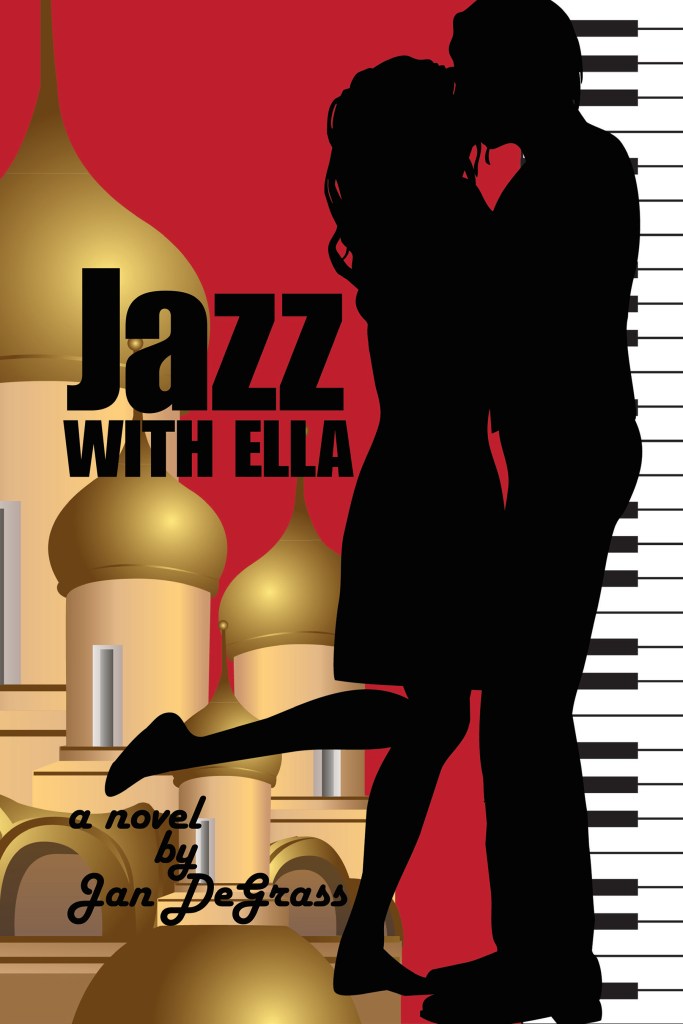
Jazz with Ella

Excerpt

Jennifer had the feeling she’d been checkmated. He had not been concerned at all about her disappearance—he only wanted to ensure she did more than her part.
“Which students?”
“David needs to develop better written skills. This is a credit course for him, and right now I can’t give him a passing grade. And then there’s Lona. Don’t know what to make of her. She wants a grade for the course, too.” His voice descended to a hush. “I really don’t consider her a serious student.” He hesitated and Jennifer remembered that she was supposed to be finding out Lona’s agenda and reporting back to Chopyk. It didn’t seem very important to her.
They had reached her room, but under no circumstances was Jennifer inviting Chopyk in. “I’ll deal with the students, Professor,” she said abruptly. “Goodnight now.”
He harrumphed by way of comment, bowed, and left her. By the time her head hit the pillow she had already forgotten how irritating he was.
She dreamed a familiar dream. She was hovering over a lake or a pond—sometimes she was in the lake—but this time she floated above it. Her fingernails had unaccountably grown extra long like those of a Chinese mandarin, and she clawed the water searching for the face that she knew would be there. The eyes that stared up at her from among the water weeds were usually familiar eyes—her little brother—and she must save him. She alone could save him. But her outsize talons snarled in the weeds and she could not scoop up the boy. Water trickled through her fingers. And when she gazed into his eyes—now she was closer, inches above the water—she saw not her brother at all, only the blue grey eyes of the attractive stranger, sinking fast.
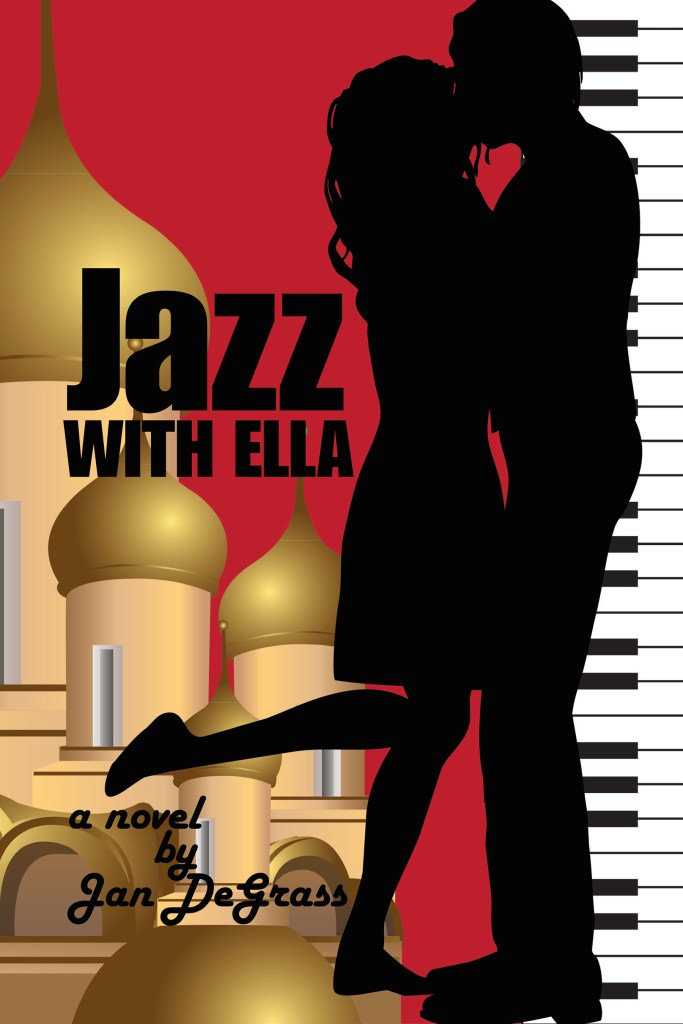
https://www.amazon.com/dp/1926763246

Jazz with Ella

Excerpt

She stopped at the Blue Bridge, paced on past the Marinsky Palace built for the Grand Duchess Marie, and caught a glimpse of what must surely be ballerinas arriving in a chauffeur- driven car at the Kirov Theatre, their graceful arms laden with costumes and carryall bags. She would attend the ballet. It would be glorious—probably Swan Lake or Giselle.
Suddenly she felt a jolt of pain, a sensation that she recognized as missing Michael. Missing him lots. Was it just missing someone to share the experience with her? Well, she would have that experience with David or Paul. That was okay. Heck, Michael didn’t even like the ballet. Yet she couldn’t help but remember one of the last times they had enjoyed each other’s company. Was it last February, March? It seemed like a million years ago. They had walked to a movie together, through an uncharacteristic sprinkle of snow over Vancouver’s Point Grey, each of them preoccupied. The sadness and distance that enveloped them had lasted all the way to the show, but once they entered, bought popcorn and seated themselves in the sticky seats, they both relaxed. It was a funny film, and he held her hand in the dark. Later, they returned to their married students’ apartment talking together with more animation about the movie, about her essay, about his thesis supervisor.
“What went wrong?” she finally asked him, knowing he would understand that she wasn’t talking about his recent lab experiment. Also knowing that he wouldn’t be able to answer. He would only shrug. In fact, it seemed that her life was very full of loved ones who wouldn’t talk to her. Still, those moments of communication: the laughter in the cinema, the caress on her hand, the discussion about her essay—they were all good. They were shared.
Jennifer continued to stride briskly, restlessly, until she had executed a broad loop which eventually brought her back to the River Moika, one of the many canals that fragmented the city into an island network.
Here, the houses hung over the water, their upper windows nearly touching the shade trees. A graceful wrought-iron bridge, the width of a footpath, led across the Moika into a neighbourhood of worn tenements. She approached it confidently.

https://www.amazon.com/dp/1926763246

Jazz with Ella

Excerpt

If he pushed his face right into the window, he could just see the edge of the canal where Gennadi often waited for him to begin their sociable walk to work together. Gennadi was younger than Volodya, 22 years old to Volodya’s 31, and his taste in music was abominable, Vlad thought, but still, he was a friendly, loyal fellow and Volodya really needed support this morning.
Their job was a dull one, though it required a certain amount of mechanical aptitude. The firm they worked for serviced automatic machines: the water vending machines located on every street corner and several other types that sold carbonated fruit juices. They replenished them, cleaned them, oiled them and fixed them when they broke down, which happened frequently. It was not the profession he would have chosen, nor why he had received such a comprehensive university education at the state’s expense. In fact, he loathed it. But he was thankful it was not an office job. At least this way, he moved around the city regularly, and it was easy to take an hour here and there for a break or to practice his music. As a job it moved along like a square wheel, and this is what had sparked his current problem with his commissar, a petty, stupid man with bad teeth, who would have him disciplined for breathing. Volodya cursed a little but not too loudly.Each day, he would arrive at work more or less on time, though his punctuality was always subject to the taunts of the administrative clerk, Ivana the Terrible as they called her, she who stamped their work orders and doled out their pitiful tools. After the morning check-in with officialdom, they were on their own. Sometimes he and Gennadi went out on foot together, sometimes they caught a lift to their destination in the service vehicle. That was why he suffered this miserable job. It was in that time, away from official eyes, that Volodya could indulge his passion for jazz music by visiting a musician friend who allowed him to use his piano.
He had always been good at finding a piano when he needed one. He had been raised in Leningrad just after the war by his mother and his aunt, and the two women had denied him nothing. In a time of excruciating hardship, they made sure he had his share of toys, candy, as nutritious food as was available, and his own little bed in their tiny, grim apartment. They discerned that he was a musical child at an early age when he would drum and tap on the tabletop, his bed, anything that would make a percussive noise with interesting rhythms. They bought him a toy drum which he adored, though it nearly drove

https://www.amazon.com/dp/1926763246

Jazz with Ella

Excerpt

The day’s itinerary included lessons, a visit to the Kremlin and Lenin’s tomb, followed by a trip to the Lenin Museum. Evening was reserved for the ballet.
“I’m thrilled about the Kremlin,” whispered Paul, “but frankly I don’t want to see the Lenin Museum.”
“It’s early days yet,” Jennifer whispered back. “Don’t start an international incident.” She speared a wedge of sausage that sat in a grease slick beside a rubbery poached egg. “The bus is leaving at 9. Let’s eat this delightful repast and get going.”

Yawning and groaning, the group boarded the bus under Natasha’s watchful eye, then waited while Paul was dispatched to round up the twins who had already found the hotel’s souvenir shop. “Just ask if they’ve seen two copies of Liza Minnelli wandering about,” Hank called after him. The twins certainly resembled the movie star although with an extra twenty pounds of weight per twin.
They waited again while Professor Chopyk delivered a brief but pompous speech of welcome. Aaargh! Why does he do things like that? Jennifer thought. It’s so irritating.
The bus took them across Red Square and parked two minutes later at one of the Kremlin gates.
“That was hardly worth the ride,” grumbled Marty.
“Arriving by bus marks us as foreign visitors,” said David, who was laden with camera equipment, “and we get privileged treatment on the tours.” It was true. Natasha marched them behind the Kremlin walls, past the many line-ups, ignoring the passive stares of the crowds, and ushered them into each historic location. They visited the quiet, simple Church of the Assumption, examined the Tsar’s Bell that had never been rung and the Tsar’s Cannon that had never been fired, and they gazed across a closely guarded, cobblestoned courtyard at the imposing edifice of the Supreme Soviet.
The Kremlin’s armoury museum was not a house of weapons as Jennifer had expected. Instead, it was a dazzling display of fine crafts, jewellery, ornate costumes, royal regalia and richly decorated carriages.

https://www.amazon.com/dp/1926763246

Jazz with Ella

Excerpt

Jennifer suddenly realized she was the hostess. “Listen, let me order some drinks or coffee. Tell me about yourselves. Do you live here in Moscow?” She moved to the phone then realized that room service might be a foreign concept in the Soviet Union.
“No need,” said Misha, pulling two tall bottles of fizzy water from his satchel. “We cannot stay very long and we have brought some drinks. May I pour?”
“Yes, please.” She picked up the two cups that sat beside a metal teapot on a corner table, and Misha poured and passed the drinks to his wife and Jennifer. He took a swig from the bottle.
“We live in Tula,” Marta said. “It’s about 60 miles south of Moscow. You know about it?” Jennifer shook her head. “The traditional samovar town—we make the finest samovars for all of the Soviet Union there. It’s also close to Tolstoy’s estate, Yasnaya Polyana. You are a language student, correct? Surely you will be visiting the home of such a great author?”
Misha cut in, “You must come to visit us. Tula is 100 kilometers east of the village where my father and your mother were born.”
“Yes, I’d like that,” Jennifer replied. She had so many questions. “When my mother got to England and met my father it was the start of a whole new life. She wouldn’t have known that her brother was still alive. Did he go back to the village after the war?”
“Only to find everyone gone: father and mother dead, sisters missing,” Misha replied. He fell quiet for a few seconds. “He said it was the saddest moment of his life.”
Misha continued to describe their family background, Marta chipping in occasionally and smiling fondly at Jennifer. Even little Nadya left her magazine and put her arms around Jennifer’s neck, calling her “auntie.”
I could grow quite fond of these people, Jennifer thought.
“We have applied to leave the country,” Misha told her. “As you know, Jews are allowed to leave—some of them. We will go to Israel.” He looked about uncomfortably. “But perhaps it’s best not to speak of these things here.” He nodded at the wall indicating a grating with a tilt of his head. Of course, microphones. They had been told that the hidden spying devices were in all the hotels that catered to foreign tourists.

https://www.amazon.com/dp/1926763246

Jazz with Ella

Excerpt

Natasha’s face broke into a smile as she followed the unruly man’s path. Her eyes pierced Jennifer. “Welcome to Moscow. Here is one of our efficient Soviet comrades at your service.”
Irony or not? Jennifer wasn’t quite sure. This woman would be the group’s constant companion for the whole three weeks. Jennifer suddenly found herself a little shy. What should she say to her?
“Did you have a pleasant flight?” Natasha asked in faintly accented English, one eyebrow rising and falling in interrogation.
“No, actually the last stretch was rough! We flew through a storm.”
The eyebrow went up again and Natasha frowned. “Statistically, you were safe,” she said. “Only safe landings have been recorded at this airport for the past 15 years.”
Jennifer stifled the urge to ask about the unrecorded flights, and she and Natasha stood in silence until the others began to trickle through the gate.

The highway into Moscow was wide with very few cars, some antiquated buses that belched black soot and many putty-coloured military vehicles, each displaying a stencilled number. Massive concrete bus shelters lined the curb, their panels dwarfing the few pedestrians. There were no houses. On the outskirts of town a sea of apartment buildings loomed, blocks of boxy housing, surrounded by paving stones between which weeds sprouted. Above, clotheslines were strung across the many balconies. At street level, the store windows displayed no colourful signs, no advertising, and not many goods behind the glass panels. Over each storefront was written a single word describing the store’s contents: Footwear, Produce, Dairy. As their bus left the suburbs and entered the city, they saw their first statue on a street corner. Almost two storeys high, it could easily be identified as Vladimir Ilyich Lenin by the pointed beard and round, smooth head.
“King Fred,” giggled Len Whalen, one of the undergrads. Natasha’s gaze soon silenced him.
Several of the group brought out their cameras, but Natasha called out, “No photos yet, please. Save your film for Red Square, coming up on your right.” The famous square flashed past in a blur—the Kremlin walls, the mausoleum, the striped onion domes of St. Basil’s Cathedral.

https://www.amazon.com/dp/1926763246