
Wellspring of Love

excerpt

“Oh yeah, Grandma Milligan rang. Said she’ll call you later.” She
swung around to face Tyne. “Is there any mail? Anything from Pa?”
“No, I’m afraid not, honey.”
Rachael shrugged. “Yeah well, I guess he’s more interested in his
new family now.”
Tyne walked over to the girl and put her arm around her. “Oh
Rachael, I’m sure that’s not the case. He’s likely busy getting them
settled, as well as going to work every day in the railway yard.”
“I know, Mom, but he used to write at least every two weeks before
he married that woman and took her kids on as well.”
Tyne frowned and withdrew her arm, but kept her voice gentle.
“Rachael, Margaret has a name. Please don’t refer to her as that
woman. She seemed very nice when we met her, and I’m sure she’s
going to make your pa happy. Don’t begrudge him that.”
Rachael sighed. “Okay, I’m sorry.” She hesitated, then blurted,
“Mom, can I go to Lyssa’s tonight after supper? She said she’ll come
pick me up.”
Tyne’s eyebrows drew together. “You were there just two nights
ago, honey. Is there something special planned for tonight?”
Rachael shrugged. “Naw, just hanging and listening to records, I
guess. Please, Mom. It’s Saturday night. Lark’ll be there, too.”
“What about your Aunt Ruby? Will she be at home?”
Rachael hesitated. “I … don’t know … that is, I don’t think so. So
Lyssa says we can have the house to ourselves and play the record
player as loud as we like.”
Tyne took a deep breath. Should she give Rachael permission to
go to the Harrisons’ when there were no adults at home? Although
Lyssa considered herself an adult, Tyne would be far happier giving
Rachael permission to spend an evening with fifteen-year-old Lark
than with the precocious eighteen-year-old sister.
“Mom?”
“We’ll ask your dad when he comes in from the barn. If he says it’s
okay, then you can go. But I want you home by half past ten.

https://draft2digital.com/book/3562917

https://www.amazon.com/dp/1926763327

Swamped

excerpt

the process. Then she went to the bathroom and emerged a moment
later looking professional and businesslike again. She sat down next
to him and talked business as if nothing but business had ever happened
between them. Eteo listened carefully and agreed on what
needed to be done for his new company, now registered under the
name Alexa Ventures. While Rebecca talked business, Eteo played
with her combed-up hair and neck and ears to the point of giving
her goosebumps, and Rebecca loved every moment of this but without
giving any hint of her awakening desire.
But when she had finished talking business, she let him undress
her to nothing and let him place her on top of him and ask her to
make him feel as wild as he had felt earlier, and Rebecca did her best
and rode his firmness deep inside her and like an amazon gave him
the utmost sexual pleasure once again. They both went to heaven and
back numerous times until they couldn’t have anymore, and then
rested in each other’s arms until the time came for Eteo to drive to
North Vancouver and Rebecca to her husband and child in Kitsilano.
Over the next few days Eteo’s work kept him busier than ever.
Golden Veins was getting a lot of attention, and its price had risen
into the fifties. This enabled Eteo to unload some of his clients’ stock
and use the funds to buy shares in Wheaton for them. Platinum Properties
was also doing very well, trading at a dollar and a half now and
with good volumes every day. John from the trading desk had gone
in and out of it a number of times as the stock moved upward, and
Eteo had sold many of the shares he held, getting good profits for his
personal accounts and his clients. Even Helena made a few dollars
on Platinum Properties. This delighted her, since as a conservative
girl she usually stayed away from risky penny stocks, except of course
when Eteo advised her to take the plunge.
One morning Eteo asked Mitch to meet him, and within half an
hour, he entered Eteo’s office, wondering what this was all about. He
didn’t have to wonder for long.
“Have a seat, Mitch,” Eteo said without any preamble. “I had a
meeting with Rebecca Horton. She has put the wheels in motion for
a new company incorporated for me with the name Alexa. You’ll
serve on the board of directors along with Peter, the engineer…

https://draft2digital.com/book/3562976

https://www.amazon.com/dp/B08WP3LMPX

Small Change

excerpt

The Best of Friends
ALL I KNEW ABOUT ETERNITY in those days came to me through the agency of its little cousin, boredom. It was Friday and it was spring. The big windows on the left side of our second floor classroom had been lifted as far as the old paint in their grooves would allow. All afternoon, an intermittent breeze came through the protective metal grill carrying coal gas and bus fumes and the oddly fishy odour of soap from the Colgate factory down by the river. It wasn’t much, but it was news from the world and I sniffed it with a perverse pleasure.
We weren’t allowed to look outside, but as often as I could I snuck a peek at the vacant lot with its bottle chips, rusty concrete, patches of crabgrass, and minute particles of coal that lay in thin drifts where the wind had blown them from the smoke of locomotives that passed all day on the elevated tracks across the street, beyond the wooden fence of the Delaware-Lackawanna coal yard.
Sister Violeta, with her lugubrious monotone and her black visions of life before death, seemed connected somehow to the nearly purple hills (piles, really) of pea coal, which I had a privileged view of at this height. They looked like black sand blown up into dunes in the desert landscape of an alien planet. I used to imagine she had been hatched there.
Father Brackendorf, who came every Friday to teach us religion, was fond of looking out toward the coal yard and explaining that our souls were like the snow before a train went by. Once we were born, the soot came down. Scrubbing did no good. You had to let confession melt the snow, and let the sin fall to the bottom. (The bottom of what, I wondered). Then a blast of grace would freeze it white again. This is what he was saying now. It made me feel empty and restless. The clock above his head, round and white and edged with black, was soft-clicking back and hard-clicking forward, minute by minute. And then the minute hand hit twelve and it was three o’clock, and we were free.
But there was this debt I owed to Danny Amoroso.
He was three or four years older than we were, but he was slow. And he seemed to enjoy it. Being slow, I mean. He was a titan among …

https://www.amazon.com/dp/1926763157

Fury of the Wind

excerpt

which Will had taken up his position at the desk. Only the monotonous
tick of the pendulum clock on the waiting room wall, and the
occasional tap tap of telegraph keys disturbed the quiet. And once
in a while Will Andrews cleared his throat.
Try as he would Will could not keep his eyes off her. His curiosity
grew with the minutes but he did not think it his place to ask
who she was waiting for. He just wished the tardy individual would
hurry up and get there. He didn’t think he should leave the young
woman alone to go to his quarters, although his feet now screamed
to be released from his boots, and his throat felt parched just thinking
about Molly’s lemonade.
He pulled his watch from the fob pocket of his trousers. Half past
four. Half an hour since the train had passed through town, and its
passenger – who had expected to be met – still waited.
A faint sound startled him and he looked up to see the woman
crossing the room towards the wicket. She appeared cool and composed
but Will could see the lines down her cheeks where rivulets
of sweat had streaked her face powder.
“Excuse me, Mr. ah ….”
“Andrews.”
“Mr. Andrews, I wonder if you could tell me if the train was early
today.”
“Nope, right on time as usual.”
“Oh … I see … thank you.” She bit her lower lip and turned away
but suddenly she swung around to face him again.
“Mr. Andrews, would you mind placing a telephone call for me,
please? It would be a local call.”
“Sure. Who to?”
“Fielding. Mr. Benjamin Fielding.”
Will’s mouth dropped open. “Ben Fielding?”
She brightened. “Yes. Do you know him?”
“Ben Fielding ain’t got a phone.”
“Oh.” She said it so quietly he scarcely heard her. Her lips trembled,
and the hand resting on the counter, still gloved, began to
shake just a little.
Again she turned to go but she stopped when he said, “Can I get
my missus to bring you a glass of lemonade? I was just going in for
some.”

https://www.amazon.com/dp/0981073530

The Qliphoth

excerpt

Nicholas:
Special Withdrawal Unit
I have to get it all down. For the record, the Akashic Record of the Aeons, naturally.
Wherein all our phantasms are inscribed, squiggles of amoebic neon in
the starry darkness, every damned thing we’ve done radiating across eternity
like an old broadcast of Journey into Space on its way to the Pleiades.
And I have to set the angelic record quite straight. Writing very carefully.
Not my usual psychedelic scribble—letterforms in doodles of wild purple,
loopy loan-words on the run—but disciplined blocks of sensible words,
arranged thus, line after neat line in my black-and-red Notebook, made in
Taiwan but purchased for me at the hospital shop right here at Oakhill, sunniest
hotbed of sanity in all Devon, as Doctor Jago says, whenever he tries to jolly
us along.
It’s very civilised, “. . . considering, after all, Mr. Beardsley, it is a locked-up
ward, yes?” He allows me the privilege of unlocking my old word-hoard in its
frumpy box of smelly brocade, my little shop of curious relics. I’m permitted
this verb therapy, joining up my grown-up writing. Better this, certainly, than
farting in the day-room all day, like old Beddowes, or wandering about strumming
a cardboard cut-out guitar, which is the preferred pose of Rog, or Rod,
or Rob, or Ron—I haven’t yet made out his name, because our mass dosage of
Largactil makes everybody’s speech slurred.
In fairness to Beddowes, such drugs doth make great farters of us all, our
sulphurous bursts of bad air permeate the lower heavens . . . Perhaps it’s really
Beddowes’ high boredom quotient that’s against him. His preferred interpretation
of reality is that he’s Headmaster of a large inner-city comprehensive
school, that our day-room is his staff-room, and that we, fellow-clients of the
Special Withdrawal Unit, are his backsliding, incompetent staff.
“You’ve no control,” he wags a warning finger several times a day, “no control
at all of your juvenile criminal elementals. Young people committing
problems of evil, terrible state of things in the toilets, boys with knives, and
tinsel in their hair, hair everywhere . . . Look what you have permitted at the
end of the day, you with all your beards and long hair . . .” With me he always
permutates the same set phrases, beards and all. Even the stuffy acoustic of the
day-room can’t take the edge off his abrasive burr, but it goes nicely with his
jowly blue-shaven red face and bald scalp with plastered licks of thin hair.
He likes to grab some old copy of Plain Truth Magazine, and he rolls it up to …

https://draft2digital.com/book/3562839

https://www.amazon.com/dp/0978186508

Water in the Wilderness

excerpt

“They’re missing, Tyne. They’ve run away. Ruby and Bill thought they might be here.”
She fell into the chair by the desk. “Dear Mother of God, no,” she blurted. “Where … how long?”
“They were gone this morning when the family got up. I don’t know what time that was, but the kids must have left in the dark. At least there’s one piece of good news … the eldest boy, Ronald, is probably with them.”
Tyne’s relief was short-lived when she realized the boy was probably not yet twelve years old. And the weather … oh, dear God in heaven, no. Even strong, adult men had been known to lose their way from barn to house in a blizzard.
“Morley, the weather … how bad is it?” She choked on a sob. “It looks like a blizzard from here.”
“Tyne… honey, try not to upset yourself. I know it looks bad, but they’re probably with a neighbor, or someone who saw them and took them in. Ronald’s old enough to know to go for help when the weather turned bad.”
“I know, Morley.” She drew in a calming breath. “Please, take care of yourself. I wish I could be there to help you at the barn, and make your dinner.”
“I’ll be fine. And listen, Tyne, I don’t want you to leave the hospital. Please tell me you’ll stay there. There must be somewhere you can sleep.”
Tyne stifled a sob. She didn’t want Morley to know how scared she felt – scared for the children and scared for him alone on the farm with animals to look after. She gave herself a mental shake and set her mind to gain control of her emotions.
“Tyne, the first thing I’d like you to do is call your parents and Aunt Millie to tell them about the kids. Ask them to alert people in their area. Oh wait, is there any possibility they could have gone to your mom’s? You’ve taken them there a few times. Maybe Rachael remembered the way.”
“No, I don’t think so. If they had gone there, Mom would have called either you or me.”
“Yeah, I suppose.” He sounded deflated.

https://draft2digital.com/book/3562884

https://www.amazon.com/dp/192676319X

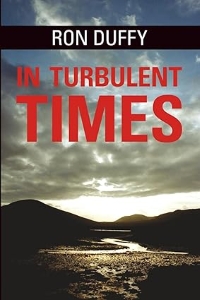
In Turbulent Times

excerpt

‘And to an English girl,’ Caitlin added.
‘Oh it happens to the best people,’ Joe said.
‘You haven’t set your sailor’s sights on one of them flighty little Maltese chickens yet, have you, Joe?’ Michael asked with a wink.
‘What would Joe want with a Maltese chicken, Michael Carrick?’ Caitlin said.
‘Well, with Stephen bringing home an English wife, and Tom maybe landing himself a pretty, young girl from north Africa, if Joe brings one from Malta or Gibraltar or wherever, we could set up a minor League of Nations here in the village. Solve all the world’s problems.’
‘Cause more problems than solve more likely,’ said Caitlin. Then she lowered her knitting to her lap. ‘Joe, would you like a wee cup of tea? The kettle’s boiling.’
‘I would if you’re having a drop yourself. Thank you.’
‘Oh I dare say I could make room for another. Michael, reach me your mug. It’s down there by the fender.’
‘Is Nora not at home tonight, Mrs Carrick?’
Caitlin stopped on her way across the kitchen. She turned slowly to face Joe and cast a glance at Michael. Joe felt a sudden fear. He too looked at Michael, then back at Caitlin. For a moment no one spoke.
‘Nora?’ Caitlin said softly.
‘There’s nothing wrong, is there?’ Joe blurted out.
‘Joe, didn’t you get her letter?’ Caitlin asked apprehensively.
‘The last letter I got was written a couple of months ago. The post is very uncertain. Tell me, is she all right? Why have you got that look on your face? Both of you. What’s happened?’
‘Joe,’ Michael said, ‘Nora’s married.’
‘Nora’s married? No, she can’t be. It’s not true. My mother would have told me.’ Panic wailed like a siren in Joe’s voice. ‘Say it isn’t true, Mrs Carrick.’
Before Caitlin could say, ‘Yes, Joe, I’m afraid it is,’ Joe was sobbing, his head turned away. He did not even hear Caitlin’s confirmation.
Michael rose and put an arm around the young man’s shoulder. ‘Joe, I’m very, very sorry. We both thought you knew.’
‘She wrote to you, Joe,’ Caitlin said. ‘I know she did. And it nearly broke her heart. For the life of me I couldn’t understand it.’
Joe turned to face Michael and Caitlin again. ‘I’m sorry for breaking down like that. But what a shock. My God, I was going to propose to her myself before I left again this time.’

https://draft2digital.com/book/3562904

https://draft2digital.com/book/3562904

The Qliphoth

excerpt

A grainy monochrome archive snapshot: Nick, in tiny heptagonal smoked
glasses, poses proudly under a giant pop art sign. Pauline, his smiling fellow-
conspirator, is putting up a poster inside the sunlit shop window. Lucas
suddenly feels wildly protective towards these funny silly people—and simultaneously
enraged. All that rich energy. How could they blow it? What went
wrong?
Outside there’s a distant rumble. The picture wobbles for an instant, as if
there’s a glitch in the power supply, the sudden gust of breeze smells oddly
saline—Abbotsburton is miles from the coast—but Lucas mustn’t lose anything,
even the pontifications of the commentary.
“. . . less than a decade later was permanently hospitalised. How did Pauline’s
nightmare begin?”
His mother’s face fills the screen, against a background of bookshelves.
She’s backlit, face in shadow, but he can discern her sharp nose, firm lips, large
anxious eyes. Her chin was more cleary defined then. And she’s wearing one of
those red t-shirts with a message. She’s staring through the screen, waiting for
the right words to form. Lucas can confirm now that he was, indeed, almost
there himself, off-camera, in his little bedroom at the end of the corridor,
Uncle Larry minding him, and special new cars and trains to play with.
This has always been puzzle corner, this dazzling fragment of memory.
How old was he? He’d blundered into the beginning of the shoot, had flinched
from the heat of the lights, had walked right into the anxious squint of the
cameraman, until women with smooth voices and clipboards had steered him
back, promising sweeties, better than grown-ups’ boring chat.
No sweeties for him now. He pauses the tape for a second, kneels with his
face only inches from the curve of the screen. He has to go through with this
ritual, there’s no going back . . .
Playback. Yes, that’s her voice, bright, edgy, slightly nasal, like a soprano
sax, solo: “It’s hard to pin-point the beginning of the end . . . Nick had always
been a little obsessive, a bit impulsive, his moods swung on a big pendulum, as
it were. You had to anticipate the motion. Either I was a fairy princess or a hag
fit to die in a garbage bin. In the first few years I was mostly the do-good fairy
on the Christmas tree, as long as I stayed in the confines of that role it was
fine . . . And believe it or not, I think I wanted to please . . .”
She’s almost managing a bitter smile, as the take fades. This nuance matters
to Lucas but the presenter, off-screen, brisk as a toothpaste advert, has left the
rest of it on a cutting-room floor and sticks to the rhetoric of his script.
“Did Pauline recognise those all-important early warning signs of mental
disorder?”
Pauline leans forward into the camera. It’s confession time.

https://www.amazon.com/dp/0978186508

Ken Kirkby – Warrior Painter

excerpt

Warriors Come in Many Shapes
“We all grow up with the weight of history on us.
Our ancestors dwell in the attics of our brains as they
do in the spiraling chains of knowledge hidden in every cell of our bodies.”
(Shirley Abbott, Writer)
~~
Ken Kirkby inherited genes from a thousand years of determined and
intelligent men and the clever women who worked beside them. In each
generation, the face of the world inhabited by his ancestors was left
improved. If he feels some pressure to leave his own imprint on his world,
he chooses to do so by inspiring others as he has been inspired; by restoring
what has been spoiled and by righting what is wrong. Justice is an important
word in his vocabulary.
His father, Ken Kirkby, Sr. turned his back on both a fortune and his
influential British steel family as a young man. He left his assured place
in Britain to make a successful life in Australia and eventually returned to
England with a reputation for a sound ability to turn failing companies into
profitable ventures. With World War II on the horizon, he was seconded by
Winston Churchill’s team to transform the venerable but struggling Rover
Motor Company into an efficient, profit-making war machine.
In 1938, he met and married Ken’s mother, Louise May Chesney. Her
father was a respected Spanish industrialist whose family traced their roots
back to Rurik of the Rus, a Dane whose history was recorded in written
form in 746 AD. Ken was born in 1940 and his sister three years later. The
Kirkby and Chesney families left recession strapped Britain for Spain in
1946 and the Kirkby family ultimately settled in the Portuguese village of
Parede, a coastal village south of Lisbon. Their neighbours were diplomats
or professional elite, but Ken’s father preferred to do his own gardening and
knew the children of all his employees by their first names.
Ken’s childhood was unorthodox by any measure. Their family home
on the Avenue of Princes welcomed many of the brightest minds of the
European world at the time, but he ran barefoot with the Gypsy kids, bartered
his drawings in the marketplace and escaped his mother’s restrictions

https://draft2digital.com/book/3562902

https://www.amazon.com/dp/B00CB8W4CG

In the Quiet After Slaughter

excerpt

But their censure didn’t weaken her resolve. She savoured my
father’s embarrassment — and cursed his having been conceived
every step of the way home.
He drank with old navy buddies at one of the Canadian Legion
branches and foolishly denied doing so. He attempted to disguise
the alcohol on his breath with Halls Cough Drops. Tobacco fumes
clung to his clothes like an invisible lint. Sometimes my mother
alleged the scent of woman.
On occasion, it was true, my father would take off for a few days
—to where, no one knows. Going absent without leave guaranteed
an intensified resumption of their conflict at some future date. The
air in our house crackled in anticipation of the rematch.
Once, to regain entry, he claimed to have gone angling with
friends.Mymother circled him warily, a dog sniffing a fire hydrant.
– Lying bastard!
Punishment often entailed his eviction from their bedroom. Banishment
could stretch from three days to three months, depending.
He appeared relieved to be sentenced to an air mattress on the living-
room floor. Because mybrother Burt and I often took myfather’s
side, it was self-serve in the kitchen until a truce was reached. Our
body weights fluctuated accordingly.
I viewed my father’s carousing like this: he was born during the
First World War and orphaned in the Depression. He spent the best
part of his 20s fighting the Second World War. I reckoned the occasional
disappearance was his way of making up for lost time.
People sometimes remarked that my parents seemed to have little
in common. This may have been the case. But there had to be a reason
they were able to cohabit for as long as they did. I think they
were joined together, as many unions are, by the sum of their unfulfilled
expectations, and because as the years passed, options
decreased and habits fossilized.
My parents, you see, were either in love or at war. Rancour
seemed an aphrodisiac. There was no Switzerland, no neutral
ground. It was the one thing they seemed to agree on: the enemy of
love is indifference.
My mother, in anticipation of their evening fete, had passed the afternoon
tethered to the dresser. Her features had been transformed by …

https://draft2digital.com/book/3562874

https://www.amazon.com/dp/B00731WSPE