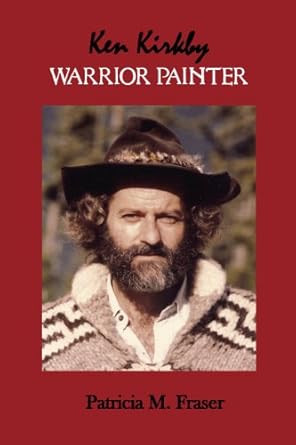

Ken Kirkby

excerpt

It was years later that I actually saw the book itself. I felt such
specialness to share this history with my grandfather who was a giant
of a man, loved by many and respected by all.
According to the National Geographic magazine, (Vol. 167, No. 3,
March 1985) Dr. Robert Paul Jordan confirms that the Viking traders known
as the Rus created Russia’s “first organized state and gave their name to a
future empire.” And the story that Ken learned as a wide-eyed boy seems to
support that claim.
As his maternal grandfather told the story, and as Ken passed it on to
his own son—who, at this point, is the last of the Kirkby line—the tale of
Rurik of the Rus goes like this:
Rurik was the eldest son and he chose to become a sailor, an adventurer
and an explorer. Like the Norwegians, the Danes were Vikings—an Old
Danish word which means ‘to dip your oar’ or in our terms, ‘traveller’.
Norwegians became known as the Norse, and Danes, the Rus.
Occupants of the Scandinavian countries realised early that to split the
farms into small holdings for their sons would make the land useless. So,
in order to preserve that livelihood, only one would inherit the land and
the others had to make their fortune elsewhere. The sea was the obvious
alternative. Through dint of need, the majority of them became mariners
and shipbuilders. They were a strong and courageous people and became
the Masters of the Seas as traders and mercenaries. The majority were
literate and highly industrious.
Those who became mercenary soldiers, a reputable occupation of the
day, were known also for their ferocity. They returned from the Middle East
with the knowledge of metalworking and equipped with this expertise, they
produced exceptionally fine swords and weaponry. This proved to be a great
advantage. A fierce minority banded together to form raiding parties and
this resulted in the Viking reputation for rape, slaughter and pillage.
Much like the dream of the Arctic that drew his future and distant
relation to northern Canada, Rurik also had a powerful dream of a vast
land beyond the ice; a land shaped by three great rivers. He was determined
to sail to that land one day. Rurik was an able navigator and commander
of several ships, and eventually he and his fellow mariners set out on a
long and arduous journey that took them east and north through the Arctic

https://draft2digital.com/book/3562902

https://www.amazon.com/dp/B00CB8W4CG

Swamped

excerpt

money we have should be placed on that … just for now though. Recommend
it to whoever you think can wait a year or so to get results.
Frankie is a patient man, but he does things right. Remember that.”
“I’ll work on that, Dad” Logan said, getting up and going back
to his desk.
As soon as his son left the office, Eteo’s phone rang. Richard
Walden was on the line and sounded excited, talking of an oil deal
he was planning to get involved in. It was a prime southern Texas location,
and a deep well with indications of plenty of reserves.
“Come over and bring what you have on it,” Eteo suggested.
Richard had not had much success with oil up to now, but Eteo was
always ready to listen if a deal sounded promising.
Half an hour later Richard walked in with a map and a letter of
intent he had already signed. Eteo glanced at the letter and saw that
Richard had agreed to contribute 20 percent of the drilling expenses
to earn ten per cent participation in one deep well.
“This all looks good, as far as I can see,” he said. “Ten percent is
a respectable piece of the well, if it’s a good one.”
“They’ve been very successful with other wells in the same area”
Richard pointed out.
“So far so good then. Just a couple of words for caution’s sake
though. Make sure before you sign the final agreement that they have
enough other participants signed up. You don’t want them using your
paper to sell the rest of the well. Second, find out who their operator
is in Texas and what he has been involved with over the last, say, five
years. I’ve come across horror stories about some of the operators
down there.”
“Don’t worry, Eteo. It’ll all be fine. I’m flying to Calgary this
weekend and meeting the brokers again on Monday morning. I expect
lots of buy-in soon.”
“That’s great, then” Eteo said, raising his coffee mug to toast the
prospect. Richard marched out with his map and a broad smile on
his face.
Eteo chuckled to himself at Richard’s optimism. He wasn’t quite
as sanguine, but he hoped the promoter would return from Calgary
with some good news. Then he turned his attention to Golden Veins.

https://draft2digital.com/book/3562976

https://www.amazon.com/dp/B08WP3LMPX

In Turbulent Times

excerpt

Petty Officer Joseph Ignatius Carney sat in an empty compartment, staring out sadly at the green and yellow countryside of England. The train chugged through it noisily and slowly. It looked so peaceful. Who could have believed that the country was at war, that it had just been fighting for its very survival like a fish on a hook? Now the worst was over and the battle for Britain won. But the battle for Europe was not going well. The German army had pushed into Yugoslavia and Greece. Yugoslavia had surrendered, and the future for Greece looked grim.
Here in England all of that was a world away. Cows lazily grazed the fresh spring grass. New-born lambs on new-found, nimble legs scampered after shaggy ewes. The first crops were growing in the ploughed fields, and women, girls, young boys, and old men joined farmers in waging their own war against the invidious invasion of weeds. In the few orchards that the train chugged by, the apple and the cherry trees were dressed in blossom like lovely, young spring brides. The April sun was warm, and the faces that turned to watch the train pass noisily by were tanned already. So few were young men’s faces. Many were the so-called Land Girls, thousands of them, recruited from the city to boost farm production to thwart the German blockade of imports brought to the country by sea. Barmaids, waitresses, maids, hairdressers and others working in urban female occupations proved themselves tougher in the fields than the sceptical farmers had imagined. They worked fifty hours a week in summer, forty-eight in winter, ploughing fields, driving tractors, making hay. They undertook the full rigours of harvesting, threshing, and thatching. They also reclaimed land, worked in orchards and market gardens, and though they had to steel themselves to do it, they caught rats as well. As for the men, most of England’s farming labourers were far from their fields and pastures. In other fields their tired, tense faces, rank on rank, were shaded only by their gun-barrels. They were strained and stressed and drained of colour. Or smashed to gory pulp. Or still, limestone grey, like the faces in church effigies, turned towards the blue sky, their eyes closed in the unsought peace of death.

https://draft2digital.com/book/3562904

https://www.amazon.com/dp/1926763270

Ken Kirkby – Warrior Painter

excerpt

Warriors Come in Many Shapes
“We all grow up with the weight of history on us.
Our ancestors dwell in the attics of our brains as they
do in the spiraling chains of knowledge hidden in every cell of our bodies.”
(Shirley Abbott, Writer)
~~
Ken Kirkby inherited genes from a thousand years of determined and
intelligent men and the clever women who worked beside them. In each
generation, the face of the world inhabited by his ancestors was left
improved. If he feels some pressure to leave his own imprint on his world,
he chooses to do so by inspiring others as he has been inspired; by restoring
what has been spoiled and by righting what is wrong. Justice is an important
word in his vocabulary.
His father, Ken Kirkby, Sr. turned his back on both a fortune and his
influential British steel family as a young man. He left his assured place
in Britain to make a successful life in Australia and eventually returned to
England with a reputation for a sound ability to turn failing companies into
profitable ventures. With World War II on the horizon, he was seconded by
Winston Churchill’s team to transform the venerable but struggling Rover
Motor Company into an efficient, profit-making war machine.
In 1938, he met and married Ken’s mother, Louise May Chesney. Her
father was a respected Spanish industrialist whose family traced their roots
back to Rurik of the Rus, a Dane whose history was recorded in written
form in 746 AD. Ken was born in 1940 and his sister three years later. The
Kirkby and Chesney families left recession strapped Britain for Spain in
1946 and the Kirkby family ultimately settled in the Portuguese village of
Parede, a coastal village south of Lisbon. Their neighbours were diplomats
or professional elite, but Ken’s father preferred to do his own gardening and
knew the children of all his employees by their first names.
Ken’s childhood was unorthodox by any measure. Their family home
on the Avenue of Princes welcomed many of the brightest minds of the
European world at the time, but he ran barefoot with the Gypsy kids, bartered
his drawings in the marketplace and escaped his mother’s restrictions

https://draft2digital.com/book/3562902

https://www.amazon.com/dp/B00CB8W4CG

Blood, Feathers and Holy Men

excerpt

Fire and Ice
For several days, the ship lay on a becalmed sea. While Finten and Ailan sat discussing
their worst fears – their slavery, the long cold winters, and uncertainties of the
future – bubbles began bursting on the water surface, becoming more and more
intense as the ship drifted slowly landward. When several fish popped up to float
dead on the water, one of the men reached over the side to retrieve a floating cod. He
remarked that the sea felt amazingly warm. Two other crew members reached into
the water and pulled out a small halibut. Everyone gathered around in amazement.
As more Norsemen plucked up floating fish, the meat fell apart in their hands
and onto the deck. When the first man remarked the fish he’d pulled up smelled
fresh-cooked, he pushed back the scaly skin and took a tiny nibble then another
and announced that it tasted good. Another sniffed then took a nibble while others
watched. Those who had dared to taste ate on and other Norsemen reached over the
sides for fish and laughed as they ate.
The Brothers joined the crew at the ship’s rail but by then hissing hot air burst
close to the prow and pulsating plumes of sediment, the colour of egg yoke, rose to
the surface and surged all around the ship. Clouds of yellow steam filled the air with
the smell of sulphur, making breathing difficult. Then a slow-moving cloud of white
smoke enveloped the ship and droplets of rain burned exposed skin, causing blisters.
The men dropped their fish and ran to the prow in a panic.
Finten’s worst fears had been realized. He knew they had finally travelled too
far and were now on the edge of hell. Soon pagans and Christians alike would be
plunged into the fiery depth. Once more he prayed aloud the psalm of death and his
Brothers joined in: “Out of the depth I cry to you, O Lord. Lord, hear my prayer.”
Captain Hjálmar shouted for calm. “And shut that infernal babbling. You papish
thralls are worse than a bunch of old women. How can I think with all that commotion?”
After about an hour of increasing turmoil in the water, the ship lurched, as a firebreathing
monster rumbled, spurting hot ash into the air. A wave formed, seemingly
out of nowhere, and pushed the Nordic knarr from the seething mountain, which
now burst and heaved its way above the boiling water. Freki ran to his captain. “I
knew it. I knew it. Now we’re all going to die in fire and water.” Everyone on board
cried out to different gods in fear and trembling. Only Captain Hjálmar appeared to
maintain his calm until he bellowed, “Quiet! Pay attention.”
Still Freki jumped up and down pulling at the captain’s cloak and shrieking. Hjálmar
pushed Freki aside and shouted above the din, calling for buckets of seawater
to douse the hot coals smouldering among the panicked sheep. The sky filled
with black clouds. A staccato of thunder and lightning sounded like Thor’s hammer
to the terrified Norsemen, while a monstrous wind roared out of nowhere to send

https://www.amazon.com/dp/1926763106

Poodie James

excerpt

Poodie saluted. Spanger hesitated, then returned the salute
before he wheeled the cruiser around and headed toward the station.
Pete Torgerson cranked the steering wheel knob as he crossed the
Great Northern tracks and guided the Packard along the dirt road
between the river and town. His headlights swept the curves, illuminating
sagebrush and bunch grass. A jack rabbit bounded in
front of him for a few yards and faded into the blackness of the
road’s margin. Ahead, a few cars rested in a dusty parking area
around a pole supporting a flickering red neon sign that identified
Ted and Angie’s Chicken Inn. George Pearson’s Lincoln, and
Fred Lawrence’s Cadillac were there. He didn’t recognize the
other cars. Inside the two-story log heap, the air was heavy with
smoke and “Tuxedo Junction.” Ted waved from behind the bar. A
man Torgerson recognized as a clerk from the J.C. Penney mens
department pumped nickels into the juke box. At a corner table,
Angie was taking a dinner order from a man who sat alone. Slim
ankles and high heels were just disappearing from the top of the
stairs into the upper hallway. Torgerson heard a slur of a male voice
loudly ask, “Which room?” In a circle of light, four men studied
their cards at a table whose green cover was embellished with stains
and cigarette burns.
“Mr. Mayor,” Pearson greeted him, with a hint of derision,
Torgerson thought, “we just got started. Seven-card stud. Throw
in. It should be an interesting game.”
Torgerson nodded to Pearson, Lawrence and two orchardists
from the north side of Lake Chelan. The growers materialized at
Ted and Angie’s every fall when packing house business with Lawrence
provided an excuse for an overnight stay in town. Angie
delivered the mayor a whiskey sour. Nothing to eat, he told her, he
wouldn’t be staying long. Torgerson anteed. Lawrence dealt.
Torgerson examined his hand. Next time around he called, and
threw two dollars in the pot. The game was underway, and the
mayor got down to business.

https://draft2digital.com/book/3562868

https://www.amazon.com/dp/B08W7SHCMV

The Unquiet Land

excerpt

“In one way they were right,” Michael interrupted.
“Yes, that’s true enough,” Caitlin agreed. “The doctor tried to tell the people it was epilepsy, but they said that epilepsy was just a doctor’s big word for seizure by the Devil. Then a fishing boat went down in a storm with the loss of all hands. The people in the fishing village blamed Padraig. They dragged him from the doctor’s house, but on the way to the harbour, where they might have drowned him, he suffered another seizure. He was writhing on the ground and foaming at the mouth when my father rescued him. The doctor agreed with my father that the best thing for his own safety was to let Padraig go.”
“What a terrible life that poor man has had,” Michael observed.
“Only the first dozen years,” Caitlin said. “He was twelve when he came here.”
“So he lived with the doctor and his wife for three years?”
“About that, yes. But he was mostly confined to their house. Children stoned him one day when he went outside.”
“Imagine being stuck in a house for three years.”
“It was a lot better than the house he came from. The doctor continued his education.”
“Padraig’s education?”
“Yes.”
“What do you mean, ‘continued’ it?”
“His mother, the school-teacher, educated him herself as best she could under the circumstances in her brother’s house. She did a good job of it too. Padraig is a clever man. A very quick learner.”
“You should know, shouldn’t you?” Michael said. “You spent a lot of time over his books too, as I’ve heard.”
“I learned as much from Padraig as he did from me,” Caitlin said modestly, but honestly. “Old Shaughnessy, the schoolmaster, didn’t know what to make of Padraig. I did. I taught him what I could. Except for theology.”
“Theology?” This was a new word for Michael.
“The study of religion.”
“I see.”
“Padraig was quite well versed in that. The doctor or his wife must have known a lot about it. Padraig actually taught himself, Michael, in between the odd jobs he did for my father. He did well enough to get to university. After that there was no stopping him.”

https://www.amazon.com/dp/1926763203

Swamped

excerpt

However, Mario wanted to have a bigger
piece of the pie than his partners, so he made a side deal with a shady
promoter and the trustee released all the stock to the new purchaser
on Mario’s instructions alone, and without the deposit that was customary
in any financial deal. The promoter ended up running around
downtown Vancouver with a briefcase full of certificates that didn’t
belong to him, and after he wasted a few certs on some of the scummiest
people in VSE circles without being able to raise the funds to
pay for the shell company, he went back to Mario and together they
concocted a story that the certs had gotten lost.
One of the scumbags the promoter dealt with was Jimmy Hall, a
character Eteo had met once, who was probably the shadiest promoter
in Vancouver. Eteo remembered how this man had called him
son when they met like some kind of mafia don, and he had not been
too surprised when Hall was later gunned down for unknown reasons,
like another famously scummy Vancouver promoter, Bobby
Hanover, who was also killed a few years later.
When, after this debacle, the three partners met to discuss their
next move with Richard Walden, another investor on Robert’s side,
and coincidentally the current president of Golden Veins, Walden had
been furious and threatened to go to the authorities. Eteo had argued
for keeping VSE officials away from the issue and instead going after
the trustee who had “lost” the certs. Mario had vehemently objected,
not surprisingly, since he was the one who had instructed her to release
the stock to the promoter in the first place, though Eteo only
discovered this later. Walden had continued to insist they go to the
VSE and report their share certificates stolen and had almost persuaded
the others until Eteo asked, “What do you expect the VSE to
do? Issue new certs to us?”
Nobody knew what to say to this.
“Look,” Eteo explained, “there’s a way to get all our shares back,
though it will take time.”
“Okay, how?” Walden demanded.
“We declare the certs lost one at a time and issue a new cert each
time, but we can only do this gradually, one cert at a time.”

https://www.amazon.com/dp/B08WP3LMPX

Swamped

excerpt

The law firms made a ton of money

too, charging the shell company thousands of dollars in fees, and the
brokerage and the accounting firms got their share filing all the financial
statements. Yes, the shell game meant a lot of money for
downtown Vancouver, and everyone knew it, even the regulators,
who had never wanted to shut the game down completely. It was only
pressure from the newspapers and the George Gains type of reporters
that made them squeeze the practice occasionally, just tightly enough
to ease the pressure without ending the game.
Every time the regulators changed something, the brokers only
had to modify their model to accommodate the change, nothing
more. When Eteo became a broker, the minimum seed stock price
was ten cents and the minimum price of prospectus shares was fifteen,
but later these were raised to twenty five cents for seed stock
and forty cents for prospectus shares. The shell companies were put
together in the same way. Only the numbers were different and the
commission rates changed. The creation of shell companies of course
depended a lot on the business cycle. In good times a lot of new companies
were listed while in rough times only a few went through.
Everything depended on the investing mood of the public, nothing
else.
Preoccupied with these thoughts, Eteo drove to Horseshoe Bay,
parked his Jaguar, and walked into the lounge of Sewell’s to find
Robert already waiting. Robert O’Leary, an Irish-Canadian, also lived
in North Vancouver, in fact at the top of Lonsdale Avenue in a thirtyyear-
old house with the most beautiful views of downtown Vancouver.
He was married to Donna and they had two daughters. Robert,
originally from Saskatchewan, had grown up in Vancouver and had
spent most of his career working for Kodak, but with the invention
of digital cameras he had found himself in an industry that was
quickly going down the drain. Rather than wait to be laid off, he had
taken early retirement, with a golden handshake, and started getting
involved in VSE deals, slowly in the beginning and more daringly as
they days went by and as he learned the tricks an investor should
know.
“Hello Eteo. How have you been?” Robert called out as soon as
Eteo stepped through the door.

https://www.amazon.com/dp/B08WP3LMPX

Ken Kirkby, A Painter’s Quest for Canada

excerpt

There is a deep hunger to have the sunshine of their former
homes, and of their great-grandparents’ former homes. There are these
stories that persist about how wonderful life was, and how sunny it was,
and how warm it was. But, with the exception of this little coastal strip,
this is a very cold country. You’re trying to give paintings of vast, distant
places that are freezing cold, to Canadians. Why would anyone, with the
psyche I’ve described, even think of buying one? They won’t even come
out to look at them.”
“Well, Jesus!”
“Go ahead – break my argument.”
“What else about these paintings then?
“One word – pretty. The Canadian art scene is almost non-existent,
but what passes for imagery in the public mind at large is pretty. Doreen!
Doreen! Bring some magazines!”
Fraser grabbed the top one, from the stack Doreen delivered, and
opened it at random. He turned two pages and pointed. “Look – here’s an
ad – it’s perfect. Isn’t that a pretty photograph? Do you notice that it has
a white, sandy beach, a scantily clad couple, and palm trees? People work
very, very hard to make money, so they can save some up and go to that
place – and it’s very pretty. That’s what is in their minds. You and I are the
children and grandchildren of peasants, and we have their tastes.”
Fraser reached into his pack of cigarettes, pulled out a fresh one, and lit
it from the butt that had almost burned down to his fingertips.
“It’s taken Europe an eon to get to its appreciation of art. You’re expecting
too much, too quickly.”
“But, if we don’t push we won’t get anywhere,” Ken said.
“It’s not just a matter of pushing the public. We have to find individuals
who will get behind this. It’s not just good old Alex and Ken who are
going to go and foist this on the country. It’s a much bigger story.”
Ken left the gallery deep in thought. Yes, there was truth in what Fraser
had said but it wasn’t the whole truth. Canada was ready for his paintings.
The Group of Seven was proof. Fraser thought they were rubbish too. If
he wanted to tell his story through his paintings, it wouldn’t be with Alex
Fraser by his side.
Unexpectedly, Ken received a letter from his Aunt Vicki in Madrid. She
had taken the photographs he had sent her, of his latest paintings, and
shown them to a popular gallery owner who wanted to exhibit them.
He tapped the note against his desk, read it again, and picked up a
pen. He wrote a letter to Mr. McEachern, the Minister of Foreign Affairs,
describing his good fortune in coming to Canada, and telling him how
he had arrived in this country. He wrote about his art and said that he
wished to go back to Europe for an exhibition in Madrid.

https://www.amazon.com/dp/0981073573