Still Waters

Excerpt

Carol Ann tossed her head. “I can’t think of anything better.”
Tyne grinned and glanced at her watch. “Hey look, gang, it’s getting
on to dinner time. I’d like to go have a peek at the roster before
we eat. So hurry up and change, then we can get to the cafeteria before
the rush. I’m starved.”
A few minutes later, as they hurried along the corridor, Tyne said,
“Did either of you see the menu board? What’s for dinner?”
“It’s Sunday. Need you ask?”
“Oh no, not beef stroganoff on my first day back?”
Moe poked her in the ribs. “No, sorry to disappoint you, kiddo.
Not beef stroganoff. That’s just their fancy name for it. It’s plain old
beef stew.”
Tyne groaned. The house mother, having overheard their comments,
looked up and scowled as they passed her desk.
As they spilled out the door onto the street, Tyne murmured under
her breath, “Oh, Mom, I sure miss you now.” 
Tyne stood at the nursing station on St. Francis and listened intently
as Sister Mary Louise assigned the graduates and student nurses
their duties for the day. Six of them gathered around the desk, two of
them third-year students. Joan Farr from the September class looked
nervous. She had just attained her third-year status, and probably
did not feel quite ready for the private patients on St. Francis, many
of whom were professional people, two of them doctors.
Tyne remembered Moe’s words as the three roomies ate breakfast
in the dining hall that morning. “It doesn’t matter how much money
they have, Tyne. Just remember that in bed with nothing on but a
skimpy nightshirt, they’re just the same as you and me.”
Tyne repeated the words to herself as she made her way down the
corridor with a tray of medications.

https://www.amazon.com/dp/1926763068

Jazz with Ella

Excerpt

The day’s itinerary included lessons, a visit to the Kremlin and Lenin’s tomb, followed by a trip to the Lenin Museum. Evening was reserved for the ballet.
“I’m thrilled about the Kremlin,” whispered Paul, “but frankly I don’t want to see the Lenin Museum.”
“It’s early days yet,” Jennifer whispered back. “Don’t start an international incident.” She speared a wedge of sausage that sat in a grease slick beside a rubbery poached egg. “The bus is leaving at 9. Let’s eat this delightful repast and get going.”

Yawning and groaning, the group boarded the bus under Natasha’s watchful eye, then waited while Paul was dispatched to round up the twins who had already found the hotel’s souvenir shop. “Just ask if they’ve seen two copies of Liza Minnelli wandering about,” Hank called after him. The twins certainly resembled the movie star although with an extra twenty pounds of weight per twin.
They waited again while Professor Chopyk delivered a brief but pompous speech of welcome. Aaargh! Why does he do things like that? Jennifer thought. It’s so irritating.
The bus took them across Red Square and parked two minutes later at one of the Kremlin gates.
“That was hardly worth the ride,” grumbled Marty.
“Arriving by bus marks us as foreign visitors,” said David, who was laden with camera equipment, “and we get privileged treatment on the tours.” It was true. Natasha marched them behind the Kremlin walls, past the many line-ups, ignoring the passive stares of the crowds, and ushered them into each historic location. They visited the quiet, simple Church of the Assumption, examined the Tsar’s Bell that had never been rung and the Tsar’s Cannon that had never been fired, and they gazed across a closely guarded, cobblestoned courtyard at the imposing edifice of the Supreme Soviet.
The Kremlin’s armoury museum was not a house of weapons as Jennifer had expected. Instead, it was a dazzling display of fine crafts, jewellery, ornate costumes, royal regalia and richly decorated carriages.

https://www.amazon.com/dp/1926763246

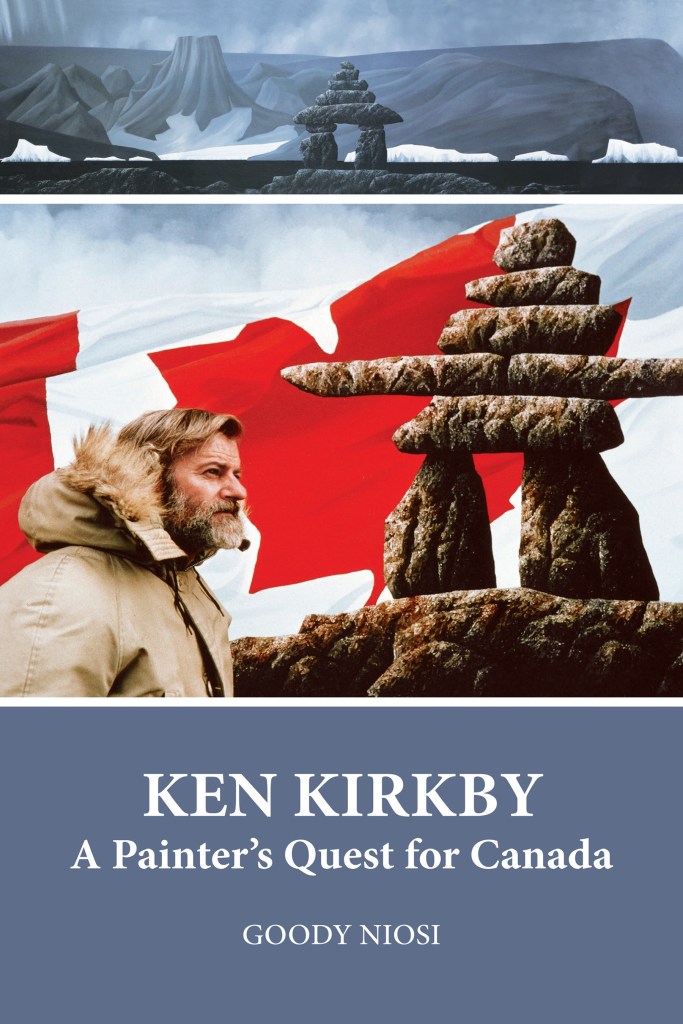
Ken Kirkby, A Painter’s Quest for Canada

Excerpt

The bush pilot told Ken that there was no such place as the Arctic – it
was an arbitrary dotted line drawn on a map, by people who had never
been there. The Arctic was a hundred thousand million places, he said,
with an enormous variety of climates and vast distances between small
communities. You might find a few people on the land, he said, but not
many. Most of them had been rounded up and put into camps built like
villages. The idea of the Eskimo as one homogenous group of people was
as big a myth as to say that all Europeans were one race.
Nevertheless, the government had decided that the Eskimos had to be
gathered together – regardless of tribe or dialect – and placed in communities,
which they would use as a base to go out and trap fur animals
for the Hudson’s Bay Company. Then they depended on the company for
their survival and were, in fact, essentially owned by it. Each Eskimo had
been given a number and a letter. Those west of Coppermine River were
assigned the letter W and a number. Those East of the area were given an
E and a number, and in some cases, those letters and numbers were tattooed
on their arms.
Ken was horrified. He repeated to Jessica, Patrick, and Long John what
the pilot had told him. John was furious, not at the government, but at
Ken and his wild dreams. “You’re on a wild goose chase! You’re mad!” he
shouted. “There’s nothing to go to – thousands of square miles of absolutely
nothing but ice, wind, and rocks – lots of frozen rocks and no
people. I tell you, there are no people there. The place is a bloody, frozen
desert. You’re made of flesh and blood – you’re not a god! What is it with
you English and your half-baked need to go to desolate places? As if life
isn’t difficult enough without going looking for trouble!”
“For someone who’s never been to the Arctic you seem to have a helluva
lot of knowledge about it,” Ken said. “How do you know there’s nothing
there?”
“I don’t need to go there,” John said. “I can read. There’s a place called
“The Barrens” and I imagine it’s called that for a good reason, don’t you
think?” John pulled out a map and pointed to the place. “Read it – it’s
right there. The Barrens – there’s nothing there. When he first looked at
the place, one of the explorers wrote in his diary, ‘This is the place that
God gave to Cain’. All I can see is that the place is going to kill you – not
much different from every other Englishman who’s gone up there. I can
see a small headline in some small newspaper somewhere, ‘The Arctic
wastes claim another Englishman.’”
“It didn’t kill Francisco,” Ken argued.

https://www.amazon.com/dp/0981073573

Savages and Beasts

Excerpt

Mary Goldberg, just twenty-five years old, who had graduated
from the McGill University of Toronto, daughter of a very
affluent Toronto family with Jewish roots, after a disappointing
erotic relationship with a young man of Jewish roots too, and
against the wishes of her parents, and against the wishes of her
best friend Rosalyn, had decided to travel across the country
and after she spent a few months on the road, and after she lived
temporarily in a few Canadian cities, she ended up in this Indian
Residential School, in Kamloops BC, where she was hired as an
administrator assistant; Mary, who stood almost six feet high
with long black hair that fell on her back almost to her waist,
was a clever eyed young woman with fair attitude; her characteristics
were complimented by her hazel eyes and full lips, an
aesthetically shaped nose and a very shapely body.
This body, hidden under the tight outfits, which Mary
liked to wear was easily discerned by the piercing eyes of Father
Jerome, who never missed noticing such things especially since
he was appointed the head of this facility in Kamloops BC,
here, where no one would ever come to check what was going on
and how the Indian Residential School was run. He knew
of course that he had some guidance from the church and the
Federal Canadian Minister on issues pertaining to education
and curricula, yet the rest of the details were up to him and him
alone, which placed him at the top of a heap he would never ever
step down from. And he made sure all members of the teaching
personnel as well as everybody else, from the British Columbia
Provincial Legislators to the Mayor of Kamloops, to the rest of
the citizens knew who he was and what his goals were; therefore
no one could ever interfere with his decisions regarding the daily
affairs in the running of the school, and the savage kids he was
meant to educate, come hell or high water.
“I wish you peaceful days and nights, Anton,” Mary said,
and her lips showed a faint tremble.

https://www.amazon.com/dp/1926763602

Water in the Wilderness

Excerpt

Morley’s face relaxed and he chuckled. “I guess not. But seriously, Tyne, it’s not just because that particular cow has a mean streak. Even the most docile animal can suddenly become possessive if she thinks her baby is being threatened.”
Tyne nodded as she picked up her fork. Then she remembered why she had gone out to the barn in the first place – before being caught up in all the drama. “Morley, I’ve done something I should not have done before consulting you.”
His eyes twinkled. “You mean besides going into a pen where you had no business going?”
Tyne kicked him gently under the table. Then, without compromising patient confidentiality, she told him about Lydia and about the promise to take the children until their mother had convalesced. “I’m sorry I didn’t consult you first. I had no business doing that either.”
But Morley reacted exactly as she knew he would. “Of course we’ll take the kids. How old are they?”
“Rachel’s seven and Bobby’s four. But you’ll have them alone at night for the next two days. What if you have to go out to the barn to see to a calving cow, or something?”
“It’s not likely to happen this week, but if it does I’ll call my mother. She’ll be happy to help, and she’ll be here in five minutes.”
Tyne smiled. Yes, of course, both of Morley’s parents who lived on the next farm not more than a mile away, would be more than happy to help. They were that kind of people.
Although Morley had wanted to drive her to work that night, Tyne assured him she had rested well and would be fine on the four mile trip to Emblem. She had spoken to Dr. Dunston earlier in the evening about the Conrad children, and he said he would accompany her to their home when she got off duty in the morning just in case Corky appeared less than hospitable when she arrived. She had also called her mother to enlist her help in looking after the little ones when Tyne was working the day shift. Emily Milligan eagerly agreed.

https://www.amazon.com/dp/192676319X

Twelve Narratives of the Gypsy

Oh, my black mule you didn’t

get any of your father’s noble

fate with the dashing body

and from my mother, I didn’t

accept the scornful serenity,

you said to me, I’m not the slave

of a slave. I know it well, oh,

my black mule, you are you

you selected two of your

mother’s and your father’s fate

and you chose your destiny

and if you aren’t as graceful

as the waves nor the bravest

and if you aren’t a stooped slave

and a tired maid who awaits

and endures, beauty has turned

you into a thoughtful being and

if you never said no, you did

because of your stubbornness

not from a peaceful submission.

You’re always strong-willed

always first always the same

in rivers and thickets and

on the road and in the noisy

harbors as your steady step

deserves a light, graceful wing.

And if I urge you to descend into

the Tartarus of earth you’ll

always obey and I won’t even

feel the trembling of your legs.

And if I wake up longing for

a skyward voyage inside of me

I’ll ascend to the stars with you

while your steady steps will

guide me up to that height and

I’ll see you as the winged horse

of the magician or the leading

black guerrilla, unbending

barren and stubborn mule.

You and I, both of us, one Fate.

And if I stirred the leaders’

armoury with my hands and

I fluttered the soldier’s banner

and my uncontrolled hair

as if I was again commencing

a new battle, as if again

I was ready for long wars

and lance competitions

and wherever I passed along

domed forests of high-joined

chestnut trees and hugging

poplars I pushed my mule

gracefully riding on her back

I was the mule-rider who

touched the domed forests

raising my arms and then

going forward or coming back

I always carried leaves and

fresh branches in my hands

and wherever a river stopped

my steps, I disregarded its

powerful current, mule-rider

who I was, I started crossing

in a fastened path that lasted

only while I was passing; and I

was a river passer, a mule rider

an engraving on the rock

mule and man, the same flesh

different from the stone, which

assumed a soul and departed

if I was lost in the deep thought

of struggle, pain, and yearning

in my mind the one emperor

having a crown on his head

the crown of the universe.

https://www.lulu.com/account/projects/gjgv4ee https://www.amazon.com/dp/B0D3LP7NW6