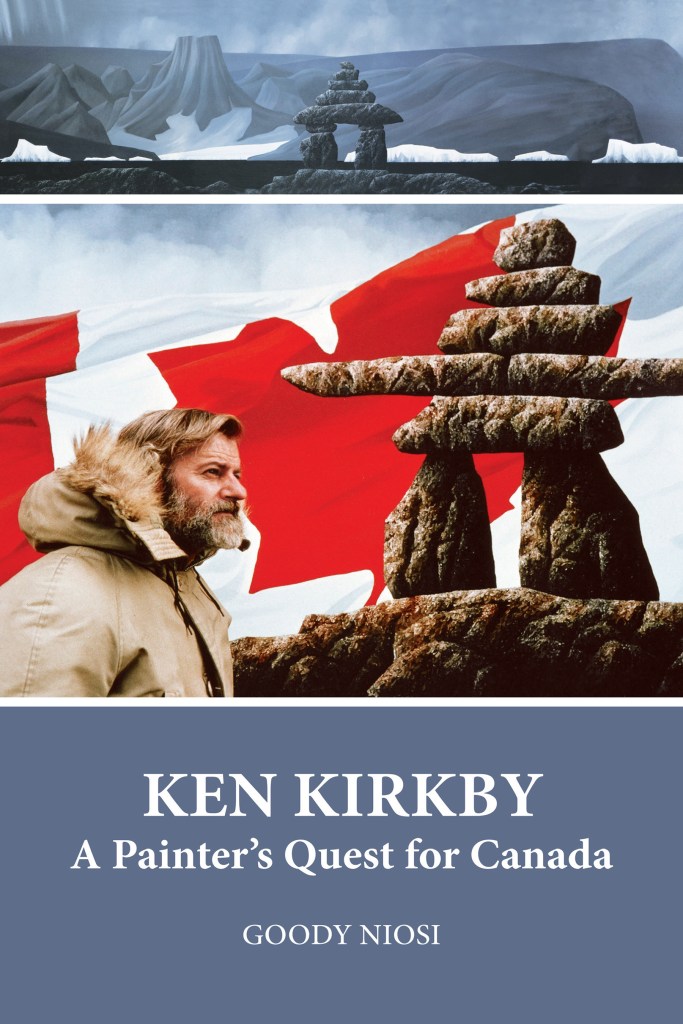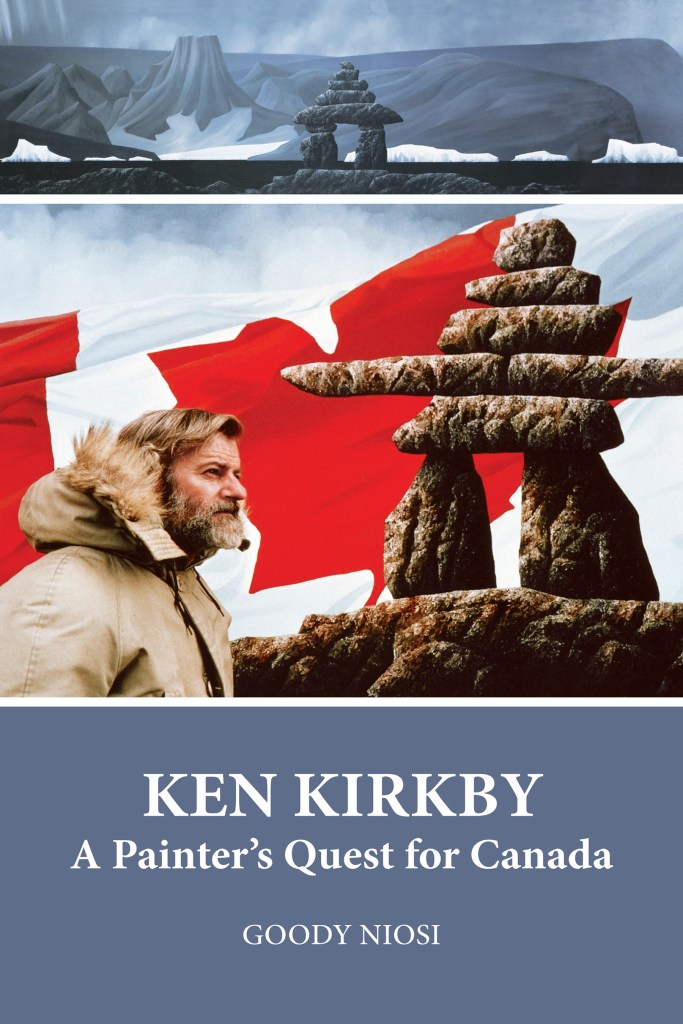
Ken Kirkby, A Painter’s Quest for Canada

Excerpt

distance away observing him. When they saw that he had noticed them,
they came to sit beside him. The man said, “My mother says you are a
very quiet Kabluna.”
“Maybe all Kablunat are quiet,” he said.
The man translated for his mother and said, “She says that all other
Kablunat that she has known are noisy. They talk a lot.”
“Maybe I don’t have much to say,” he replied. “Maybe I don’t know
very much.”
When Ken questioned the old woman about the Inuksuit she told him
a story that began a long, long time ago when there were very few human
beings. They travelled over the vast land in small family groups, following
the herds of caribou that were the source of their food, their tents,
their clothing, and their utensils. They could not afford to deplete their
energy by chasing the food. Instead, they made stone human beings and
called them Inukshuk, which means, like a person or acting in the place
of a person.
The people placed the Inuksuit in V-shaped formations. The caribou
with their poor eyesight, thought the Inuksuit were hunters and so it required
only a very few people to herd them into a trap. The closer they
came to the end of the V, the closer together the Inuksuit were placed.
At the point of the V, hunters hid behind boulders while women
and children lay on the ground beside the Inuksuit. As the caribou approached,
the women and children jumped up, waved their arms, and
danced about, to give the appearance of many, many hunters. The caribou
would then stampede to the end of the V, which was usually at the
junction of a lake and a river. When the caribou plunged into the lake,
the hunters hidden behind the boulders would jump into their kayaks
and paddle after them, spearing them in the water. Then they would haul
them back to shore where the entire family, even the children, would
clean and gut the animals.
Inuksuit also took on many other shapes, the old woman said. The one
on the river’s edge where they were sitting was a fishing Inukshuk. She
knew this because it was topped with a smooth stone taken from the riverbed.
It indicted that the fishing was good here. Other shapes had other
meanings and the configurations of Inuksuit had meaning also.
To my mind, what I was hearing sounded like language but they didn’t
write the language on a piece of paper – they wrote it directly on the land.
And I was beginning to get the picture of absolute practicality. Here you
could live with minimum technology if you knew how. To think that you
could direct an entire way of life by putting a few stones together just so,
so that other people coming would be able to read the significance of these
things. The degree of sophistication of this began to seep into me and I realized
there was much to learn here. And this way of life was like the people

https://www.amazon.com/dp/0981073573

Ken Kirkby, A Painter’s Quest for Canada

Excerpt

back to camp, where he presented them to the old woman. She nodded
and smiled, laying them out in a row and then producing a half-moon
shaped object made of iron. Pointing to it she said, “Ulu.”
“Ulu,” Ken repeated.
Deftly, she skinned the animals with the homemade knife and cut
them into sections. Another woman shuffled over carrying a large pot
into which they placed the meat.
And everything was unspoken. This was a world in which each person
knew what to do. You didn’t; have to chatter about it. It seemed you only
talked if there was something really important that needed to be said. There
was something very appealing about that. I wondered how much of what we
talked about was utter nonsense.
Ken asked the hunter about the silence.
“No, we don’t talk much,” he said.
“How did you learn English?” Ken asked.
“Hospital.”
“Hospital?”
“TB. I was in the hospital.”
After a long silence he said. “Good rifle.”
Ken nodded.
“Too expensive,” he said. “The bullets – too expensive.”
“Twenty-twos are cheaper?”
“Yes.”
“Where do you get them?”
“It’s very hard to get them.”
“Do they sell them in the village across the river?”
“Yes.”
“So why don’t we go over there?”
The man didn’t answer.
“I can go over there,” Ken suggested.
“Good idea,” the man said.
“Would you like me to go over there?”
“Yes.”
“How do I cross the river?”
The man walked to a clump of willows, growing waist high on the
riverbank, where a big freighter canoe was hidden. Ken shouldered his
backpack, tucked a wad of money into his pocket, and climbed into the
canoe. The current carried them swiftly downriver. The man steered with
the tiller and his paddle, angling them toward the opposite shore. On the
bank, they pulled the canoe ashore and dragged it into another clump of
willows. Ken shouldered his pack and walked into town.
The village was a ramshackle collection of caribou hide tents, canvas
tents, and buildings cobbled together from the flotsam and jetsam

https://www.amazon.com/dp/0981073573

Ken Kirkby, A Painter’s Quest for Canada

Excerpt

Ken circled around the stone people, which he later learned were called
Inuksuit. Around and around he walked, occasionally reaching out a hand
to touch them in a dazed kind of wonderment and awe. For the first time
in many weeks, his spirit began to lift.
I thought I was quite a well-informed person on a variety of subjects,
given that in my upbringing, acquiring general knowledge was considered
important. General knowledge led you to being a generalist and it’s the generalists
that run the world so you want to have vast amounts of knowledge
in a variety of areas. So, you learn about the pyramids and the sphinx and
Stonehenge and Easter Island and all of that. But here were these strange
human-like figures made of stone that I had never heard of – and at that
point, I started to come out of my stupor. These figures got a hold of me. This
was something that captured my attention in a major way.
He set up his tent some distance from them, thinking perhaps they
were sacred symbols and while he struggled with his tent, he kept glancing
at the stone men, reluctant to look away even for a moment lest he
lose the magic. With his little tent tamed, and his camp set up on the
windy plain, he dug out one of his rolls of paper – from the depths of
his backpack – and began drawing. He rolled the paper farther after each
drawing and began another. He couldn’t stop; he was infused with the
same energy he had felt when he first began drawing, in Portugal, as a
young boy.
When his stomach let him know he was hungry, he walked down to
the river and caught a fish. Cooking was a challenge because there was so
little wood of any kind to burn. He had learned to start a fire with dried
moss and then add bits of shrubbery to get an intense blaze that lasted
mere minutes. He usually managed to cook one side of the fish over the
flame. Then he had to start a fresh fire to cook the other side. In time, he
learned to eat and enjoy raw fish because it was so much simpler.
While camped near the Inuksuit for several days, making drawing after
drawing, he noticed a group of people setting up camp some distance
from him near the river. The people on the west side of the river didn’t
acknowledge these people on the east side, and they in turn did not speak
to the people on the west bank. Ken concluded that these were Eskimos,
the people he had been searching for.
The Eskimos paid no attention to Ken and he did not try to make
contact. Instead, he continued to draw, fish and cook his meals. He was
consciously becoming a silent person and the deeper he fell into the stillness,
the greater the solace he found.
One day a woman with a deeply lined and weathered face carried some
fish and bannock on a flat stone to Ken’s tent, placed it on the ground and
walked back to her camp. Ken ate gratefully. “How shall I respond?” he
wondered.

https://www.amazon.com/dp/0981073573