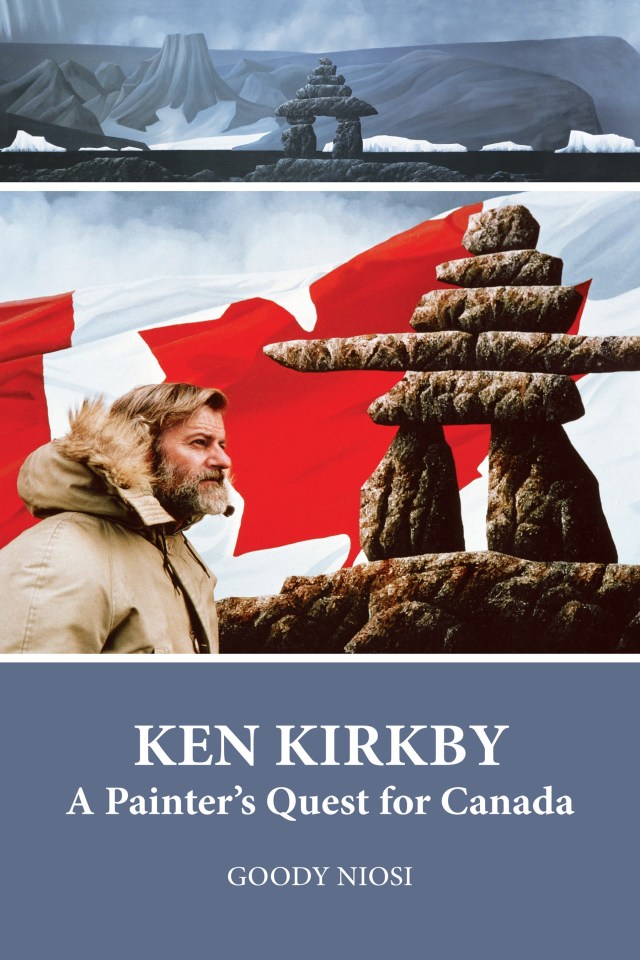
Ken Kirkby

excerpt

It was years later that I actually saw the book itself. I felt such
specialness to share this history with my grandfather who was a giant
of a man, loved by many and respected by all.
According to the National Geographic magazine, (Vol. 167, No. 3,
March 1985) Dr. Robert Paul Jordan confirms that the Viking traders known
as the Rus created Russia’s “first organized state and gave their name to a
future empire.” And the story that Ken learned as a wide-eyed boy seems to
support that claim.
As his maternal grandfather told the story, and as Ken passed it on to
his own son—who, at this point, is the last of the Kirkby line—the tale of
Rurik of the Rus goes like this:
Rurik was the eldest son and he chose to become a sailor, an adventurer
and an explorer. Like the Norwegians, the Danes were Vikings—an Old
Danish word which means ‘to dip your oar’ or in our terms, ‘traveller’.
Norwegians became known as the Norse, and Danes, the Rus.
Occupants of the Scandinavian countries realised early that to split the
farms into small holdings for their sons would make the land useless. So,
in order to preserve that livelihood, only one would inherit the land and
the others had to make their fortune elsewhere. The sea was the obvious
alternative. Through dint of need, the majority of them became mariners
and shipbuilders. They were a strong and courageous people and became
the Masters of the Seas as traders and mercenaries. The majority were
literate and highly industrious.
Those who became mercenary soldiers, a reputable occupation of the
day, were known also for their ferocity. They returned from the Middle East
with the knowledge of metalworking and equipped with this expertise, they
produced exceptionally fine swords and weaponry. This proved to be a great
advantage. A fierce minority banded together to form raiding parties and
this resulted in the Viking reputation for rape, slaughter and pillage.
Much like the dream of the Arctic that drew his future and distant
relation to northern Canada, Rurik also had a powerful dream of a vast
land beyond the ice; a land shaped by three great rivers. He was determined
to sail to that land one day. Rurik was an able navigator and commander
of several ships, and eventually he and his fellow mariners set out on a
long and arduous journey that took them east and north through the Arctic

https://draft2digital.com/book/3562902

https://www.amazon.com/dp/B00CB8W4CG

Ken Kirkby, A Painter’s Quest for Canada

excerpt

same feeling about you as I had about where that puck would be.”
“I want to help you,” he said one day over lunch.
“I’d appreciate all the help I can get,” Ken said. “There hasn’t been a
helluva a lot of it at this point.”
“Yes, so I gather.”
Virgil Pires, a tall Portuguese man, became another frequent visitor.
“You come from my country,” he said when he introduced himself.
“You’re almost Portuguese. I love what is in the papers and on TV. You
talk about my country with so much love.
“I wasn’t born in Portugal,” Ken said. “But I think that part of my soul
is Portuguese.”
The collection of paintings for the show grew, most of them featuring
an Inukshuk standing sentinel over the stark Arctic landscape. Irving and
Virgil visited almost daily, moving the paintings around, discussing the
merits of each one, and arguing about who should purchase which. Virgil
liked to say proudly, “He’s Portuguese, you know.”
Irving argued, “Portuguese, my ass. He’s no more Portuguese than
I am. He’s a mongrel – Danish, Irish, Spanish, French, Italian, Jewish
grandmothers, Christian grandfathers – grew up in Portugal – I tell you,
he’s a mongrel!”
“Oh no!” Virgil protested. “This is brilliant! This is magnificent! It was
written in heaven! This man has a place in heaven!”
Ken painted, working in a world he was entering for the first time.
These visions of the Arctic had been bottled up inside him for years, and
a great dam had burst open, spilling out a Niagara of creativity. The faster
he painted, the more powerful the pictures.
The week before the show, Irving and Virgil began to choose the paintings
they wanted, arguing good-naturedly over several of them. “You
can’t have them all,” Ken said. “You can only have twenty paintings!”
“Between us or each?” Virgil asked.
Were they serious? Ken wondered, beginning to feel excited. “Each,”
Ken said.
He had completed ninety-six canvases. Virgil and Irving fell on them
with the glee of schoolboys who had just been told they could choose a
dozen of any sort of candy in the store. They argued, talked, and wrangled
possessively over one or two of the larger paintings, until each had a
pile of twenty. “How much?” they wanted to know.
Ken forced his voice to remain calm. He studied each painting and methodically
wrote the price on a slip of paper. The forty canvases totalled
eighty-five thousand dollars.
Neither man flinched. Instead, they insisted on a celebration, and over
a bottle of good wine, Ken explained that their paintings would be part of
the exhibit – and he recalled one of Alex Fraser’s pieces of advice.

https://www.amazon.com/dp/0981073573

https://draft2digital.com/book/3562830

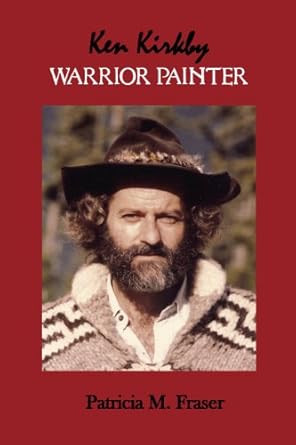
Ken Kirkby, Warrior Painter

excerpt

To have the warmth and companionship fade away now that he had time
to devote to her in the pursuit of her dreams seemed to be nothing short of
cruel. Whatever it took to appease Karen would be done.
~~
Now, in Bowser, Ken was faced with the sudden realisation that he had
been living life on autopilot. It was a severe jolt for the man who prided
himself on being attentive at all times to what was going on, both within
himself and in the world surrounding him. As a quicksilver dawn slipped
above the scattering of islands offshore, Ken made a fresh pot of coffee and
realized he’d made a breakthrough. It had been a long night coming to grips
with the situation. Self-awareness was a fundamental state of mind for him,
but as he replayed the recent years, he could identify countless occurrences
that had ultimately reduced him to this astonishing loss of control.
His elusive mind was stubborn in its refusal to follow an orderly chain
of thoughts, and he became aware that for months, perhaps even years,
his overloaded brain had taken refuge in the distractions provided by an
intelligent mind. No matter how vigorously he attempted to discipline it to
the process, it slid sideways into something less conflicting.
The act of thinking had become busy work, necessary in order to avoid
the bleak despair that filled him, most especially intensified when Karen had
withdrawn. But he now recognised it was an escape mechanism that needed
to be meticulously managed. For the first time in a long while, he was
looking with a clear eye at the core of his anguish rather than retreating from
it. Gradually he was being filled with certainty that, with this awakening, he
was exactly where he should be.
My real job now was to be painstaking in programming my healing,
much as I did in Portugal when my dad turned the problem of beating
my recurring childhood illness over to me.
Ken was frequently ill in his early years. Although no medical expense
was spared, the ailment remained unnamed. He had grown weaker, thinner
and yet more tired following relocation from Britain to Spain. However,
in his mother’s Spanish culture, weakness—whether physical or mental—
was never to be acknowledged. It was only after the family rejoined Ken’s
dad in Parede, Portugal that the six-year-old was permitted to articulate…

https://www.amazon.com/dp/B00CB8W4CG

https://draft2digital.com/book/3562902

Ken Kirkby, A Painter’s Quest for Canada

excerpt

assion doesn’t come from this generation.”
“I was. I was raised in an ancient place by somewhat ancient people.”
“So, what do you propose I do?”
“I propose you find out whether I am telling you the truth.”
As he and Rocco left, Ken turned and said, “By the way, I think the gallery
should be called The Joseph D. Carrier Gallery.”
Carrier smiled. “Of course.”
Once work on the gallery began, Ken and Carrier met frequently. When
Carrier discovered that Ken’s paternal grandmother, Constanze Inocente,
was from Genoa, he declared that the connection made Ken Italian, and a
member of the community. With Carrier’s urging, Ken joined the Canadian
Italian Business and Professional Association, a dynamic and diverse
group that included doctors, lawyers, carpenters, and bricklayers.
As opening night of the Carrier Gallery approached, Ken suggested a
show of his Arctic paintings, on a massive scale.
“You haven’t sold any and you want to start off with a huge explosion?
Rocco asked. “What if it fails?”
“You’re sounding like my mother. What if…”
“I love the idea, but what a risk!”
“When you jump off a cliff, make sure you do it head first. Be honourable.
Do it big.”
What about the cost?” Rocco asked. “Who will pay for it?”
“All we have to do is commit to the vision and the rest will follow.”
Ken rented the warehouse next door to the framing factory, a space
large enough for his Arctic paintings. He painted the ceiling black, the
walls white, and the floor battleship gray. Then, he went to work on the
giant paintings. Rocco focused on the show. They needed a sponsor, Ken
said. The show had to be unique. Canadians didn’t care about the Arctic
so everything about it had to be special.
“If Canadians don’t care, why are we doing this?” Rocco asked.
“Because this story has to be told,” Ken said, explaining that the entire
saga had begun on a beach in Portugal. And that’s when it struck him –
Portugal would be their sponsor.
He wrote a letter to Dr. Antonio Tanger Correia, the Portuguese Consul
General.
Correia called. “Mr. Kirkby. As if you had to explain yourself! What a
delight to get your letter. We must have lunch!”
They met for a lunch that extended into dinner. Ken explained that he
wanted the invitations for the exhibition to come from the Portuguese
people, meaning the Consul General and the Portuguese Ambassador to
Canada. “I’m not asking for money,” he said. “I simply want you to issue
the invitations.”

https://www.amazon.com/dp/0981073573

Ken Kirkby, A Painter’s Quest for Canada

excerpt

trying to meet you for years,” he said. Gruber carved decoys, many of
which had made their way into Ken’s extensive collection. “Our paths
have crossed many times,” he said. “But somehow we’ve never met. Now,
unfortunately, we have to meet under circumstances that aren’t the best. I
work for a credit company, and I have to cancel and pick up your gas card.
I’m awfully sorry to do this.”
“That’s fine,” Ken said. “You’re just doing your job. Come over now.”
They talked, while consuming an entire bottle of Scotch, and became
friends for life. Ron and his wife lived in a big house near Jericho Beach,
that had separate living quarters on the ground floor. When Ken told him
he had just lost his house, Ron suggested he move into their ground floor
suite, and a few days later, Ken loaded his possessions into his truck and
drove to Jericho Beach.
Revenue Canada sent a letter demanding a large sum of money in back
taxes on his real estate investments. Because he had never taken the money,
but only reinvested it, it had never been taxed. Ken put the letter on his
bureau. Another letter arrived and then another, until he had accumulated
seventeen progressively threatening tax notices. The final one informed
him he was being sued. Ken took the notices to his accountant who was as
puzzled as Ken. Each one demanded a different sum of money.
When they went to court, the lawyer for Revenue Canada made his
statement. The judge turned to Ken. “Guilty or not guilty?”
“Not guilty,” Ken said. “Impossibly and completely not guilty.”
“How so?”
“Your honour, if I may be allowed to approach the bench and present
you with the situation in writing. But, before I do that, may I ask you a
question in order to help clarify the situation?”
“What if one were walking down the street,” he asked, “and came across
a car lot, and spotted a car he fancied, and wanted to buy it, and the salesman
didn’t know how much it cost? And what if he went to his sales manager
and the manager, also, didn’t know how much it cost? And what if
he went to the owner of the car lot and the owner didn’t know how much
the car cost – would one be able to conclude a satisfactory transaction?”
“Clearly not,” the judge said.
“This would appear to be the same situation,” Ken said, handing the
demand letters to the judge. “There are seventeen different notices here,
which are completely confusing. There is no way, even according to the
accountants I am acquainted with, to make head or tail of it. Every single
one has a different figure on it: that makes no sense at all.”
The judge studied the demands, his frown deepening.
“As far as I’m concerned, I don’t owe the money,” Ken said.
“I think you’re absolutely correct,” the judge said. “This is disgraceful.”
And he threw the case out of court.

https://www.amazon.com/dp/0981073573

Ken Kirkby, A Painter’s Quest for Canada

excerpt

The day before the exhibit, he helped hang the paintings;
only one in each room of the gallery. Opening night resembled a Hollywood
premier. People gathered in the street and, when a chauffeur
driven limousine drew up to the curb, the media descended. Ken parted
the crowd and opened the door, guiding the Duchess into the gallery. The
crowd inside fell back as though God himself had made an entrance.
Ken led her through the rooms, telling the stories of the Canadian
North. She nodded, smiled, listened attentively, and left as quickly as she
had come. Forty-five minutes later every painting wore a sold sticker.
Ken extended his stay, in order to accept all the invitations he was besieged
with. He had been in Madrid for six weeks, when his father called.
“You must come home right away.”
“What happened?”
“Just, come home immediately. It looks like the trust company has
gone under.”
He flew home the next day and took a cab directly to his father’s apartment,
where he found him more agitated than Ken had ever known him
to be. “This is real trouble,” he said. “We tried to get into the office and it’s
locked – the locks have been changed and nobody is there.”
In his own office, he discovered several key files missing. He arranged
a meeting with other clients of the trust company. There were rumours.
Some said the company principal had moved to the Fraser Valley, where
he had set up an Arabian horse farm and purchased a Rolls-Royce. Others
said he had simply vanished without a trace.
Ken called the RCMP commercial crime division and drove to the station
with his father. The officer explained that the department was aware
of the issue. “It’s a complicated mess,” he said. “We’re going to have to
investigate you and your activities, the same as everyone else.”
The police found many of the missing files but not a trace of the company
president and CEO. Rumours continued to circulate. One claimed
that the head of the trust company had had nothing to do with the missing
funds. It was Ken Kirkby. He was crazy, and smart, and out of the
country when disaster struck. He was the one who had masterminded the
plot. The media ran with it and reporters parked their cars and vans in
front of his house waiting for one glimpse – to take just one picture with a
telephoto lens. Two professional hockey players, convinced that Ken had
taken their money, filed a lawsuit. The judge threw it out of court. Ken
threw himself into the investigation, working with the police day after
day to piece together what had happened.
The RCMP interviewed the victims of the fraud and examined the
documents. Sorting through his own papers became a full time job, and
there were many times he gave up all hope of making sense of them.
His greater despair was the loss of his friends.

https://www.amazon.com/dp/0981073573

Ken Kirkby, A Painter’s Quest for Canada

excerpt

There is a deep hunger to have the sunshine of their former
homes, and of their great-grandparents’ former homes. There are these
stories that persist about how wonderful life was, and how sunny it was,
and how warm it was. But, with the exception of this little coastal strip,
this is a very cold country. You’re trying to give paintings of vast, distant
places that are freezing cold, to Canadians. Why would anyone, with the
psyche I’ve described, even think of buying one? They won’t even come
out to look at them.”
“Well, Jesus!”
“Go ahead – break my argument.”
“What else about these paintings then?
“One word – pretty. The Canadian art scene is almost non-existent,
but what passes for imagery in the public mind at large is pretty. Doreen!
Doreen! Bring some magazines!”
Fraser grabbed the top one, from the stack Doreen delivered, and
opened it at random. He turned two pages and pointed. “Look – here’s an
ad – it’s perfect. Isn’t that a pretty photograph? Do you notice that it has
a white, sandy beach, a scantily clad couple, and palm trees? People work
very, very hard to make money, so they can save some up and go to that
place – and it’s very pretty. That’s what is in their minds. You and I are the
children and grandchildren of peasants, and we have their tastes.”
Fraser reached into his pack of cigarettes, pulled out a fresh one, and lit
it from the butt that had almost burned down to his fingertips.
“It’s taken Europe an eon to get to its appreciation of art. You’re expecting
too much, too quickly.”
“But, if we don’t push we won’t get anywhere,” Ken said.
“It’s not just a matter of pushing the public. We have to find individuals
who will get behind this. It’s not just good old Alex and Ken who are
going to go and foist this on the country. It’s a much bigger story.”
Ken left the gallery deep in thought. Yes, there was truth in what Fraser
had said but it wasn’t the whole truth. Canada was ready for his paintings.
The Group of Seven was proof. Fraser thought they were rubbish too. If
he wanted to tell his story through his paintings, it wouldn’t be with Alex
Fraser by his side.
Unexpectedly, Ken received a letter from his Aunt Vicki in Madrid. She
had taken the photographs he had sent her, of his latest paintings, and
shown them to a popular gallery owner who wanted to exhibit them.
He tapped the note against his desk, read it again, and picked up a
pen. He wrote a letter to Mr. McEachern, the Minister of Foreign Affairs,
describing his good fortune in coming to Canada, and telling him how
he had arrived in this country. He wrote about his art and said that he
wished to go back to Europe for an exhibition in Madrid.

https://www.amazon.com/dp/0981073573

Ken Kirkby, A Painter’s Quest for Canada

excerpt

“Why?”
“A painting that is given is all but worthless. It’ll be up in the attic or
down in the basement before you know it. A painting must always be
well paid for and it will be up above the mantel quicker than you can
snap your fingers – and it will stay there. And another thing you need to
know – you never give wealth a gift. It’s one of the ‘middle classes’ really
bad habits.”
When Ken walked into the gallery in Kelowna, Jack Hamilton took
him into the back office and handed him an envelope. “I see you keep
very fancy company,” he said.
Ken tore it open. The premier had written that he would be delighted
to visit the gallery the next morning at eight.
At seven-fifty, Jack staggered down the steps from the apartment above
the gallery, in his rumpled pyjamas, unlocked the front door to let Ken
in, and shuffled back up the stairs. At eight sharp, a chauffeur driven car
pulled up, and Bennett stepped out. He gave Ken a hearty handshake, sat
down at a small table near the front of the gallery and asked to hear stories
of the Arctic. “I thought you were just going up there for a month or
two, but you seem to have gotten yourself lost up there.”
“In a way, I did,” Ken replied. “It’s a long story.”
“I want to hear it.”
He told the Premier about his adventures and the atrocious conditions
the people lived with. He talked about the famine and the disease, and the
autocratic rule of the church, the RCMP, and the Hudson’s Bay Company.
When he finished, he asked if there was anything the Premier could do to
help the people up there.
Bennett stood. “Let’s see your paintings,” he said.
They walked through the gallery.
“What do the red dots signify?” Bennett asked.
“It means they’re sold.”
“It looks like they’re all sold.”
“Yes, they are.”
“You must be doing very well.”
“Yes I am – I’m very lucky.”
“I’d say there’s more than luck involved. I know nothing about art but
I do like what you’re doing, especially that one,” pointing to a landscape
of rolling grasslands. “I’d be interested in owning that one.”
“I’m sorry,” Ken said. “I’m afraid the entire exhibit was sold before it
got here.”
He led him into the back office where three paintings leaned against
the wall. “These are not sold,” he said.
Bennett pointed to one of the high plateau on the Douglas Lake Ranch.
“I like that one. Where is that?”

https://www.amazon.com/dp/0981073573

Ken Kirkby, A Painter’s Quest for Canada

excerpt

“Sure. I’ll be happy to try that, but you know that while I’m doing that
I won’t be painting.”
“Don’t worry about that,” Fraser said.
“I’m not worried. I just don’t want you to get in a huff about not having
enough paintings.”
“I said don’t worry. I’ll make it worth your while.”
“That’s not what I mean. I’m happy to do it for you in return for what
you’re doing for me. And I don’t want any money for it.”
“You don’t want any money! Well, I never – a man who doesn’t want
money. So what do you want?”
“I just don’t want you to get upset when my painting production falls
off because I’m doing other things for you.”
“Of course, I’ll be upset at your lack of paintings. Why wouldn’t I be?”
“But that’s not reasonable!”
“It’s quite reasonable in light of how you present yourself – as the one
apart – the one to whom the rules don’t apply – the one who walked in
here without an appointment. There isn’t a painter in the country that
would dare do that. And, your shenanigans in the Peace River Country
– and your wanderings in the Arctic – as if you owned the bloody place.
You put yourself forward, with a quiet aloofness, as the man who can do
everything and anything, so I’m sure it won’t be any kind of a trick for
you to be in two places at the same time, doing two different things at the
same time.”
“Well,” Ken said. “That’s not how I see myself.”
“Fine. But I’m only telling you how you portray yourself.”
“If I was who you say I am, I’d be able to get my Arctic paintings and
stories out to the public, and I can’t.”
“Your Arctic paintings are the only tentative part of you. You haven’t
come to terms with that subject. You’re unsure and it shows. Everything
else you paint is clear, simple, strong and sure-footed. But don’t be concerned.
In good time, all of this will look after itself. With your confidence
and your bloody single-mindedness, you’ll work your way through it. But
right now, you’re not there and I will neither show them nor recommend
them. In that area you have a long way to go.”
That evening, he related the conversation to Helen.
She laughed. “Don’t tell me you’re surprised. You have an ego as big as
the world. You’re full of yourself. The long and short of it is that you’re
arrogant. Alex is right. You wander into a place, you give it the once-over
and all of a sudden, you’re going to fix everything, you’re in control, and
you’ll take care of it. That’s what it looks like from the outside.”
“It does?”
“Yes, it does. And what do you have in mind anyway? Where are you
heading with all this?”

https://www.amazon.com/dp/0981073573

Ken Kirkby, A Painter’s Quest for Canada

excerpt

Then he reached to the side, and turned on the
tap of the small bar sink, and filled a pitcher with water. Lastly, he opened
another cupboard, lifted down two tumblers, poured a goodly measure
of whiskey into both, and splashed water into the glasses.
“This is how you and I are going to do business,” he said. “We’re going
to drink.”
‘In the middle of the day?” Ken asked.
“What’s that got to do with anything? We’re going to drink.”
“Why do we have to drink?” Ken eyed the whiskey with revulsion. “My
guess is it’s to do with, ‘get a man drunk and you’ll find out who he is.’”
“Who told you that?”
“My father.”
“I’d like to meet your father.” He took a large swallow. “So, tell me
about yourself.”
Ken told his story, while he watched Fraser drink until the bottle was
empty. He drank a bottle every day, he said, and he was as proud of that
as the fact that he was a one match a day man. He struck a match in the
morning to light his first cigarette, and every subsequent cigarette, for the
rest of the day, was lit from the stub of the last. “It takes discipline to do
that.”
“I want you to come to the gallery two or three days a week. I want to
hear your story. I want you to tell me your feelings, your thoughts, your
understanding of the universe – everything. I want to listen to you. I want
to hear you.”
For several weeks, Ken visited and talked, while Fraser downed a bottle
of rye and smoked an eternal chain of cigarettes. “You have a passion that
is white-hot and I love it,” he said. “We have all these artists around, and
they’re all limp. I want to see a man with a paintbrush in one hand and a
sword in the other. That’s you.”
One day, Ken asked Fraser why he never saw the paintings he sold to
him. “Where do you put them?”
“I’ve sold them.”
“All of them?”
Yes, all of them.”
“Oh my gosh. Well, that’s terrific.”
“You look surprised.”
“I am.”
“That’s not a very nice thing to say to me. Of course, they’re sold. So,
bring me some more. Go and paint.”
“There’s a limit to my speed.”
“I’m sure there is and I want to find it. I suspect the faster you paint the
better you get. You’re thinking too much. Don’t think. Painting isn’t about
thinking. This is not an intellectual exercise.

https://www.amazon.com/dp/0981073573