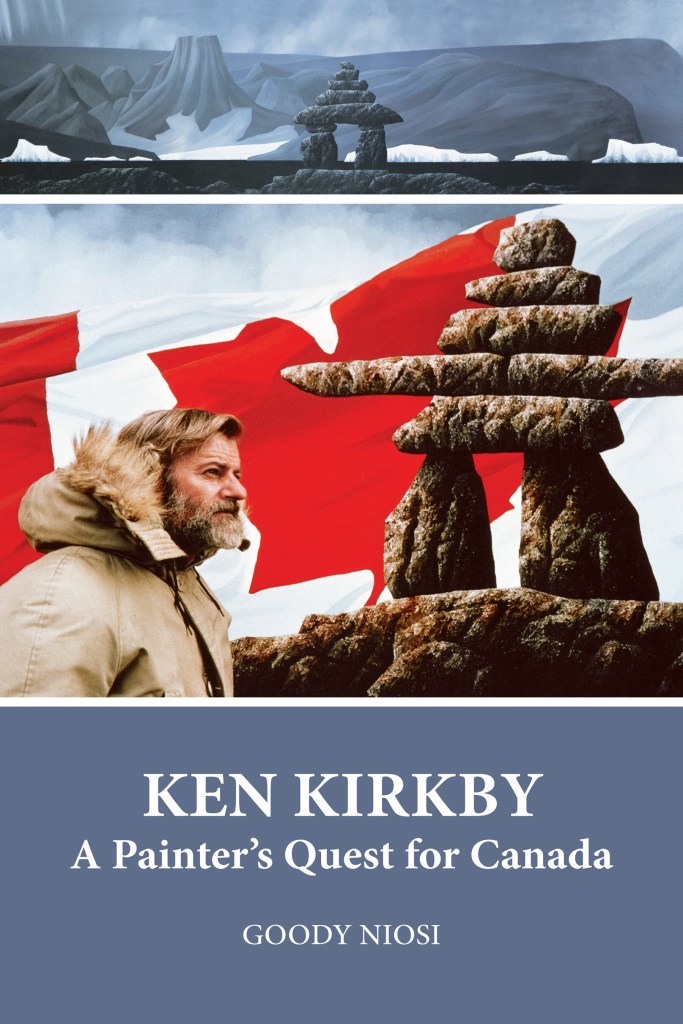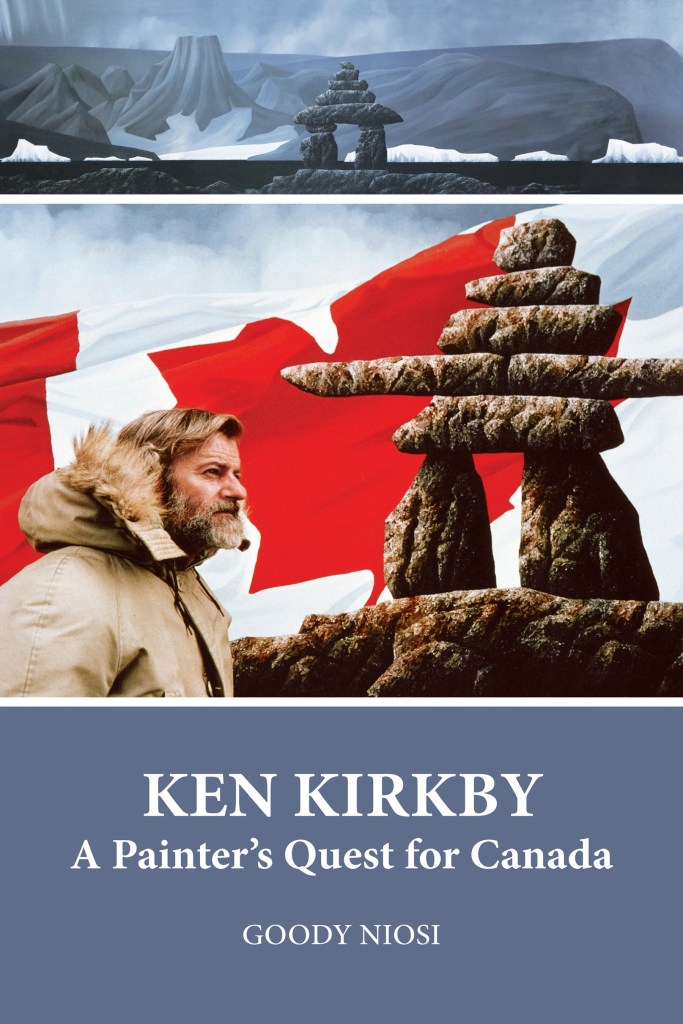
Ken Kirkby, A Painter’s Quest for Canada

Excerpt

Ken’s people were caribou people.
When the last of the caribou had passed, they dragged the fresh carcasses
to several large piles of rocks that they lifted to reveal deep pits
lined with more rocks. They lowered the meat into the pits and replaced
the rocks. The main danger to their food reserves was marauding wolverines.
By caching their meat under rocks too heavy for the wolverines to
move, they guaranteed a food supply for the season to come.
The days changed. The shiny green bearberry that covered the tundra
turned blood red and when Ken gazed across the land he saw a river of
crimson. One morning the snow geese flew across in the hundreds of
thousands. When they settled on the land a down blanket covered the
scarlet sea.
The days grew shorter and the temperature dipped dramatically. Ken
shivered in his sleeping bag and the old woman gave him two caribou
hides – one to put under his bag and one to cover it. He developed a new
understanding of the word “cold”. Cold was not simply a word here – it
was a palpable, physical thing, which assaulted every sense – it was the
god that controlled the land.
A few days after giving him the caribou hides, the old woman presented
him with a caribou parka lined with Arctic fox. Through her son,
she explained that this was to be worn without undergarments, next to
the skin. The parka was light, soft and astonishingly warm.
They continued to travel east until they came to a lake dotted with a
number of small islands, where they had left sleigh dogs that had whelped
in early summer. The animals were wild, ferocious, and pugnacious. They
took them back to the mainland where they pegged them to the ground,
placing the lead dog at the front of the pack. Once a day someone tossed
a frozen fish to each dog, which it consumed ravenously. The dogs were
born to pull sleighs and once in the traces would run across the ice until
they dropped from exhaustion.
With the dogs in tow, they continued trekking to the place the old
woman called home. She was a Netsielik, People of the Seal. Her husband,
who had died of TB, was People of the Caribou. TB had become epidemic
among the Inuit. Several people in the group had severe coughs and often
spit up bloody phlegm.
Snow began to stream across the land, blowing from the west in a million
little rivulets. The temperature, already chillingly cold, continued to
drop. The old woman gave Ken a pair of trousers made from caribou hide
and sewed a wolverine hide along the edge of the hood of Ken’s parka.
To the amusement of the Inuit, Ken sat on the frozen tundra in his new
clothes, watching the snow dance across the land. He felt fortunate. He
was living his childhood dreams. This was the Arctic he had envisioned –
the land of Francisco’s stories.

https://www.amazon.com/dp/0981073573

Ken Kirkby, A Painter’s Quest for Canada

Excerpt

On shore, Ken’s friend took out a sharp knife and slit open the belly of
one of the big fish exposing a white strip of pure fat. He peeled it off, put
the end in his mouth and cut it off with his ulu. He passed Ken a piece of
the precious fat that melted deliciously on one’s tongue.
Ken became mesmerized by the minutiae of Inuit life. Everything they
did was alien to his previous experience. He watched one of the men
make a drum from the hide of a young caribou. Only the skin of a young
animal would do, the man explained. It was shaved clean, soaked with
water and spread out in the hot sun where it bleached white. It was then
stretched over several pieces of wood that had also been soaked, bent to
make a circle and bound together with strips of leather. The skin was
sewn on to the hoop and left out in the sun again, this time to shrink.
Watching the process, Ken understood how important each piece of
wood was to these people. Where he came from people would have used
just one piece of wood to form the hoop. Here, the circle was made of
many small pieces of wood. Trees didn’t grow on the tundra. There might
be the occasional knee-high shrub and very rarely, willows that grew waist
high in protected gullies. Every scrap of wood was hoarded and used with
care and precision.
The Inuit had to obtain additional wood from the south where the
sub-Arctic Indians lived. The old woman told Ken that there had been
an uneasy truce between the Indians and the Inuit, which was often not
honoured. Raids and massacres had taken place for years.
When the woman told stories through her son, she often said words
that she asked Ken to repeat. When he learned a new Inuktitut word, she
smiled and when he began to put words together to form a sentence, she
beamed. It was the most difficult language he had ever learned, but then
the people were like no others he had ever encountered. They didn’t make
eye contact when they spoke and they had no word for me, mine or I.
Raising your voice, particularly to children, was taboo. Children were
expected to learn by the example others set. They ate when they were hungry,
slept when they were tired, and played when they wanted to. Adult
displeasure was shown in the smallest facial expressions – the wrinkling
of a nose or a slightly raised eyebrow.
One day a young man named John joined the camp. He was about
sixteen years old and he spoke excellent English. He told Ken that he was
on holiday from the residential school in the south but he had decided
not to return. They had cut off his hair and had beaten him for speaking
his language. The old woman was his grandmother, and John told Ken
that she and others were trying to get their children back. But this was not
easy. While they needed to be stationary so that they could be contacted,
they also needed to keep moving …

https://www.amazon.com/dp/0981073573

Ken Kirkby, A Painter’s Quest for Canada

Excerpt

Ken circled around the stone people, which he later learned were called
Inuksuit. Around and around he walked, occasionally reaching out a hand
to touch them in a dazed kind of wonderment and awe. For the first time
in many weeks, his spirit began to lift.
I thought I was quite a well-informed person on a variety of subjects,
given that in my upbringing, acquiring general knowledge was considered
important. General knowledge led you to being a generalist and it’s the generalists
that run the world so you want to have vast amounts of knowledge
in a variety of areas. So, you learn about the pyramids and the sphinx and
Stonehenge and Easter Island and all of that. But here were these strange
human-like figures made of stone that I had never heard of – and at that
point, I started to come out of my stupor. These figures got a hold of me. This
was something that captured my attention in a major way.
He set up his tent some distance from them, thinking perhaps they
were sacred symbols and while he struggled with his tent, he kept glancing
at the stone men, reluctant to look away even for a moment lest he
lose the magic. With his little tent tamed, and his camp set up on the
windy plain, he dug out one of his rolls of paper – from the depths of
his backpack – and began drawing. He rolled the paper farther after each
drawing and began another. He couldn’t stop; he was infused with the
same energy he had felt when he first began drawing, in Portugal, as a
young boy.
When his stomach let him know he was hungry, he walked down to
the river and caught a fish. Cooking was a challenge because there was so
little wood of any kind to burn. He had learned to start a fire with dried
moss and then add bits of shrubbery to get an intense blaze that lasted
mere minutes. He usually managed to cook one side of the fish over the
flame. Then he had to start a fresh fire to cook the other side. In time, he
learned to eat and enjoy raw fish because it was so much simpler.
While camped near the Inuksuit for several days, making drawing after
drawing, he noticed a group of people setting up camp some distance
from him near the river. The people on the west side of the river didn’t
acknowledge these people on the east side, and they in turn did not speak
to the people on the west bank. Ken concluded that these were Eskimos,
the people he had been searching for.
The Eskimos paid no attention to Ken and he did not try to make
contact. Instead, he continued to draw, fish and cook his meals. He was
consciously becoming a silent person and the deeper he fell into the stillness,
the greater the solace he found.
One day a woman with a deeply lined and weathered face carried some
fish and bannock on a flat stone to Ken’s tent, placed it on the ground and
walked back to her camp. Ken ate gratefully. “How shall I respond?” he
wondered.

https://www.amazon.com/dp/0981073573

Ken Kirkby, A Painter’s Quest for Canada

Excerpt

He ran to the first aid clinic next door. “What’s going on?” he asked.
“There’s been an accident on the road,” the medic said.
“What sort of accident?”
“A tractor-trailer jackknifed and went off the road.”
“Anyone else involved?”
“A pickup truck. There’s other help coming from town.”
Ken’s skin crawled. He forced the bile in his throat back down into his
gut and ran back to the lab, yelling through the door to John that he was
going to check on Jessica and her family. He cranked up the truck, his
heart pounding, an unnameable fear rising in his chest. He put his foot to
the floor, the truck careening around potholes and over the rutted washboard
road. About thirty miles down the road he saw the flashing lights.
He pulled up, got out of the truck and ran to the RCMP car parked at the
edge of the road. Below him, at the bottom of the embankment, amid the
jagged broken-up pieces of the semi, the pickup burned. Shaking beyond
control, Ken ran, stumbling and sliding down the steep slope. The young
RCMP officer he had met previously was struggling back up toward him.
He held up his hand. “Don’t go down there!” he shouted to Ken.
Ken stumbled toward him.
“Don’t go down there!” He yelled, again.
The officer grabbed at Ken’s shirt. Ken spun away. “Is the pickup blue?”
he shouted.
“I don’t know.” The officer said.
“How many people are in the truck?”
“I don’t know.”
“How many people in the god damned truck?” Ken screamed.
“Three, I think.”
“What do you mean, you think?”
“Don’t go down there, the officer pleaded. “Please don’t go down there.”
Ken ran down; tripped, fell, rolled, picked himself up and scrambled
down. He stopped when he hit the wall of heat bursting from the truck.
The flames were dying; the truck was gutted. But what he saw was a vision
he would spend the rest of his life trying to erase from his mind – a scene
that would come to him in nightmares over and over, until sleep meant
nothing but reliving the carnage – pieces of charred bodies inside the truck
– one of them still wearing a piece of fringed and beaded leather jacket.
I have spent so much of my life trying to contain these feelings – to deal
with these things. For a person of that age I had seen far too much death. I
was born to it – born in it. Anyone looking at me – coming from the right
side of the tracks, from a privileged family – anyone who would imagine the
sort of life a person like that would have would be completely off the mark.
So, I have to deal with these feelings very severely because I can’t make the
pictures go away. They don’t go away.

https://www.amazon.com/dp/0981073573

Ken Kirkby, A Painter’s Quest for Canada

Excerpt

“Grab a coffee and shut the door,” the manager said. When he was sure
no one could hear, he said, “I’ll hire you.”
“Sure,” Ken said. “That’s fine, but let’s sort this out first. I’ll keep your
offer as an ace in the hole.”
Later that day a small plane landed at the airstrip, disgorging the owner
of the company and his entourage, who commandeered an office and
closed the door. Ken slammed the door open and strode into the room.
One man jumped to his feet and tried to usher Ken out. “No,” he said,
shaking the man off. “If this is about me, I’m going to have my say. You
don’t hire an engineer. You don’t have one on the job, but you expect the
job to get done. I’ve learned how to do it. I’m doing it and what’s more,
ask yourself, is there any single thing wrong in the information provided?
Show me one thing that is incorrect – just one! I know you can’t. The
other question I have, is why am I doing the job of four to five men and
getting paid for one? I’m glad I’m fired. It feels good. Have a nice time!”
Ken slammed out of the room, as boldly as he had entered, got in the
truck, and drove back to Jessica’s house. He was nearing the gate when
he spotted the camp manager in his rear view mirror. Ken stopped and
waited for him to pull alongside.
“Are you fired?” he asked.
“I haven’t a damned clue and I don’t care. I’m having a good time.”
“Let me know immediately,” he said. “I’ll get you on the payroll right
away.”
“How much?” Ken asked.
“What are you making now?”
“That’s got nothing to do with it.”
“Well what do you want?”
“When I know what I want I’ll tell you. Right now I don’t want anything.”
Late that evening John came to the log house with the news that the
entire issue had been smoothed over. He had told the owner that he was
the one who had taught Ken how to use a slide rule, and that everything
had been done correctly. They had screwed up in head office, not Ken.
The camp manager had also spoken on his behalf. In fact, John said, it
was a lovefest. “Everyone’s in love with you. And the owner of the company
looks like a dummy. Of course, he’s not – he’s a smart guy but he had
no idea what was going on. He has a lot of other companies to look after.
But this is a big project with a lot of contracts. No one wants to look like
an idiot. But, everybody’s happy now!”
“Well, isn’t that wonderful!” Ken said. “I’m not happy!”
“But it’s okay – you’re supposed to come back,” John said.
“I’m not going anywhere,” Ken said. “I’ve been fired.”
“So what do we do?”

https://www.amazon.com/dp/0981073573

Ken Kirkby, A Painter’s Quest for Canada

Excerpt

The bush pilot told Ken that there was no such place as the Arctic – it
was an arbitrary dotted line drawn on a map, by people who had never
been there. The Arctic was a hundred thousand million places, he said,
with an enormous variety of climates and vast distances between small
communities. You might find a few people on the land, he said, but not
many. Most of them had been rounded up and put into camps built like
villages. The idea of the Eskimo as one homogenous group of people was
as big a myth as to say that all Europeans were one race.
Nevertheless, the government had decided that the Eskimos had to be
gathered together – regardless of tribe or dialect – and placed in communities,
which they would use as a base to go out and trap fur animals
for the Hudson’s Bay Company. Then they depended on the company for
their survival and were, in fact, essentially owned by it. Each Eskimo had
been given a number and a letter. Those west of Coppermine River were
assigned the letter W and a number. Those East of the area were given an
E and a number, and in some cases, those letters and numbers were tattooed
on their arms.
Ken was horrified. He repeated to Jessica, Patrick, and Long John what
the pilot had told him. John was furious, not at the government, but at
Ken and his wild dreams. “You’re on a wild goose chase! You’re mad!” he
shouted. “There’s nothing to go to – thousands of square miles of absolutely
nothing but ice, wind, and rocks – lots of frozen rocks and no
people. I tell you, there are no people there. The place is a bloody, frozen
desert. You’re made of flesh and blood – you’re not a god! What is it with
you English and your half-baked need to go to desolate places? As if life
isn’t difficult enough without going looking for trouble!”
“For someone who’s never been to the Arctic you seem to have a helluva
lot of knowledge about it,” Ken said. “How do you know there’s nothing
there?”
“I don’t need to go there,” John said. “I can read. There’s a place called
“The Barrens” and I imagine it’s called that for a good reason, don’t you
think?” John pulled out a map and pointed to the place. “Read it – it’s
right there. The Barrens – there’s nothing there. When he first looked at
the place, one of the explorers wrote in his diary, ‘This is the place that
God gave to Cain’. All I can see is that the place is going to kill you – not
much different from every other Englishman who’s gone up there. I can
see a small headline in some small newspaper somewhere, ‘The Arctic
wastes claim another Englishman.’”
“It didn’t kill Francisco,” Ken argued.

https://www.amazon.com/dp/0981073573