Jazz with Ella

excerpt

The galley kitchen was utilitarian and old-fashioned with a two-burner gas stove, a scarred countertop and a tiny porcelain sink. Marta peeled cucumber and kept her back to Jennifer, her posture erect.
“May I help you?” Jennifer asked. There was no answer. Suddenly Jennifer knew exactly what to say. “Is that cabbage rolls I smell?” she asked. “Mom used to make those—were they ever good.” The shoulders relaxed slightly and Marta turned, wiped her hands on a dishcloth and said with a wan smile, “Yes, they are Misha’s favourite, too.”
The conversation was polite but not warm over the dinner table although Nadya recovered some of her childish energy and rattled on to Jennifer about her school work and her friends. As soon as the dishes were cleared away, Marta directed Volodya and Jennifer to Nadya’s room, hastily vacated for the night in order to accommodate the travellers. The single bed had been made up with clean sheets for one person and a series of cushions had been placed on the floor with a quilt on top.
“I’m sorry we don’t have more beds and another room for you,” Marta said coolly. “But I think you will be comfortable in here.” Marta closed the door behind her, leaving Jennifer and Volodya staring at each other wordlessly. She turned away, wanting only to sleep and too exhausted to challenge his behaviour. He began undressing with no further comment. But as they prepared for bed, a knock on the door startled them. Misha’s head appeared around the door.
“Can I see you, Zhen? I’ll be in the living room.” Wrapping her robe around her, she glanced at Volodya and left the room.
Misha was sitting on the uncomfortable sofa. “This is where we should have started—right when you arrived, Zhen.” He patted a worn, leather-bound album. “Forgive me that I did not show you this sooner.”
Family photos, thought Jennifer. How will this help? Misha opened the album lovingly, smoothing the pages. She sat beside him. Most of the pictures had been taken in the last few years and they showed the couple at their wedding, traditional photos posed in front of the war memorial, some scenes from their trip to Sochi and many of Nadya’s childhood. Flipping through the book quickly, Misha opened it at a page of older, grainier photos. He pointed at one dog-eared print. Jennifer gasped. The picture depicted two teenagers standing together solemnly, kerchiefs around their heads, their faces forming weak smiles, their arms linked.
https://draft2digital.com/book/3562892

https://www.amazon.com/dp/1926763246

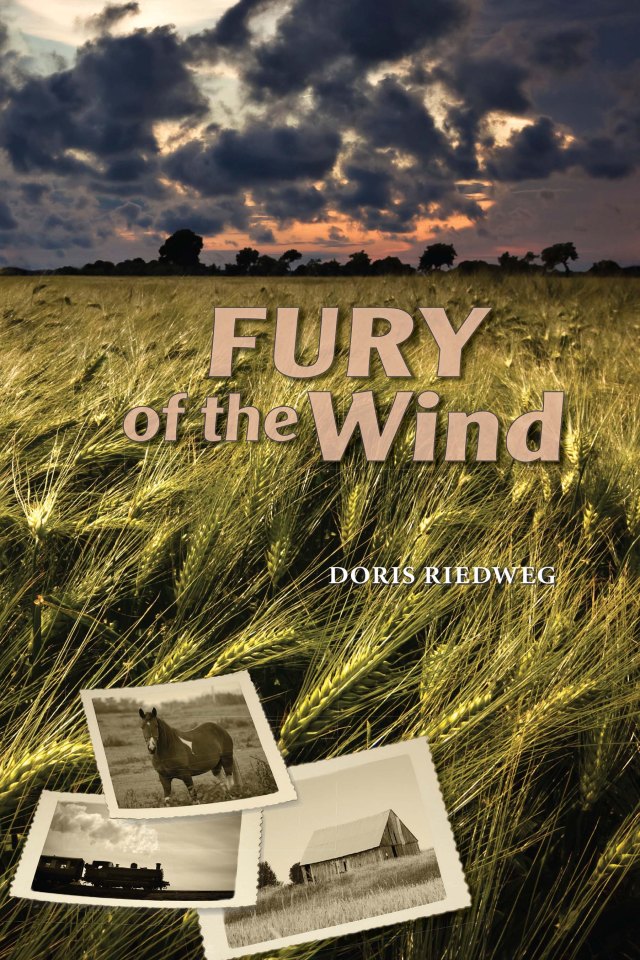
Fury of the Wind

excerpt

Back in the Saddle
Two weeks after her marriage Sarah Fielding had a visitor. She
was cleaning and rearranging cupboards in the pantry when she
heard the thud of a horse’s hooves in the backyard. Through the
window she could see that it was not Ben as she had expected, but a
stranger dismounting from his horse.
He stood for a moment and looked towards the stables before
walking to the back door. When Sarah opened it, the young man
removed his hat to reveal a head of curly auburn hair. His smile
reached to his eyes and lit up his face.
“How do you do, Mrs. Fielding? I’m Dave McNeill. Live over there
about a mile.” He jerked his thumb in a south-westerly direction.
“I’m pleased to meet you, Mr. McNeill,” Sarah said cheerfully,
“you’re the first neighbour I’ve had the privilege of meeting.”
“It’s Dave, please. Is Ben around?”
“Yes, I believe he’s gone over to that field behind the stable.” She,
too, pointed.
“Oh, the north pasture. Thanks, Mrs. Fielding, I’ll see if I can find
him.”
He replaced his hat, and was turning away when Sarah, surprising
even herself, said quickly, “But won’t you come in? I was just
going to make a cup of coffee. Would you like one? And,” she added
stepping aside to let him enter the kitchen, “I’d be pleased if you’d
call me Sarah. I’m not used to Mrs. Fielding yet.”
“Right, Sarah it is then. We’ve been anxious to meet you, Penny
and me.” At Sarah’s questioning look, he added, “Penny’s my wife.”
Sarah bustled from the pantry to the kitchen and back again,
anxious to get the coffee started before her visitor should become
impatient and decide he had to go. But he seemed in no hurry.

https://www.amazon.com/dp/0981073530

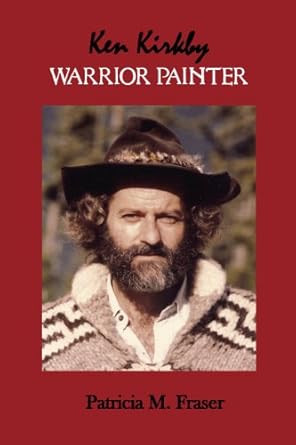
Ken Kirkby – Warrior Painter

excerpt

I took my rowboat and paddled out from shore to start the process of
familiarization. I observed the mouth of the creeks, the curve of the
beaches, the blend of driftwood and rock, the colour of the sky. I met
people with aircraft and begged rides off them. And, do you know?
This vast island is totally different than you might think. At one time the
bulk of the land between the seashore and the mountains was actively
farmed. The climate was favourable, and after clearing, the land was
fertile.
If you walk through it—there are still roads in the process of being
reclaimed by nature—you’d be amazed at how much of it had been
cultivated. Some of the parcels were very large, others just enough
to maintain a family or two. Then along came the Boer War, which
consumed a bunch of the young men, and then World Wars I & II
finished the job. Without the next generation to continue what had been
started, the forest grew back, roofs caved in, machinery rusted.
Once I got the feel of it, I decided I’d try to tell the story of this part
of the country—not the history, not the ‘big’ story, but the sense I had
of the size and shape of the island. The wind wracked trees and snowcrusted
mountains stirred my blood. And I found I was once again a
painter.
By the end of 2002, Ken was producing paintings to his satisfaction
and was pleased to find the attitude of the island galleries more amenable
than he’d experienced when he first returned to Vancouver. He came across
galleries dealing in second-market sales where a Kirkby oil of a solitary
Inukshuk standing proud on the tundra, or a parade of Inuksuit backed with
Arctic snows would be on display. He’d introduce himself and was pleased
to see that his name was recognised. He’d tell them that he was now in
business on the west coast. Might they be interested in fresh pieces?
The reaction was always positive. But when he laid out his canvases of
coppery grasses, water-worn granite boulders, wind-bowed trees or perhaps
a lonely lighthouse blinking eerily behind a rising ocean fog, he was met
with consternation.
“What’s this? Where are the icebergs? The Inuksuit? We can’t sell
these. That’s not you.”

https://draft2digital.com/book/3562902

https://www.amazon.com/dp/B00CB8W4CG

Redemption

excerpt

these voices of the innumerable people, pagans as they were called,
the ones who had died under the knife of the first Christians, who
exterminated thousands and thousands, as the scholars claimed,
perhaps even millions, to establish the new religion? It was written
in certain books, not of course in the regular books taught in
schools, that millions of Hellenes were eliminated so Christianity
could spread over the lands, and perhaps these voices and groans
Hermes was hearing coming from the depths of the earth were none
other than the pain those millions of Hellenes suffered.
He stood motionless as if to listen to a discourse coming from
somewhere deep under the floor of the monastery, groans of people
killed and buried under the soil of this church, when unexpectedly
a thought came to him: did the purpose justified the means when a
man is condemned to death for the success of a movement, did the
death of a man in the hands of another was rightfully approved by the
system which always craves to retain power over the people? And what
about the killing of a brother by brother, only for the killer to gain the
approval and help of a superior? Such thoughts overtook Hermes to
the point of feeling sick, indeed he felt the need to run away, far away
from this place, which he had visited with all the positive intentions of
looking into the monastery correspondence. He felt suffocated. He put
the papers away, he walked out of the church, he didn’t stop to thank
the monk who helped him, he just walked out at a fast pace as if to distance
himself from voices and images he wanted to forget.
Then, when far out, he felt his heart had calmed down as he
climbed a short hill since he wanted to change his route and followed
a narrow trail towards the top of the hill to reach his village on the
other side. He surely felt a lot better, and quite unexpectedly, a tune
rose from within his essence to his lips, and he started singing a local
tune; soon, he reached the top of the hill and found an old man on a
donkey right ahead of him. He greeted him and then asked,
“Are there any partridges around here, Uncle?”
“I have seen a couple of flocks over that mountain,” the old man
pointed to the other side of the horizon.

https://draft2digital.com/book/4172538#print

https://www.amazon.com/dp/1926763858

In Turbulent Times

excerpt

…no doubt hoping that the audience might have been larger. Denied by religious difference the pleasure of verbally crucifying Liam in front of his congregation in church, the Reverend MacNevin had decided to get compensating satisfaction by birching him in the barber’s shop. Unfortunately for the Reverend MacNevin only the barber was present. The other chairs were empty. Jackie Harrison’s assistant came in from Carraghlin only on Friday evening and Saturday.
‘I would have preferred not to inform you of this highly distasteful matter, Mr Dooley,’ the minister went on disingenuously, ‘but the act was witnessed inadvertently by two teenaged boys, one of whom happens to be my son. They went to collect waste paper at your house and it so transpired that they caught sight of the adulterers through your kitchen window. Fornicating on the floor. On the floor, I repeat. In their lustful passion they could not even wait to go to bed. I have extracted a promise from my son that there shall be no spreading of this unseemly scandal on his part, and he has endeavoured to extract a similar promise from his companion. But I fear the damage may already have been done. You can, of course, imagine the effect that such a sordid narrative must have on the imagination of adolescents. And what kind of an example does it present to them? The schoolmaster’s wife and an officer of the Royal Navy. By the greatest of good fortune, your wife is no longer a teacher at your school. You showed commendable prudence, Mr Dooley, in removing her from that position of responsibility. But I shudder to think what she might have been instrumental in instilling in the minds of her charges while she was so employed. That is why I have made it my painful duty to draw your wife’s gross indecency to your notice. It cannot be allowed to happen again. Furthermore, as a moral lesson to the young people of this village, it cannot be permitted to go unpunished. The very least you can do, Mr Dooley, is to forbid your wife ever to be seen in public with Joseph Carney again. What further steps you take to ensure that your wife does not repeat such immorality is, of course, up to you. I should think, however, that in view of the house from which she comes, such immorality and gross misconduct are indelible aspects of her character. Good day to you, Mr Dooley. And to you, Mr Harrison.’
With that the Reverend Lucas MacNevin, touching his hat to the two men, abruptly left the barber’s.
Jackie Harrison turned to finish the cutting of Liam’s hair. ‘None of this will go any further than these four walls, Liam,’ he promised.
But Liam did not hear what the barber said and would not have believed him if he had.

https://draft2digital.com/book/3562904

https://www.amazon.com/dp/1926763270

Arrows

excerpt

Guacaipuro surveyed the damage.
“Your god,” he panted, “is evil.”
Then he seemed to see something in the shadows of the bushes
illuminated by the firelight, and all distress lifted from his
countenance. He reached out, but life left him at that moment. He
collapsed onto Urquía, his face buried in her bosom. I gawked at
them. He had trusted me with her life, and there she was, dead. And
he saw her die.
I was on my feet. Where had all the air gone? I gasped, trying to
suck it in, and stumbled away. My knees buckled, and I held myself
by the middle. A shout emerged from the centre of my soul, a long
throat-shredding, “No!”
She hadn’t converted either.
The Spaniards stepped back. I would have liked to see them try
and touch his body, chop off his head and take it as a trophy.
Something stopped them. Horror, I guess. As they fled uphill,
leaving only desolation behind, I felt Benjamin’s big hand on my
shoulder.
“Coming?”
I shot him a loathing look; pain choked me, tears stung my eyes,
my head throbbed. I saw in the fleeting expression that crossed his
face that that was the last thing he expected from me. He strode
away, looking back over his big, swaying shoulders a couple of
times. It was not his fault, of course, but at that moment he became
the Spaniards, a group I did not want to belong to any longer. My
reaction was unjust, and I knew it, but couldn’t bring myself to be
like Jesus.
Had I ever?
The next hours were filled with the numbness of incredulity. I just
sat there until the hut was nothing more than a glowing mass of
smouldering thatch. Desolation after the storm. Not a breath of hope
in the air. Nothing but pain and sorrow. Fragments of the person…

https://draft2digital.com/book/3562848

https://www.amazon.com/dp/0981073522

Redemption

excerpt

mother had waited for him to get up so she could talk to him, so she
could look at him, so she could look at her first and only child, a man
now, a graduate from the university, her pride. All night, she wondered
about what to prepare for him, what to treat him with. She knew it was
difficult for him to live away from his mother’s touch while studying
in the city, attending classes, writing exams, and all. She had prepared
some cheese pies of her own recipe with lots of sugar and cinnamon,
which she knew he loved. She expected him to rise late since he had
travelled all day yesterday; she fixed his coffee and walked to his bedroom.
To her surprise, he was not only awake but also dressed.
Hermes’ father, George Dragakis, was a fifty-two-year-old man
who grew up in the orphanage, placed there by his mother, a young,
unmarried woman who got pregnant out of wedlock. George grew up
in the orphanage until he reached the age of eighteen, when he went
back to the village where his mother and natural father lived. He had
two stepsiblings on his mother’s side: a brother, Demetre, who lived
in Athens, where Hermes stayed while in school, and a sister, Katerina,
who lived somewhere in Germany. He also had a few stepsiblings
from his natural father’s side, but his father had never told Hermes
how many there were and whether they had any children.
Hermes’ father was a reticent man, and it was rare to be able to
start a conversation with him. It was Hermes’ mother, Despina, who
told him the story about his father and how they got married soon
after he came back to the village from the orphanage. Despina was a
chubby sixty-four-year-old woman, a saint, as her son thought of her.
She had only love in her heart, so much love for everyone, but mostly
for her only son Hermes, who was her pride.
“Oh, Mother,” he said affectionately and embraced her. “I will
have to leave you soon after breakfast because I need to go up to the
monastery. I promise we will have a long talk when I come back.”
“Why do you need to go to the monastery, son?”
“I need to look for something in their library. I will go by the
orchards to say good morning to Father first and then carry on from
there. I will be back for lunch.”

https://draft2digital.com/book/4172538#print

https://www.amazon.com/dp/1926763858

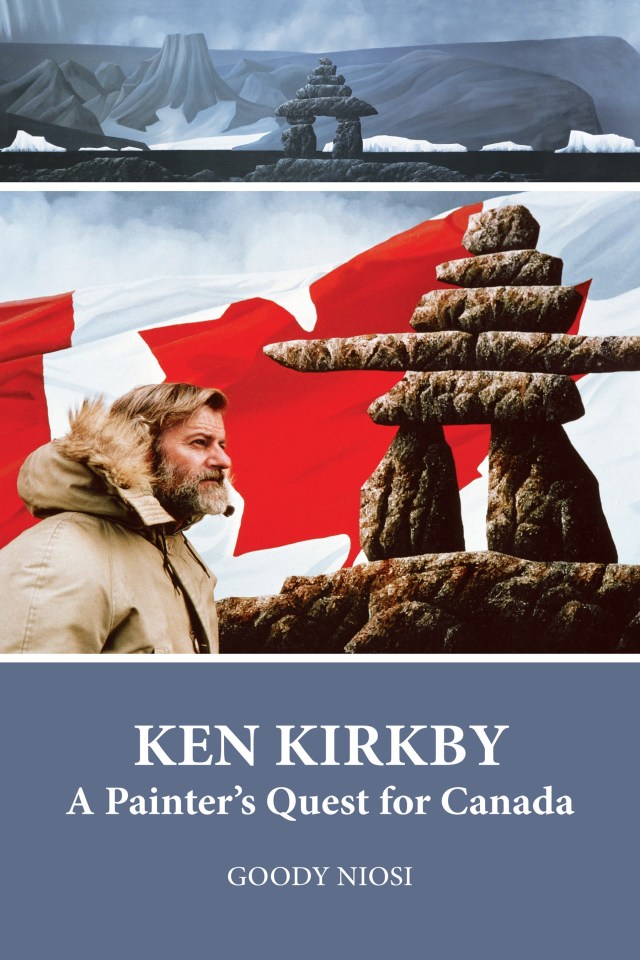
Ken Kirkby, A Painter’s Quest for Canada

excerpt

Keith nodded. “Well, that’s something I want to talk to you about. I can
help you and I want you to help me.” His room bookings for the following
year, when the lodge would be completed, were with Americans and
a handful of Europeans – not a single Canadian on the reservation list.
“You seem to have a great capacity for publicity and getting media attention,
and I’d like you to help me. In return, you can come and stay here,
have the use of airplanes – anything you want. But I need you to help me
to get people to come.”
Ken thought about the problem and suggested a slide show in his studio
with multiple projectors. He enlisted the help of Avril and Roberto;
they commandeered Tergey, the young Norwegian pilot who worked for
the lodge.
As Keith had predicted it wasn’t long before they heard the sound of
an approaching float plane that glided to a landing on the lake. It pulled
up to the dock and two men stepped out. They shook hands and asked
Ken what he was doing at the lodge. “Fishing with my son,” he said, and
excused himself, explaining that it had been a long trip and they were
tired.
They crawled into their sleeping bags, pulled caribou hides over them,
and drifted blissfully off to sleep. Too soon, a hand shaking his arm woke
him. “There’s someone I want you to meet,” Keith said.
Joan Scottie, a reserved and beautiful Inuk woman, had been born
about two miles down Ferguson Lake. “Joan has been a friend for years,”
Keith said. “She’s here to help us finish building the lodge. She is the most
capable human being you will ever encounter. There isn’t anything she
can’t do. She was born in an igloo and is a computer expert. She is also
the finest hunter and fisher you will ever meet.”
Joan was also a photography buff. She took Ken to her hut near Keith’s
home and showed him a collection of photographs. Her Scot and Inuk,
father, Basil Scottie, who was almost totally deaf and dumb, glared fiercely
at the camera. Another photo showed her family, two men, and seven
women, standing formally in a row, dressed in bleached white hides with
intricate designs.
“I think I have been where these pictures were taken,” Ken said, studying
them. “But I can’t be sure.”
“Yes,” she said. “They were taken near here and you were there.”
“How do you know?”
“I heard.”
“Who told you?”
“Old folks.”
“I had an incredible experience – a horrible experience that never left
me. It was somewhere in this region – a lot of people died.”
“Yes, I know.”

https://draft2digital.com/book/3562830

https://www.amazon.com/dp/0981073573

Blood, Feathers and Holy Men

excerpt

Brother Rordan, tied up alone in another hut, wondered about his new friend, Ul.
So far, no one had been able to get him to say more than a few words. Rordan still
knew nothing about him except for his strange name.
Brown Bear and his son, Running Deer, returned from mourning at the Island
of the Dead to find the camp deserted. Corn Mother was gone but had drawn into
the sandy soil at the door to his lodge a picture of the hunt. He erased the message
meant for his eyes alone.
A young Native with spear stood watch while Rordan relieved himself at a long
pit, dug some distance from the huts. As he squatted, he looked toward the hut
where he’d spent the night, hoping for some sign of the others but he was alone
with his guard. Perhaps they were only being let out one at a time. His business
done, Rordan was led back to one of a dozen or more small huts. The huts were
slung low and covered with sheets of thick birch bark woven between saplings. At
the centre of the camp, several Native women ground corn and roots on a large flat
rock surface with wooden mortars.
In the semidarkness, Rordan’s guard tied his hands behind his back and attached
him once more to the centre lodge pole. Another Native came in with a wooden
bowl of corn mush and baked fish and tried to feed him but he refused to open his
mouth. Rordan heard distant drumming and felt a headache coming on. His eyes
burned but he couldn’t close them. The Native gave up his attempt to feed him and
finally left with the food bowl. Rordan preferred the quiet and darkness.
Brown Bear asked to see the captives. He looked in on two but did not recognize
either. In the farthest lodge, he saw Bjorn, his companion from the night of
the hunting feast, tied to the lodge pole, refusing to eat the food being offered by
Broken Wing. Brown Bear took the bowl and sat facing Bjorn. As soon as Broken
Wing left the lodge, Brown Bear untied Bjorn and handed him the food bowl.
Neither tried to speak. Bjorn wolfed down the corn and fish while Brown Bear sat
and watched his friend eat.
Rordan opened his eyes and gazed down at his previously bare feet now dressed
in gold slippers. His body was covered with brilliant, multicoloured feathers. Rordan
looked up to where a low ceiling had held him in darkness. The sky was filled with
stars. He extended his arms, no longer tied to the lodge pole behind his back and
effortlessly floated up, high above the captors’ village.
He flew with a myriad of birds of many colours, over forests, rivers, and great
expanses of desert landscape with deep canyons and pink sandstone plateaus.
He flew on between mountains capped with snow. Rordan glided above their
frosted solitude then down over a steamy jungle to a vast city on a lake. There
he saw exotic flowers and sparkling fountains and heard strange and beautiful
instrumental music. The birds led him on to another city on a hill. Here were
many pyramids of white and pink stone. People dressed in flowing robes of multicoloured
feathers moved up and down countless steps.

https://draft2digital.com/book/3562826

https://www.amazon.com/dp/1926763106

Jazz with Ella

excerpt

It was delicious and she washed it down with a sip from a tumbler full of what appeared to be neat spirit. She was sitting in the family’s combination living and dining room where the ornate, antique table was laden with small plates of food. Wise in the ways of Russian dining from having partied with Ukrainians and Polish, she knew that these were only the zakuski, the appetizers, and that a more substantial meal would follow. “No, really, now I’m full up.” At least the food is dampening the effects of the vodka, she thought. “How about you, Paul?”
The man referred to as Paul looked up from a plate of bread and sausage and smiled shyly. “Thank you. You are good hosts,” he murmured.
“Your Russian is so good. Did you study long in university?” asked Marta of Paul while Misha seemed distracted and regarded Jennifer solemnly. Paul-Volodya did not reply right away and Marta was interrupted by the sound of something bubbling on the stove. The afternoon so far had been wonderful, full of affectionate hugs and cheerful toasts toward Jennifer, friendship in which she reciprocated and in which Paul had been generously included. Their daughter, Nadya, was at school but the couple promised that she would return home very soon.
After refreshment, the cousins had spoken of their own hopes to leave the Soviet Union and live in Canada. The nervousness with which they raised the topic and the intensity with which they spoke made Jennifer realize how important this move was to them. They would need help and support in Canada. She didn’t know much about Canadian immigration laws, but wouldn’t they need a sponsor? Someone from within the country—a relative who would vouch for them, promise to provide for them? She thought at first of her mother as the closest relative but had an uneasy feeling these two were grooming their newfound cousin for the role.
Yet nagging questions persisted. Were they truly related to her? She wondered at their eagerness. They seemed to have everything here: a private apartment of their own, not too big but with a balcony that gave a view of the playground opposite. Their daughter enjoyed school and Young Pioneers, they said, and they were both working, he as a technician and she as a bus driver. This last gave Jennifer pause as she tried to envision the dainty, polite Marta in the driver’s seat of a soot-black, fume-spewing bus, but she knew that the Soviet Union was ahead of the west in ensuring women joined the work force in many non-traditional jobs. Marta worked shifts so was off-duty right now…

https://draft2digital.com/book/3562892

https://www.amazon.com/dp/1926763246