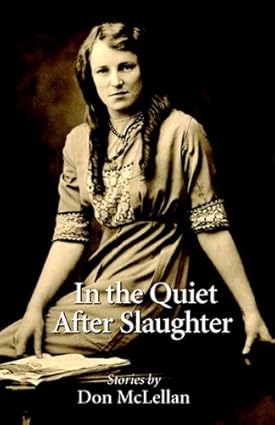
In the Quiet After Slaughter

excerpt

Back on the road, rain-streaked fronds slapping at the windshield,
parrots screeching in the jacaranda trees, Paco asks if Witherspoon
would care to meet his fiancée, Carmela.
– A little detour, he says. It’s not far.
They arrive after nightfall. The settlement is without electricity;
oil-fueled torches illuminate the village’s muddy streets. Witherspoon
unfolds a map on the hood of the Datsun and searches with his flashlight.
– What do you call this place again?
– Absolución, Paco says. It means — he consults his phrasebook
— forgiveness.
Carmela’s folks operate a popular eatery. It has a thatched roof, a
fire smoldering in the stone hearth. The food is superb and the
fiancée as lovely as Paco had claimed. She has copper skin that in the
glow of the charcoal embers shines like a newly minted coin.
– Carmela has two sisters, Paco says. Look.
There’s an enclosure walled in by mosquito netting at the rear of
the family compound. Witherspoon is able to make out a pair of silhouettes.
One sister sways in a hammock, an arm lazily draped over
the side as though her fingers trail through water. The other is
perched on a stool. She is raking a brush through her hair, the back
arched like half a parenthesis, thighs spread.
The Canadian thinks to himself: Forgiveness. What a strange
name for a village.
A backlog of vehicles has been idled by the roadblock. Lined up
around the bend are a few squeaky transport trucks, a second-class
bus with threadbare tires, a taxi painted with dust. Youngsters
trickle from the jungle to sell refreshments to the inconvenienced.
His guard off scrounging a cigarette, Witherspoon stole a glimpse
of the swelling crowd. Some huddled in the shade, readying their
bribes. Others made the sign of the cross, wincing with every blow
administered to Witherspoon’s new friend. The ballplayer supposed
all were as terrified as he—evidently the point of the delay.
The welts on Paco’s face were beginning to change colour.
Witherspoon wondered how much more his friend could endure—
wondered how much he himself could endure. And was he next?

https://draft2digital.com/book/3562874

https://www.amazon.com/dp/0980897971

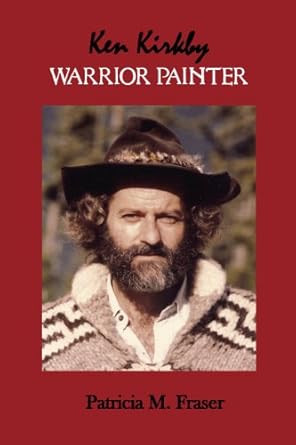
Ken Kirkby – Warrior Painter

excerpt

she was pregnant with his child when she died.
Jessica came into his life a number of years later when he was
working in northern British Columbia. Again, a woman on the fringes of
acceptable society, she was wise, beautiful, self-reliant, and she loved him
unconditionally. Ken met her through her brother, Patrick, with whom he
worked. They were First Nations people filled with the pride of their early
ancestors. There is a saying that home is where the heart is, and Ken found
Jessica’s cozy log house in the ranch country the closest thing to a home that
he’d ever experienced. The lovers spent blissful months together planning
their wedding. It was one of the happiest times in his life.
The perverse hand of Fate nearly destroyed him when Jessica and
Patrick were killed in a horrific accident on icy, winter roads. The pickup
was still burning when Ken arrived at the scene, his last hope extinguished
when, through the shattered window of the burnt out vehicle he recognized
the sleeve of Jessica’s buckskin coat, the mate to the one he was wearing.
The traumatic image of the fiery wreck haunted his dreams long after, and
virtually drove him into the Arctic seeking some form of peace.
On his return from the years spent in the Arctic, Ken entered into
a comfortable relationship with Helen. She was a settled, intelligent
schoolteacher who appeared to support his drive to re-establish himself
as a painter within the Vancouver art scene. He was not the first man to
marry under the mistaken belief that his woman accepted his stipulation
that fatherhood was not in his plans. Ken clearly understood the depth of
his own drive and focus and believed that, consumed as he was to right the
wrong that had been done to the Inuit, he had nothing left over to give a
child. But he had not reckoned with the determination of a woman bent on
motherhood.
When Michael was born, Ken was immediately captivated by this tiny
bundle of human life. Torn between wonderment and reality, he knew that
his kind of obsessive dedication to the northern problem left little time for
the sort of nurturing his own father had given him. What was done could
never be undone however, and Ken did his best to provide for his family
both financially and emotionally. Things proceeded relatively smoothly for
a handful of years, although Ken never quite trusted Helen in the same way
he had before the unexpected pregnancy. Happily though, over the years, he
and Michael crafted a wonderfully strong, mutual love and the young man…

https://www.amazon.com/dp/B00CB8W4CG

Ken Kirkby, A Painter’s Quest for Canada

excerpt

trying to meet you for years,” he said. Gruber carved decoys, many of
which had made their way into Ken’s extensive collection. “Our paths
have crossed many times,” he said. “But somehow we’ve never met. Now,
unfortunately, we have to meet under circumstances that aren’t the best. I
work for a credit company, and I have to cancel and pick up your gas card.
I’m awfully sorry to do this.”
“That’s fine,” Ken said. “You’re just doing your job. Come over now.”
They talked, while consuming an entire bottle of Scotch, and became
friends for life. Ron and his wife lived in a big house near Jericho Beach,
that had separate living quarters on the ground floor. When Ken told him
he had just lost his house, Ron suggested he move into their ground floor
suite, and a few days later, Ken loaded his possessions into his truck and
drove to Jericho Beach.
Revenue Canada sent a letter demanding a large sum of money in back
taxes on his real estate investments. Because he had never taken the money,
but only reinvested it, it had never been taxed. Ken put the letter on his
bureau. Another letter arrived and then another, until he had accumulated
seventeen progressively threatening tax notices. The final one informed
him he was being sued. Ken took the notices to his accountant who was as
puzzled as Ken. Each one demanded a different sum of money.
When they went to court, the lawyer for Revenue Canada made his
statement. The judge turned to Ken. “Guilty or not guilty?”
“Not guilty,” Ken said. “Impossibly and completely not guilty.”
“How so?”
“Your honour, if I may be allowed to approach the bench and present
you with the situation in writing. But, before I do that, may I ask you a
question in order to help clarify the situation?”
“What if one were walking down the street,” he asked, “and came across
a car lot, and spotted a car he fancied, and wanted to buy it, and the salesman
didn’t know how much it cost? And what if he went to his sales manager
and the manager, also, didn’t know how much it cost? And what if
he went to the owner of the car lot and the owner didn’t know how much
the car cost – would one be able to conclude a satisfactory transaction?”
“Clearly not,” the judge said.
“This would appear to be the same situation,” Ken said, handing the
demand letters to the judge. “There are seventeen different notices here,
which are completely confusing. There is no way, even according to the
accountants I am acquainted with, to make head or tail of it. Every single
one has a different figure on it: that makes no sense at all.”
The judge studied the demands, his frown deepening.
“As far as I’m concerned, I don’t owe the money,” Ken said.
“I think you’re absolutely correct,” the judge said. “This is disgraceful.”
And he threw the case out of court.

https://www.amazon.com/dp/0981073573

Swamped

excerpt

Eteo’s thoughts took him back and forth between this pleasant
Vancouver afternoon with its sea whispers and almost imperceptible
sounds of the people around him and the lonely days of his childhood
when his father was far away and he and his brother struggled
to understand why. He was on the way back to his car when Logan
called to ask whether he should dispose of all the shares of the underperforming
real estate company that another client, Tom Batsas,
had in his account and switch Tom to Platinum Properties or keep
some of the real estate shares and buy Tom just a few of the new company.
Eteo advised him to tell Tom to sell all the underperforming
shares and put all the funds into the new company, which would give
Tom a good chance of making something out of this one.
When he had almost reached his car, Eteo spotted Frankie again.
This time the promoter was with two other people, Sandra Wilson, a
well-known Hollywood actress, and a young man he did not recognize.
Frankie gestured for Eteo to join them and introduced him to
the actress, whom Eteo had already recognized, and the young man,
who was introduced as Ricardo. As they shook hands, Frankie told
his companions that Eteo was an investor and a good supporter of
Lionsgate Entertainment.The others responded politely, but what impressed
Eteo most were the simple manners of the famous actress.
She spoke to Eteo as if she had known him all her life, as did Ricardo,
even though the encounter was brief and they only exchanged the
usual pleasantries.
All the same the encounter made Eteo want to find out more
about Frankie’s new venture into the realm of Hollywood and of actors
and actresses who were paid at the level of Sandra Wilson. He
knew she was one of the most highly paid actresses in the world. Perhaps
it would be a good idea to invest some of his clients’ money in
this new company, but he hesitated. He was unfamiliar with the industry.
Recommending Lionsgate Entertainment would be taking a
chance unless he delved into the details, especially the earnings potential
and success rates of such ventures. Of course, he knew very
well that every time someone put money in a company it wasn’t …

https://www.amazon.com/dp/B08WP3LMPX

Ken Kirkby, A Painter’s Quest for Canada

Excerpt

back to camp, where he presented them to the old woman. She nodded
and smiled, laying them out in a row and then producing a half-moon
shaped object made of iron. Pointing to it she said, “Ulu.”
“Ulu,” Ken repeated.
Deftly, she skinned the animals with the homemade knife and cut
them into sections. Another woman shuffled over carrying a large pot
into which they placed the meat.
And everything was unspoken. This was a world in which each person
knew what to do. You didn’t; have to chatter about it. It seemed you only
talked if there was something really important that needed to be said. There
was something very appealing about that. I wondered how much of what we
talked about was utter nonsense.
Ken asked the hunter about the silence.
“No, we don’t talk much,” he said.
“How did you learn English?” Ken asked.
“Hospital.”
“Hospital?”
“TB. I was in the hospital.”
After a long silence he said. “Good rifle.”
Ken nodded.
“Too expensive,” he said. “The bullets – too expensive.”
“Twenty-twos are cheaper?”
“Yes.”
“Where do you get them?”
“It’s very hard to get them.”
“Do they sell them in the village across the river?”
“Yes.”
“So why don’t we go over there?”
The man didn’t answer.
“I can go over there,” Ken suggested.
“Good idea,” the man said.
“Would you like me to go over there?”
“Yes.”
“How do I cross the river?”
The man walked to a clump of willows, growing waist high on the
riverbank, where a big freighter canoe was hidden. Ken shouldered his
backpack, tucked a wad of money into his pocket, and climbed into the
canoe. The current carried them swiftly downriver. The man steered with
the tiller and his paddle, angling them toward the opposite shore. On the
bank, they pulled the canoe ashore and dragged it into another clump of
willows. Ken shouldered his pack and walked into town.
The village was a ramshackle collection of caribou hide tents, canvas
tents, and buildings cobbled together from the flotsam and jetsam

https://www.amazon.com/dp/0981073573