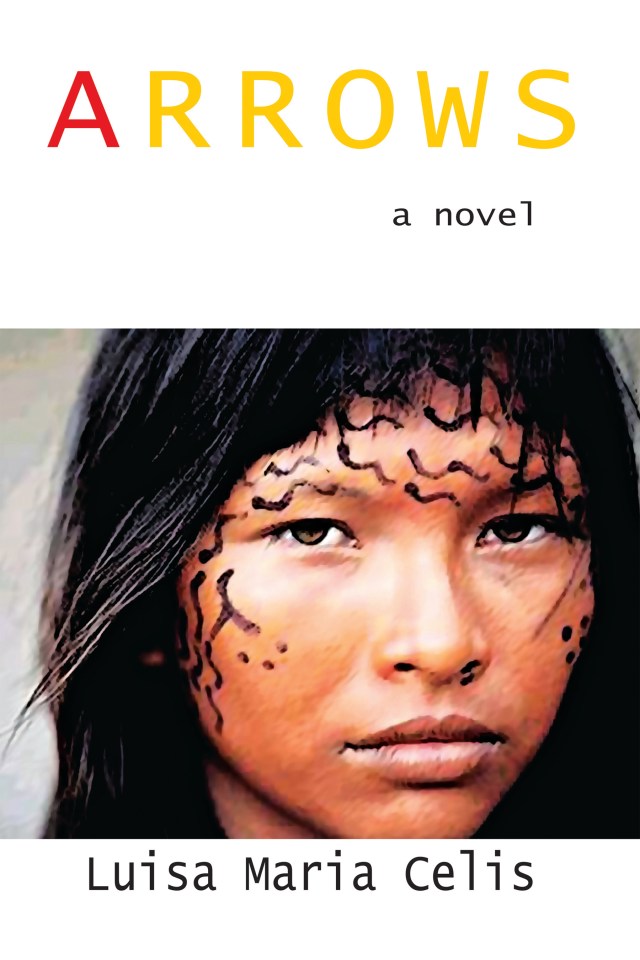
Arrows

excerpt

thundersticks of the white men, never making it to the appointed
battlefield. Others fell under the hoofs of the frightening beasts or
were stuck by the long spears while trying to break through metal
with their wooden swords.
Guacaipuro and Paramaconi persisted in their attempts to pass,
thinking that the rest of the coalition must long be engaged in battle.
Precious hours went by. It was past noon when Losada, sick to his
stomach in bed, was notified of the unnatural gathering of savages
on the outskirts of the city.
The several caciques that had opted to wait and those who had
wanted the charge soon found the choice made for them. I was told
later by Benjamin that Losada dressed leisurely when alerted to the
Indian presence, showing once again the temperance that had
always characterized him. He chose thirty men and appointed the
rest to the protection of the city.
The cavalry went out first, forming a crushing front with horses
bred and trained for bodily conflict: horses that would kick, turn and
caracole on command; that would not shy away from the sound of
battle; that would dismiss wounds as long as they could stand. The
infantry followed, finishing off any stubborn traces of life. Many
Indians fled in confusion, but it was a massacre all the same.
In my days with the conquistadors, I heard many stories of battle
and triumph. In those accounts, there were always thousands of
Indians attacking a handful of heroes who, despite the odds,
managed to come out victorious. The Indians could not possibly win
simply because of their inferior means, but had there been so many
thousands, as the Spanish accounts relate, I am sure no Spaniard,
half-breed or traitorous Indian would have survived.
From living amongst them, I knew there was no lack of courage or
commitment from the Indians. On that day, according to Benjamin,
after the Spaniards had thought most of the Indians were dead or
had withdrawn, a solitary voice defied Losada. There, amid corpses
and dying friends, stood Tiuna with gold bracelets on his arms and a
gold pendant on his chest. He was a warrior from the Caracas
Indians, of which Catia was cacique.

https://draft2digital.com/book/3562848

https://www.amazon.com/dp/0981073522

Arrows

excerpt

Arrogant and stupid, that’s what I was. And being what I was, I
failed to stop the last great war. I hesitated. I waited too long.
One night I was startled awake by drums in the small hours
before dawn. Indians used hollow tree trunks that were remarkably
loud, hitting them with sticks of about the length and diameter of a
forearm. The women started a hellish racket that would have
awakened Lazarus.
I went outside and found the fires blazing and a sizable group of
women walking rhythmically about in single file, each with a hand
on the shoulder of the next in the firelight.
Some men stood while their women painted their bodies with
crushed onoto seeds mixed with ashes and adorned them with
feathers. Others were ready and gathering their weapons. There was
tension in the air. I made my way through the confusion in search of
someone who could explain what was happening.
I went to Guacaipuro’s hut and saw him standing very still at the
entrance, his gaze lost in the distance. Beside him, Baruta, painted
and feathered, waited unobtrusively. Someone tapped me on the
arm. Pariamanaco was breathing fast, a stern expression on his
boyish face.
“What’s happening?” I asked him.
“War.”
“Who? Where?” I asked.
“The city they founded.”
“Santiago de León de Caracas?”
He shrugged, curving the corners of his mouth. Those words
meant nothing to his ears.
“I must talk to your uncle.”
“He ordered to be left alone. He doesn’t want to talk. All caciques
will bring their men. They will meet at Maracapana. It is too late for
talk.”
“Maracapana?”
He shrugged. He didn’t know where that was. He had never been
more than a few miles from the confines of the village.
Gaucaipuro stood while Urquía ceremoniously placed a jaguar’s

https://draft2digital.com/book/3562848

https://www.amazon.com/dp/0981073522

Blood, Feathers and Holy Men

excerpt

the ship’s rail while Brother Berach bathed his fevered face. Hrafen climbed aboard
in a fury of curses. First, he picked up the bucket of water Berach had been using and
dumped the contents on the two monks. Then he grabbed the protesting Berach by
the back of his tunic, swung him around, and flung him against the rail. The old man
lay unmoving on the deck.
Brother Keallach had taken a few moments from the hot job of caulking to
come on deck to relieve himself over the side. On seeing what was happening between
Hrafen and the two elderly Brothers, he bounded to the prow to face the
bully. Though he shook with anger at such an unwarranted attack, he held himself
in check while the Norseman continued his tirade. When Hrafen bellowed that the
two old thralls must have been responsible for the ram’s escape in the first place,
Keallach, who had seen how the animal bolted the moment it was released from
its pen on board ship, could neither speak nor understand the Norse tongue. As it
was, the two men stood glaring at one another. The Norseman picked up the empty
bucket and flung it with all his might toward the open sea. Then he stomped off to
the far end of the knarr.
Finten, Rordan, Ailan and Lorcan came on deck, along with Atall their guard, to
see what was going on. But Kyrri was sufficiently deaf that he had not been disturbed
by the ruckus on deck. He just carried on caulking and did not come up until he
noticed his helpers were gone.
Father Finten knelt in a slowly forming puddle of blood to hold the old man, now
limp in his arms. Brother Berach’s neck hung at an odd angle, blood trickling from
his open mouth. Rordan and Ailan crossed themselves and dropped to their knees
in silent shock, tears streaming from their eyes. Keallach stood glaring at the bully,
holding his own anger.
Brother Lorcan did not kneel. He looked at Keallach, turned to follow his gaze toward
the killer and slowly, deliberately walked toward him. By the time they thought
to hold him back, it was too late. Hrafen picked him up with both hands around his
throat, shook him violently and heaved him over the side.

https://draft2digital.com/book/3562826

https://www.amazon.com/dp/1926763106

Arrows

excerpt

When he had finished with my face, he gave me an appreciative
look and nodded his satisfaction. Then, he extended the gourd to me
and told me to do the same over the rest of my body. I was reluctant
at first, but after a spell he left, and I began to feel the itching ease.
Good enough for me, I thought, and proceeded to do as I was told.
I was squeezing the last of the sap and applying it to my groin
when Guacaipuro appeared, still wearing his perpetual scowl.
“Mareoka,” he said.
Apparently he was resuming our conversation. He extended his
hand, palm upward. I looked at it stupidly and then at his
countenance, failing to grasp his meaning.
“Mareoka,” he repeated. He thrust his hand toward me again. I
felt as though there was a tiny monk running amok inside my head,
looking in every corner for something related to this one magic word
that was the gateway to his witchcraft.
“Ah! Mareoka!” I slapped my forehead, as if I suddenly
understood.
For the first time, Guacaipuro smiled, as if he had finally won me
over. From the pocket of my habit I extracted my copy of the New
Testament that he had previously rejected by tossing it onto the
ground. I offered it to him again. “Mareoka,” I said, solemnly.
If I was agreeing that Mareoka was superior, it was only to allow
me the freedom to prove to him otherwise. I hoped God would
forgive me.
“Tamanoa,” I said, pointing to my friend.
Guacaipuro was more interested in the strangeness of the book. I
seized the opportunity to take advantage of my newfound
respectability by untying the ropes. Guacaipuro did not appear to
object. I moved slowly, deliberately, until Tamanoa was able to
stand beside me, free.
Guacaipuro shook his head, dissatisfied. He took the rope and
tied Tamanoa’s wrist to my wrist. This was his compromise
solution. I must not allow my servant to run away. As soon as I
gleaned his intent, I yanked hard on the rope, jerking Tamanoa
beside me.

https://draft2digital.com/book/3562848

https://www.amazon.com/dp/0981073522

Arrows

excerpt

We hobbled jerkily, as directed, like some pathetic, three-legged
creature, until gradually we learned to swing our shared leg in
unison. In this humbled manner we were brought before the war
council of caciques.
The caciques were seated in a circle, with Guacaipuro given no
special place of honour. I was surprised to find Baruta among them.
Apacuana later told us that he had recently been made a cacique and
his body still bore the scars of the tests he had completed.
These were men who exuded confidence and authority, not the
kind of men one would cross unnecessarily. Their reputation for
bloodthirstiness coloured my apprehensions. I wondered if perhaps
we were meant to be slaughtered before them, as some sort of
ceremonial prelude to war.
I knew as well as Tamanoa that these Caribs were warriors,
conquerors in their own right. For generations, they had moved
from the south of the mainland to the northern coast, fighting their
way and conquering the gentler Arawaks.
Caribs fought among themselves, too, and made trading
incursions to the islands north of the mainland from which they
obtained not only goods, but also women. Not surprisingly, such
men were not inclined towards plans for surrender.
Though most of these men wielded authority over vast expanses
of land, Guacaipuro was chief of six other villages besides Suruapo.
Consequently it was the military strategist Guacaipuro who had
summoned the caciques of seven neighboring nations.
Whispering, Tamanoa quickly explained the gist of the
situation: Losada had founded the city of Santiago de León de
Caracas upon the settlement of San Francisco, and for the natives,
this had but one meaning: war.We were present because a cacique
called Mamacuri from the coast was arguing in favour of using the
shaman of the white men to obtain inside information about
Losada and his party.
Other caciques, like Paramaconi, great chief of the Toromaynas
from the valley where the new city had been founded, were more
inclined to kill me. Catia agreed with Paramaconi.

https://draft2digital.com/book/3562848

https://www.amazon.com/dp/0981073522

Blood, Feathers and Holy Men

excerpt

Eagle Talon and his son, Honiahaka Little Wolf, emerged from the forest with a
magnificent buck slung from a sapling pole between them. The two men paused to
rest and massage their aching shoulders. Below them stretched the mighty water,
birthplace of the sun and home to the great creatures who blew fountains into the
air. It was also home to the friendly man savers.
As Eagle Talon looked far out to sea, he remembered how his youngest son, Kosumi,
was washed out of his canoe by a savage wave. He thought he’d lost his son to
the sea, but two man-size sea creatures, those who blew fountains of water into the
air, came to Kosumi and swam him safely to shore.
From that day forward, the Nation declared these man-savers Friends of the First
Light People. Never again did they hunt them for food. Since that time, the sea mammals
leapt from the water to greet the young men whenever they sailed out to spear
the white fish or to dive for the clawed sea-cleaners.
Eagle Talon whispered his thanks once more for his son’s life. Then he whispered
his thanks to all the creatures of the sea that fed his family and his people.
Little Wolf saw it first and crawled on all fours to the edge of the embankment for
a better look and beckoned his father to join him. On the beach below was a great
canoe, big as a longhouse. Strange, white-skinned men with hairy faces shouted at
one another and banged at boards of split pine, inside. Outside, men were painting
the frightful beast whose head was a double serpent totem of scarlet, blue and green.
Eagle Talon and his son watched in awe. They must return quickly to the village.
Surely the sachem, White Eagle, would have an answer to the appearance of such
strange visitors.
Since Eagle Talon and his tribe greatly respected White Eagle as a wise elder, a
confederation of villages elected him sachem. He governed the people of his district,
upheld the law, allocated farmland according to the size of each family, collected
tribute, provided for widows and orphans, and taught all boys up to the age of sixteen
the arts of manhood. He also acted as arbitrator, whenever war threatened.
White Eagle sat erect. His grey hair flowed unadorned in long shiny strands to
his lower back. He wore a beaded doeskin jacket, pants and moccasins. The sachem
raised his hand to call for calm and addressed the gathering of braves.
“My brothers. These strangers have surely come in peace. Let us welcome them
with gifts of food, as is our custom. We will honour them with song and dance at our
Lodge Fire and celebrate Broken Wing’s success in the hunt. If they allow us, we will
help them repair their strange craft that they may soon be on their way.”
The gathered braves turned to one another in discussion. Then they voted by a
show of hands to follow the sachem’s advice.
White Eagle continued. “I will approach the strangers at their camp. Broken
Wing, Crow Foot and Eagle Talon will bring sweet corn, the gift of the gods, and
fresh salmon. I go to prepare my face and body with red earth as a sign we are men
of the earth.”
Freki, ever on the lookout, was the first to see the four Natives approach the fire.
They wore only tan breechcloths. Three of the Natives wore crow and turkey feathers
in long braids. They had their heads shaved except for a long strip of stubble…

https://draft2digital.com/book/3562826

https://www.amazon.com/dp/1926763106

Blood, Feathers and Holy Men

excerpt

“True, but first we must find a safe shore and make repairs to the prow. She is
ready to break up if we run into more rough weather.”
“Fresh water is running low, and we need fruit and vegetables to stop the spongy
gums and bleeding. Several men are quite sick. Their wounds from the sheep capture
are not healing.”
Hjálmar was the last to speak. “Well, then, we will let the current carry us farther
south. There is land to the west, but ice still floes between here and that far shore. We
have plentiful fish and fresh lamb on board to last us to safe harbour.”
When Captain Hjálmar informed the crew of his decision, they expressed their
approval with a loud cheer. Only Ari voiced disappointment to his new friend,
Brother Lorcan. “Now you will not get to meet my brother, Melrakki, nor fish with
me in our mountain streams, nor ride our Norse horses. But most of all, I will not
see my dear father whom I miss so much. We argued when I left to go to sea. I have
been away from home so long that he will think me drowned as he threatened I
would be.”
With the tremendous pressures of having to fight currents, winds, and unexpected
disasters finally over, Norsemen and monks alike began to relax, to enjoy the
leisurely voyage south. Some mended clothes. Some whittled dogs, horses and sheep
out of bone and driftwood as toys for their children at home. Others fished by attaching
gut line to small blocks of wood. With rock weights and bronze fish hooks
baited with lamb liver, they hauled up cod hand-over-hand as they sailed once more
over open water, steadily southward. The diet of fresh fish was welcome, although
several of the crew were experiencing sores and lesions in their mouths and on their
lips caused by lack of fresh vegetables and fruits.
Brother Rordan at last sat talking with Ul beyond the almost silent sheep pen.
The captain’s thrall had given up trying to avoid the Celtic monk who had been so
insulting.
“Please forgive me and trust me to be your friend. If we were to be sold in Thulé, I
doubt if we will be now. Whatever time we have left, I would like to get to know you.”
“I bloody well doubt it. There’s not a member of Hjálmar’s crew wouldn’t like to
get his filthy hands on me, and if he catches me talking to you, I’ll be in for a beating
and so will you.” With that, the Irish thrall rose to his feet and slipped away.
Eighteen days after the eruption off Thulé and five since their ice encounter, a
huge whale, almost sixty feet long, began following the ship. It blew a fountain of
water higher than the ship’s rail. Then, with a massive sigh and a gentle rippling of
the water, it sank beneath the surface and reappeared far ahead. Later on the same
afternoon, the Norsemen were visited by a shining black pod of killer whales. One
by one, the dozen beautiful mammals moved gently under the hull and resurfaced
on the other side, blowing water like Moorish fountains.
Captain Hjálmar saw the visit as a good omen. “Tomorrow,” he told the men, “we
will find good harbour and all will go ashore.”
That evening, everyone drank toasts of mead to Ægir, King of the Sea and to the
Sækonungar, protectors and patrons of Nordic sailors and explorers. Every Norseman
also drank to the Irish God who had delivered them from an icy grave.
Finten felt a sudden surge of excitement as he recalled stories told to the student

https://www.amazon.com/dp/1926763106

Arrows

excerpt

voices when the breeze allowed it. Looking for so long into the
distance, we were completely unprepared to turn and see five men
behind us.
Even before we could rise from our crouching positions, five big
warriors, scowling fiercely, materialized from the bushes, pointing
arrows at us.
“I looks like you may never get to know Guacaipuro, my friend,”
said Tamanoa.
I could not imagine ever responding with such aplomb. This was
his way of retaining control of himself, not showing fear. He was
showing me what to do, how to face death. Or to avoid it. I
mimicked Tamanoa’s stalwart behaviour, literally at ever step, as
the Indians led us into the village; two ahead of us and three behind.
In the days and months that followed, our captors would assume
Tamanoa was my servant because he was a half-breed, and yet it
would be Tamanoa’s ability to interpret their speech and their
behaviour that would keep me alive. Without Tamanoa, I would
never have been able to develop the language skills that enabled me
to talk to Apacuana, and I would never have survived to tell this
tale. But it was God’s will, or the way of Mareoka, to make everyone
assume I was the leader.

I was as lost as I have ever been as we marched to the village at
arrow point. People gathered on the trail and around an open space
dominated by the imposing figure of a man who could only be
Guacaipuro. The sun shone directly above our heads, gleaming
silver on the silky raven-black hair of Guacaipuro, whose face was a
mask chiselled in stone. His eyes were ominous black slits. The
hollows of his cheeks were elongated shadows.
He stood immobile, his chest heaved, and deep lines creased his
brow. The corners of his mouth were pulled down in outright
loathing. He held a spear, the butt resting on the ground.
As we approached, he held the spear almost to my chest, glaring

https://www.amazon.com/dp/0981073522

Arrows

excerpt

Although she had suffered terrible humiliation at the hands of
Gregorio, and possibly Baruta, there was nothing weak about her.
She was undefeated, strong. Like the jaguar, I thought, bold and
proud. Perhaps Tamanoa found her independent spirit was
unbecoming for her sex.
As she bathed, Apacuana told us more. The night before,
apparently Baruta had gone to the river looking for her in vain.
When she returned, they argued, for she had told him she was going
to get water; instead, she went to feed me. That night she had cried in
my arms because Baruta wanted to take her with him to Suruapo,
Guacaipuro’s village up in the mountains, as his woman. Apacuana
had refused and ended up telling him she did not want to marry
him, at least not yet. Baruta had reached for the macana, intending to
hammer some sense into his betrothed.
As I had guessed, Baruta had pressed Yulema into talking. She
sang like a nightingale, telling him everything except the precise
whereabouts of the cave. Instead she had led him off the track,
thereby allowing time to forewarn Apacuana. Fuming with his
inherited hatred of white men, Baruta had set off to find me, but he
had looked further east of the river.
“Will Baruta keep looking for us?” I asked.
She thought not. Guacaipurowas anticipating Paramaconi’s answer
with the greatest urgency, and so Baruta’s duty to his father would
have to take precedence. It was very important business, Apacuana
told us. Paramaconiwas being summoned to a war council in Suruapo.
The meeting would take place very soon, in a matter of days.
All the principal caciques of the region were being called upon to
unite forces in a major attack against Losada in the valley of San
Francisco.
I waded further downstream where I might discreetly disrobe
and wash my privates. I was obliged, by my race, to warn Losada,
but Apacuana had just run away from her betrothed because of me,
she had been raped by Gregorio, and I couldn’t possibly take her
back to the valley of San Francisco.

https://www.amazon.com/dp/0981073522

Blood, Feathers and Holy Men

excerpt

Fire and Ice
For several days, the ship lay on a becalmed sea. While Finten and Ailan sat discussing
their worst fears – their slavery, the long cold winters, and uncertainties of the
future – bubbles began bursting on the water surface, becoming more and more
intense as the ship drifted slowly landward. When several fish popped up to float
dead on the water, one of the men reached over the side to retrieve a floating cod. He
remarked that the sea felt amazingly warm. Two other crew members reached into
the water and pulled out a small halibut. Everyone gathered around in amazement.
As more Norsemen plucked up floating fish, the meat fell apart in their hands
and onto the deck. When the first man remarked the fish he’d pulled up smelled
fresh-cooked, he pushed back the scaly skin and took a tiny nibble then another
and announced that it tasted good. Another sniffed then took a nibble while others
watched. Those who had dared to taste ate on and other Norsemen reached over the
sides for fish and laughed as they ate.
The Brothers joined the crew at the ship’s rail but by then hissing hot air burst
close to the prow and pulsating plumes of sediment, the colour of egg yoke, rose to
the surface and surged all around the ship. Clouds of yellow steam filled the air with
the smell of sulphur, making breathing difficult. Then a slow-moving cloud of white
smoke enveloped the ship and droplets of rain burned exposed skin, causing blisters.
The men dropped their fish and ran to the prow in a panic.
Finten’s worst fears had been realized. He knew they had finally travelled too
far and were now on the edge of hell. Soon pagans and Christians alike would be
plunged into the fiery depth. Once more he prayed aloud the psalm of death and his
Brothers joined in: “Out of the depth I cry to you, O Lord. Lord, hear my prayer.”
Captain Hjálmar shouted for calm. “And shut that infernal babbling. You papish
thralls are worse than a bunch of old women. How can I think with all that commotion?”
After about an hour of increasing turmoil in the water, the ship lurched, as a firebreathing
monster rumbled, spurting hot ash into the air. A wave formed, seemingly
out of nowhere, and pushed the Nordic knarr from the seething mountain, which
now burst and heaved its way above the boiling water. Freki ran to his captain. “I
knew it. I knew it. Now we’re all going to die in fire and water.” Everyone on board
cried out to different gods in fear and trembling. Only Captain Hjálmar appeared to
maintain his calm until he bellowed, “Quiet! Pay attention.”
Still Freki jumped up and down pulling at the captain’s cloak and shrieking. Hjálmar
pushed Freki aside and shouted above the din, calling for buckets of seawater
to douse the hot coals smouldering among the panicked sheep. The sky filled
with black clouds. A staccato of thunder and lightning sounded like Thor’s hammer
to the terrified Norsemen, while a monstrous wind roared out of nowhere to send

https://www.amazon.com/dp/1926763106