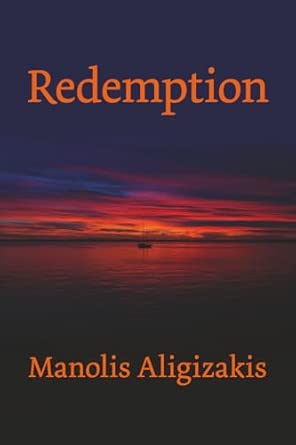
Redemption

excerpt

insisted, so his uncle and auntie said their farewells at home. Eleni
and Hermes met in a nightclub a couple of years ago on the island of
Ios, where they were both vacationing. Hermes loved to play with her
blonde hair, and he mostly enjoyed letting his eyes dive deep into her
blue eyes.
He walked toward the deck bar, passing by the pretty tourist
girl sunbathing. It was not easy to walk along with all these people
sitting or lying around on the deck.
He ordered a cold coffee and glanced around. Next to him was
an old man drinking his lemonade: tough features, wrinkles on
his face, white hair, black circles around his eyes. The old man felt
Hermes’ glance and turned toward him:
“And where are you from, young man?”
“From around here, Uncle,” Hermes answered, imitating the
old man’s accent. It was customary to address an older man as “Uncle”
when one didn’t know his name. Whenever coming to the island,
Hermes liked to talk with an accent close to the locals to conform to
their ways as much as possible.
His coffee was brewed, and he took a slow sip to check it out.
The old man observed his ritual manner, satisfied.
“Could I ask you something, Uncle?” Hermes felt the need to
kill the silence between them.
“Sure. What is it, my son?”
“The island, why is it called Crete?”
The old man raised his eyebrows. Not many people asked this
kind of question.
“We call it Crete because it means wines and meats.”
Hermes was surprised. He never knew. Did this mean that this
island used to be fertile and fruitful, and the people never had to
worry about their food?
The old man turned and asked him.
“What do you do in Athens, my son?”
“I attend the university, Uncle. I am graduating this year.”
“Oh, you are a sand pebble then.”

https://draft2digital.com/book/4172538#print

https://www.amazon.com/dp/1926763858

Yannis Ritsos – Poems, Volume III

14th of November
As we focus our eyes to notice a difference
among the pieces of day, we don’t know how to get
a hold of ourselves, we miss the shape, the hour, colors,
faces. We only listen carefully so that we might
discern a sound that confirms the passing of time,
so we can reverse the performance, box, broom handle,
name, the dice that roll on the table,
the limping wind that stumbles onto the barbwire
the fork that hits the plate and its sound that continues
internally.
Otherwise a circle without a center remains, a whirl
in the air with no movement but its own;
it can’t become a car tire that crosses a forest
and if once it becomes a square
it’s not a window through which you look at the world
or the three lined carpentries in an unfamiliar
neighborhood,
but only the relativity of straight lines, the analogy of corners,
boring, very boring things. A mathematician and
an astronomer could create something concrete and
clear out of all these.
I can’t. Yet I always liked the Observatories; the dark
stairway, the clock, the telescope, those photographs
of stars in homely positions: Orion without his sword,
with no underwear, Verenice with her many freckles,
unwashed, frumpy, a whole urban kitchen
transferred to a metaphysical location, boiling cups,
jugs, casseroles, the grater, salt cellar, baking tins,
white spots, a bit of steam hanging onto the smoked
walls of the night.
Someone was talking of numbers and more numbers,
light-eons, leagues and leagues. I wasn’t listening.
Today a friend was telling me that when he was thirteen
he was selling oranges and lemons in Piraeus;
he also had a young Armenian friend who was selling
socks. During the summer afternoons they’d meet in the
harbour behind a pile of sacks, where they’d put down
their baskets and read poems; then they’d eat a sesame
bread ring and an orange and gaze at the sea, the jumping
fish, the foreign ships.
From today I also have a friend who smells of orange
and harbour. He keeps many evening whistles of ships
in his pockets. I see the movement of the big finger
of the big harbour clock on his hands. From today on,
I’ll love him, I’ll unbutton one of his coat buttons.
Now I think of going to find his young Armenian friend
to find a basket with socks on the road, to cry out, socks,
beautiful socks, cheap socks. At noon, I’m sure I’ll find
the Armenian youth behind the sacks, I’ll get to know him;
he’ll recognize me since we both have the traces of our
common friend’s eyes on the lips. If I missed that
basket with the socks and the one with the lemons I
wouldn’t know how to fill my day, my words,
my silence.
Yet I believe every comrade wishes to have such a basket,
only that I don’t know where to find it and I get angry and
I search.

https://www.amazon.com/dp/B096TLBNFK