
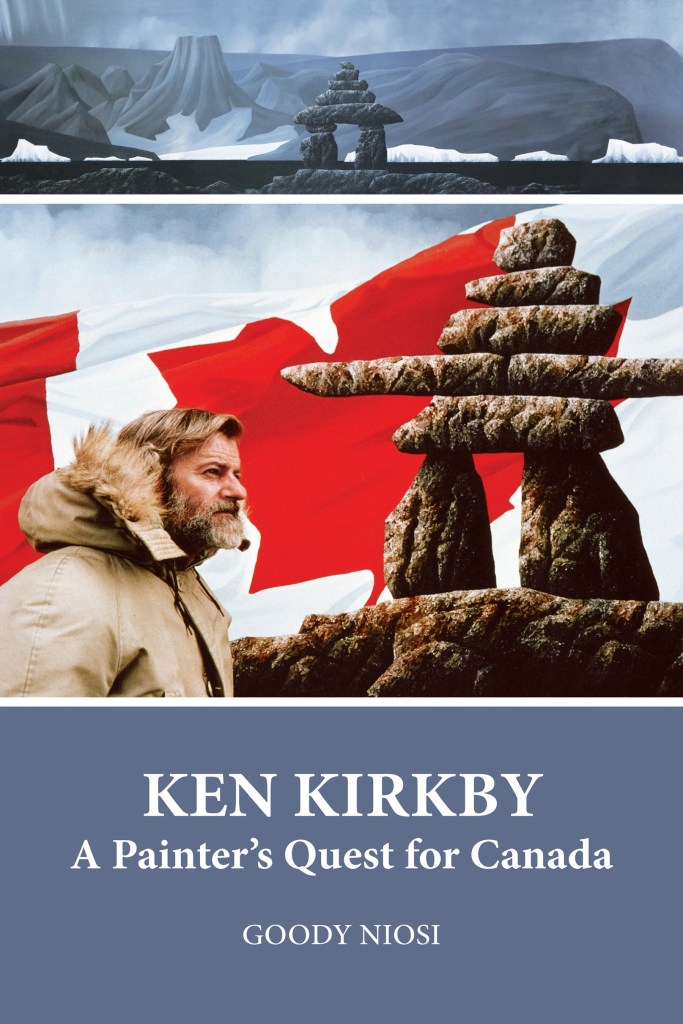
Ken Kirkby, A Painter’s Quest for Canada

Excerpt

never been a connection between those people and the Inuit and yet here was
an original seminal idea being spoken by a woman in a completely different
time and space and place. All these things were like jolts hitting me. Here I
was living with an ancient people that were speaking to me directly. This was
not something being told to me by a teacher or a relative. I was getting the
original story and it affected me very profoundly.
When the old woman finished her story, silence enveloped the igloo like
a down blanket. Quietly, Ken stood and walked outside. The sky was filled
with as many stars as Ken’s mind was filled with thoughts. In one instant,
his life had changed. Knowingly or not, the old women had answered his
question about his role in this place, and in the lives of the Inuit.
She joined him, and he linked his arm through hers. Together they
stood gazing at the sky. Icy crystals of thought invaded his heart, while an
avalanche of ideas roared through his mind.
This was that crystal moment when everything that had happened before
made sense. I now had a clear purpose. I had gone to the Arctic because of
the stories that had been told to me in that cave in Portugal, but now, I felt
an urgency to gather as much information as possible – and to disseminate
it. It was clear to me how brilliantly I had been prepared. From this moment
on, I was no longer pursuing childhood dreams. I had a white-hot fire burning
inside me.
One day, the sun reappeared over the horizon and Ken felt as though
he was awakening from a dream. For a seemingly endless amount of time,
he had lived in darkness, listening to stories and legends, and the line between
waking and dreaming had blurred. And now the sun – a cause for
celebration – a reason for feasting!
Feasting also served to remind them of their great good fortune. They
had food, warmth, and clothing. Even more important, others had been
helped and they were grateful to have been able to help them. The young
man who had amputated his toes had survived, and that was even further
cause for thanksgiving.
As the days grew longer, the polar bears came out of hibernation. One
had been spotted nearby and men quickly prepared for the hunt. Once
again, grandmother prevailed upon the hunters to include Ken. When
the dogs picked up the scent they were released from their traces, and the
men followed their high-pitched howling.
When the dogs found their quarry they surrounded it, darting in close,
and then running back, staying out of reach of its lethal claws. Finally,
overheated and exhausted, the bear collapsed. The hunters fired at the
downed body until it lay still in a pool of blood, and then they began the
enormous task of skinning and butchering it. The oldest hunter stood
back. “In my day, that’s not how we hunted bears,” he said. “When we
hunted, it was one man with a spear and one bear with his claws.

https://www.amazon.com/dp/0981073573

Jazz with Ella

Excerpt

He didn’t seem to have much family left except his grandmother in California and Jennifer felt as if she had been cast out of her own. They sat in the campus centre’s uncomfortable chairs, too hard for sleeping, just soft enough for flopping, smoked cigarettes—even though neither were smokers—and talked far into the night. At first she thought she wanted to sleep with him and made a few subtle overtures.
Jennifer had lost her virginity during the first year of college to a fraternity man who pressed his attentions on her in the back row of the movie theatre. From there, a succession of eager males had dated her but only a few had captured her interest. She didn’t believe in saving it for her husband, but she wanted respect from her partner. She wanted to find the right one—someone to love when lovemaking would be a passionate, full experience.
Paul was good-looking, tall, grey-eyed, with pronounced cheekbones, and as they wandered the campus together, she found herself wondering how he would look naked, whether he would be a good lover. But when she invited him back to her shared apartment for a nightcap, he told her about his girlfriend in Vancouver, a chemistry major who sounded as exciting as two planks of wood. Jennifer backed off. In his polite, contained style, he offered her nothing but a companionship that she would soon learn to treasure. At the end of the summer they kissed on the lips, promised to write to one another and he suggested that she apply for graduate work at his university where they could be colleagues. This parting tenderness made her feel warmer than the parting kiss of her many dates. Paul was special, no doubt about it. But he wasn’t the one.
The summer had scarcely faded into autumn before she met Michael. She had noticed him in the line-up at the cafeteria; he always ate at about the same time each day, moved his tray through the line efficiently, then always sat in the same spot, a table by the door. One day when the cafeteria was full, she thought what the hell and asked if the seat opposite him was taken. Politely, he gathered up his sprawling papers and books and indicated the seat. Then he returned to reading. She studied him. His most obvious feature was bushy black eyebrows. His thick full hair dropped to his shoulders in the current style. He was wearing a white cotton shirt with embroidery and she could see his well-proportioned body through the material.

https://www.amazon.com/dp/1926763246

Water in the Wilderness

Excerpt

Jeff’s lean face took on a scowl, but his eyes twinkled. “I’ll thank you not to malign my good old Chevy, young lady. Sure, I still have it. It’s safe and sound in the shed in the back yard.”
Tyne groaned. “I might have known.”
Jeff’s long, slender body reclined against the back of his swivel desk chair. “So what brings you here? Have you been to see your mother?”
“Yes, I just left her. Aunt Millie was there, so we had a good visit. And as for what brings me here – Morley and I would like you all to come to dinner on Sunday evening.”
For just a moment, Jeff looked at her, then he swung his chair towards his typewriter at the side of his desk, and began to hit the keyboard with one determined finger.
Tyne took a deep breath. “Will you come, Dad?”
“I thought you have dinner at noon on the farm,” he said without looking at her.
“We usually do. But we’ll have a light meal after church, and dinner in the evening.”
The typewriter keys flew over the page in the carriage, surprisingly fast for one finger typing. Tyne waited. Finally, her dad turned to face her.
“I don’t know if I can make it … deadline, you know.”
Tyne tried to keep the exasperation out of her voice. “It’s Sunday, Dad. The paper doesn’t come out until Wednesday.” She sat forward. “Look, you’ve been out to the farm only once, and that was just after we were married to bring some of my things. Morley and I have been to see you and Mom several times. Just for a change, I’d like to cook dinner for my family.” She sat back in her chair, and said quietly, “You’re part of my family.”
Jeff drew his lips together in a tight line. “Have you asked your mother?”
“Yes I did. She’d like to come but she said she’d leave it up to you.” As always, Tyne thought. In that respect Emily Milligan had not changed.
Jeff nodded. “I’ll think about it. Your mother will call you tomorrow.” He turned back to his typewriter.

https://www.amazon.com/dp/192676319X

Still Waters

Excerpt

She felt Morley give her hand an extra squeeze to bring her attention
to the scene before her. People were coming out of the church,
laughing and talking, wishing each other a merry Christmas. Among
them, almost at the bottom of the steps, she saw her mother and
dad. Tyne drew in her breath and waited. Her mother looked in their
direction, and her eyes grew large with disbelief. Then she turned to
speak to her husband.
Jeff swung around. In the light from the doorway Tyne saw his expression
change from surprise to displeasure. Then he walked away
from his wife and came towards them.
Tyne let Morley’s hand go, and took a couple of steps to meet her
father. “Hello, Dad. Merry Christmas.” She lifted her face for his kiss.
It landed, cold and stiff, on her cheek.
“What are you doing here, Tyne? We didn’t know you were coming
home.” He glanced at Morley who had moved to her side. “We
would have met you at the bus depot, you know. You didn’t have to
bring Morley in from the farm. I’m sure he has better things to do
on Christmas Eve.”
“Not at all, sir,” Morley said. “I was only too happy to come. And
I’m pleased Tyne invited me to church with her.”
Jeff cleared his throat but did not reply. He turned back to his
daughter. “Well, I see you’re not afraid of being snowed in, after all. I
only hope, for your sake, that you don’t have to miss any days of your
training this close to the end.”
“I’m sure it will be all right, Dad,” Tyne murmured as she turned
to hug her mother who appeared bewildered and anxious.
Tyne felt her mother’s anxiety, and understood. All her married
life, Emily Milligan had lived in her husband’s shadow, obeying him,
pleasing him, keeping the peace within the family as far as it was in
her power to do so. Tyne knew that whatever her mother said to discourage
her daughter’s relationship with Morley was only a reflection
of her husband’s feelings. She said what she knew he would want her
to say, and felt about it the way she perceived her husband to feel.
Tyne hugged her mother hard as tears stung her eyes. Oh, Mom, I
don’t want to bring you grief. Please try to understand, and be strong
for my sake.

https://www.amazon.com/dp/1926763068

Arrows

Excerpt

Through the smoke I made out the hem of her dress some distance
away. She was kneeling beside an inert body, which was pierced by
an arrow through the thigh and another in the chest. It was her
husband.
Out of the corner of my eye, I saw a near-naked man running. The
smoke partially hid him, but I saw he was tall, with strands of black
hair pasted to his chest by sweat and speed and others floating over
his shoulders. Funny, I thought, I have not seen that kind of long
loincloth before.
Then I realized he was charging toward Josefa. He bore a
belligerent expression, and there was blood on his naked chest
under his quiver’s band. A pang of fear hit me like a bucket of cold
water. Surely he wouldn’t kill a woman, would he?
We were both closing in on Josefa and her dead husband but from
different directions. I was closer than he was. Josefa looked up at the
Indian, open-mouthed and white as the ghost she was in danger of
becoming. I sprinted toward her, heart throbbing, and tore the
buckler from her dead husband’s grasp. There was a serviceable
harquebus lying at his side and the sheathed dagger at his belt but I
didn’t want to use any potentially lethal weapon.
I squared my shoulders and braced myself for whatever might
come. It was God’s choice to see us through or not. I raised the small
shield on my forearm as I had seen others do. His bare feet landed
underneath the buckler, and he delivered a savage blow that
shocked its way up my arm, pushing me back, the clang resonating
in my ears.
He held his arm high, ready to deliver another blow. I was
crouching, peering over the buckler. Josefa yelped. I charged and
overthrew him, grunting like a beast. He fell but was on his feet
before I knew it, the hellish macana still in his grasp. His eyes leered
at me from his horribly painted face. I could feel his anger, his pride,
his hate, but there was a fortitude that sent a chill down my spine.
He turned and swung at my belly, but I leapt backwards as the
macana came within inches. “Run!” I shouted.

https://www.amazon.com/dp/0981073522

Jazz with Ella

Excerpt

Volodya stirred from his place on the bench, one arm over her shoulders. His face betrayed an odd mixture of pride in his home and uneasiness at the conversation. “You have no idea how much suffering,” he replied. “This very spot, these buildings around us, were built by Swedish prisoners of war during Peter’s time. This was a swamp and many of them died working in it, their bodies beneath us in this earth.” He shuddered. “Then, of course, there was bloodshed during the Revolution… That boat—you can almost see it from here, the cruiser Aurora—it fired the first shots after Our Leader, Lenin, arrived in the city to rally the workers in 1917. Those years meant war and famine. There is not much recorded because the state does not want to remember those bad times.”
“The city was under siege again in the Second World War, I know,” added Jennifer, “and many died of hunger.” She felt privileged to hear the stories of its history from a real Leningrader and not from their pedantic tour guide.
“Yes, those years are well documented. The destruction was visited upon us from the Nazis, not from the revolutionary forces.” He fell quiet for a time. “I love this city,” he went on, “but it illustrates a horrible truth. It seems that anything that rises up and is good must always be built on suffering. This city has a legacy of suffering and bloodshed but it has survived, and it’s good. What was that word you used? Joyous?”
“Yes, joyous,” and the thought of the untapped beauty still to be found in this extraordinary place made her swell with emotion. She leaned over to kiss him, not for the physical act of kissing, but because she wanted to seal that thought with something meaningful. He was surprised at her gesture but soon kissed her back. When they finally fell gently away from one another, a few faint stars had appeared in the sky.

On the fourth day in Leningrad she noticed that, suddenly, the stores were stocked with Israeli oranges. Everywhere women shopped in pairs, each carrying one handle of a shopping bag overflowing with the fruit. At the end of a long afternoon together, Jennifer and Volodya stood

https://www.amazon.com/dp/1926763246

Ken Kirkby, A Painter’s Quest for Canada

Excerpt

Ken’s people were caribou people.
When the last of the caribou had passed, they dragged the fresh carcasses
to several large piles of rocks that they lifted to reveal deep pits
lined with more rocks. They lowered the meat into the pits and replaced
the rocks. The main danger to their food reserves was marauding wolverines.
By caching their meat under rocks too heavy for the wolverines to
move, they guaranteed a food supply for the season to come.
The days changed. The shiny green bearberry that covered the tundra
turned blood red and when Ken gazed across the land he saw a river of
crimson. One morning the snow geese flew across in the hundreds of
thousands. When they settled on the land a down blanket covered the
scarlet sea.
The days grew shorter and the temperature dipped dramatically. Ken
shivered in his sleeping bag and the old woman gave him two caribou
hides – one to put under his bag and one to cover it. He developed a new
understanding of the word “cold”. Cold was not simply a word here – it
was a palpable, physical thing, which assaulted every sense – it was the
god that controlled the land.
A few days after giving him the caribou hides, the old woman presented
him with a caribou parka lined with Arctic fox. Through her son,
she explained that this was to be worn without undergarments, next to
the skin. The parka was light, soft and astonishingly warm.
They continued to travel east until they came to a lake dotted with a
number of small islands, where they had left sleigh dogs that had whelped
in early summer. The animals were wild, ferocious, and pugnacious. They
took them back to the mainland where they pegged them to the ground,
placing the lead dog at the front of the pack. Once a day someone tossed
a frozen fish to each dog, which it consumed ravenously. The dogs were
born to pull sleighs and once in the traces would run across the ice until
they dropped from exhaustion.
With the dogs in tow, they continued trekking to the place the old
woman called home. She was a Netsielik, People of the Seal. Her husband,
who had died of TB, was People of the Caribou. TB had become epidemic
among the Inuit. Several people in the group had severe coughs and often
spit up bloody phlegm.
Snow began to stream across the land, blowing from the west in a million
little rivulets. The temperature, already chillingly cold, continued to
drop. The old woman gave Ken a pair of trousers made from caribou hide
and sewed a wolverine hide along the edge of the hood of Ken’s parka.
To the amusement of the Inuit, Ken sat on the frozen tundra in his new
clothes, watching the snow dance across the land. He felt fortunate. He
was living his childhood dreams. This was the Arctic he had envisioned –
the land of Francisco’s stories.

https://www.amazon.com/dp/0981073573

Savages and Beasts

excerpt

encounter in life are shared by all only to a different perhaps
level of intensity from one to the other ultimately to be left with
that Pandora’s gift to the universe: hope. And upon this hope
one commences all over, like a new Sisyphus pushing his rock
towards the hilltop.”
“You speak of very wise things, Dylan, and I don’t hesitate
to say that I enjoy your philosophical views,” Anton smiled at the
old Irish man.
Anton’s side view caught Migizi with a young girl coming
towards them. When they neared Anton and Dylan the youth
introduced his sister Miigwan to Anton.
“My sister,” the boy said proudly and his cheeks turned
red as much as his sister who lowered her eyes and didn’t say any
word.
“Good to meet you Miigwan,” Anton said to the girl who
whispered something, which only her brother Migizi heard.
Anton realized that it wasn’t meant to hear what the young
girl said and who continued to look at the ground and kept silent.
Her brother smiled at Anton and Dylan, pulled his sister
by the hand and walked away. Soon they were among all the other
children who walked around the grounds in bunches of two or
three, until the school bell was herd and Father Nicolas who was
on duty with Mary gathered them. They were put in rows of three
and slowly walked into the school for their morning porridge.
“Another day in Paradise,” Anton thought and smiled. Yes
another day to work in the laundry with the old Irish man.
The skunk was buried today while the sun played hide
and seek with the ones who looked up high and noticed, those
few who had perceptional vision of that kind. The skunk died
and took along with him the stench of those days, bad days as
Dylan named them; yet were today’s days different and if so in

https://www.amazon.com/dp/1926763602

Water in the Wilderness

Excerpt

Auntie Tyne had brushed her long blonde hair and pulled it into a cute pony tail before they set off for the Harrisons’ house. Rachael had felt like a princess. She hadn’t wanted to take her skirt and blouse and sweater off, so had kept them on for the rest of the day, and at bedtime she’d looked for a place to hang them. Her cousins had peeled off their own clothes and dropped them into a heap on the floor.
When Rachael couldn’t find a spare wire hanger in the small clothes cupboard, she had laid her new garments carefully over the back of the one chair in the room. But Lyssa had immediately swept them off onto the floor, and as much as Rachael wanted to pick them up, she resisted when she saw the ‘I dare you’ look on the nine-year-old’s face.
Rachael’s stomach growled. In the stillness it sounded to her ears like the rumble of the freight trains that passed through Emblem several times throughout the day and night. It growled a second time, and Rachael clutched her abdomen with both hands in an effort to keep it quiet. She didn’t want to wake Lyssa and Lark – they would start pushing her again. She wished she could have slept on a cot like Bobby was allowed to do in the boys’ bedroom. But the girls’ had a bigger bed, so she had been told to sleep with them.
Her stomach would not stop grumbling, and now the hunger pangs made her wince. Rachael was no stranger to hunger. Sometimes, at home, Mommy had not had money to buy enough food for them. It wasn’t their mom’s fault, though. Rachael had seen her go without a meal so that she and Bobby could eat what little there was.
At the farm she and Bobby were never hungry. There had been lots of food on the table, and Auntie Tyne and Uncle Morley had made sure to fill up both her plate and Bobby’s at every meal. The food was good, too, always with generous helpings of the vegetables that Uncle Morley brought in fresh from his garden every day. Just thinking about it made her hunger pangs worse. She’d better think of something else.
But Rachael could not keep her mind off her empty stomach, and she thought about the big breakfast Auntie Tyne had cooked for them before they left for the Harrisons’ house that morning.

https://www.amazon.com/dp/192676319X

Ken Kirkby, A Painter’s Quest for Canada

Excerpt

On shore, Ken’s friend took out a sharp knife and slit open the belly of
one of the big fish exposing a white strip of pure fat. He peeled it off, put
the end in his mouth and cut it off with his ulu. He passed Ken a piece of
the precious fat that melted deliciously on one’s tongue.
Ken became mesmerized by the minutiae of Inuit life. Everything they
did was alien to his previous experience. He watched one of the men
make a drum from the hide of a young caribou. Only the skin of a young
animal would do, the man explained. It was shaved clean, soaked with
water and spread out in the hot sun where it bleached white. It was then
stretched over several pieces of wood that had also been soaked, bent to
make a circle and bound together with strips of leather. The skin was
sewn on to the hoop and left out in the sun again, this time to shrink.
Watching the process, Ken understood how important each piece of
wood was to these people. Where he came from people would have used
just one piece of wood to form the hoop. Here, the circle was made of
many small pieces of wood. Trees didn’t grow on the tundra. There might
be the occasional knee-high shrub and very rarely, willows that grew waist
high in protected gullies. Every scrap of wood was hoarded and used with
care and precision.
The Inuit had to obtain additional wood from the south where the
sub-Arctic Indians lived. The old woman told Ken that there had been
an uneasy truce between the Indians and the Inuit, which was often not
honoured. Raids and massacres had taken place for years.
When the woman told stories through her son, she often said words
that she asked Ken to repeat. When he learned a new Inuktitut word, she
smiled and when he began to put words together to form a sentence, she
beamed. It was the most difficult language he had ever learned, but then
the people were like no others he had ever encountered. They didn’t make
eye contact when they spoke and they had no word for me, mine or I.
Raising your voice, particularly to children, was taboo. Children were
expected to learn by the example others set. They ate when they were hungry,
slept when they were tired, and played when they wanted to. Adult
displeasure was shown in the smallest facial expressions – the wrinkling
of a nose or a slightly raised eyebrow.
One day a young man named John joined the camp. He was about
sixteen years old and he spoke excellent English. He told Ken that he was
on holiday from the residential school in the south but he had decided
not to return. They had cut off his hair and had beaten him for speaking
his language. The old woman was his grandmother, and John told Ken
that she and others were trying to get their children back. But this was not
easy. While they needed to be stationary so that they could be contacted,
they also needed to keep moving …

https://www.amazon.com/dp/0981073573